
A reward system gets designed once. It teaches something every day after that.
What it teaches is rarely what the policy document says. It is whatever the rules actually pay for. A program that pays for measurable output trains people to produce measurable output. But the most useful work is sometimes fixing the broken process behind those numbers. That work slows output while it is under way. So the program quietly penalizes it.
A program that rewards whoever is visible trains visibility. Neither lesson is written down anywhere. Neither shows up in a program review either. Reviews count awards given, not behavior changed.
In 2016, Wells Fargo employees opened millions of accounts customers had never asked for. The targets were met. The staff were not short of values. They were responding accurately to the signal their leadership had chosen to send. Incentivization is never neutral. It either accelerates a healthy culture or corrodes one gradually.
Reward systems produce four reliable advantages and four recognizable failure modes. The advantages come from directing behavior, signaling fairness, improving retention and reinforcing values. The failures come from crowding out intrinsic motivation, creating perceived inequity, driving short-term focus, and rewarding outcomes nobody intended. Which set your employee reward program produces is rarely a question of budget.
Why Understanding Employee Reward Systems is Crucial for Business Success
A reward system is the mechanism that connects what an employee contributes to what the organization gives back. Get that connection right and it directs effort. Get it wrong and it quietly teaches people to do the wrong things well.
The stakes are not small. Recognition-driven cultures report 92% retention against 76% in low-recognition peers, and 91% employee motivation against 73% (AIRe Report). Organizations running comprehensive, behaviorally-designed recognition programs see 31% lower voluntary turnover (Mercer x Vantage Circle, Future of Total Rewards, 2025).
But those numbers describe programs that work. The same mechanism, badly designed, produces the opposite. That is the whole reason this topic needs more than a pros-and-cons list.
Types of Employee Reward Systems
Four structures cover most reward systems in use: points-based, performance-based, recognition-based, and non-monetary. Each carries a different balance of advantages and risks. The trade-offs only make sense once you know which structure you are running.
1. Points-Based Reward Systems
Employees earn points for specific behaviors and redeem them from a catalog. The strength is flexibility. Different people redeem for different things, so one program feels personally relevant across a diverse workforce.
The risk is that points can drift into feeling like a second currency, where contribution becomes arithmetic. For the mechanics of running one at scale, see our breakdown of points-based rewards.
2. Performance-Based Reward Systems
Rewards tied directly to measurable output: bonuses, commissions, spot awards. Most effective where the link between individual behavior and outcome is genuinely direct.
The risk is that measurable output is rarely the whole job. Whatever you do not measure becomes invisible, and the coordination work that holds teams together is almost never on the scorecard.
3. Recognition-Based Reward Systems
Acknowledgment rather than payment: public shoutouts, peer nominations, values awards. Research published in the Journal of Management and Social Sciences found recognition-based rewards improve both employee efficiency and effectiveness, measured across both dimensions.
The risk is inconsistency. Recognition that depends entirely on whether a manager remembers is recognition most of the company never receives. Where acknowledgment carries a monetary component, the distinction matters enough to have its own name: compensated recognition.
4. Non-Monetary Reward Systems
Flexible hours, development budgets, extra leave, experiences. According to an SHRM study, non-cash awards are widely used precisely because they carry meaning that cash does not.
The risk is mismatch. A reward nobody wants is not a reward, and preferences vary more than most programs assume.
For a fuller treatment of each structure and how to choose between them, see our piece on the types of reward systems.
Advantages of Reward Systems for Employees
Reward systems produce four measurable advantages when designed well: they direct behavior toward stated priorities, they signal fairness, they improve retention among recognized employees, and they turn stated values into practiced daily habits.
1. Boosts Employee Motivation
Rewards make the link between effort and outcome visible. When people can see that contribution registers somewhere, discretionary effort goes up. This is the most immediate advantage and the easiest to observe.
2. Enhances Employee Retention
Recognized employees stay longer. Gallup's research on retention and attraction consistently finds that feeling valued is among the strongest predictors of whether someone starts looking elsewhere.
3. Encourages Healthy Competition
A well-scoped reward system gives teams a shared standard to aim at. The word doing the work in that sentence is "scoped." Competition helps when the criteria are visible and the pool is not artificially limited.
4. Converts Values Into Practiced Habits
Stated values are a poster until something reinforces them. Tying awards to named values is what moves a value from the wall into the week. This is also the advantage most often left on the table, because it requires defining criteria rather than rewarding whoever is visible.
| Advantage | What it produces | How you would measure it |
|---|---|---|
| Directs behavior | Effort concentrates on stated priorities | Share of awards tied to a named value or goal |
| Signals fairness | Trust in how contribution is judged | Perceived-fairness score in engagement surveys |
| Improves retention | Recognized employees stay longer | Attrition among recognized vs unrecognized staff |
| Reinforces values | Values become observable behavior | Values-tagged awards as a share of the total |
For wider benchmarks on how recognition correlates with retention and motivation, the employee recognition statistics worth tracking are collected separately.
Disadvantages of Reward Systems for Employees
Reward systems fail in four recognizable ways: they crowd out intrinsic motivation, they create perceived inequity, they drive short-term focus at the expense of long-term contribution, and they can reward outcomes the organization never intended.
1. Risk of Creating Unhealthy Competition
When rewards are scarce and visible, colleagues become rivals. The behavior that suffers first is the kind nobody measures: covering for someone, sharing a shortcut, mentoring a new joiner. A system that rewards individual output in a collaborative role is quietly taxing collaboration.
2. May Lead to Short-Term Focus
Rewards attach to what can be counted this quarter. Work with a longer payoff, like fixing the process rather than hitting the number, becomes the rational thing to postpone. The program does not announce this trade-off. People simply notice where the points are.
3. Financial Burden for Companies
Reward budgets are easy to start and hard to stop. Expectations reset upward, and a program that shrinks reads as a program that was withdrawn. The cost is rarely the initial spend. It is the floor that spend establishes.
4. Can Reward Outcomes Nobody Intended
This failure mode carries the widest blast radius, and it tends to surface only after the damage is done. If the metric can be satisfied without the underlying work being done, some proportion of people will satisfy the metric. That is not a character flaw. It is a design flaw.
Incentivization is never neutral. It either accelerates a healthy culture or corrodes one gradually.
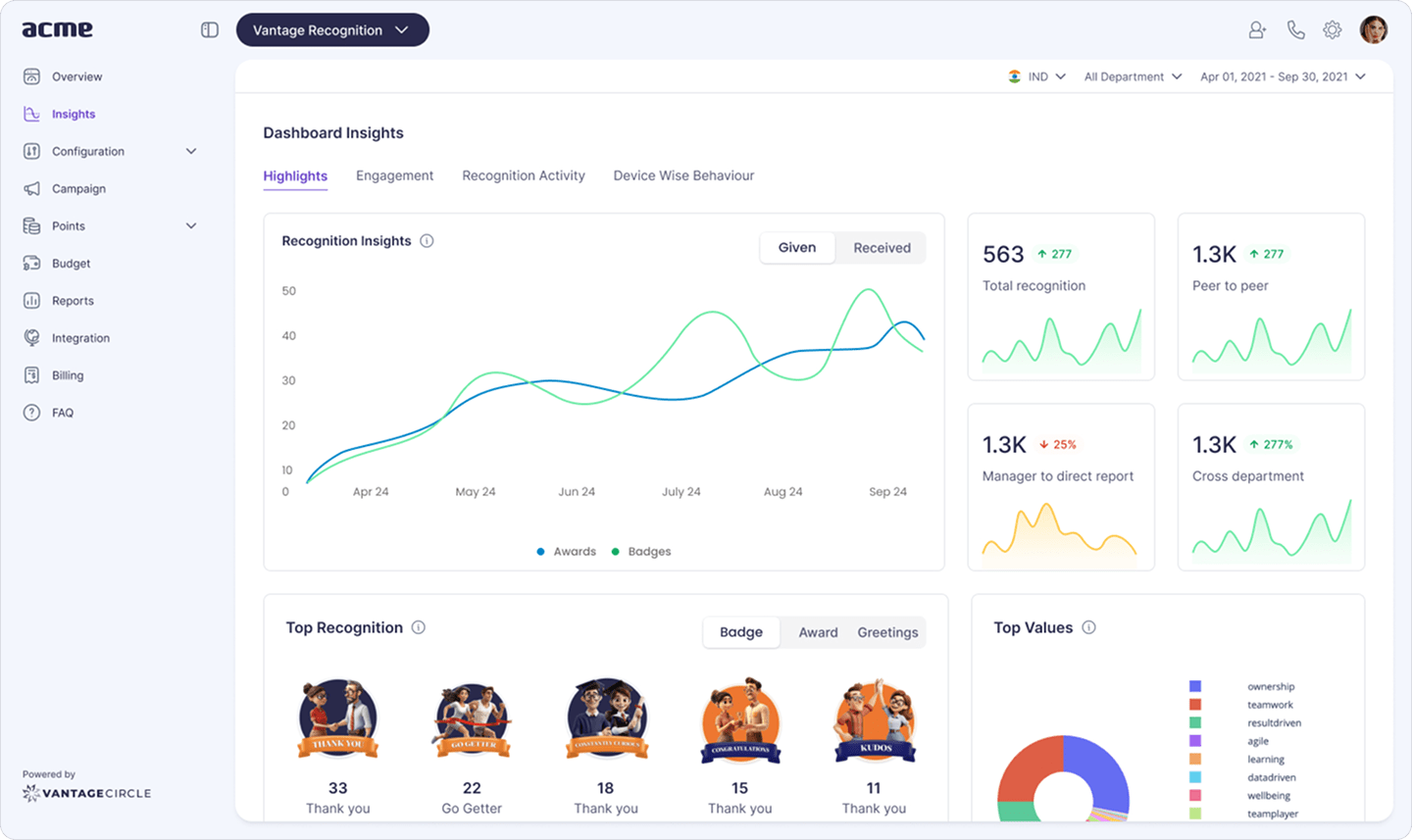
Why Reward Systems Backfire
Each of those four failures has a named mechanism. Behavioral science described them decades ago, and knowing which one is operating tells you what to change. A reward system that is failing on fairness needs a different fix from one that is failing on consistency.
The framing below draws on the AIRe Framework, Vantage Circle's recognition and rewards research developed with the University of Liverpool.
Expectancy Theory: Why Inconsistency Kills Motivation
Victor Vroom's expectancy theory (1964) holds that people are motivated when three beliefs hold at once. Expectancy is the belief that effort leads to performance. Instrumentality is the belief that performance leads to reward. Valence is the belief that the reward is worth having.
Break any one link and the incentive stops working. A reward applied inconsistently erodes instrumentality, because people stop believing performance reliably produces it. A reward nobody wants lacks valence. In both cases motivation drops, and no increase in budget fixes it. The problem was never size.
Equity Theory: Why Employees Judge Rewards Comparatively
J. Stacy Adams' equity theory (1965) adds the part most programs forget. Employees do not evaluate rewards in isolation. They weigh their own inputs, meaning effort, skill and loyalty, against their outcomes, and then compare that ratio to their colleagues'.
When the comparison feels unfair, motivation drops quickly. Research by Colquitt and colleagues (2001) found that inequitable systems do more than demotivate. They provoke counterproductive behavior: reduced effort, disengagement, and attempts to rebalance the scales through means the organization did not sanction.
This is why a technically generous program can still fail. Generosity distributed unevenly reads as unfairness, not generosity.
The Overjustification Effect: Why Paying for Good Behavior Can Stop It
Deci and Ryan's self-determination theory (2000) describes the subtlest failure of the four. Extrinsic rewards can displace intrinsic motivation rather than add to it. The effect has a name: overjustification.
The practical version is familiar. When helping a colleague is rewarded only with a tangible prize, employees stop experiencing it as generosity and start treating it as a transaction. Remove the prize and the helping stops, because the original motive has been overwritten. The reward undermines the culture it was introduced to reinforce.
What Wells Fargo Shows About Incentive Design
The 2016 cross-selling scandal is the clearest large-scale example. Wells Fargo tied employee targets to the number of accounts opened. Employees hit the targets. Millions of those accounts had never been requested by the customers whose names were on them.
The instructive part is that this required no unusual dishonesty. People responded to the signal they were given, at the intensity the incentive demanded. The system worked exactly as designed. The design was the problem.
| Failure mode | Mechanism | Named theory | What to change |
|---|---|---|---|
| Rewards stop motivating | Inconsistent application breaks the belief that performance produces reward | Expectancy theory (Vroom, 1964) | Consistency and clear criteria, not a bigger budget |
| Perceived unfairness | Employees judge their reward ratio against colleagues', not in isolation | Equity theory (Adams, 1965) | Visible criteria and published distribution |
| Good behavior stops when rewards do | Extrinsic reward displaces the original intrinsic motive | Self-determination theory (Deci and Ryan, 2000) | Keep a recognition layer that carries no payout |
| Unintended outcomes get rewarded | The metric can be satisfied without the underlying work | Demonstrated at scale by the Wells Fargo case | Reward the behavior, not only the number |
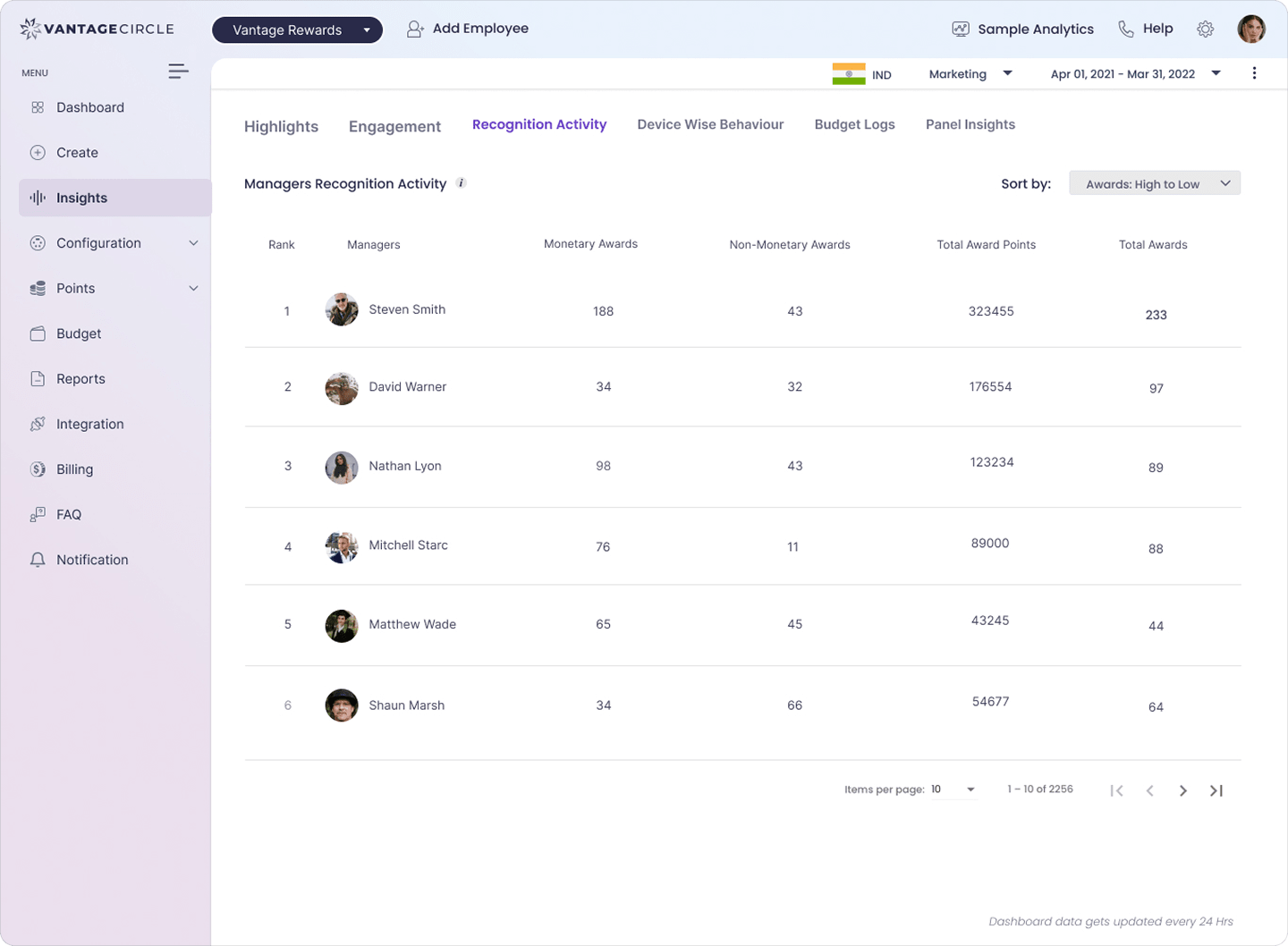
How to Tell Whether Your Reward System is Working
Four signals separate a working reward system from a failing one: distribution skew, manager participation spread, the balance between paid and unpaid recognition, and whether employees can state the criteria without being told.
Most reward dashboards report total awards given. That number usually looks healthy and says almost nothing about who was reached or what was reinforced.
| Signal | What healthy looks like | Where the number comes from |
|---|---|---|
| Distribution skew | The top 10% of recipients take a falling share quarter on quarter | Recognition analytics |
| Manager participation spread | No business unit sits far below the company median | Manager recognition report |
| Paid vs unpaid balance | A meaningful share of recognition carries no monetary attachment | Award type breakdown |
| Criteria recall | Employees can state what earns an award, unprompted | Pulse survey, open text |
That last one costs nothing to run, and it is the one most programs skip. If people cannot tell you what earns recognition, the system is not directing behavior. It is distributing prizes.
Reward data tells you what was given. It cannot tell you how it landed. Vantage Pulse is Vantage Circle's employee engagement and pulse survey tool. It surfaces the gap between a program that is technically running and one employees actually believe in. It also picks up the perceived unfairness people will rarely raise through their own manager.
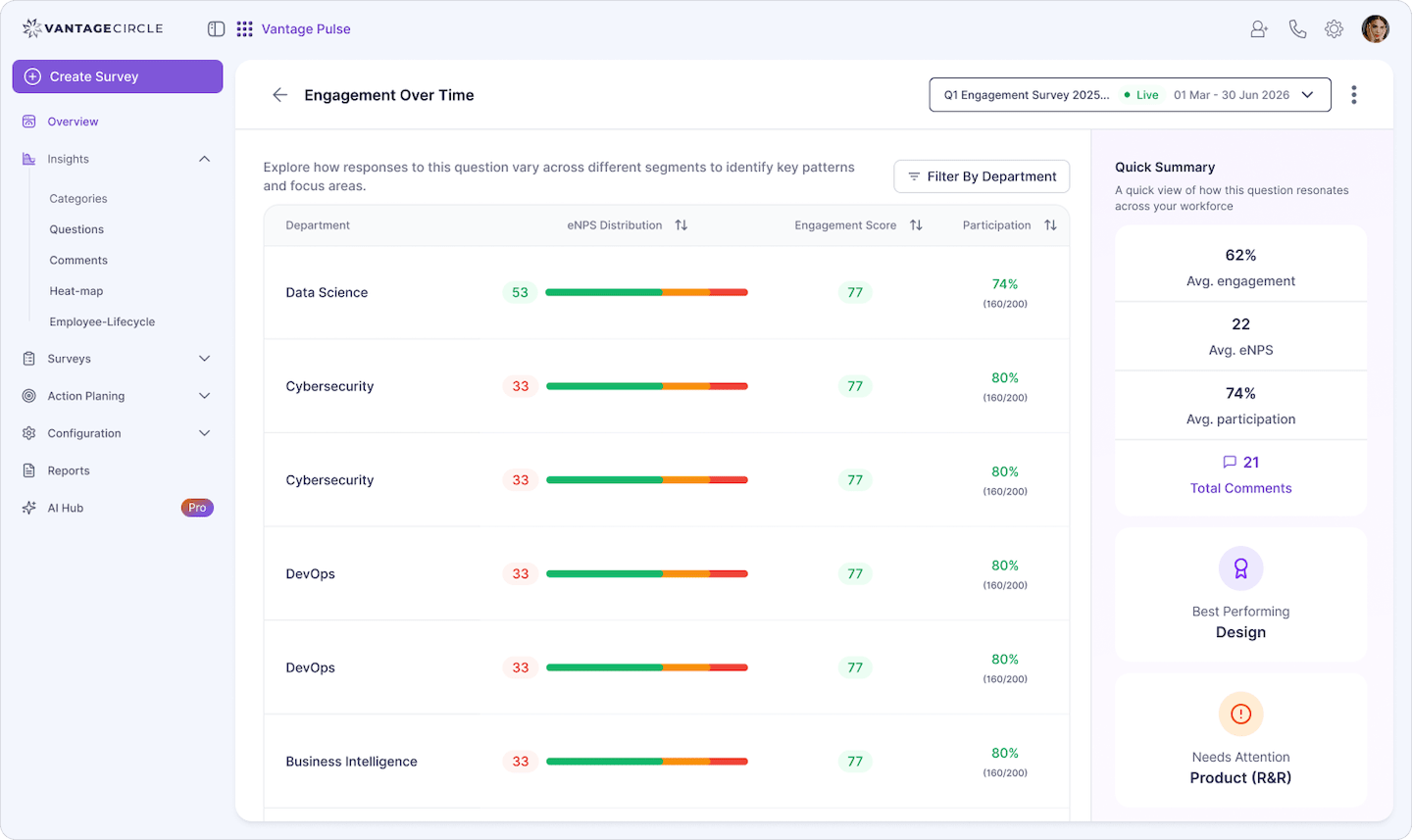
This is also where the recognition gap shows up first. It appears as a distance between what leadership believes the program delivers and what employees report receiving.
How to Balance the Pros and Cons of Reward Systems
Balancing the trade-offs means making three choices deliberately: the mix of monetary and non-monetary rewards, the split between individual and team recognition, and the relationship between frequency and value.
1. Understand Employee Preferences
Valence is not a guess. Ask what people actually want before building a catalog around what you assume they want. A reward with no valence has no motivational force regardless of cost.
2. Offer Flexible Reward Choices
Preference varies across roles, geographies and life stages. Choice is the mechanism that lets one program stay relevant across a workforce that is not uniform.
3. Ensure Fairness and Transparency
Equity theory says the comparison is unavoidable, so the control that matters most is making the basis of comparison visible. Publish the criteria. Report distribution. Fairness that cannot be inspected is indistinguishable from unfairness.
4. Align Rewards With Company Values
Tying awards to named values is one of the most direct guards against rewarding unintended outcomes. It shifts the question from "did the number move" to "was this how we wanted it moved."
5. Keep a Layer That Carries No Payout
This is the guard against overjustification. Peer recognition that runs on acknowledgment rather than points keeps some part of the culture outside the transactional frame. Not every good act should have a price attached.
Getting the structure right is a design problem more than a budget one. For a step-by-step approach, see how to design a reward system that holds up in practice.
The four failure modes above map onto the four dimensions of the AIRe Framework: Appreciation, Incentivization, Reinforcement and eMotional Connect. The AIRe Assessment scores an existing program against them rather than against a feature checklist.
Summing It Up
Reward systems are not good or bad in themselves. They are amplifiers. A well-designed one directs effort, signals fairness and turns values into habits. A poorly designed one teaches people to game a metric, and does it just as efficiently.
The difference is rarely budget. It is consistency, visible criteria, and leaving some recognition unpriced. When a program stops working, the useful question is not whether rewards work. It is which of the four mechanisms is operating, because each one has a different fix.
Start with the cheapest diagnostic. Ask a handful of employees what earns recognition where they work. If they cannot tell you, you have found your starting point.
FAQ
What are the downsides of using a reward system?
Reward systems have four main downsides. They can crowd out intrinsic motivation, so behavior that was voluntary stops when the reward does. They can create perceived unfairness, because employees judge their rewards by comparison with colleagues rather than in isolation. They can push attention toward short-term measurable work and away from longer-term contribution. And they can reward outcomes the organization never intended, when a metric can be satisfied without the underlying work being done.
What are the benefits of using a reward system?
A well-designed reward system directs effort toward stated priorities, signals that contribution is judged fairly, improves retention among recognized employees, and turns stated company values into observable daily behavior. Recognition-driven cultures report 92% retention against 76% in low-recognition peers. The benefits depend almost entirely on design rather than spend.
What are the four types of reward systems?
The four common structures are points-based, performance-based, recognition-based and non-monetary systems. Points-based systems let employees earn and redeem points from a catalog. Performance-based systems tie rewards to measurable output such as bonuses and commissions. Recognition-based systems use acknowledgment, including peer nominations and values awards. Non-monetary systems offer flexible hours, development budgets or experiences. Most organizations run a combination rather than a single structure.
What are the disadvantages of a reward system for employees?
From the employee's side, the most common complaints are opacity and inconsistency. When the criteria for earning a reward are not published, employees cannot tell whether the system is fair. Most default to assuming it is not. Inconsistent application causes a second problem: once people stop believing performance reliably produces reward, the incentive loses its motivational force entirely.
Do reward systems reduce intrinsic motivation?
They can, through what researchers call the overjustification effect. When an activity someone already found satisfying becomes tied to an external reward, the original motive can be displaced rather than reinforced. The practical guard is to keep part of your recognition unpriced. Acknowledgment between colleagues then stays an act of appreciation rather than a transaction.

Nilotpal M Saharia is an Assistant Manager, Content Marketing at Vantage Circle and a recognition-and-rewards (R&R) strategist with 9 years of experience spanning Marketing, HR, and content strategy. He helps HR leaders turn employee recognition and leadership research into practical workplace programs.
Connect with Nilotpal on LinkedIn.