
Most HR leaders know the feeling: you have run a recognition program for two years, the budget is solid, participation is up, and yet employees still say they do not feel recognized. Part of the problem is often definitional. Awards and rewards get used interchangeably, and when that happens, programs tend to over-index on payouts and miss the moments that actually build culture.
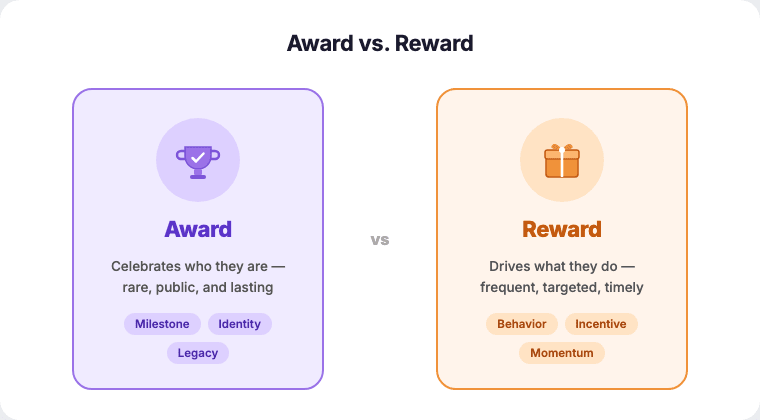
In the workplace, an award is formal recognition of a specific achievement, judged against criteria and presented publicly, like a Long Service Award or Employee of the Year. A reward is an incentive given in return for a behavior or result, such as a bonus, gift card, or points. Awards celebrate who someone became; rewards reinforce what someone did.
Getting this distinction right is not semantic housekeeping. It is the difference between a recognition program that moves people and one that just moves money. Only 23% of employees worldwide are engaged at work, according to Gallup's State of the Global Workplace report (2023). Recognition design is one of the clearest levers HR has to change that number.
This guide breaks down the difference between awards and rewards, shows where each one works, and surfaces a strategic asymmetry between the two that most recognition budgets never account for.
Key Takeaways
- Awards vs Rewards: The Core Difference in One Table
- What Is an Award? Definition, Traits, and Examples
- What Is a Reward? Definition, Traits, and Examples
- Award vs Reward vs Prize vs Incentive: Clearing the Confusion
- Psychological Impact: Why Awards and Rewards Motivate Differently
- The Asymmetry Nobody Budgets For: Awards Appreciate, Rewards Depreciate
- Awards vs Rewards Through the AIRe Framework
- When to Use an Award vs a Reward: A Decision Framework
- How to Build a Balanced Awards and Rewards Program
Awards vs Rewards: The Core Difference in One Table
Before going deeper, here is the distinction in full.
| Dimension | Award | Reward |
|---|---|---|
| Purpose | Recognize a specific achievement or distinction | Incentivize a behavior or reinforce a result |
| Trigger | Committee decision, nomination, or criteria met over time | Metric hit, manager discretion, or specific action completed |
| Formality | High: structured, criteria-driven, often ceremonial | Low to medium: flexible, informal, often spontaneous |
| Format | Trophy, plaque, certificate, title, public ceremony | Bonus, gift card, points, extra time off, experience |
| Frequency | Occasional: quarterly or annual cadence | Frequent: real-time, monthly, or event-based |
| Selection process | Competitive: judged, limited recipients | Non-competitive: accessible to many |
| Audience | Public: presented to peers and leaders | Variable: can be private or public |
| Emotional driver | Pride, identity, status, belonging | Motivation, satisfaction, momentum |
| Motivational half-life | Long: attached to memory and identity | Short: fades as hedonic adaptation sets in |
Dimension: Purpose
Award: Recognize a specific achievement or distinction
Reward: Incentivize a behavior or reinforce a result
Dimension: Trigger
Award: Committee decision, nomination, or criteria met over time
Reward: Metric hit, manager discretion, or specific action completed
Dimension: Formality
Award: High: structured, criteria-driven, often ceremonial
Reward: Low to medium: flexible, informal, often spontaneous
Dimension: Format
Award: Trophy, plaque, certificate, title, public ceremony
Reward: Bonus, gift card, points, extra time off, experience
Dimension: Frequency
Award: Occasional: quarterly or annual cadence
Reward: Frequent: real-time, monthly, or event-based
Dimension: Selection process
Award: Competitive: judged, limited recipients
Reward: Non-competitive: accessible to many
Dimension: Audience
Award: Public: presented to peers and leaders
Reward: Variable: can be private or public
Dimension: Emotional driver
Award: Pride, identity, status, belonging
Reward: Motivation, satisfaction, momentum
Dimension: Motivational half-life
Award: Long: attached to memory and identity
Reward: Short: fades as hedonic adaptation sets in
Quick rule: If a committee decides it, it is an award. If a metric triggers it, it is a reward.
The Recognition Effect: What Great Workplaces Do Differently
Discover how recognition shapes workplace culture — insights from a joint study with Great Place To Work® on what sets top employers apart.
Download the ReportWhat Is an Award? Definition, Traits, and Examples
An award is a formal act of organizational recognition. It says: this person did something exceptional, and we want everyone to know it.
Awards are selective by design. Not everyone wins, and that scarcity is precisely what gives them weight. They are almost always public, announced at a town hall, shared on a company-wide recognition feed, or celebrated in front of peers. The goal is not only to honor the recipient but to signal to the entire organization what excellence looks like here.
The Defining Traits of a Workplace Award
- Criteria-based: There are defined standards: behavioral, performance-based, or values-aligned, that a recipient must meet
- Retrospective: Awards look back at what someone achieved over a defined period, not forward at what they might do
- Public: The recognition is visible to peers, not just the recipient and their manager
- Symbolic: Much of the value is in the meaning, not the monetary amount; a plaque carries emotional weight that a bonus check simply does not
- Competitive: Awards go to few; that scarcity is the point
Common Types of Employee Awards
- Employee of the Month, Quarter, or Year
- Years of Service Awards for tenure milestones
- Leadership Excellence Awards for people managers
- Values Champion Awards nominated by peers
- Innovation or Impact Awards for project-level contributions
- Learning Champion Awards for capability building and mentorship
Wipro has issued 30,000+ Long Service Awards since 2021, and engagement on those public milestone posts runs 9.8 times higher than standard recognition activity. The data makes the mechanism clear: when an award is visible to the whole organization, it stops being a private moment between a manager and an employee and becomes a cultural signal about what excellence looks like here.
What Is a Reward? Definition, Traits, and Examples
A reward is a tangible or intangible benefit given in return for a specific behavior or outcome. If an award says "this is who you are," a reward says "this is what you did, and we want you to do it again."
Rewards are the everyday engine of a recognition program. They run frequently, they are tied to measurable actions, and they do not require a nomination panel or quarterly review cycle. A spot bonus for closing a difficult deal, points redeemable for a gift card after hitting a quarterly target, an extra day off after a demanding sprint; these are rewards. They keep the connection between effort and recognition tight and fast.
Monetary vs Non-Monetary Rewards
| Type | Examples | Best used when |
|---|---|---|
| Monetary | Spot bonuses, performance bonuses, profit-sharing | The outcome is clearly measurable and the link between effort and payout is direct |
| Non-monetary (tangible) | Gift cards, merchandise, experiences, extra time off | You want to personalize the recognition and avoid pure cash transactionality |
| Non-monetary (intangible) | Public praise, manager shoutouts, peer recognition points | Frequent reinforcement is needed; formal budget is limited |
Type: Monetary
Examples: Spot bonuses, performance bonuses, profit-sharing
Best used when: The outcome is clearly measurable and the link between effort and payout is direct
Type: Non-monetary (tangible)
Examples: Gift cards, merchandise, experiences, extra time off
Best used when: You want to personalize the recognition and avoid pure cash transactionality
Type: Non-monetary (intangible)
Examples: Public praise, manager shoutouts, peer recognition points
Best used when: Frequent reinforcement is needed; formal budget is limited
One practical note worth flagging for HR teams: under IRS guidelines, cash rewards and cash-equivalent gift cards are generally treated as taxable wages. Certain non-cash achievement awards may qualify for different tax treatment depending on their structure and value thresholds. Verify with your payroll or tax counsel before finalizing a reward program design.
Common Types of Employee Rewards
- Spot bonuses for immediate, high-impact performance
- Points redeemable through a global rewards catalog (gift cards, merchandise, experiences)
- Target-based sales or performance incentives
- Wellness rewards such as gym memberships or paid mental health days
- Referral bonuses tied to successful talent acquisition
Recommended Resource: Types of Rewards for Employees: What Enterprise Data Reveals
Award vs Reward vs Prize vs Incentive: Clearing the Confusion
These four terms are used interchangeably in most workplaces. They are not the same.
| Term | Definition | Key trait | Workplace example |
|---|---|---|---|
| Award | Formal recognition of achievement, judged against criteria | Retrospective, selective, public | Employee of the Year |
| Reward | Benefit given in return for a specific behavior or outcome | Behavior-linked, frequent, tangible | Spot bonus, gift card |
| Prize | Something won through competition or chance | Win/lose structure, one or few recipients | Sales contest winner |
| Incentive | A promised benefit designed to motivate future behavior | Forward-looking, conditional | "Hit your Q3 target, earn a trip" |
Term: Award
Definition: Formal recognition of achievement, judged against criteria
Key trait: Retrospective, selective, public
Workplace example: Employee of the Year
Term: Reward
Definition: Benefit given in return for a specific behavior or outcome
Key trait: Behavior-linked, frequent, tangible
Workplace example: Spot bonus, gift card
Term: Prize
Definition: Something won through competition or chance
Key trait: Win/lose structure, one or few recipients
Workplace example: Sales contest winner
Term: Incentive
Definition: A promised benefit designed to motivate future behavior
Key trait: Forward-looking, conditional
Workplace example: "Hit your Q3 target, earn a trip"
The distinction matters operationally. A prize requires a competition structure with clear rules and one winner. An incentive is a promise made before the behavior. A reward is given after the fact. An award is judged and conferred. When these are conflated in program design, employees lose clarity on what they are working toward and why, which is exactly when recognition programs start feeling arbitrary.
Psychological Impact: Why Awards and Rewards Motivate Differently
Recognition is not one-size-fits-all psychology. Awards and rewards activate different parts of the human motivation system, and effective HR leaders understand which lever to pull and when.
Intrinsic vs Extrinsic Motivation
Rewards primarily engage extrinsic motivation. Drawing on B.F. Skinner's operant conditioning research, behavior that is immediately reinforced tends to be repeated. When a reward closely follows an action, the brain strengthens the association between that effort and a positive outcome. A spot bonus issued the same week a project closes, points allocated the day a target is hit: the closer the reward to the action, the stronger the reinforcement signal.
Awards operate differently. They satisfy what Abraham Maslow identified as higher-order psychological needs: esteem (to be recognized, respected, seen as significant) and self-actualization (to know that your contribution mattered beyond the transactional). Because awards are public and selective, they do not just tell the recipient something; they shape how that person sees themselves and how colleagues see them.
Status, Identity, and the Memory of Recognition
A 2022 Gallup and Workhuman study found that employees who receive great recognition are 20 times more likely to be engaged than those who receive poor recognition. Critically, the most memorable recognition moments in that research shared two characteristics: they were tied to meaning and they were publicly visible, both hallmarks of awards, not transactional rewards.
This is why awards have a longer motivational half-life. A gift card is spent and largely forgotten. An Employee of the Year recognition sits in someone's professional story for years. The award has become part of how that person narrates their career. That narrative compounds over time in ways that no quarterly bonus can replicate.
The Asymmetry Nobody Budgets For: Awards Appreciate, Rewards Depreciate
Here is something most recognition program budgets ignore entirely: awards and rewards do not behave the same way over time. One gains value. The other loses it.
Why Rewards Lose Value and Awards Gain It
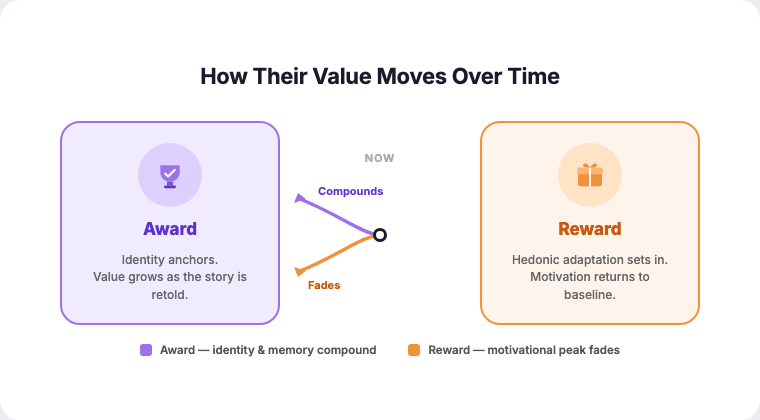
Rewards are subject to hedonic adaptation, the well-documented psychological principle, established through Philip Brickman and Donald Campbell's foundational 1971 work and consistently replicated since, that people quickly return to an emotional baseline after a positive change. The spot bonus that felt genuinely exciting in March is unremarkable by June. The $50 gift card that motivated behavior in Q1 needs to be $75 in Q3 to produce the same effect. Rewards depreciate. Their motivational value decays at a predictable rate.
Awards behave in the opposite direction. Because they attach to identity and status rather than consumption, their emotional value tends to grow over time. Employees retell the story of a meaningful award years later. It becomes a reference point in how they talk about their career, how they approach new challenges, and how they describe the organization to people outside it. A Long Service Award given on a 10-year anniversary is still part of someone's professional identity at year 15. Its motivational half-life is measured in years, not weeks.
Most organizations have this backwards. They over-invest in rewards, recurring, transactional, easy to expense, easy to scale, and under-invest in awards, which are harder to systematize and feel less measurable in the short term. The result is predictable: recognition spend rises while emotional connection stays flat. SHRM research consistently shows that recognition programs tied to organizational values outperform transactional reward programs on retention and engagement outcomes, yet most budgets still skew toward the transactional. Gallup's State of the Global Workplace report (2023) puts the scale of the problem in context: only 23% of employees worldwide are engaged at work, and recognition design is one of the clearest levers HR has to move that number.
The reframe for HR: treat rewards as an operating cost and awards as a capital investment in culture.
The One-Line Self-Audit for HR Leaders
Before your next program review, run this diagnostic:
List what your last five awards celebrated. Then list what your last five rewards paid out for. If the two lists pull in different directions; if your awards honor collaboration while your rewards pay for individual output, your employees have already noticed the gap. They follow the reward. The award is the press release; the reward is the policy.
Recognition Analytics in Vantage Rewards surfaces this gap directly. It shows the distribution between award types and reward volume, how each maps to stated company values, and where the say-do gap is widest. The data tells you whether what you claim to value and what you actually reinforce are telling the same story.
Vantage Influencers Podcast
"Flip the R. Recognition should be at the top. Rewards have to be fair, but recognition has to be the core. That is what drives a positive culture and high productivity."
Binni Rai, Chief Human Resource Officer, Omnipresent Robot Tech
Listen to the EpisodeAwards vs Rewards Through the AIRe Framework
The AIRe framework maps each recognition type to a specific motivation outcome across four pillars: Appreciation, Incentivization, Reinforcement, and Emotional Connect. Here is how awards and rewards sit within it.
| AIRe Pillar | Award Works Best When | Reward Works Best When |
|---|---|---|
| Appreciation | Public recognition is needed to elevate excellence and create visible role models | Immediate acknowledgment is needed for effort or near-term progress |
| Incentivization | Long-term goals, sustained impact, or career milestones need to be recognized | Short-term KPIs or specific milestones are reached |
| Reinforcement | Cultural behaviors and organizational values need to be honored and publicly retold | Specific actions need to be repeated consistently across the team |
| Emotional Connect | Peer-nominated or values-based awards build shared pride and a sense of belonging | Personalized, timely rewards build individual trust and goodwill |
AIRe Pillar: Appreciation
Award Works Best When: Public recognition is needed to elevate excellence and create visible role models
Reward Works Best When: Immediate acknowledgment is needed for effort or near-term progress
AIRe Pillar: Incentivization
Award Works Best When: Long-term goals, sustained impact, or career milestones need to be recognized
Reward Works Best When: Short-term KPIs or specific milestones are reached
AIRe Pillar: Reinforcement
Award Works Best When: Cultural behaviors and organizational values need to be honored and publicly retold
Reward Works Best When: Specific actions need to be repeated consistently across the team
AIRe Pillar: Emotional Connect
Award Works Best When: Peer-nominated or values-based awards build shared pride and a sense of belonging
Reward Works Best When: Personalized, timely rewards build individual trust and goodwill
Awards carry the heaviest weight on Appreciation and Emotional Connect. Rewards are the more direct lever for Incentivization and short-cycle Reinforcement. A high-impact recognition strategy uses both, calibrated to the level of motivation each moment actually requires.
When to Use an Award vs a Reward: A Decision Framework
Neither awards nor rewards work well in isolation. The question is not which one; it is which one, for this moment, for this person, for this outcome.
Use an Award When
- The contribution is rare, exceptional, or clearly above what the role typically demands
- You want to reinforce cultural values publicly and create visible role models for the rest of the organization
- The recognition needs to build emotional connection across the team, not just acknowledge one person's output
- The achievement represents a significant career or tenure milestone
- You want the recognition moment to be retold and remembered, not just received
Use a Reward When
- The behavior is specific, measurable, and you want to see it repeated
- Speed matters; the closer the reward to the action, the stronger the reinforcement
- You need to drive performance across a large group, not honor a single exceptional individual
- The outcome is tied to a clear KPI: a sales figure, a productivity metric, a project deadline
- You need to sustain motivation between award cycles without escalating the budget
The Award-or-Reward Decision Checklist
| Scenario | Award | Reward | Why |
|---|---|---|---|
| Employee hits quarterly sales target | Yes | Measurable, repeatable, needs fast reinforcement | |
| Employee mentors three junior colleagues through a difficult transition | Yes | Values-aligned, exceptional, culture-building, not directly measurable | |
| Team delivers a product launch under budget and ahead of schedule | Yes | Optional | Milestone achievement; public award builds team identity; optional reward for individual contributors |
| Employee completes a required compliance certification | Yes | Specific, measurable action; not exceptional, needs behavioral reinforcement | |
| Manager is consistently peer-nominated for leadership behavior | Yes | Sustained behavioral excellence; public signal needed | |
| New hire successfully refers three candidates in their first year | Yes | Specific, measurable outcome tied to a clear program rule |
Scenario: Employee hits quarterly sales target
Award: N/A
Reward: Yes
Why: Measurable, repeatable, needs fast reinforcement
Scenario: Employee mentors three junior colleagues through a difficult transition
Award: Yes
Reward: N/A
Why: Values-aligned, exceptional, culture-building, not directly measurable
Scenario: Team delivers a product launch under budget and ahead of schedule
Award: Yes
Reward: Optional
Why: Milestone achievement; public award builds team identity; optional reward for individual contributors
Scenario: Employee completes a required compliance certification
Award: N/A
Reward: Yes
Why: Specific, measurable action; not exceptional, needs behavioral reinforcement
Scenario: Manager is consistently peer-nominated for leadership behavior
Award: Yes
Reward: N/A
Why: Sustained behavioral excellence; public signal needed
Scenario: New hire successfully refers three candidates in their first year
Award: N/A
Reward: Yes
Why: Specific, measurable outcome tied to a clear program rule
How to Build a Balanced Awards and Rewards Program
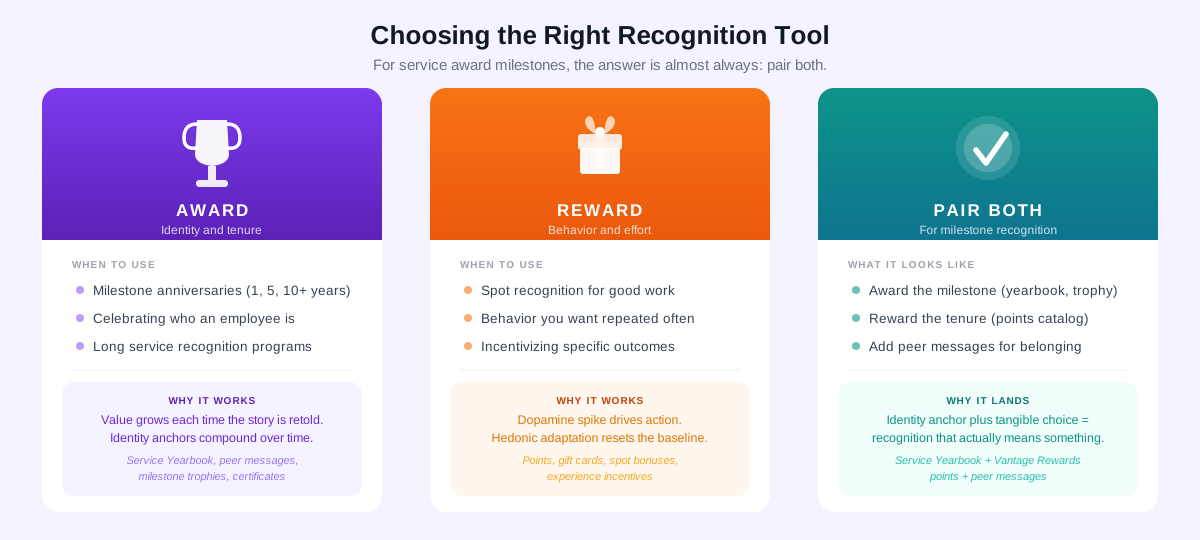
A recognition program that runs only rewards becomes transactional over time. One that runs only awards becomes ceremonial and disconnected from everyday effort. The most effective programs use both with intention, and they measure whether what they claim to value and what they actually recognize are the same thing.
Step 1: Map Each Recognition Type to a Company Value
Every award and every reward should trace back to a behavior the organization explicitly says it values. If your stated values include innovation, customer obsession, and collaboration, your program should make it possible to tag each recognition to one of those values, not just a generic "good performance" bucket.
When a leading IT consultancy with 250,000 employees implemented Vantage Rewards, a core requirement was the ability to connect every recognition to a company value. Recognition activity increased by 47%, not because employees suddenly became more appreciative, but because the program gave recognition a shared language and made the connection between contribution and company values visible.
Step 2: Set the Award and Reward Budget Split
There is no universal formula, but a useful starting heuristic: awards should be fewer, less frequent, and higher in visibility; rewards should be more frequent, lower in individual value, and faster to deliver. A program that allocates 80% of its recognition budget to recurring monthly rewards and 20% to annual awards is likely over-investing in transactional recognition at the expense of the moments that shape culture.
Review the split annually. Use the one-line self-audit above before each review cycle.
Step 3: Define Criteria and Cadence
Awards without clear criteria breed cynicism. Document the behavioral standards for each award type, make them visible to everyone, and review them annually. For rewards, set equally clear triggering conditions. Ambiguity about when a reward will or will not be given erodes trust faster than most HR leaders realize. SHRM research consistently identifies fairness and consistency as top drivers of whether employees trust the recognition system at all.
Step 4: Measure the Mix
Recognition programs that are not measured are programs that will eventually be cut. At minimum, track:
- Award-to-reward ratio: Is your program balanced or skewed entirely toward transactional payouts?
- Value distribution: Are awards going to the same group every cycle, or is recognition reaching across levels and functions?
- Values alignment: Which company values are being recognized most, and which are invisible in the data?
- Recency and frequency: When was the last time each employee received any form of recognition?
Frequently Asked Questions
Is there a difference between rewards and awards?
Yes. An award is formal recognition of a specific achievement, judged against criteria, typically public, and retrospective in nature. A reward is a tangible or intangible benefit given in return for a specific behavior or result. Awards build identity and status; rewards reinforce effort and performance. Both belong in a recognition program, but they serve different psychological and strategic functions.
Is it "awards" or "rewards": are they the same word?
They are different words with distinct meanings. In everyday conversation they are often used interchangeably, but in HR and organizational design they are not the same. An award is conferred based on judgment. A reward is triggered by a behavior or outcome. The distinction matters most when designing recognition programs that need to achieve both cultural and performance goals.
What are the main types of employee rewards?
Employee rewards fall into three broad categories: monetary (cash bonuses, performance bonuses, profit-sharing), non-monetary tangible (gift cards, merchandise, experiences, paid time off), and non-monetary intangible (public praise, peer recognition, manager shoutouts). Each serves a different motivation purpose and carries different tax implications under IRS guidelines for HR and payroll teams.
What are common types of employee awards?
Common workplace awards include Employee of the Year or Month, Years of Service Awards for tenure milestones, Leadership Excellence Awards, peer-nominated Values Champion Awards, and project-based Innovation or Impact Awards. The most effective awards are criteria-based, publicly presented, and explicitly tied to the behaviors the organization wants to reinforce.
When should you give an award vs a reward?
Give an award when the contribution is exceptional, values-aligned, and worth signaling publicly to the rest of the organization. Give a reward when the behavior is measurable, repeatable, and needs fast reinforcement. A useful shortcut: if a committee should decide it, it is an award. If a metric triggers it, it is a reward.
Can an award also be a reward?
Yes, and in well-designed programs, they often overlap. A Long Service Award on a 10-year anniversary is an award (formal, criteria-based, public) but may also include a monetary component that functions as a reward. The award carries the meaning; the reward reinforces the value. Together they are more powerful than either on its own.
Conclusion
Awards and rewards belong in every recognition program, but they belong in the right place, for the right reason, at the right moment.
Awards build the things that cannot be directly incentivized: pride, identity, cultural memory, the sense that the organization sees who you are and not just what you produced this quarter. Rewards keep the everyday engine running, reinforcing effort, sustaining momentum, and keeping the connection between contribution and recognition tight and fast.
The organizations that get this right do not treat awards and rewards as two versions of the same thing. They treat them as distinct strategic tools with different motivational half-lives, different budget logic, and different signals to the workforce. They measure the mix. They run the self-audit. They make sure what they celebrate publicly and what they reinforce daily tell the same story.
That alignment, between the recognition you give ceremonially and the behavior you reinforce consistently, is what separates a recognition program from a recognition culture.
Ready to build a program that does both? See how Vantage Rewards runs awards and rewards on one platform.

Supriya is a Content Marketing Lead at Vantage Circle, where she writes on employee engagement, recognition, workplace communication, and culture. Her work on remote team recognition draws on primary research from Vantage Circle's platform data and customer deployments across distributed workforces. She spent the earlier part of her career in corporate communications at Burson, ESPN Star Sports, and CBRE, advising organizations on the messages employees actually hear.
Connect with Supriya on LinkedIn.