
Here is a common scenario that HR leaders are encountering more frequently.
They have a survey tool that generates dashboards, a recognition platform that sends automated birthday messages, and an employee portal with the company’s handbook. Despite all this, the latest engagement scores are the same as they were 18 months ago.
The problem is not related to the lack of tools. It is the wrong tools for the wrong engagement problem, and three vendor contracts instead of one coherent strategy.
That is what this blog is intended to address.
If you’re evaluating a single platform that can consolidate recognition, surveys, and rewards, see our employee engagement software overview.
Below, you will find 10 independently evaluated employee engagement software platforms, each matched to a specific use case. We have included pricing, G2 ratings, company-size fit, and drawbacks for each because the best tool for a 50-person startup and the best tool for a 10,000-person global enterprise are hardly the same thing.
A Study reveals that the global employee engagement software market size was valued at USD 1.22 billion in 2025. The market is projected to grow from USD 1.43 billion in 2026 to USD 4.47 billion by 2034.
At-a-Glance Comparison Table
The platforms below represent the strongest options across the engagement spectrum in 2026, selected based on market position, G2 ratings, feature depth, and use-case specificity.
| Platform | Best For | Starting Price | G2 Rating (2026) | Best Fit Size |
|---|---|---|---|---|
| Vantage Recognition | Global recognition and rewards | Custom (request demo) | 4.7/5 | 500–5000+ employees |
| Achievers | Always-on peer recognition and rewards | Custom | 4.7/5 (1,000+ reviews) | 500–10,000+ employees |
| Bonusly | Peer-to-peer micro-rewards | $3/user/month (Core) | 4.7/5 | 50–500 employees |
| Workvivo (by Zoom) | Internal communication and community | Custom | 4.8/5 | 250–10,000+ employees |
| Workleap | Manager-employee pulse surveys | $5/user/month (Essential) | 4.3/5 | 50–1,000 employees |
| Lattice | Performance and engagement combined | $11/user/month (Engagement add-on) | 4.7/5 | 100–1,000 employees |
| 15Five | Continuous performance conversations | $4/user/month (Engage) | 4.6/5 | 50–1000+ employees |
| Leapsome | Mid-market performance and learning | Custom | 4.8/5 | 100–1,000 employees |
| Qualtrics EmployeeXM | Enterprise survey depth | Custom | 4.4/5 | 500–50,000 employees |
| Culture Amp | Engagement surveys and culture analytics | Custom | 4.5/5 | 200–5000+ employees |
The 10 Best Employee Engagement Software Platforms in 2026

Vantage Recognition
Why Vantage Recognition?
In distributed organizations, recognition programs frequently break down at the point of execution: the acknowledgment does not reach the right person, the reward catalog does not serve the recipient's geography, or the platform lacks the compliance infrastructure required for cross-border transactions. Well, Vantage Recognition was built to solve all three of these problems at an enterprise scale.
The platform's reward catalog spans 10 million-plus options across 85+ countries, and is backed by a SOLI framework, making it one of the few recognition solutions capable of delivering a consistent, locally relevant experience across highly diverse global workforces. Every recognition event can be tagged to a specific company value, creating an auditable record that connects individual acknowledgments to cultural reinforcement. It is a layer that HR teams increasingly need to demonstrate recognition program ROI to senior leadership.
Best For: Global enterprises running peer-to-peer and values-based recognition programs across multiple geographies, currencies, and compliance jurisdictions.
Key Features
SOC 2 and GDPR-compliant infrastructure with single sign-on (SSO) and HRIS integration.
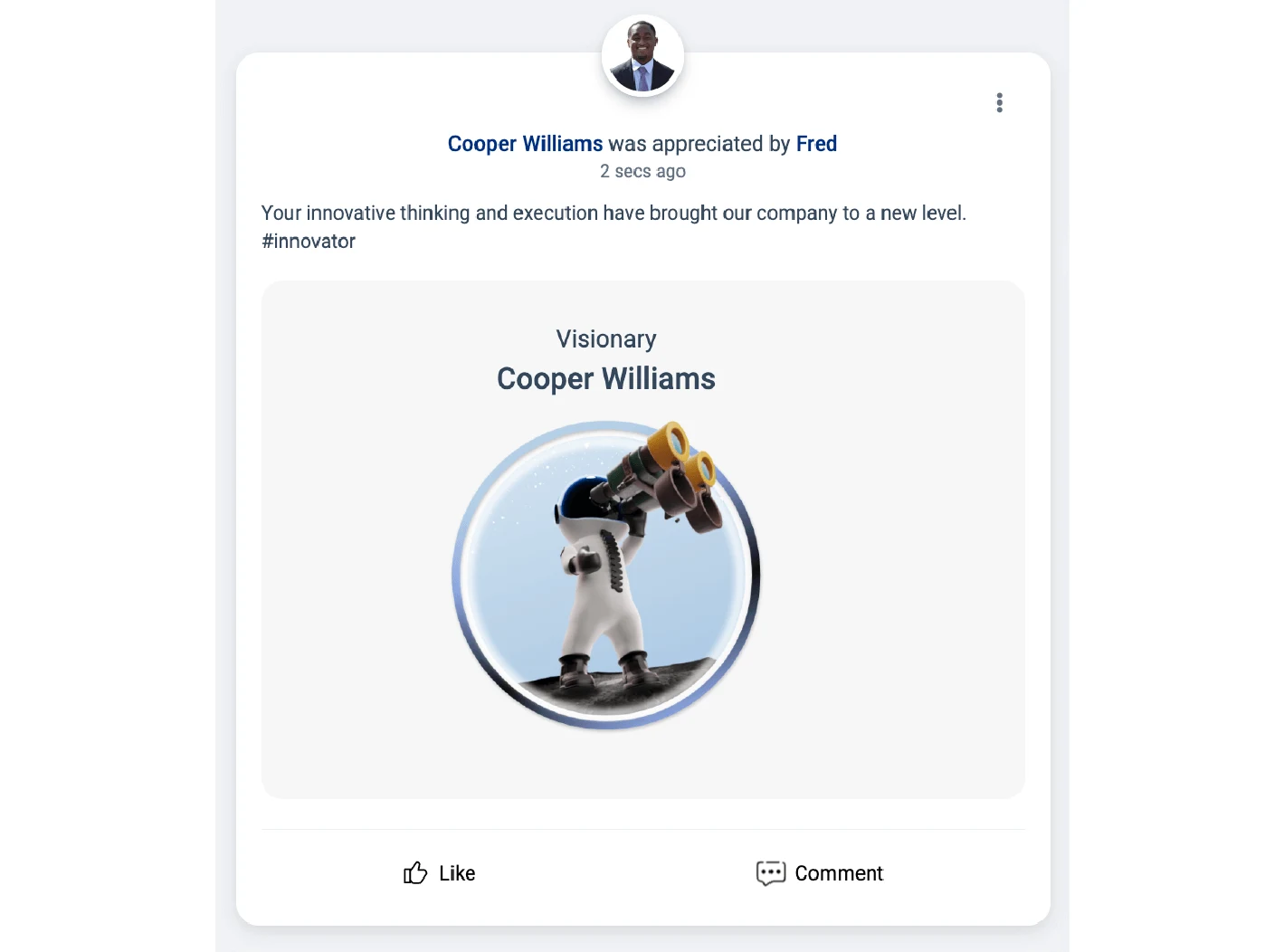
Peer Recognition: Real-time recognition via digital badges, awards, and messages displayed on a live activity feed, keeping appreciation visible across the organization
AI-powered recognition nudges that identify recognition gaps by team, manager, and department.
Social Feedback Portal: A built-in web portal enabling 1-on-1 communication with varying degrees of anonymity, giving employees a safe channel to share feedback
Goal and Challenge Creation: Personal and professional goals with customizable milestones, due dates, and built-in progress tracking
Automation: Automates operational tasks to reduce manual administrative burden on HR teams
Content Library: A pre-built library of useable content to support faster deployment of engagement initiatives

- Value-tagging creates an auditable record HR can use to demonstrate culture ROI to leadership, not just report activity volume.
- AI nudges make program consistency independent of individual manager behavior. Participation doesn't drop when managers get busy.
- Automation of operational tasks reduces the ongoing administrative load, particularly valuable for leaner HR teams
- Strong HRIS and social tool integrations mean Vantage Circle can slot into existing HR tech stacks without significant disruption

- Enterprise-first pricing and implementation model; the scope and cost structure may be disproportionate for organizations with fewer than 100 employees.
- No self-serve tier; all deployments require a demo and custom pricing engagement.
- Full platform value requires a structured onboarding period; organizations without a dedicated HR administrator should factor implementation support into the procurement plan.

Achievers
Why Achievers?
Achievers is a global employee recognition and rewards platform trusted by more than 4 million employees across 164 countries. It is built around a fundamental principle: recognition should be continuous and daily, not calendar-dependent or event-driven. Its always-on points-based model supports both peer-to-peer and manager-to-employee acknowledgment, backed by one of the strongest analytics layers in the recognition category, tracking recognition frequency, participation rates, and values alignment to give HR teams measurable program ROI.
With a comprehensive mix of monetary and non-monetary recognition options, a global rewards marketplace, and seamless integrations with Workday, Microsoft, Slack, and SAP, Achievers functions as a unifying layer across the HR tech stack rather than a standalone tool. Powerful enough for complex global enterprises and flexible enough for mid-market organizations, it scales to meet organizations wherever they are.
Best For: Mid-market to enterprise organizations in North America seeking an always-on peer recognition program with strong analytics and HRIS integration depth.
Key Features
Reward Catalog & Customisation: An extensive gift card and rewards catalog with personalised messages, giving employees genuine choice in how they are recognized
Budget Management: Built-in tools for managing reward budgets at team or individual level, keeping recognition programs financially controlled
Rewards API: Allows businesses to integrate and automate reward delivery directly within their own applications, enabling deeper customization
Performance Benchmarking: Survey results benchmarked against industry standards to identify meaningful improvement areas
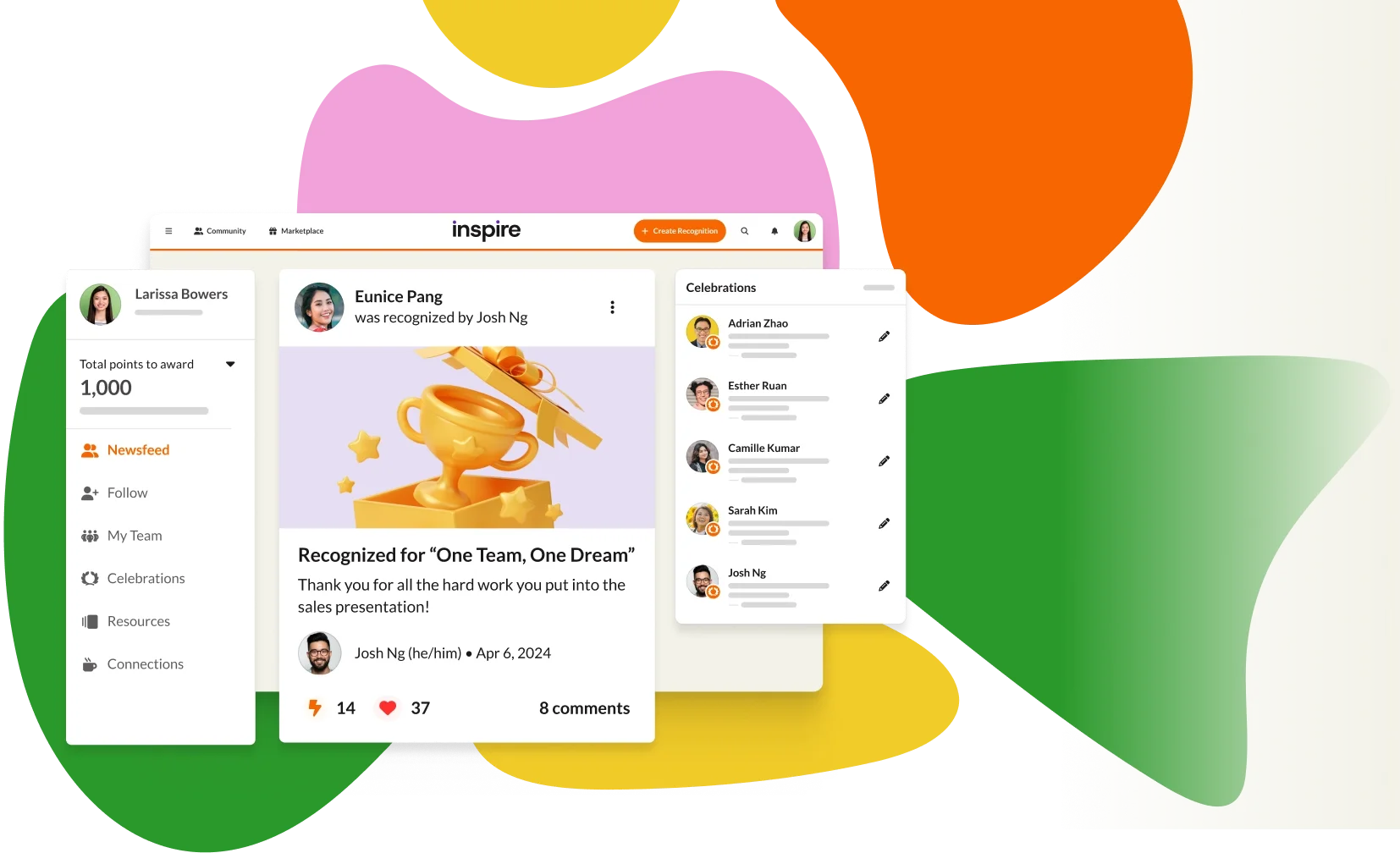
Peer Recognition: Real-time recognition via badges, awards, and messages on a live activity feed
Corporate Discounts: Employees gain access to discounts on products and services, extending value beyond formal recognition moments
Analytics & Reporting: Tracks funds, reward deliveries, orders, and redemptions alongside broader engagement metrics
- The depth of the rewards infrastructure — catalog, budget management, API, and analytics — makes Achievers a strong choice for organizations where tangible recognition is central to their engagement strategy
- Rewards API enables sophisticated integration with internal systems, giving larger or more technical organizations meaningful flexibility
- Corporate discounts add everyday value for employees, reinforcing the platform's usefulness beyond peak recognition moments
- Performance benchmarking adds external context to engagement data, helping organizations understand where they stand relative to their industry
- Science-based survey templates bring credibility and structure to engagement measurement
- The heavy emphasis on rewards and incentives may feel transactional for organizations seeking to build a more value-driven or culture-led recognition program
- Budget management adds administrative overhead that smaller teams may find disproportionate to their recognition needs
- Organizations without a dedicated rewards budget may struggle to unlock the platform's core value proposition fully

Bonusly
Why Bonusly?
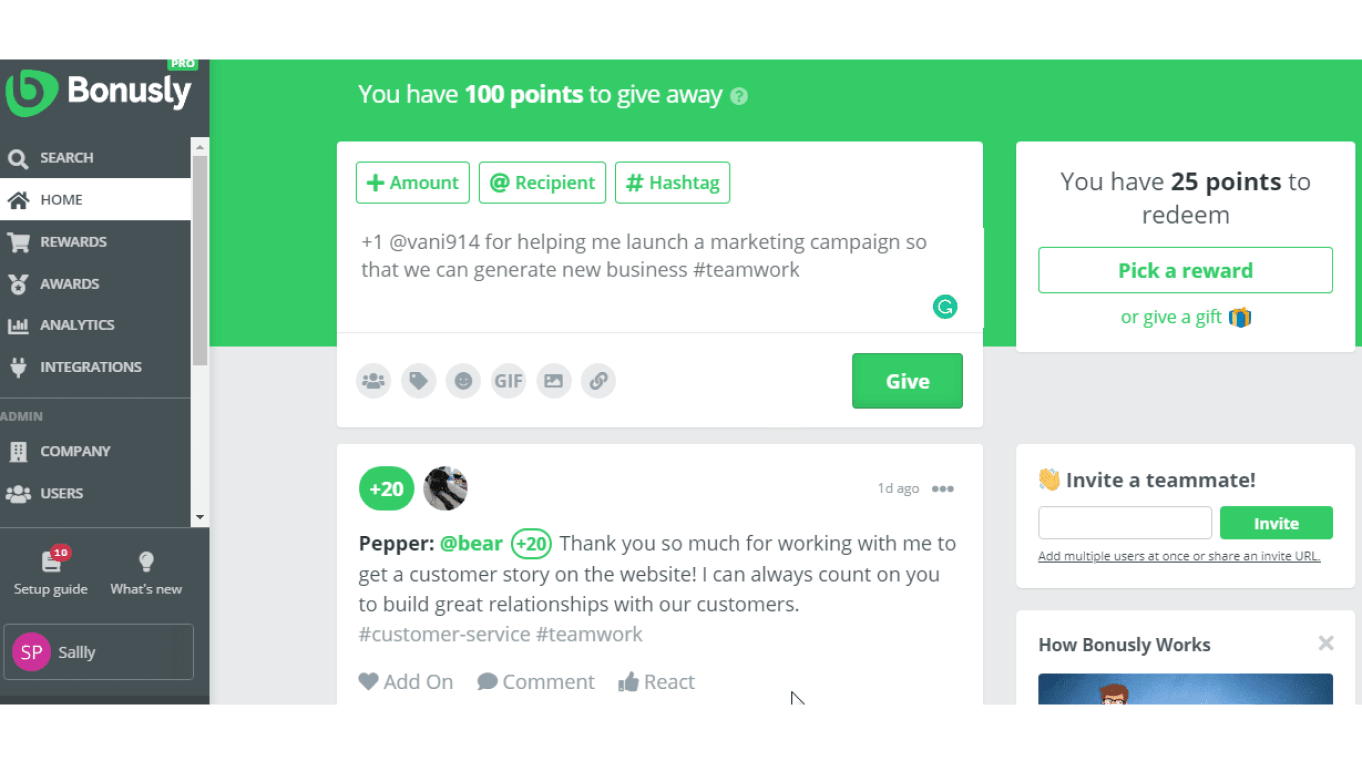
Bonusly is a peer recognition and employee engagement platform built for SMBs and mid-market organizations. Its core mechanic, monthly point allowances distributed to peers alongside personalized recognition notes, integrates naturally into existing workflows through native Slack and Microsoft Teams integrations, driving adoption without adding new behavioral demands on employees.
Beyond recognition, Bonusly surfaces real-time signals from everyday interactions, giving managers and HR leaders continuous visibility into team collaboration, cultural health, and engagement patterns. Rather than relying solely on periodic surveys, organizations can identify where support is needed and reinforce values in real time, making culture a measurable input for performance and retention.
Best For: Small and medium-sized businesses and mid-market teams seeking a straightforward, high-adoption peer recognition system built around visible, social acknowledgment.
Key Features
Peer Recognition: Digital badges, awards, and messages displayed on a live activity feed
Rewards: Flexible, easy-to-manage employee reward options
Integrations: HRIS systems and social tools (Slack and Microsoft Teams)
Employee Pulse Surveys: Short, customizable culture-focused surveys to measure engagement
Reporting & Dashboards: Real-time visualization, manager dashboards, and automated reporting
- Recognition happens in real time via a live activity feed, keeping engagement visible
- Flexible rewards catalog gives employees meaningful choice
- Integrates with existing business tools, reducing platform-switching friction
- Pulse surveys + dashboards give managers actionable data, not just anecdotal feedback
- Initial setup may require significant admin time to configure customization, access management, and roles properly
- The peer-to-peer focus means top-down, manager-to-employee monetary recognition feels secondary to the platform's core design
- Multi-currency and multi-language capabilities are present, but the extent of international support may require closer evaluation for global teams

Workvivo by Zoom
Why Workvivo by Zoom?
Workvivo by Zoom is an employee experience platform that brings internal communications, engagement, and intranet capabilities into a single mobile-first hub. Unlike platforms that optimize purely for information delivery, Workvivo is designed around organizational belonging. It makes company communication feel participatory rather than broadcast, which matters most for organizations where disconnection is the root cause of low engagement.
Built for frontline, hybrid, remote, and desk-based workforces, Workvivo gives employees one place to access company news, recognition, feedback channels, and workplace tools. Following Zoom's acquisition in 2023, and its integration with Zoom's meeting infrastructure, make it a particularly strong fit for distributed teams that need a high-visibility internal community layer connecting every employee, wherever work happens.
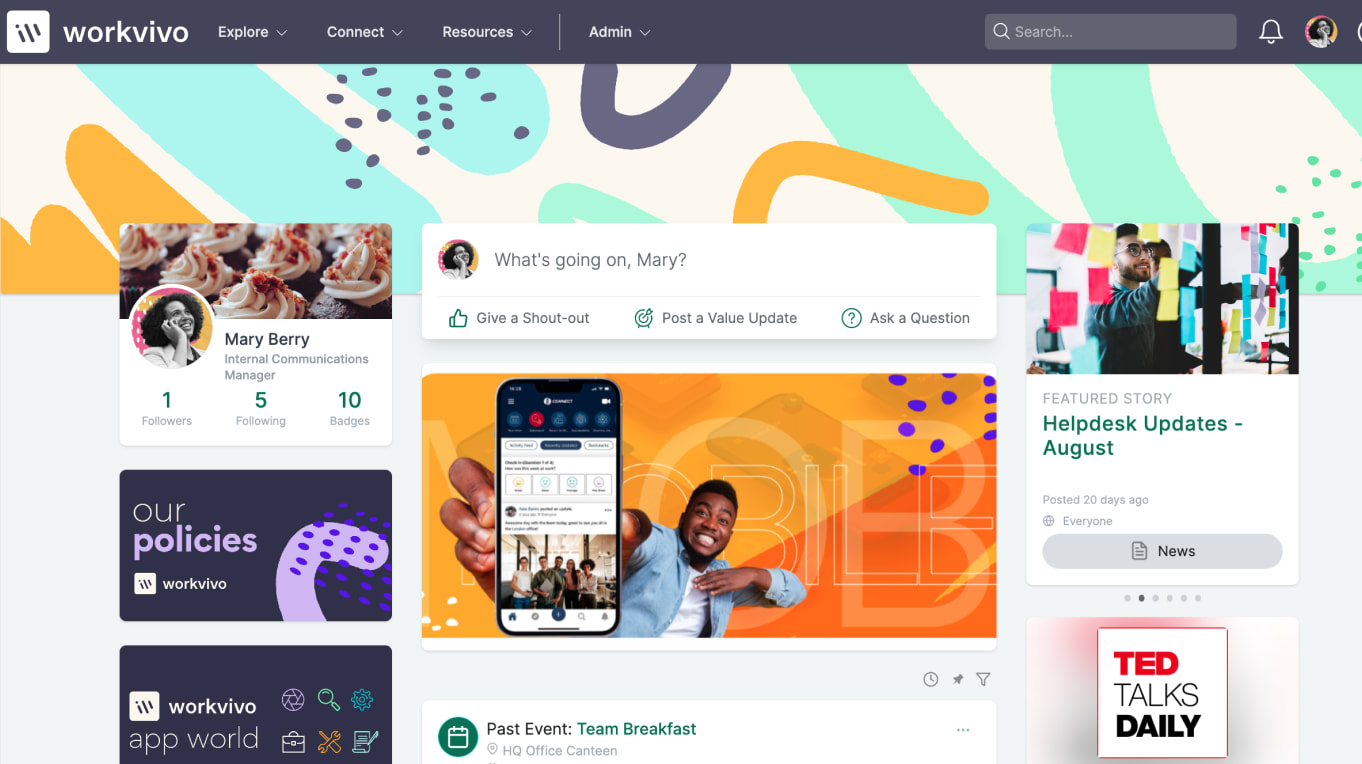
Best For: Distributed and hybrid organizations that need a corporate social network experience to build organizational belonging and community at scale.
Key Features
Multi-Channel Information Sharing: Distributes content via news feed, newsletter, push notifications, and email simultaneously, keeping all employees informed across channels
Employee Pulse Surveys & Survey Customization: Short, customizable surveys with control over questions, frequency, audience, and anonymity levels
Gamification: Badges, rewards, and leaderboards drive engagement and recognition across the platform
Chat & Social Feed: Audience-based chat rooms, content reactions, tagging, and commenting replicate the feel of familiar consumer apps
Frontline Worker Tools: Shift scheduling, task management, emergency notifications, and onboarding materials make it suited beyond desk-based employees
Performance Benchmarking: Compares survey results against industry benchmarks at both high-level and individual employee level
Analytics & Reporting: Real-time dashboards and reporting tools track platform usage, engagement, and business metrics
- Genuine multi-channel approach means employees receive information however they prefer to consume it
- Built-in gamification and social interaction features create organic engagement rather than relying solely on top-down communication
- Strong frontline worker functionality makes it viable for organizations with distributed or non-desk workforces
- Inline translation and internationalization support make it practical for global teams
- Survey benchmarking adds competitive context to engagement data, going beyond internal metrics alone
- The breadth of features, from shift scheduling to knowledge management, may feel overwhelming for smaller organizations with simpler needs
- Chat and social feed functionality may face internal resistance where tools like Slack or Teams are already deeply embedded
- Content moderation and user management demands could place a significant ongoing burden on administrators at scale
- The frontline and ESN feature sets overlap considerably, which may create confusion around how the platform is best positioned and adopted internally

Workleap
Why Workleap?
Workleap is an agentic people platform built around a distinct model where managers are active participants in a continuous feedback loop rather than passive recipients of quarterly dashboards that arrive too late to act on. Its always-on, weekly pulse cadence delivers automated questions to employees. Following this, the managers receive real-time team dashboards and structured 1-on-1 templates that convert engagement data directly into conversation agendas, closing the gap between insight and action that most engagement programs fail to address.
Beyond engagement, Workleap brings performance management, compensation, and recognition into a single system, making it particularly valuable for smaller HR teams that need to run essential people programs without the overhead of managing multiple vendors.
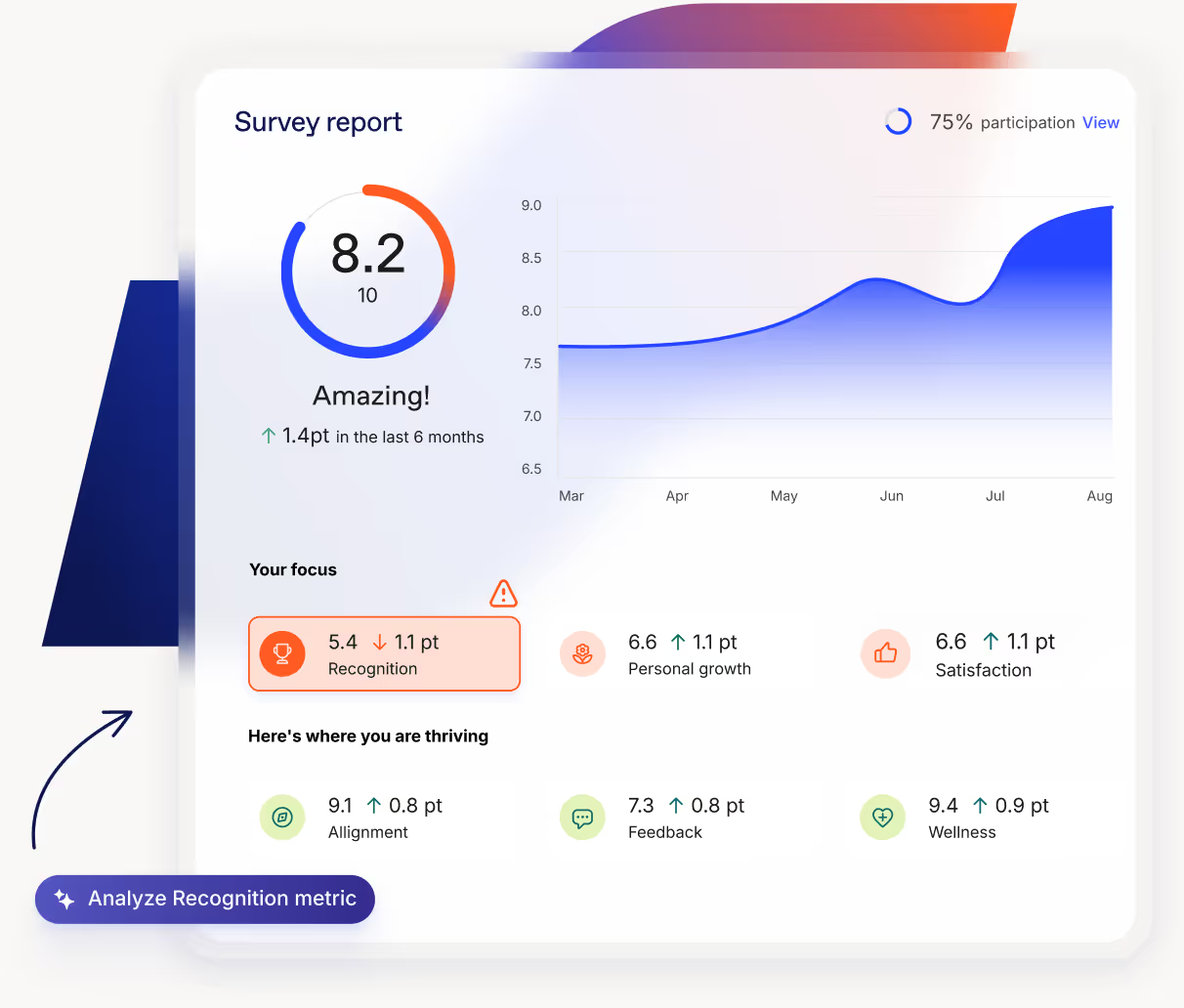
Best For: Organizations where manager accountability is the primary engagement gap, and where a lightweight, consistent weekly feedback cadence is the intervention.
Key Features
Anonymous Pulse Surveys: Automated, science-backed surveys sent weekly, bi-weekly, or monthly across 10 key engagement metrics, with anonymity to encourage honest feedback
Actionable 1-on-1s: Shared, collaborative meeting agendas with tracked action items; managers can reply to employee comments anonymously to build trust
Custom Surveys: Personalized questionnaires built on specific templates to test team initiatives or gather targeted feedback beyond baseline pulse data
Good Vibes Recognition: Peer-to-peer digital cards that celebrate wins, acknowledge effort, and reinforce company culture
Smart Reports: Visual dashboards that track engagement shifts and sentiment changes in real time
Feedback Response Rate Tracking: Monitors how effectively managers and executives are addressing employee concerns
Workleap AI: Automatically generates survey questions, analyses feedback, and summarizes eNPS data into clear, actionable recommendations
Slack & Microsoft Teams Integration: Employees complete surveys and receive notifications directly within their existing daily workflow
- Anonymous pulse surveys across 10 engagement metrics give HR teams structured, consistent data without requiring employees to self-initiate feedback
- Workleap AI removes the manual effort of data analysis, turning raw feedback into actionable recommendations automatically
- Slack and Teams integration means survey participation happens inside tools employees already use, reducing friction and improving response rates
- Good Vibes recognition adds a lightweight culture layer without requiring a separate recognition platform
- The platform's strength in pulse surveys and manager feedback may feel narrow for organizations seeking broader performance management or career development tools
- Custom survey capability, while useful, sits on top of a fixed baseline structure, which may limit flexibility for organizations with highly specific listening needs
- Organizations already using dedicated recognition platforms may find Good Vibes insufficient as a standalone alternative
- The depth of value depends heavily on manager participation; teams with low manager engagement may see limited return from the 1-on-1 and feedback response features

Lattice
Why Lattice?
Lattice is a people management platform built to consolidate the fragmented HR tech stacks that hold mid-market organizations back. By connecting performance reviews, OKRs, engagement surveys, continuous feedback, and compensation into a single interconnected system, Lattice gives HR leaders the analytical depth to identify patterns that isolated platforms simply cannot surface.
Powered by AI and supported by 50+ native integrations, Lattice embeds performance and people management directly into the flow of work. Managers lead with greater confidence, employees grow with clarity, and HR teams can move from periodic insight to continuous action, making culture and performance mutually reinforcing rather than separately managed.
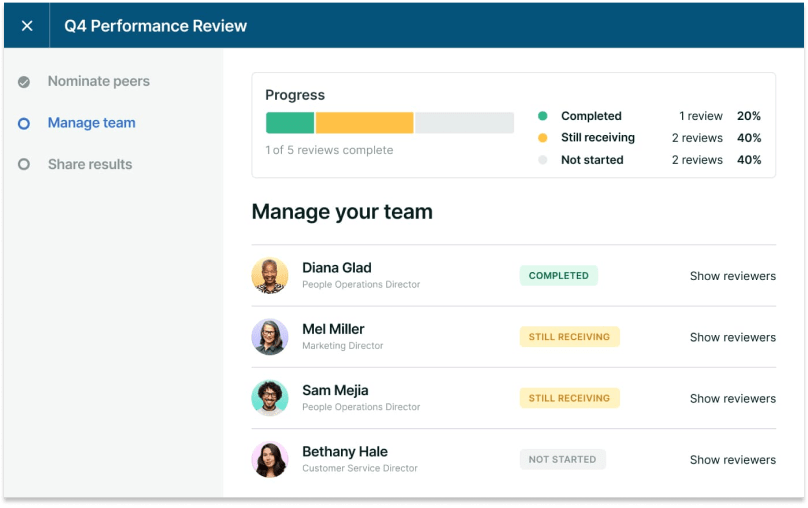
Best For: HR teams seeking to consolidate performance reviews, OKR tracking, and engagement measurement into a unified platform rather than managing multiple disconnected vendor contracts.
Key Features
360 Reviews: Facilitates feedback between managers, employees, and peers, giving a well-rounded view of individual performance
OKR Management: Supports team and individual OKRs, aligning personal goals with broader company priorities
Continuous Feedback: Ongoing feedback collection and storage moves performance conversations beyond the annual review cycle
Career & Employee Development: Tracks skills, progress, and experience to support internal talent growth and mobility
1-on-1 Meetings: Structured check-ins with agenda and action item management keep manager-employee relationships consistent
Performance Benchmarking: Survey results compared against industry standards to identify meaningful areas for improvement
Employee Pulse Surveys: Customizable, culture-focused surveys with control over frequency, audience, and anonymity
- The combination of OKRs, continuous feedback, and 360 reviews creates a genuinely joined-up performance management experience
- Career development and employee tracking tools support retention by making internal growth pathways visible
- Customizable review forms and survey tools give HR teams flexibility without requiring heavy technical configuration
- Historical performance data retention allows for meaningful trend analysis over time
- Public praise functionality adds a recognition layer within what is primarily a performance-focused platform
- Teams without a strong feedback culture may find the continuous feedback and 360 review tools underutilized without proper adoption support
- Career development and talent mobility features may overlap with existing HRIS or LMS tools, creating potential duplication
- The platform leans heavily toward structured performance processes, which may feel rigid for organizations seeking a more flexible or informal approach to employee development

15Five
Why 15Five?
15Five is an AI-powered performance management platform built around a simple but powerful insight: the engagement gap in most teams lives in the weeks between formal reviews, not inside them. Its founding design principle, employees invest 15 minutes on a weekly update, managers invest 5 minutes reviewing it, creates a continuous feedback rhythm that quarterly survey tools are structurally unable to replicate.
By combining weekly check-ins, 360° performance reviews, engagement surveys, goal tracking, and guided 1-on-1s into a single AI-powered system, 15Five gives HR leaders data-driven insights and transforms managers into more effective coaches. This results in an organization where engagement signals surface in real time, performance conversations happen consistently, and disengagement is addressed before it escalates.

Best For: Manager-led teams seeking to replace infrequent, periodic performance reviews with a disciplined weekly check-in rhythm that surfaces engagement signals in real time.
Key Features
Mind Mapping for Goals: Uniquely allows users to arrange tasks and goals visually in a mind map, adding a layer of strategic clarity to goal planning
OKR Management: Supports both team and individual OKRs, connecting personal objectives to company-wide priorities
Continuous Feedback & 1-on-1 Meetings: Ongoing feedback tools paired with structured check-ins keep performance conversations frequent and documented
360 Reviews: Collects feedback from managers, peers, and employees for a comprehensive view of individual performance
Employee Pulse Surveys: Customizable surveys with control over questions, frequency, audience size, and anonymity
Public Praise: A dedicated space for employees and managers to recognize exceptional performance openly
Historical Performance Data: Retains past review data to support long-term trend analysis and informed decision-making
- Mind mapping is a distinctive goal-planning feature that sets 15Five apart from more linearly structured performance tools
- The combination of continuous feedback, 1-on-1 tools, and 360 reviews supports a culture of regular, meaningful performance dialogue
- Science-based survey templates add credibility and rigor to engagement measurement
- Customizable review forms and employee segmenting give HR teams meaningful control over how feedback is collected and analyzed
- The breadth of goal-setting and feedback tools may require a structured rollout and manager training to avoid feature fatigue
- Organizations without an existing feedback culture may find the platform's expectations around regular check-ins and continuous feedback difficult to sustain
- The social feedback portal and peer recognition features, while present, feel secondary to the platform's core performance management focus

Leapsome
Why Leapsome?
Leapsome is an AI-powered people platform that addresses one of the most overlooked drivers of disengagement, perceived stagnation, and insufficient development pathways. By combining a modern HRIS with performance management, engagement surveys, learning, compensation, and goal tracking into a single interconnected system, Leapsome treats career growth and performance as inseparable rather than parallel concerns.
Built for European mid-market HR teams and gaining strong traction in the US, Leapsome simplifies and automates HR processes across the entire employee lifecycle, from onboarding through to reviews, development, and beyond. Powerful AI capabilities and built-in best practices give HR leaders the analytical depth to make better people decisions with significantly less administrative overhead.
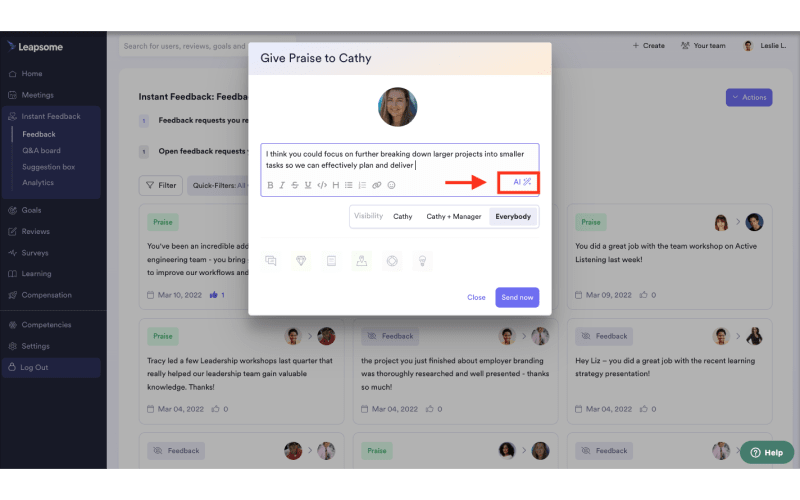
Best For: European and US mid-market organizations seeking to combine engagement measurement, performance management, and structured learning and development within a single platform.
Key Features
Automated Onboarding Workflows: Tracks new hire progress with automated workflows, notifications, and org-chart-based team introductions from day one
Core HR & Compliance: Manages time, attendance, PTO, salary structures, and compliance tracking within a single platform
E-Signature & Offer Letter Management: Supports electronic signing and offer letter approvals, streamlining the pre-boarding experience
Employee Pulse Surveys: Customizable, culture-focused surveys with control over frequency, audience, and anonymity
Peer Recognition: Real-time recognition via digital badges, awards, and messages displayed on a live activity feed
Self-Service Portal: Employees can log in independently to manage and view their own onboarding journey
Alerts & Notifications: Self-monitoring metrics with in-app, email, or text notifications keep both managers and employees informed
- The combination of Core HR, onboarding automation, and compliance tools makes Leapsome a strong option for organizations looking to consolidate HR processes in one place
- Automated team introductions and onboarding notifications reduce the administrative burden on managers during new hire transitions
- E-signature and offer letter functionality extends the platform's value into the pre-boarding stage, earlier than most engagement-focused tools
- Employee segmenting allows surveys and reporting to be filtered by location, demographics, and role for more targeted insights
- The breadth of HR functionality spanning onboarding, compliance, time tracking, and engagement may create complexity for teams seeking a more focused solution
- Organizations already running a dedicated HRIS may find overlap with existing systems, making the case for full adoption harder to justify
- Onboarding strengths may overshadow the platform's engagement and performance features
Qualtrics EmployeeXM
Why Qualtrics EmployeeXM?
Qualtrics EmployeeXM occupies the highest tier of the enterprise employee listening category, built for organizations that need statistically rigorous, multi-language, multi-region engagement programs delivered at the business-unit level to executive and board audiences. While most survey tools measure sentiment, Qualtrics goes further, using AI, machine learning, and NLP analytics to automatically synthesize listening data from every employee touchpoint and surface root causes faster than periodic measurement alone can achieve.
Integrated with enterprise infrastructure, including Workday and SAP SuccessFactors, Qualtrics gives HR leaders, senior executives, and people managers the actionable insights needed to improve engagement, strengthen retention, and drive performance at scale. The depth of capability comes with a corresponding implementation investment.
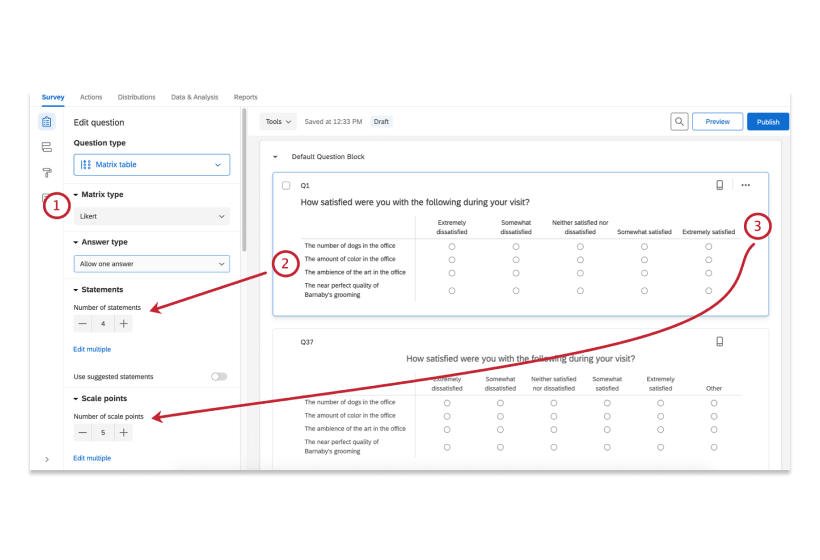
Best For: Large enterprises with complex, multi-region, multi-language survey programs, advanced statistical analysis requirements, and existing SAP or Workday infrastructure.
Key Features
Survey Customization & Content Creation: Build original survey content directly within the platform, with full control over questions, frequency, audience, and anonymity
Science-Based Templates: Pre-built survey templates developed by academics and practitioners, grounding engagement measurement in research
Performance Benchmarking: Compares survey results against industry benchmarks at both organizational and individual employee level
Historical Analysis: Retains historical performance data over time, enabling meaningful trend tracking and long-term insight
360 Reviews & Continuous Feedback: Facilitates multi-directional feedback between managers, peers, and employees on an ongoing basis
Alerts & Notifications: Self-monitoring metrics with automated alerts keep key stakeholders informed without manual oversight
- Survey depth and customization capability are best-in-class, making them particularly well-suited for organizations with sophisticated listening strategies
- Science-based templates add academic rigor that differentiates Qualtrics from lighter engagement tools
- Historical data retention and benchmarking together create a strong foundation for evidence-based people decisions
- Continuous feedback and 360 review tools extend the platform beyond pure surveying into broader performance dialogue
- Strong interoperability means it can sit alongside existing HR tech stacks rather than replacing them
- The platform's roots in survey and research tooling mean it carries a more analytical feel that may require more effort to drive employee-facing adoption
- Peer recognition, rewards, and social engagement features are largely absent, making it a weaker standalone choice for organizations prioritizing culture-building alongside data collection
- The level of configurability and content creation capability may demand more from HR and admin teams in terms of time and expertise to manage effectively
- Organizations seeking an all-in-one engagement and performance platform may find Qualtrics better suited as a complementary tool rather than a primary employee experience solution

Culture Amp
Why Culture Amp?
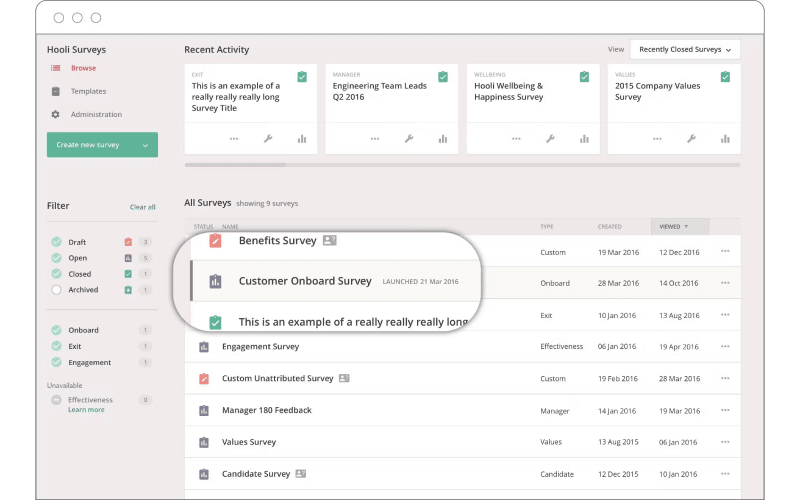
Culture Amp was founded by organizational psychologists and data scientists, and that origin shapes everything about how the platform approaches employee engagement. Powered by the largest employee dataset in the world, drawn from over 25 million employees across 6,500 companies, Culture Amp enables organizations to contextualize their engagement scores against verified industry peers rather than relying solely on internal historical data, fundamentally changing how leadership interprets results and prioritizes action.
The platform has evolved from a science-backed survey tool into a comprehensive culture analytics system covering employee engagement, performance management, career development, and recognition. For HR teams whose primary challenge is acting on data rather than simply collecting it, Culture Amp's manager-level dashboards and data-driven recommendations make it one of the most complete people strategy platforms available at scale.
Best For: Mid-market to enterprise organizations that require science-backed survey benchmarks, demographic segmentation, and structured manager-level action planning.
Key Features
Employee Development & Career Pathing: Tracks skills, progress, and experience while supporting self-assessments, internal talent discovery, and mobility management
OKR Management: Supports both team and individual OKRs, with action item creation linking meeting outcomes directly to goal-setting
Mind Mapping for Goals: Allows tasks and goals to be arranged visually, bringing strategic clarity to individual and team planning
Performance Benchmarking: Survey results measured against industry benchmarks at both organizational and individual levels
Employee Segmenting: Filters surveys and results by location, demographics, and position for more targeted people insights
Confidence Level Tracking: Employees can rate their own confidence in goal completion, giving managers early visibility into potential blockers
Peer Recognition: Real-time recognition via badges, awards, and messages on a live activity feed
- The combination of career development, employee tracking, and OKR tools positions Culture Amp as a strong platform for organizations focused on long-term talent retention
- Mind mapping and confidence level tracking are distinctive features that add depth to goal management beyond standard OKR frameworks
- Employee segmenting enables HR teams to surface insights at a granular level, making survey data more actionable across diverse workforces
- Science-based survey templates and performance benchmarking ground engagement measurement in evidence rather than intuition
- The social feedback portal supports a degree of psychological safety by allowing varying levels of anonymity in employee communication
- Career development and talent mobility tools may duplicate functionality already present in existing HRIS or LMS systems within larger organizations
- The platform's breadth across goal-setting, recognition, surveys, and development may require a phased rollout to avoid overwhelming teams during adoption
- Peer recognition and rewards features, while present, are less developed than dedicated recognition platforms like Achievers or Bonusly
How We Evaluated These Employee Engagement Platforms
The 10 platforms listed above were evaluated against five criteria, applied consistently to every tool on the list.
1. Feature depth: Does the platform genuinely address a core engagement outcome, whether that is survey measurement, peer recognition, internal communication, or performance feedback? We excluded platforms that only peripherally touch engagement.
2. Pricing transparency: Every platform in this list either displays a starting price (in USD, per user per month or annually) or an explicit “Custom” designation where vendors do not publish pricing.
3. Integration ecosystem: How well are the platforms integrated with the tools your teams are already using, specifically Slack, Microsoft Teams, your Human Resource Information System (HRIS), and payroll?
4. Customer support quality: Based on G2 reviewer sentiment around implementation support, onboarding speed, and ongoing account management.
5. G2 ratings, 2026: We used verified third-party ratings to anchor every recommendation. No internal scores.
Best Employee Engagement Software by Use Case
You ought to understand that there is no single best employee engagement platform. But there can only be the best platform for your specific engagement problem. Here is how the top 10 maps to the five most common use cases.
Best for Surveys and Engagement Analytics
Culture Amp and Qualtrics EmployeeXM lead this category. Culture Amp excels in ease of use and manager-level action plans, and Qualtrics excels in enterprise survey depth and statistical rigor.
Best for Recognition and Rewards
Vantage Recognition leads at enterprise scale for global, value-based recognition. Bonusly leads for SMB and mid-market teams that want a simple peer-recognition feed. Achievers suits organizations that need recognition to be continuous, analytically accountable, and scalable across complex global environments.
Best for Internal Communication
Workvivo is the clear leader here, especially for distributed and hybrid organizations that need a corporate social network feel rather than a broadcast intranet.
Best for Performance and Engagement Together
Lattice, 15Five, and Leapsome all occupy this space with meaningfully different approaches: Lattice is broadest (performance, OKRs, compensation); 15Five is manager-led and cadence-focused; Leapsome adds L&D depth.
Best for Manager-Employee Feedback
Workleap and 15Five are the two strongest options for manager-led pulse loops. Workleap is lighter and faster to deploy; 15Five integrates more tightly with OKR and performance data.
Best Employee Engagement Software for Small Businesses (Under 200 Employees)
For most SMB teams, the engagement challenge is less about measurement and more about recognition infrastructure and manager accountability. Hence, the best employee engagement software for small businesses will be the one that delivers value from day one without requiring a dedicated implementation team or a six-figure budget.
The platforms below address both without overwhelming the HR team.
Top 2 SMB picks:
- Bonusly ($3/user/month, Core): Fastest time-to-value for peer recognition. Slack and Teams integrations mean adoption does not require behavioral change.
- Workleap ($5/user/month, Essential): Best for SMBs where manager accountability is the engagement gap. Weekly pulse plus one-on-one templates create structure without complexity.
SMB buying checklist:
- Does the platform offer a free trial or pilot period without a sales-led process?
- Is pricing per user per month with no minimum seat requirement above 50?
- Does it integrate with the communication tool your team already uses (Slack or Teams)?
- Can a non-technical HR generalist administer the platform without IT support?
- Is there a transparent self-serve tier without requiring a demo call?
Best Employee Engagement Software for Enterprises (1,000-Plus Employees)
The best employee engagement software for enterprises in 2026 prioritizes data security, HRIS integration, and the ability to cut engagement signals by region, department, manager, and tenure without losing statistical significance.
At enterprise scale, a single recognition touchpoint or a decorative survey dashboard does not suffice. The question is whether the platform can make engagement data actionable for 200 managers across 15 countries without creating a reporting burden that only the central HR team can interpret.
Top 3 enterprise picks:
- Culture Amp: Best for enterprises where the CHRO needs to demonstrate engagement ROI to the board. Benchmark library and manager action plans make the data usable at every level.
- Vantage Recognition: Best for enterprises where recognition needs to work across 100-plus countries with local currency, local reward catalog, and global compliance (SOC 2, GDPR). Department-wise recognition dashboards surface which leaders are driving or starving engagement velocity.
- Qualtrics EmployeeXM: Best for enterprises where the survey methodology itself needs to be defensible. Census surveys, multi-language support, and Workday/SAP integration are table stakes at this level.
Enterprise buying checklist:
- Does the platform support SAML-based single sign-on (SSO) and SCIM provisioning for automated user management?
- Is SOC 2 Type II certification in place, with GDPR data processing agreements available for EU operations?
- Does the platform support multi-language surveys and reward catalogs across all operating regions?
- Can reporting be segmented by business unit, manager, tenure, and geography without a custom data export?
- Is there a dedicated customer success manager included in the enterprise tier, not just a ticketing system?
Bottom Line: Pick the Platform Your Engagement Goal Demands
The truth is, there is no single best employee engagement software. The best one is the one that fits your needs.
The question your buying decision should answer is not “which platform has the most features?” It is “which platform is built for the specific engagement outcome we need to move in the next 90 days?”
Start with that question. Use the comparison table and use-case section of this blog to narrow from 10 to 3. Then run a pilot.
The right platform is the one your managers will use, your employees will respond to, and your HR team can act on, not the one with the longest feature list.
FAQs
Q: What is employee engagement software?
A: Employee engagement software is HR technology that helps organizations measure and improve employee connection, motivation, and commitment. It usually includes pulse surveys, recognition, feedback tools, rewards, and analytics.
Q: What is an employee engagement platform?
A: An employee engagement platform is an integrated system that brings surveys, recognition, feedback, communication, and analytics into one place. It is broader than a single-purpose engagement tool.
Q: How much does employee engagement software cost?
A: Employee engagement software typically costs $2–$5 per user/month for basic plans, $5–$15 for mid-market platforms, and custom pricing for enterprise solutions. Implementation, integrations, and training may incur additional costs.
Q: How do you choose the right employee engagement software?
A: Choose software based on the engagement problem you want to solve, such as low recognition, poor feedback, or weak survey participation. Check integrations, run a pilot, and track metrics like response rate, eNPS, and adoption before scaling.


