
Most employee recognition programs are dead within 90 days of launch. Not because the idea was bad. Not because people don't want to feel appreciated. But because someone sent an email, called it a launch, and moved on.
The problem isn't the program, it's the approach. Launching recognition means asking people to change daily behavior: how managers give feedback, how peers acknowledge each other, what good work looks like out loud. That's not an announcement. That's a culture shift.
The organizations that get it right treat it like one. And the backbone of that approach is change management.
Change management is a structured way of moving people, not just systems, from how things work today to how you need them to work tomorrow. Done right, it's the difference between a program that sticks and one that quietly disappears. Wondering where your organization stands? Start with a change management survey to get a read on readiness before you launch.
Here's exactly how to do it.
Why a Recognition Program Launch is a Change Management Project
You know what, most recognition programs fail because someone treated the launch like a product release instead of people's initiative.
Give a thought to this.
You’re asking managers to change how they talk to their teams. You’re asking employees to start doing something new. Publicly acknowledging each other, which might feel awkward at first.
But you’re shifting what ”good work” looks like in your organization. And that behavior change is, by definition, change management process.
Here, let me define it for you.
Change management is the structured process of moving people from how things work today to how you need them to work tomorrow. Mind you, ”people,” not just ”systems.” It’s the difference between rolling out a new tool and actually getting people to use it.
But for recognition program, it means planning for the human side:
- The skeptical managers
- The employees who’ve seen initiatives come and go
- The leaders who need to model the behavior before anyone else will
Gallup states that employees who feel recognized are significantly more engaged and far less likely to be looking for the exit.
However, the stat only matters if people actually use the program.

VANTAGE INFLUENCERS PODCAST
"Many businesses implement employee appreciation programs only to fail — not because they lack the budget, but because they are still holding on to outdated ideas about how recognition actually works."
— Christopher Littlefield, Employee Appreciation and Workplace Culture Expert
Listen to the EpisodeThe 7-Step Change Management Framework for Launching a Recognition Program
Most frameworks look great on paper and fall apart in practice. This one is built around what actually moves people. Work through these steps in order. Each one sets up the next.
Step 1- Build the Case for Change and Briefly Define success
Before you design anything, answer one honest question: what problem are you actually solving?
Maybe your engagement survey showed people don't feel seen. Maybe you're losing good employees to competitors offering nothing more than a better culture. Maybe managers have no idea how to give feedback that means something. The answer shapes everything: the program's design, the story you'll tell to get buy-in, and the metrics you'll use to prove it worked.
Capture your baseline before anything launches. Pull your current employee recognition data: eNPS scores, voluntary turnover rate, manager feedback scores. You can't prove the program worked if you didn't document what "before" looked like.
Then define success in plain language. "70% of employees give or receive recognition at least once a month within six months" beats "improve engagement" every time.
Step 2- Secure an Executive Sponsor
Not a budget approver. A sponsor.
A budget approver writes a check and goes back to their inbox. A sponsor shows up at the launch event, in the all-hands, on the Slack channel. They give the first public recognition on the platform, name attached, visible to everyone. That one act signals to the entire organization that this program is real.
Your sponsor should be willing to speak at launch, reference the program in leadership conversations, and help address resistance when it surfaces. People follow leaders, not line items.
Note: Brief your sponsor before launch day. Prepare a draft recognition they can personalize and post. If you leave it open-ended, it often does not happen. And a sponsor who is visibly absent in launch week sends a louder signal than any announcement you put out.
Step 3- Map Stakeholders and Recruit a Champion Coalition
Before launching, map your stakeholders honestly:
- Who's on board
- Who's neutral
- Who's likely to push back
Then build a champion coalition across departments and levels who will carry that energy into their corners of the company.
A solid rule of thumb: one champion per 100 employees. That's enough coverage to make the program feel grassroots rather than top-down. Champions can run team demos, field questions, and feed you real-time ground-level feedback that no survey will catch.
Tip: Do not only recruit people who are already enthusiastic. A champion who was initially skeptical and came around is far more persuasive to the holdouts than someone who was on board from day one.
Step 4- Co-Design the Program with the People who will use it
If recognition criteria are designed entirely by HR and leadership, they'll reflect what leadership values, which may not be what employees actually care about. Bring in a cross-section of managers and frontline employees early.
Ask what meaningful recognition looks like in their world or what behaviors should actually be recognized?
Tie recognition to your company values. Peer-to-peer recognition is especially powerful here. When a colleague calls out another for living a company value, it reinforces that value in a way a poster on the wall never will.
Do Give a Read: Peer-to-Peer Recognition: Why It Matters and How to Build It Into Your Culture
Step 5- Build a Phased Communication Plan
A phased communication plan looks like this:
A. Pre-launch (4–6 weeks out):
Build awareness. Get your sponsor talking about it. Share a honest "why we're doing this" message from leadership, not corporate-speak.
B. Launch week:
Make it simple: what the program is, how it works, and what to do right now. FAQs, a short demo video, a dedicated channel for questions.
C. Post-launch (ongoing):
Keep the conversation alive. Share recognition stories. Highlight moments in newsletters and team meetings. This is where adoption actually takes root.
You must assign message owners for each phase. Not everything should come from HR.
Step 6- Run a Pilot Before the Full Rollout
How about picking one department with a supportive manager and a mix of tenures.
You can run the pilot for 4–6 weeks. Track participation rate, recognition frequency, and qualitative feedback. Ask the team what felt awkward, what felt natural, and what they'd change.
Define your go/no-go criteria in advance. If participation is below 35% at six weeks, find out why before you scale. A low number is not failure; it is data. The insights from a well-run pilot are worth more than any amount of pre-launch planning.
Step 7- Launch, Measure Adoption, and Sustain Momentum
Launch day should feel like an event. Let your sponsor give the first recognition publicly. Celebrate early adopters by name.
Then track what matters:
- 30 days: Are people logging in? Who has given their first recognition?
- 60 days: Is participation spreading, or concentrated in a few teams?
- 90 days: Are manager-led recognition rates healthy? What is happening to your baseline metrics?
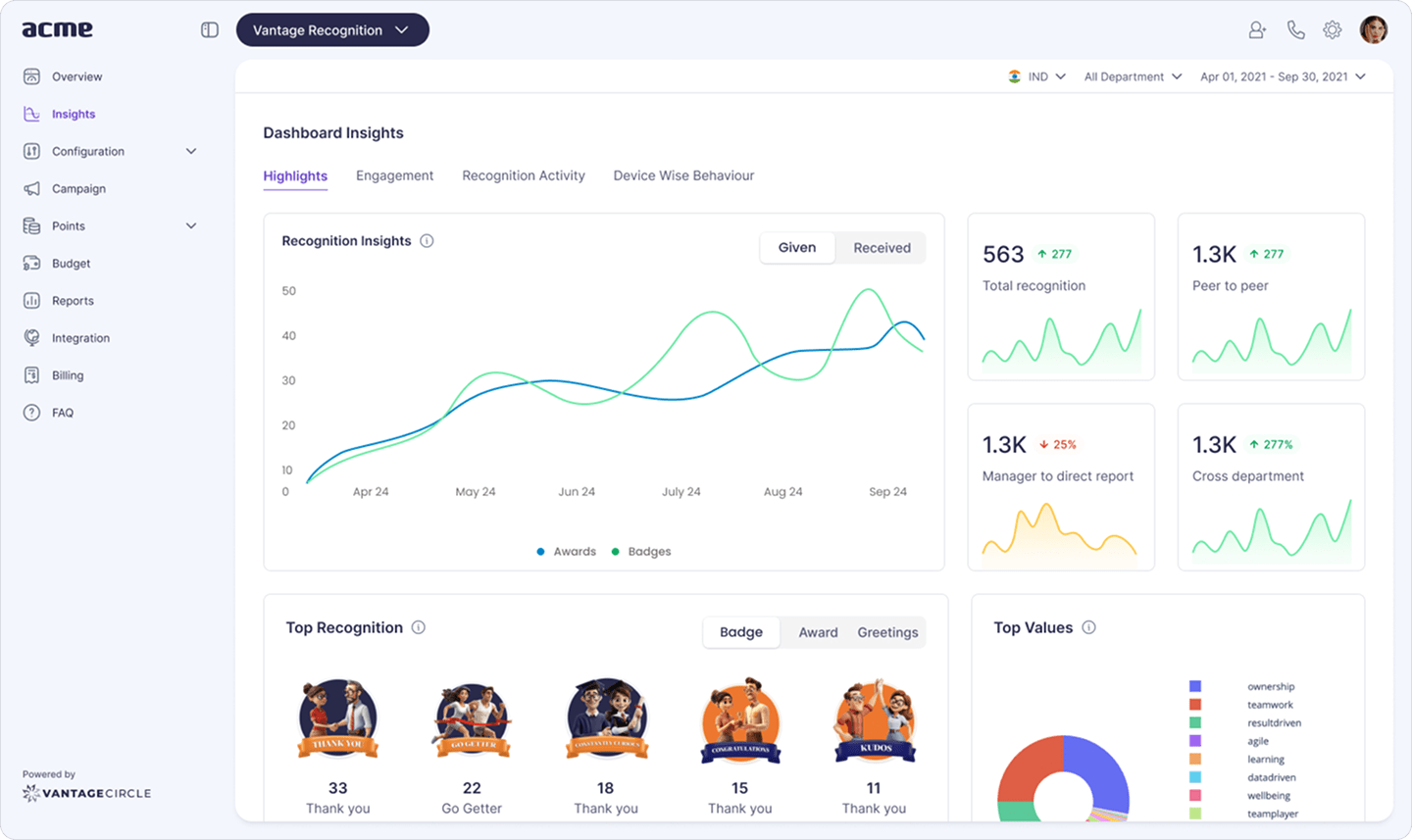
If you are tracking these manually, the numbers often arrive too late to act on. Vantage Recognition surfaces participation, reach, and manager activity in real time, so you can course-correct during the 30-day window rather than after it closes.
The organizations that build a lasting culture of recognition embed it into existing rituals: team standups, onboarding, quarterly reviews. Launch is where the program goes live. Sustainment is where it actually works.
Metrics That Prove Your Recognition Program Launch Worked
Gut feelings is not a success metric. If you want to defend the program budget next year, or simply know whether what you built is actually working, you need numbers. Here are the five worth tracking.
1. Participation rate
What percentage of employees gave or received recognition in a given period?
Gallup research states that, organizations where employees receive recognition regularly see significantly higher engagement and lower turnover.
Keeping that in mind, aim for 80% of employees receiving recognition within the first quarter, with the expectation that your first 30 days will naturally be lower.
2. Recognition reach
Are the same five people getting recognized every week, or is appreciation spreading across the organization?
Reach tells you whether the program is genuinely embedded or just popular with a small group.
3. Manager activity rate
Manager-led recognition is one of the strongest leading indicators of team health and program stickiness.
And it matters more than most realize.
24% of employees say the most memorable recognition they have ever received came from a high-level leader or CEO.
What managers and leaders do sets the bar for everyone else.
4. eNPS movement
You must track your employee Net Promoter Score quarterly.
A well-run recognition program moves this number over time. If it is not moving after six months, dig into why.
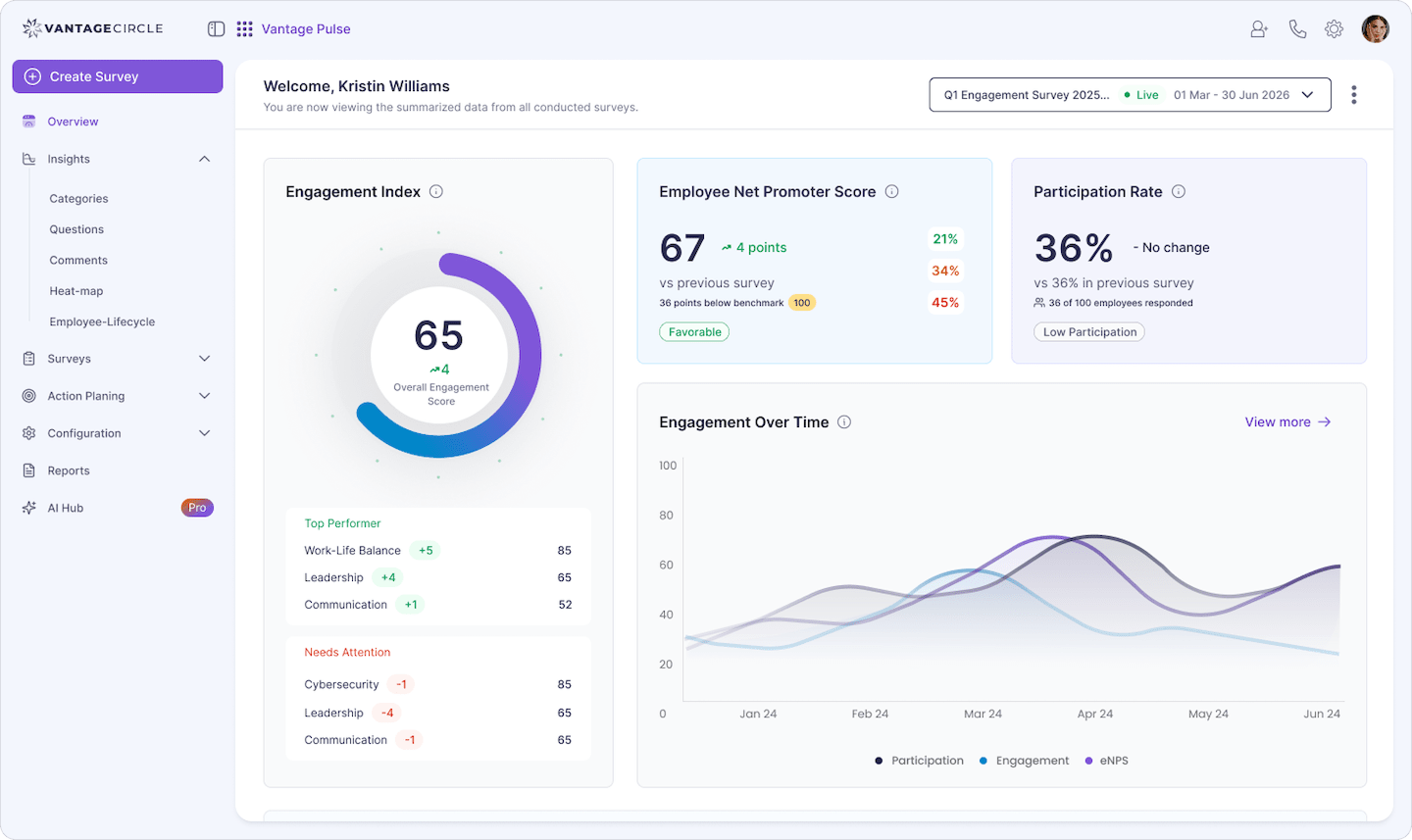
Tools like Vantage Pulse can make this easier by running pulse surveys that give you a steady read on how sentiment is shifting, without waiting for the annual engagement survey to find out.
5. Time-to-first-recognition
How long after launch does the average employee give their first recognition? The shorter the window, the stronger the launch momentum.
For real-world context on how other companies measure and report on these, explore these recognition program examples.
Related Resource: Six Ways to Successfully Implement an Employee Recognition Program
How to Overcome Resistance to a New Recognition Program
Every recognition rollout hits the same three walls: managers who think it's extra work, employees who've watched programs quietly die, and leaders who aren't sure the investment is worth it.
The resistance isn't random. Each group has a specific reason for skepticism, and each reason has a specific answer.
Getting ahead of it means naming it first.
The best approach forward is, before launch, sit with your champion coalition and work through every objection they've already heard in the hallway. The ones that surface in a focus group are manageable. The ones that stay underground will quietly drag your participation numbers down until you're running a program that exists on paper and nowhere else.
The table below maps the six most common forms of resistance to the root cause behind each one and the response that actually moves people.
| Objection / Resistance | Why It Happens | How to Address It |
|---|---|---|
| "This is just another HR initiative that'll fade in 3 months." | Past programs launched with fanfare and then disappeared without explanation. | Show a 12-month roadmap with named milestones. Let your executive sponsor publicly commit to a 6-month review. |
| "I don't have time to give recognition on top of everything else." | Managers see it as an add-on task, not part of how they already lead. | Reduce friction: embed recognition into tools they already use (Slack, Teams, email). Show it takes under 60 seconds. |
| "Recognition feels forced and performative to me." | Employees associate public praise with awkward all-hands shoutouts, not genuine acknowledgment. | Show them what peer-to-peer recognition looks like in practice. Let pilots shape the tone before full rollout. |
| "How do we know who actually deserves recognition?" | No shared criteria means managers default to recognizing who they like, not who they should. | Co-design recognition criteria tied to company values. Make the rubric visible and consistent across teams. |
| "This will create favoritism." | People have seen recognition used inconsistently, often rewarding visibility over impact. | Build in reach metrics from day one. Track whether recognition is spreading or clustering, and make that data visible to managers. |
| "Leadership says they care but they're not actually participating." | Employees read leader behavior, not leader messaging. | Your executive sponsor must go first — publicly, visibly, with their name on it. One act beats ten announcements. |
Objection: "This is just another HR initiative that'll fade in 3 months."
Why It Happens: Past programs launched with fanfare and then disappeared without explanation.
How to Address It: Show a 12-month roadmap with named milestones. Let your executive sponsor publicly commit to a 6-month review.
Objection: "I don't have time to give recognition on top of everything else."
Why It Happens: Managers see it as an add-on task, not part of how they already lead.
How to Address It: Reduce friction: embed recognition into tools they already use (Slack, Teams, email). Show it takes under 60 seconds.
Objection: "Recognition feels forced and performative to me."
Why It Happens: Employees associate public praise with awkward all-hands shoutouts, not genuine acknowledgment.
How to Address It: Show them what peer-to-peer recognition looks like in practice. Let pilots shape the tone before full rollout.
Objection: "How do we know who actually deserves recognition?"
Why It Happens: No shared criteria means managers default to recognizing who they like, not who they should.
How to Address It: Co-design recognition criteria tied to company values. Make the rubric visible and consistent across teams.
Objection: "This will create favoritism."
Why It Happens: People have seen recognition used inconsistently, often rewarding visibility over impact.
How to Address It: Build in reach metrics from day one. Track whether recognition is spreading or clustering, and make that data visible to managers.
Objection: "Leadership says they care but they're not actually participating."
Why It Happens: Employees read leader behavior, not leader messaging.
How to Address It: Your executive sponsor must go first — publicly, visibly, with their name on it. One act beats ten announcements.
Do remember, the most dangerous objection is silence.
Your pilot participation coming in at 20% and no one raises a hand, it doesn't mean things are fine. It means people have already decided the program isn't worth their energy.
Low pilot numbers are an objection. Treat them like one: find the source, name it, and address it before you scale.
Real-Life Examples of Recognition Change Management Done Right
1. Wipro: Making Recognition Consistent Across 230,000 Employees
Wipro had 230,000 employees across 66 countries. Their challenge was not finding a platform. It was getting recognition to happen consistently across levels, geographies, and business units while employees were under constant client delivery pressure.
Their Winners' Circle program solved this by embedding recognition directly into daily workflow rather than treating it as a separate initiative. The result: 57% employee recognition coverage and one recognition happening every 1.2 minutes across the organization. The program won Brandon Hall Gold in 2023.
The Wipro case is a clear example of what happens when a company treats recognition as a change management project from the start, not a tool rollout.
2. Tata Communications: What Sustainment Actually Looks Like Over 5 Years
Tata Communications launched their Applause program and then did the harder thing: they kept it alive. Over five years (FY2020 to FY2025), peer-to-peer recognition grew by 185% and active users increased by 134%. By FY2024-25, one recognition was happening every 2 minutes.
None of those numbers came from the launch. They came from the five years of intentional sustainment after it.
The 5-year arc of Applause is the best argument for building sustainment into your plan before you launch. The programs that compound are the ones treated as culture infrastructure, not campaigns.
Common Recognition Program Launch Mistakes to Avoid
Most recognition programs don't fail dramatically. They just quietly fizzle. Usually, it comes down to one of these five things.
1. Keeping recognition top-down
When appreciation only flows from leadership, it starts feeling like a corporate formality. Employees want to recognize each other too, build that in from the start.
2. No executive sponsor
HR can build a great program, but if leadership isn't visibly participating, employees will take their cues from that silence. Sponsorship sets the tone for everyone else.
3. Launching to everyone on day one
It leaves no room to catch problems before they spread. A focused pilot gives you space to learn and adjust without the stakes of a company-wide rollout.
4. Skipping manager training
A manager who doesn't know how to recognize well will either do it generically or skip it altogether. Both quietly undermine the program before it finds its footing.
Note: Generic recognition ("great work!") without specifics can feel as hollow as no recognition at all. Train managers to name the behavior, not just the outcome. "You stayed calm under pressure in that client call and it changed the room" lands. "Good job this week" does not.
5. Launch and forget
Recognition initiatives tend to get a strong week one, then slowly disappear from everyone's radar. The programs that stick are the ones woven into rituals that already exist.
Tip: Put your 30-, 60-, and 90-day adoption reviews on the calendar before launch day. What gets scheduled gets done.
Frequently Asked Questions
1. How do you introduce an employee recognition program?
Start with the why before the what. Tell employees what problem you're solving and why it matters to them personally. Keep the rollout simple, make participation easy, and let early recognition moments speak for themselves. A program that starts quietly and builds organically tends to outlast one that launches with a lot of fanfare but no follow-through.
2. How do you announce an employee recognition program?
Skip the corporate "we're excited to announce" opener. Be direct and human about what's changing and why. Have your executive sponsor deliver the message, use the channels your employees actually check, and give people a clear next step they can take in the next five minutes. The announcement should feel like the beginning of a conversation, not a memo.
3. What is an example of an employee recognition program?
A simple but effective setup: employees can recognize peers tied to company values, visible to the whole team. Managers get a monthly summary of who has been recognized on their team. Standout moments get highlighted at the quarterly all-hands. It does not need to be complicated. It needs to be consistent.
4. What are the 5 C's of employee retention?
The 5 C's are Compensation, Culture, Career, Connection, and Contribution. A well-run recognition program directly strengthens the last three. Employees who feel their contributions are noticed tend to feel more connected and more invested in growing where they are.
5. What is a good recognition sentence?
Specific and timely beats generic every time. Instead of "great job this week," try something like: "The way you handled that client situation on Thursday, staying calm and keeping everyone in the loop, that is exactly the kind of ownership that makes a difference." Name the behavior, name the impact.
Conclusion
Here is the truth, you can't miss, your recognition platform is not what makes the program work. Your people are.
The 7 steps in this post are not a checklist. They are a way of thinking about change, one that puts the human side of the launch at the center, not as an afterthought.
You do not need to do everything at once. Pick the step you have been skipping and start there. The rest will follow.

Sanjeevani Saikia is a Senior Content Strategist at Vantage Circle, where she leads end-to-end content strategy across SEO, thought leadership, brand storytelling, podcasts, and video. She is also the host of the Vantage Influencers Podcast, where she brings conversations with HR and business leaders from top global organisations, including Fortune 500 companies.
Connect with Sanjeevani on LinkedIn.