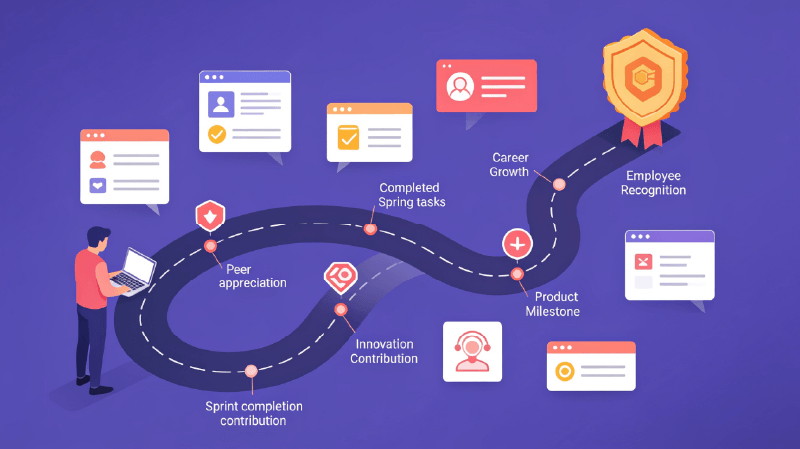
Ask a leadership team to name the perks they offer and the answer comes fast. Ask what each one costs per head, or how many people touched it last quarter, or whose job it is to renew the contract, and the room goes quiet. That quiet is the whole difference between a pile of perks and a program.
An employee perks program is a structured set of non-salary benefits that an organization funds and administers as one offering, usually through a single platform. The list is the easy half. The program is the half with an owner. Somebody whose name sits against the budget, who wrangles the vendors, who keeps nudging people that the thing exists long after the launch email died, and who actually opens the usage report nobody else wants to read.
Plenty of companies have the first and quietly call it the second.
So here is the practical version. What actually separates a perk from a benefit, 22 workplace perks worth putting in, roughly what each one runs you, and how to choose the right ones, get people to notice them, and tell whether any of it worked.
What Is an Employee Perks Program?
An employee perks program is the administrative layer that turns scattered benefits into something an employee can find, use, and value in one place. The perks are the easy part. The program is the part that decides whether they get used at all.
Look at what "administered as one offering" actually means in practice. One access point instead of six logins. One owner who can tell you the annual spend without a week of digging. A renewal calendar so you are not surprised by an auto-charge in March. A communication cadence that reminds people the perk exists after the launch email fades. And usage reporting, which is the piece almost everyone skips.
Here is what most leaders miss. The value of a perks program is not the discount or the stipend. It is the fact that someone is accountable for whether the discount or the stipend does anything. A gym subsidy nobody redeems is not a cheaper perk. It is a dead line item that still shows up on the invoice.
That accountability is also what makes the program defensible at budget time. When finance asks what the spend bought this year, a list of perks cannot answer the question. A program can, because someone has been watching the usage the whole time.
Perks vs Benefits: What Actually Counts as a Perk
A workplace perk is something an employer hands you on top of pay and core benefits: optional, usually cheap per person, and there to make daily working life better rather than to cover risk. The test I actually use is blunter than the textbook one. If pulling it would set off a compliance question, it is a benefit. If pulling it would set off a morale question, it is a perk.
Benefits cover risk and obligation. Health insurance, retirement contributions, life cover, statutory paid time off (PTO). Pull one and you are usually into legal, regulatory, or contractual territory. Perks live above that line, and being discretionary is the whole point of them. It is why they change how a place feels to work at. It is also why they are first on the chopping block when the budget gets tight.
The middle is where it gets murky, and pretending otherwise is how things end up mislabeled. Take a learning allowance. It reads as a benefit if you treat it as a retention obligation and a perk if you treat it as a nice-to-have, and honestly it can be either. The ambiguity does not bother me. What matters is knowing which side you are funding it from, because a benefit and a perk get measured differently and get defended differently when someone comes for the budget.
| Item | Perk or benefit | Why it falls that way |
|---|---|---|
| Health insurance | Benefit | Covers medical risk. Pull it and you have a compliance and duty-of-care problem on your hands. |
| Retirement or 401(k) match | Benefit | A long-term financial obligation employees plan around. |
| Statutory paid time off | Benefit | Legally mandated in most markets. Not discretionary. |
| Gym or fitness stipend | Perk | Improves daily life. Removing it is a morale question, not a legal one. |
| Free or subsidized meals | Perk | Discretionary comfort spend. No obligation attached. |
| Employee discount program | Perk | Optional saving on top of pay. Pure quality-of-life. |
| Life insurance | Benefit | Covers financial risk to an employee's family. |
| Commuter subsidy | Perk | Eases a daily cost. Discretionary, though it edges toward benefit territory in some markets. |
For the fuller treatment of the discretionary category, see fringe benefits, which sits alongside this distinction.
22 Workplace Perks Worth Offering
Here are 22 workplace perks worth offering, sorted into the six categories people actually pull from. Inside each group I have ordered them by how often they get used, not by how good they look on a careers page. The two are rarely the same list. Cost figures are rough per-head ranges rather than quotes, so treat them as a planning starting point, not a spreadsheet.
Flexibility perks
Flexibility is the highest-uptake, lowest-cost category on any perks list, which is why it belongs first. It costs a policy decision rather than a budget line, and people use it every single day.
1. Remote or hybrid work. This is the one people now weigh against salary, and sometimes win. For any role where the output is not bolted to a location, it costs almost nothing beyond some coordination overhead, yet it is probably the strongest retention lever on this whole page. Finance never sees it on an invoice, which is part of why it gets underrated. One caveat: pair it with a real work-life balance policy, or it quietly curdles into always-on.
2. Flexible hours. Let people start and stop around their own focus and their own school run. Nearly everyone outside shift work can use it, and it costs nothing. The catch is trust. Flexible hours only work in a place that measures what gets done instead of who was at their desk at nine.
3. Compressed workweek. Four longer days, or nine days over two weeks, for the same output. It costs nothing on paper. What it costs is scheduling discipline, because someone still has to cover Friday. Where it is genuinely offered rather than technically allowed, people grab it fast.
4. Flexible or unlimited PTO. Ditch the accrual ledger and treat people like adults about time off. It reads as generous and costs little on paper. Here is the trap nobody warns you about: without a floor, people take less, not more, because no number quietly reads as no permission. Whether it works comes down entirely to whether managers actually take leave themselves.
Wellness perks
Wellness perks get bought far more than they get used. So the real design question is not what you offer. It is whether anyone actually opens the thing. The ones that land give people a reason to show up on an ordinary Tuesday, instead of sitting there unremembered until renewal.
5. Mental health support. Counseling, therapy sessions, or a structured employee assistance program (EAP). Every workforce needs it, full stop, and the cost runs from modest per-head EAP fees up to richer app-based provision. What is odd about this one is the gap between how obviously it is needed and how quietly it gets used. Nine times out of ten that gap is a communication failure, not a sign people do not want it.
6. Health and wellness stipend. A flexible monthly allowance people spend on whatever wellness fits their actual life: a gym, a bike, a nutrition app, a yoga class. This one earns its keep on distributed teams, where a single corporate gym deal helps almost nobody. Moderate cost, and the perceived value runs high for one reason. The employee gets to choose.
7. Fitness challenges. Participation-based programs that give a passive wellness budget an actual engagement loop. They work on teams with a bit of a competitive streak. Vantage Fit runs these as step and activity challenges, and the part I care about is measurement. Participation is one of the only wellness numbers you can read straight off the dashboard without sending anyone a survey.
8. Meditation and mindfulness access. Guided content for stress and focus, usually through an app. Low per-head cost, most valuable in high-pressure functions. Worth noting where the demand is going: it is the fastest-growing category on most of the competitor lists I have read, which rarely happens by accident.
Food and everyday perks
Food and everyday perks are the ones people notice daily and forget to value, which makes them satisfying and deceptively expensive. They earn their place on presence and goodwill, not on strategic weight.
9. Catered meals or a meal stipend. Free lunch on-site, or a stipend so your remote people are not left out of an office-only perk. It shines in cultures where eating together is part of how the team works. But go in clear-eyed. This is often the priciest perk per head you will fund, and it feeds whoever happened to walk in that day, which is a strange thing to discover only after you have scaled it.
10. Coffee, snacks, and a stocked kitchen. Small, constant, noticed out of all proportion to what it costs. Any physical workplace can run it cheaply. The quirk here is asymmetry. Nobody writes you a thank-you note for the good coffee, but they will absolutely notice the day it disappears.
11. Commuter benefits. Pre-tax transit help or a parking subsidy that takes the sting out of what it costs someone just to show up. Most relevant for office-based teams in expensive cities. Moderate spend, and it does something subtle. It softens the return-to-office ask without turning it into a fight.
Financial perks
Financial perks carry the widest gap between value delivered and value noticed. The saving is real and recurring, but it only registers if the employee meets it at the moment they were about to spend anyway.
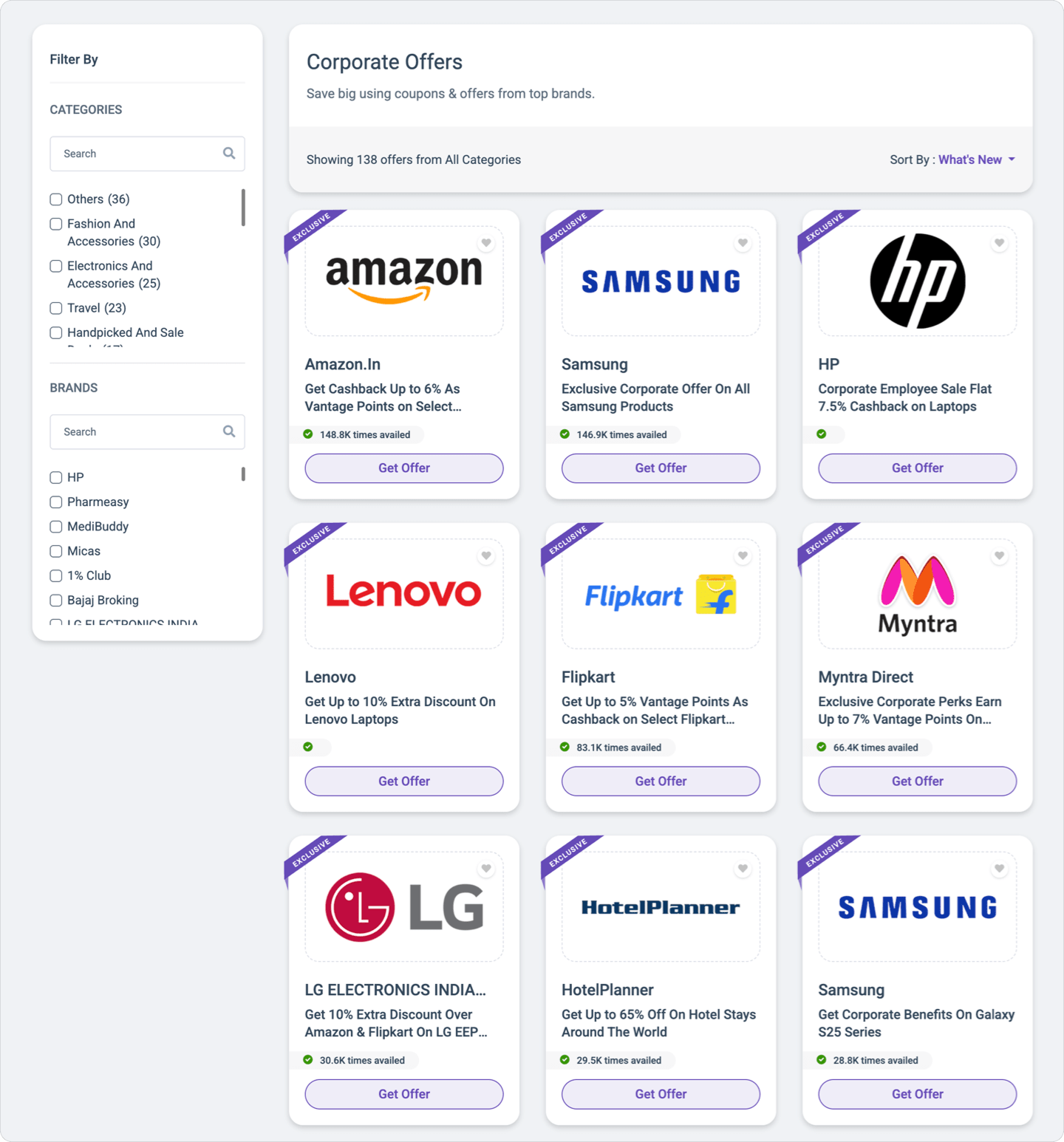
12. Employee discount program. Negotiated savings on retail, travel, dining, and electronics, applied to money people were spending anyway. Everyone shops, so everyone can use it. Employee discounts through Vantage Perks are built on that exact logic. The discount has to meet the person where they already are, at the second they are about to pay. Miss that window and the saving goes unclaimed and the whole perk quietly evaporates.
13. Financial wellness support. Savings tools, salary-linked benefits, and coaching that help people manage money instead of just earning it. It matters across every income band, not only the lower ones. Vantage Perks folds this in as financial wellness, and the strange thing about it is the mismatch. It may carry the highest per-employee value on the entire list and the lowest recall, because it matters ferociously at one moment, usually a decision about a loan or savings, and goes invisible every other day of the year.
14. Retirement match top-up. An employer contribution above the statutory floor. This is the perk experienced hires actually read the fine print for. It costs more than most, and it sits close to the benefit line, but it buys genuine loyalty from the people planning in decades rather than pay cycles.
15. Emergency savings or hardship support. A fund or a salary-advance mechanism people can reach when something genuinely goes wrong. It matters most where you have hourly or early-career staff without a cushion. The cost is small next to the goodwill, and unlike most perks, the person remembers it for years after the crunch has passed.
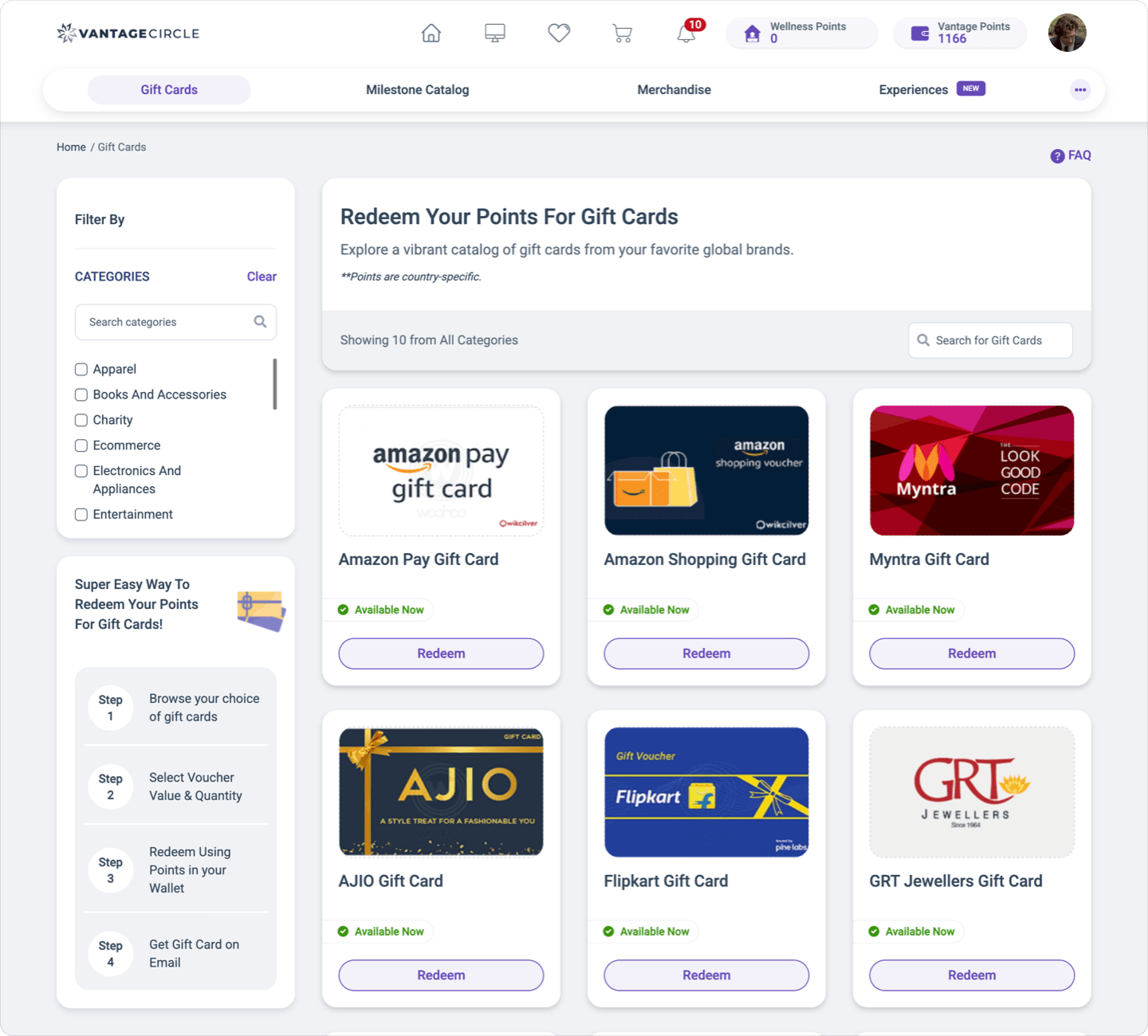
Learning and growth perks
Learning perks are the clearest test of whether a company means what it says about development, because the budget is allocated per person and the uptake concentrates in a minority. What separates a real learning perk from a decorative one is whether anyone tracks the unspent balance.
16. Learning and tuition allowance. A yearly budget for courses, certifications, or tuition toward a real qualification. Early-career and technical staff reach for it hardest. The cost is moderate, the uptake is uneven, and it works far better bolted to a proper employee development framework, so the money buys progression instead of a pile of half-finished courses.
17. Conference and certification budget. Funded attendance, plus the certifications that come out the other side. Specialists and senior individual contributors value it most. The cost varies, but the signal is loud. It tells someone the company expects them to still be here next year, and still getting better at their job.
18. Mentorship and coaching. Structured internal mentoring, or funded external coaching for the people who need it. High-potential employees and brand-new managers get the most out of it. It costs time far more than money, which is exactly why it gets undervalued and under-run. Time is the budget nobody protects.
Recognition perks
Recognition almost never appears on a perks list, and that omission is the most revealing thing about how most companies think about perks. Zendesk, BambooHR, Workhuman, Indeed, Benepass. None of them file recognition as a perk. That is a mistake, and a costly one, because recognition is the lowest-cost, highest-frequency perk a company can run, and it is the only one that happens weekly instead of at renewal.
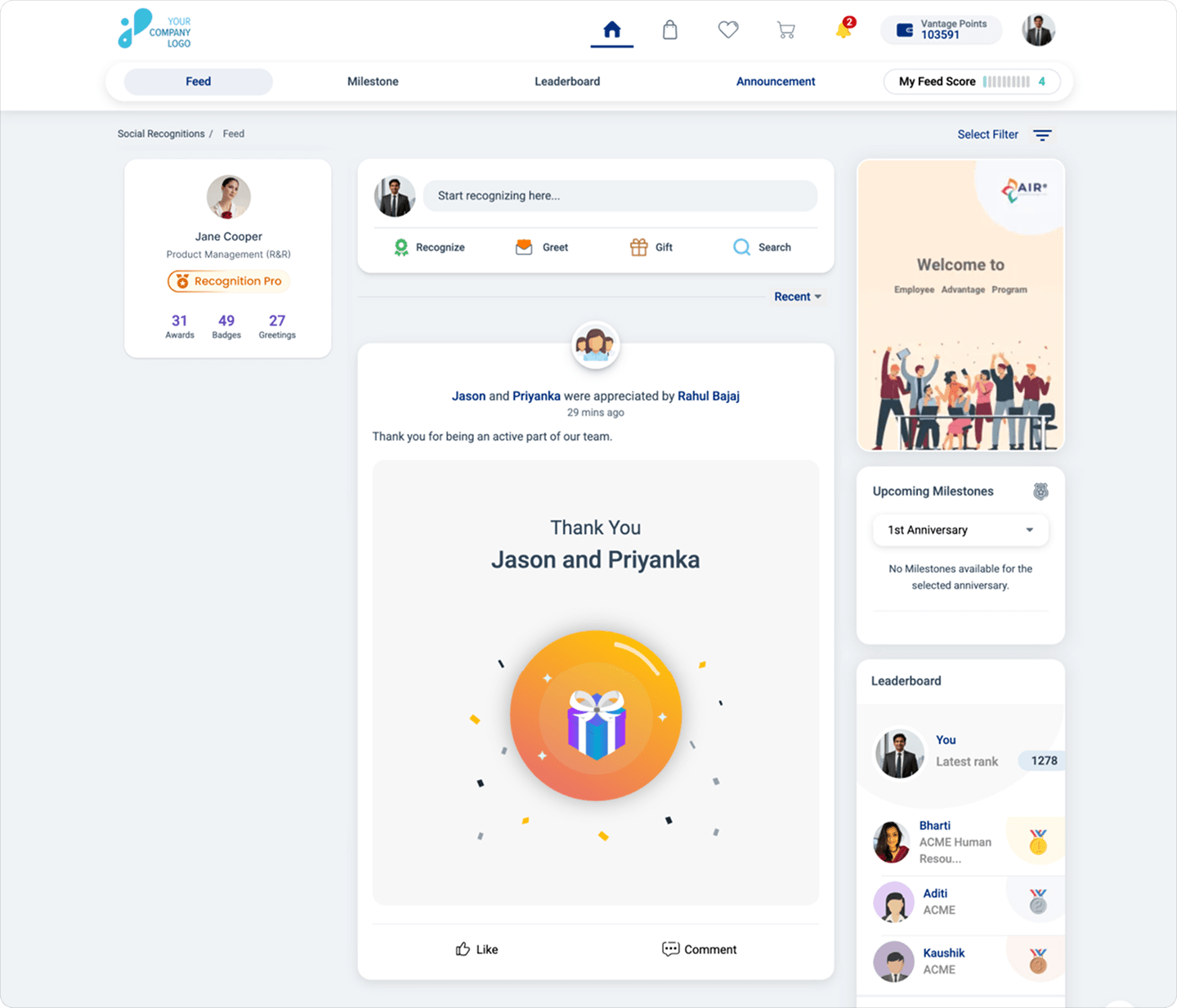
19. Peer-to-peer recognition. Colleagues thanking each other directly, out loud, without waiting for a manager to happen to notice. Every team can run it. Peer-to-peer recognition in Vantage Rewards turns recognition from a manager's chore into something the whole team does, and that shift is what makes it stick. The cost per head is trivial against how often it gets used.
20. Service and milestone awards. Marking tenure and career milestones so the people who stay actually feel seen for it. This matters more every year as median tenure keeps shrinking. Moderate cost, and a long memory attached to it.
21. Spot rewards and points. Small, immediate rewards pinned to a specific piece of work and redeemable for something the person genuinely wants. On fast-moving teams, an annual cycle misses the moment entirely, and this is the fix. Low cost, and the immediacy is the whole point.
22. Public appreciation. A visible feed where good work gets named in front of peers instead of buried in a private one-to-one. Distributed teams need it most, because otherwise good work happens where nobody can see it. It costs next to nothing, and it teaches a team that talking about performance in the open is normal and safe rather than risky.
For a sense of how leading companies assemble these, see companies with the best employee perks.
Which Perks Are Worth the Money
The perks with the highest uptake are rarely the most expensive ones. Flexibility costs almost nothing and gets used every day. Catered lunch costs the most per head in most programs and gets used by whoever happened to be in the building. If you funded a perks program purely on cost-to-value, the ranking would look nothing like the one on a typical careers page.
The table below is the one competitors do not publish, because it is uncomfortable. It maps rough per-head cost against typical uptake and, in the last column, what each perk actually signals about a company once you strip the marketing away. These are practitioner estimates, not vendor quotes. Your numbers will shift with headcount and market.
| Perk | Rough cost per employee / year | Typical uptake | What it signals |
|---|---|---|---|
| Remote or hybrid work | Near zero | Daily, near-universal | The company trusts output over attendance |
| Flexible hours | Near zero | Daily, high | Autonomy is real, not just on the poster |
| Peer-to-peer recognition | Very low | Weekly, high where seeded | Good work gets seen without waiting for review season |
| Employee discounts | Low | Ongoing, moderate | Everyday costs matter to leadership, not just salaries |
| Mental health / EAP | Low to moderate | Low but critical | Wellbeing is supported quietly, not performatively |
| Learning allowance | Moderate | Concentrated in a minority | Development is funded, though rarely evenly claimed |
| Fitness or wellness stipend | Moderate | Moderate, self-selected | People choose their own wellbeing rather than a chosen gym |
| Unlimited or flexible PTO | Low on paper | Variable, manager-dependent | Trust, but only if leaders actually take time off |
| Financial wellness support | Moderate | Rare but high-value at the moment | The company thinks past payday |
| Catered meals | High | In-office only | Presence is valued, at a real cost per plate |
The recruiting-deck test. If a perk shows up on your careers page but not in your usage data, you are paying for a signal, not a benefit. That is a defensible spend as long as you know that is what you are buying. It stops being defensible the moment you tell yourself it is doing something for the people already here.
I will push back on my own table for a second. Cost-to-value is not the only lens, and treating it as the only lens would quietly kill the catered lunch that is doing real cultural work in a small in-office team. Some low-uptake perks earn their keep on the few who need them badly, like the hardship fund nobody hopes to use. The point of the table is not to cut the expensive perks. It is to stop you defending them on the wrong grounds.
Learning allowances are the sharpest illustration of the whole problem. Learning benefits in Vantage Perks make the budget-versus-uptake gap visible, because the allowance is allocated per person and claimed by a minority, and the unspent balance stays invisible until someone reports on it. Which is the recurring theme of this entire section: the perk is only as good as your line of sight into whether it gets used.
Low-Cost and No-Cost Perks That Still Land
The perks that cost the least are usually the ones that require a decision rather than a budget: who controls their own calendar, who can leave early without narrating why, whose good work gets said out loud in front of the team.
Search any HR (human resources) community for perks and you find the same thread over and over. Someone asks what to offer on little to no budget, and hundreds of practitioners answer, and almost none of the answers involve money. That is not people making do. That is people telling you where the real leverage sits.
What I have seen repeatedly is that the cheapest perks outperform the expensive ones on the metric that matters, which is daily lived experience. A manager who protects focus time. A no-questions early finish on a Friday in summer. A genuine "you saved us on the Henderson thing" said in the team channel where everyone can see it. None of that touches a budget. All of it changes how Monday feels.
The trap is treating "free" as "effortless." Free perks cost something scarcer than money. They cost managers behaving consistently, and leadership deciding that autonomy and recognition are policy rather than personality. That is harder to fund than a snack budget, which is probably why so many companies skip straight to the snacks.
If you want the structured version of this, low-cost employee benefits breaks the category down further.
How to Run an Employee Perks Program
Running a perks program is really four jobs, and the first one makes the other three possible. Someone owns it, with their name against the budget and the renewal calendar. After that the work is choosing the right perks for the people you actually have, communicating them until they get used, and measuring uptake so you can retire what dies quietly on the invoice. The two parts below cover the choosing, then the communicating and measuring.
Choosing the Right Perks for Your Organization
Choose perks by looking at what your people already spend their own money and time on, not by copying what a bigger company offers. The perk that works at a 4,000-person tech firm can be dead weight at a 200-person services business, because the workforce, the budget, and the daily friction are all different.
Start with your own people, not a benchmark report. Ask them, properly, through a short survey rather than a suggestion box that fills up with jokes. Look at the demographics, because a workforce of new parents and a workforce of new graduates want genuinely different things. Then set the budget honestly and design inside it, rather than designing a wish list and negotiating down.
Then comes the platform question, which is where most programs quietly succeed or fail. A perk delivered through a clunky system with six logins gets abandoned no matter how good the underlying deal is. Judge a platform on the boring things: whether people can actually use it without a manual, whether it plugs into the systems you already run, and whether there is real support when something breaks. The Vantage Perks platform is built around that usability point, and the practical payoff is visibility. You can see which categories your own people draw on, which tells you what to expand and what to quietly retire, rather than guessing from someone else's benchmark.
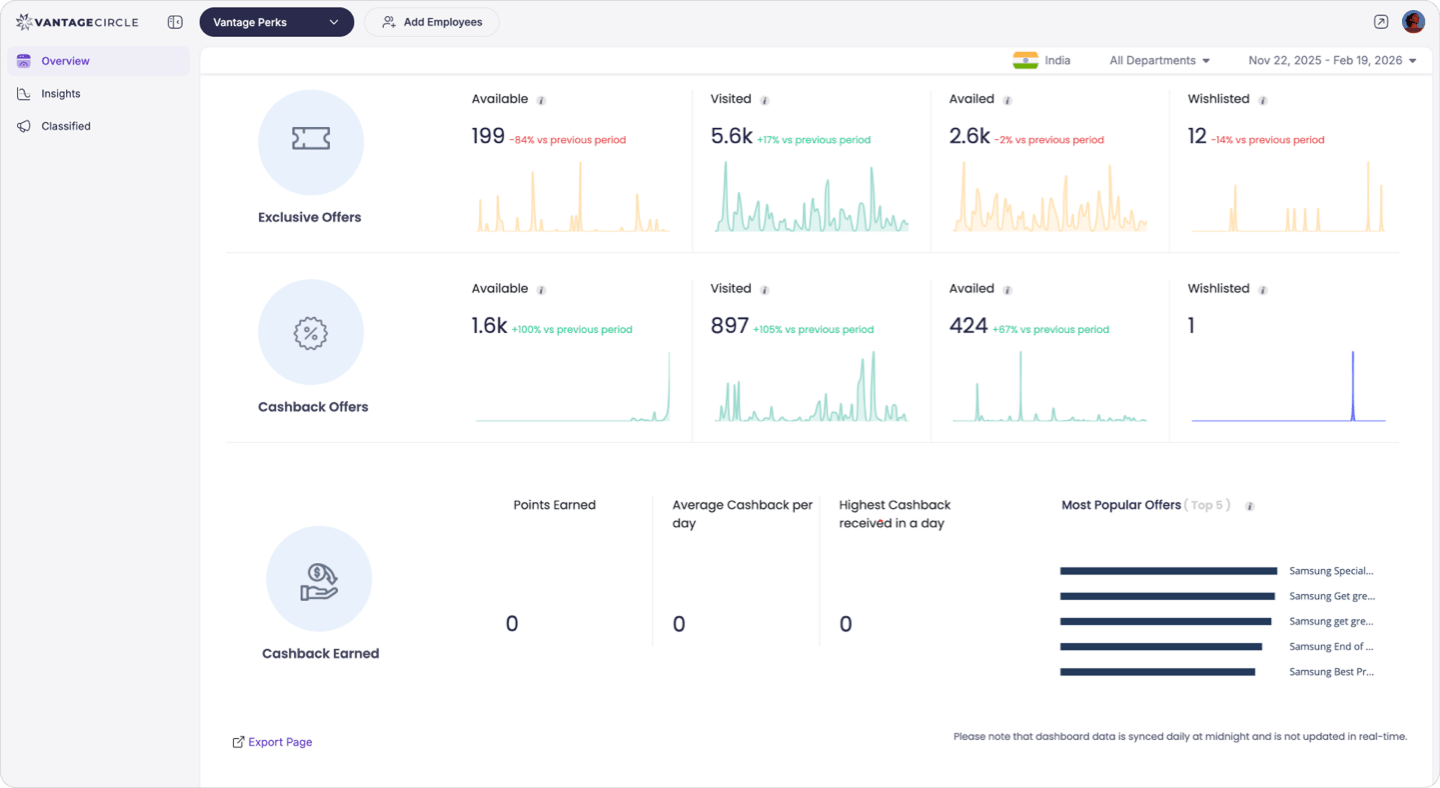
One routing note for anyone reading this while shopping for software. If you are specifically evaluating discount platforms, the employee discount program guide covers that commercial decision in far more depth than this page does.
Communicating and Measuring the Program
A perks program is measured by usage, not by satisfaction scores, because a perk nobody opens will still score fine on a survey question that only asks whether people like having it. "Do you value having a wellness benefit?" gets a yes from people who have never once used it. That yes is worthless, and it is the number most programs report.
Communication comes first, because a perk nobody knows about has a usage rate of zero regardless of quality. Build a real plan rather than a launch email that fades in a week. Say what the perk is in plain language, say what it is worth to the person specifically, and then say it again on a cadence, because awareness decays and new hires arrive who never saw the original announcement. The programs that get used are the ones that keep reminding people they exist.
Then measure the thing that is true rather than the thing that is flattering. Track participation and utilization per perk, not just overall satisfaction. Watch the cost per employee against actual uptake, so you can spot the dead line items. Review on a real schedule and be willing to retire what is not landing, which is harder than it sounds, because someone championed every perk you are now looking at cutting.
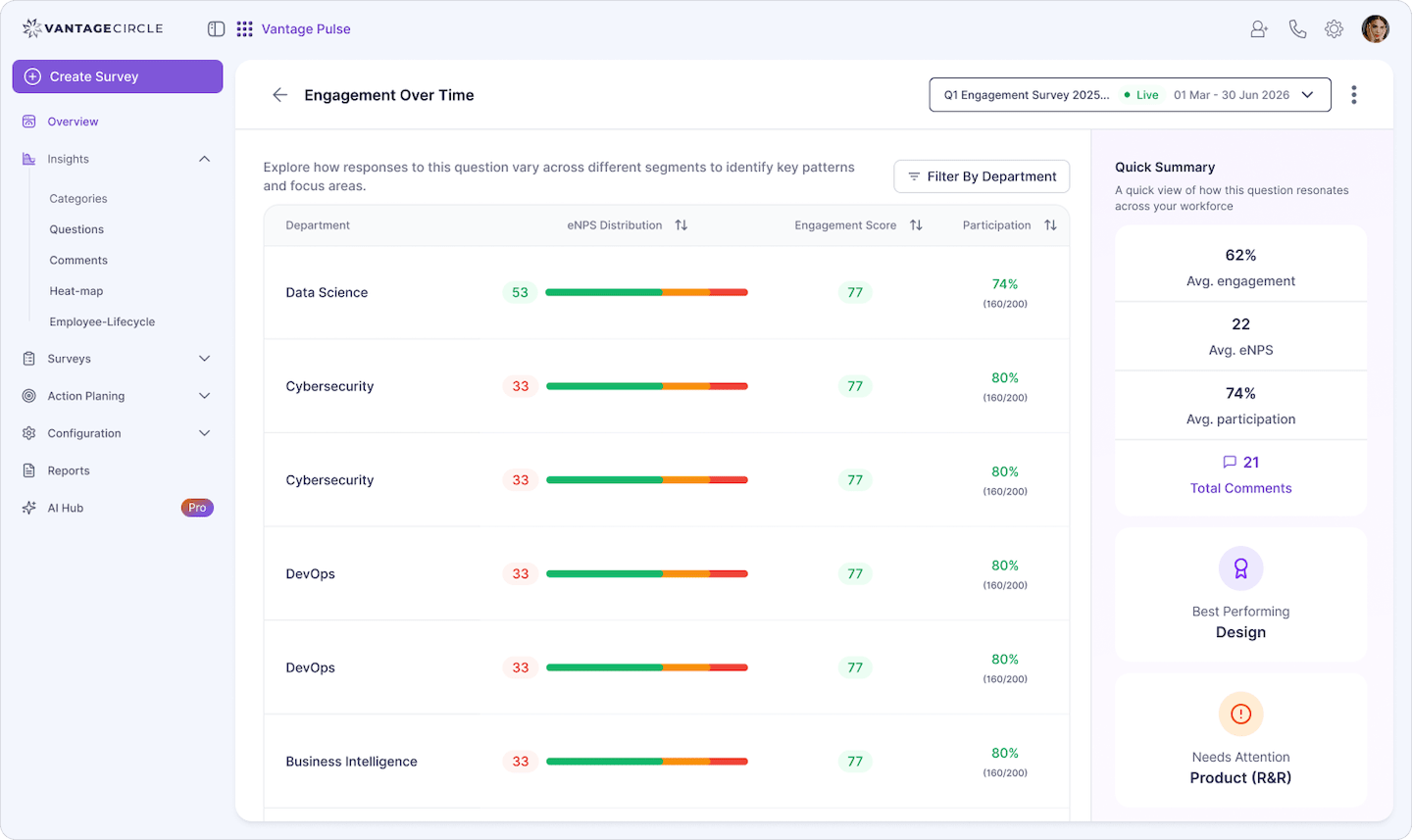
The honest test of a program is whether an employee can name what they have without checking a portal. Vantage Pulse eNPS (employee Net Promoter Score) surveys turn that from an impression into a number you can track between budget cycles. Ask on a rhythm rather than once a year, and the one-off gesture becomes a trend line a people team can actually manage against.
See it in action: One platform to run every perk on this page. Explore Vantage Perks or book a demo to see the usage reporting that keeps a program defensible.
Frequently Asked Questions
What are some perks at work?
Perks at work usually fall into a handful of groups: flexible or remote working, wellness and mental health support, employee discounts, food, learning allowances, and recognition like peer-to-peer appreciation. The mix matters more than the length of the list. The programs that work lean on a few cheap, high-frequency perks, flexibility and recognition especially, and add a smaller number of expensive, high-value ones like financial wellness. Spread a thin budget across a long list and you please nobody.
What are the most popular work perks?
The most popular work perks are the ones people use daily, not the ones that photograph well for a job ad. Flexible and remote work sit at the top of almost every honest usage ranking, trailed by flexible hours, employee discounts, and recognition. All of those get used constantly and cost very little. Catered lunches and the like poll well when you ask people whether they enjoy having them, then show much lower real uptake, which is exactly why you should read popularity off usage data instead of a survey.
What is a perk in the workplace?
A workplace perk is something an employer gives on top of pay and core benefits: optional, usually cheap per person, and meant to improve daily working life rather than cover risk. There is a simple test for the gray cases. If taking it away would raise a compliance question, it is a benefit. If taking it away would raise a morale question, it is a perk. Gym stipends, free lunches, and employee discounts are perks. Health insurance and retirement contributions are benefits.
What is a corporate perk?
A corporate perk is just a non-salary advantage a company gives its people, from discounts and wellness support to flexible working and recognition. The word "corporate" adds nothing except scale. What bigger organizations tend to do differently is deliver everything through one administered platform, and that platform is what turns a loose scatter of perks into an actual program with an owner, a budget, and usage data behind it. Strip that away and the idea is identical to any workplace perk.

He has worked in the human resources environment and has elevated recognition and rewards through his insightful and detailed writing. He aims to enhance the practice of Recognition in the workplace with new ideas and innovation that will help shape the work culture. For any related queries, contact editor@vantagecircle.com