We live in a world where Spotify curates our mood, Google finishes our sentences, and our phone unlocks with our faces. Then why should logging into our work computer feel like a full-body workout?
Today’s employees expect the same seamless, intuitive experience at work that they enjoy in their personal lives. If workplace tech feels clunky, outdated, or frustrating, it chips away employee engagement, productivity, and overall morale.
According to Fortune, an average employee toggles between nine apps daily and wastes 21 minutes just wrangling tech. That’s not productivity lost, it’s energy drained.
A strong Digital Employee Experience (DEX) isn’t flashy. It’s silent, feels invisible, and works seamlessly. This way your employees spend their day solving problems, not creating tickets.
In this blog, we’ll help you build a DEX that attracts, retains, and empowers. Because the future of work isn’t just flexible or hybrid. It’s frictionless.
What is a Digital Employee Experience (DEX)?
Digital Employee Experience (DEX) refers to the overall quality of an employee's interactions with the digital tools, technologies, and systems they use every day at work. It encompasses everything from devices and applications to networks, workflows, and support systems.
A strong DEX removes friction so tools feel fast, intuitive, and reliable. It blends measurable IT performance with employee sentiment, and it directly affects productivity, engagement, and retention.
of organizations now treat Digital Employee Experience (DEX) as a higher or top priority — because it empowers people to do their best work without tech getting in the way.
The Core Pillars of DEX
DEX rests on four measurable pillars. The first three are technical and observable. The fourth is human and is the one most technology team skip.
| Pillar | What It Covers | How It's Measured |
|---|---|---|
| Device health | Boot time, crashes, battery, memory, and OS stability across laptops, desktops, and phones | Endpoint telemetry, crash logs, device performance scores |
| Software performance | App load and response times, login friction, and how often core tools fail mid-task | Application response monitoring, error rates, login success rates |
| Network connectivity | VPN reliability, Wi-Fi quality, and latency for remote, hybrid, and in-office work | Latency and packet-loss data, VPN session stability, connectivity uptime |
| End-user sentiment | Whether employees feel their tools help or hinder them, and which workflows they dread | Pulse surveys, eNPS, sentiment scoring, open-text feedback |
DEX vs EX vs DEM: What's the Difference?
DEX is the digital layer of employee experience (EX), while digital experience monitoring (DEM) is the IT toolset that measures the technical side of it. People confuse the three because the acronyms overlap and most vendors define only the one they sell.
| Term | Definition | Who Owns It |
|---|---|---|
| EX (employee experience) | The sum of every interaction an employee has with the organization, from hiring to exit, online and offline | HR, with leadership |
| DEX (digital employee experience) | The technology slice of EX: how employees experience the devices, apps, and networks they work with daily | HR and IT, jointly |
| DEM (digital experience monitoring) | The telemetry and analytics tooling that tracks device, app, and network performance behind DEX | IT, primarily |
EX is the parent topic, and DEX is its fastest-growing branch as more work moves into software. For the wider frame, see our guide to employee experience.
Why Digital Employee Experience Matters?
1Enhances Productivity & Performance
Take Spotify, for example. Their employees don't waste time jumping through hoops to access information or collaborate across teams. Their streamlined digital ecosystem makes a developer in Stockholm seamlessly work with a designer in New York, without missing a beat.
The result? They've maintained their position as the world's leading audio streaming platform while consistently shipping features that keep users hooked.
2Boosts Employee Engagement & Retention
Did you know? Replacing a skilled employee can cost anywhere from 50% to 200% of their salary. Now multiply that by the number of people walking out your door because they're frustrated with your outdated digital tools. Suddenly, you've got a massive drain on your budget.
To be honest, employees need to feel empowered by technology rather than held hostage by it. When your team loves their digital environment, they stick around longer, contribute more, and become your biggest asset.
3Directly Improves the Customer Experience (CX)
Great customer experience starts with a great employee experience. Happy, empowered employees create happy, loyal customers.
When support teams aren't bogged down by disconnected systems, they can focus on helping customers instead of playing digital detectives. And when sales teams have instant access to the right content, they sell smarter and close faster.
4Enables a Seamless Hybrid & Remote Workforce
A superior digital employee experience makes location irrelevant and keeps your team going regardless of where they're logged in from. It ensures that whether you're brainstorming in Buenos Aires or debugging in Denver, you have everything you need to contribute meaningfully.
5Strengthens Company Culture & Inclusivity
Take Microsoft Teams for example. They have enabled organizations to maintain cultural cohesion across global operations. Features like translation services, accessibility tools, and flexible communication options ensure that everyone can participate fully, regardless of language, location, or physical abilities.
When your digital employee experience is designed with inclusivity in mind, you create an environment where diverse perspectives can flourish, leading to more innovative solutions.
The Human Side of DEX: Fostering Digital Well-being and Trust
How do you build a digital workplace that fuels performance and not burnout? Too often, companies chase the latest productivity apps and shiny collaboration tools. But the smartest ones know better.
Here are a few key ways organizations can foster digital well-being and trust in their workspace:
Combating Digital Burnout
Cut notification noise, protect focus time, and reduce the cognitive overload that quietly drives burnout.
Ethics & Privacy
Personalize with consent and transparency, so insight never crosses the line into surveillance.
Psychological Safety
Build digital spaces where people can speak up, flag concerns, and admit overwhelm without fear.
Combating Digital Burnout and Cognitive Overload
Remember when multitasking was a badge of honor? Turns out, it’s a fast track to burnout. Today’s employees aren’t slacking, they’re overwhelmed, often without realizing it.
Digital burnout is real. It’s deep mental fatigue from constant context-switching, endless notifications, and decision fatigue. According to Microsoft’s Global Work Trend Index Special Report, the average employee now receives 117 emails and 153 Teams messages a day. That’s not productivity, it’s digital chaos.
The smarter approach? Intentional design over feature overload. Here’s what forward-thinking companies are doing:
- Notification Hygiene: Salesforce runs “No Meeting Fridays” and promotes batching communication to reduce 24/7 digital noise.
- Cognitive Load Audits: Spotify cut onboarding complexity by 70% by reducing systems from 12 to 3.
- Focus Time Protection: Microsoft Teams now blocks notifications during deep work.
Balancing Personalization with Privacy and Autonomy
We're living in the golden age of workplace surveillance, disguised as productivity insights. Chances are, your company knows more about your work habits than you do. The very systems designed to support employees are often powered by data they didn’t know they were giving away.
But the question isn't whether you can collect this data. It’s whether you should and if so, how do you do it responsibly? And while the intent may be to “optimize performance,” it walks a razor-thin line between support and surveillance.
The companies getting this right aren’t the ones with the most sophisticated analytics dashboards. They’re the ones putting transparency and consent at the core of their DEX strategy. Because personalization without permission is just intrusion.
Building Psychological Safety in Your Digital Environment
Coined by Harvard professor Amy Edmondson, psychological safety is the belief that you can take interpersonal risks at work without fear of embarrassment or punishment.
In the physical workplace, this might look like speaking up in a meeting. In the digital world? It's flagging a project concern in a shared doc, or admitting you're overwhelmed on Slack.
But digital environments don’t always make this easy. Emojis can’t replace empathy. Video calls don’t guarantee inclusion. And constant visibility can start to feel like quiet surveillance.
So, how do we build psychological safety when our main interactions are mediated by screens? It starts with intentional digital culture. Leaders must normalize imperfection, and create digital spaces where feedback is welcomed.
Core Components of a Modern DEX Strategy
1. Technology and Tools: The Digital Workplace Foundation
According to Okta, the average company now uses 88 different SaaS applications. That’s not productivity. That’s a digital trap. The result? Tool fatigue, siloed data, and overwhelmed teams who spend more time toggling than working.
The most effective DEX strategies don’t aim for more tools rather they aim for the right ones, with seamless integration and a user-first design.
Think of Shopify, which streamlined its entire digital workflow around just three core platforms: Slack for communication, Notion for documentation, and a custom-built system for project management. Anything that didn’t plug in cleanly was left out on purpose.
2. User Interface (UI) and User Experience (UX): Simplicity and Intuition
Today’s workforce doesn’t have the time or patience for clunky portals, outdated dashboards, or complicated navigation. If it takes five clicks to find a pay stub or locate a project file, something needs to change.
The most effective digital environments are built on clarity, speed, and purpose. It doesn’t just make work easier; it increases adoption, lowers training time, and boosts satisfaction. And when tools work the way people expect them to, employees focus more on their actual job and less on navigating the system.
3. Workflow Automation and Personalization
In most organizations, employees spend far too much time on repetitive, manual tasks like filing reports, requesting approvals, or updating trackers. Automation solves this by taking the routine off employees’ plates. It clears the clutter so people can focus on what matters the most.
But automation alone isn’t enough. To really move the needle, digital systems need to feel personalized. Think of a platform that remembers what resources an employee frequently uses, prioritizes their most accessed apps, or recommends relevant training based on their career goals.
Smart organizations are weaving these elements into their platforms. Google Workspace’s Smart Compose anticipates what you’re going to say. Asana adjusts your project dashboard based on your recent activity.
4. Accessibility and Mobility for a Flexible Workforce
True digital accessibility isn’t just about meeting compliance standards like Web Content Accessibility Guidelines (WCAG). It is more about ensuring that everyone, regardless of ability or circumstance, can fully participate in the digital workplace.
An inclusive design often leads to better UX overall, with cleaner interfaces, clearer content, and more intuitive workflows. With hybrid and remote work now as a permanent fixture, employees expect to move seamlessly between devices and environments.
If an employee can’t reset a password, submit a leave request, or access learning resources from their phone, that’s a breakdown of the experience.
5. Proactive IT Support and Self-Service Options
In the digital workplace, nothing derails momentum faster than tech that doesn’t work and support that doesn’t show up. Whether it’s a broken login link, a frozen app, or a mystery error message, the impact is the same.
Gone are the days when employees were willing to wait in help desk queues or submit tickets into a black hole. Today’s workforce expects proactive IT support and real-time solutions. Think intelligent knowledge bases, chatbots that can handle common requests, and tools that empower employees to troubleshoot without waiting for IT.
And rightly so. Because when people have to fight their tech to get work done, engagement and productivity tanks.
6. Robust Security without Sacrificing Experience
In today’s hybrid workplace, threats are constant, and the stakes are high. Therefore a robust security is a non-negotiable.
There’s no doubt that employees want to feel secure, but they also want to get on with their work. If logging in takes three platforms and five steps, it could be frustrating. And worse? People start finding workarounds like using personal devices, unauthorized tools, or unsecured channels. That’s not just inefficient. It’s dangerous.
Try to build single sign-on systems that authenticate once across platforms. Or try adaptive security measures that scale based on risk levels.
7. Continuous Feedback and Sentiment Analysis
Today, annual employee engagement surveys just don’t cut it anymore. Employee sentiment can shift quickly based on a tool rollout, a policy change, or even a new manager.
That’s why leading organizations are embedding continuous feedback into the digital experience itself. Not just to measure satisfaction, but to identify friction, and improve the employee journey in real time.
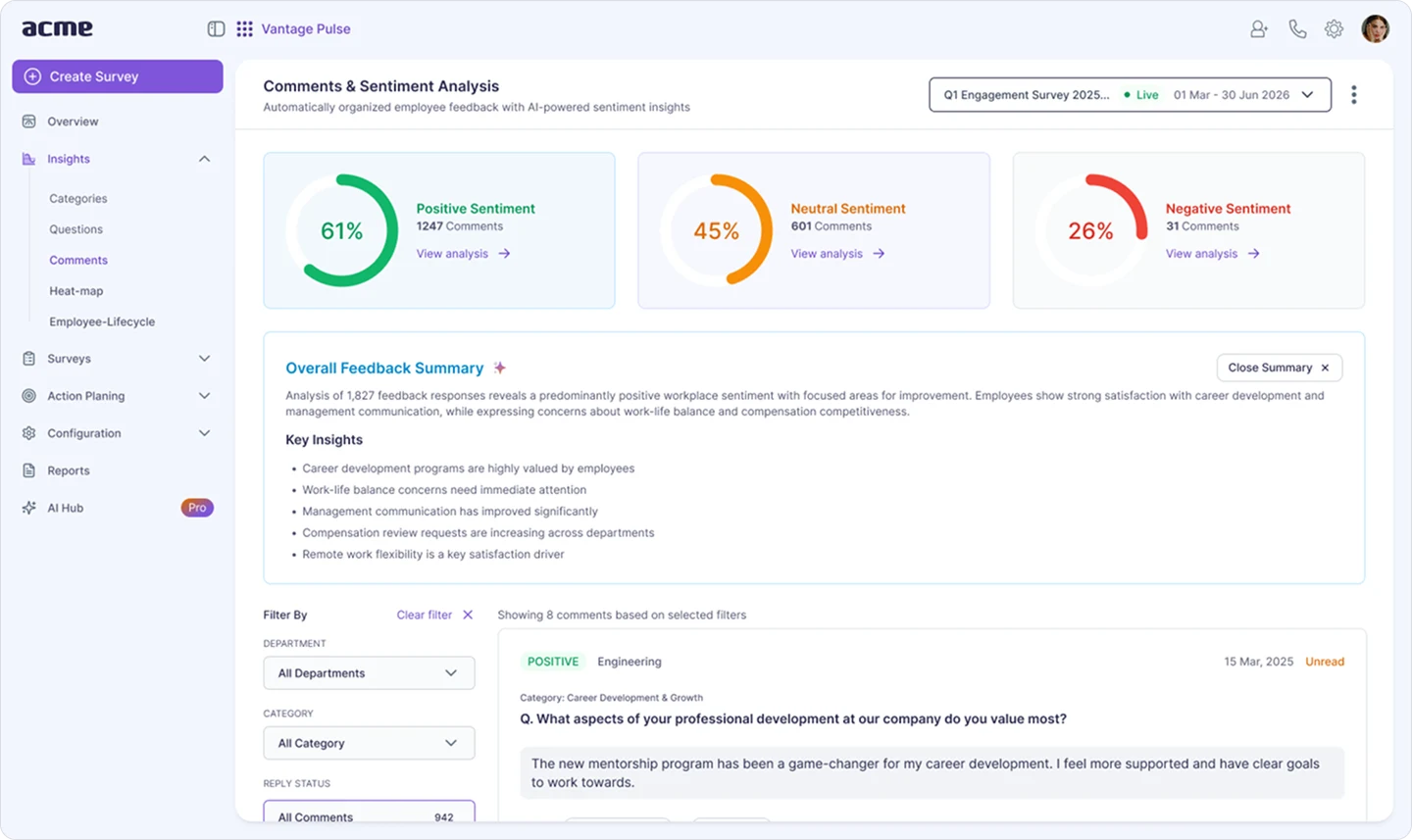
Platforms like Vantage Pulse have turned feedback into a continuous loop with their nuanced pulse surveys that take anonymous feedback from employees. They also capture behavioral analytics to help you understand patterns and potential burnout signals before they escalate.
Beyond the Office: Tailoring DEX for the Frontline & Deskless Workforce
Unique Challenges for Deskless Workers
Did you know? Over 70-80% of the global workforce is deskless, working in roles that keep them on the move. And yet, most DEX strategies continue to overlook this massive segment.
Why is that? Below is a list of three core challenges that affect millions of workers every single day:
Connectivity
For deskless workers, reliable internet access is essential for getting their jobs done. But once connectivity fails, productivity declines and frustration takes place.
The solution isn't just better WiFi. Organizations need to think smarter about offline functionality, local caching, and lightweight apps that keep running even when the signal drops.
Devices
Unlike office workers, most deskless employees don't have personal laptops or 24/7 access to a screen. They often rely on shared, rugged, or low-spec devices, if they have access at all.
Interfaces need to be touch-friendly, easy to navigate with gloves, voice-activated, and instantly understandable. If using a system requires more than a couple taps, it's already too complex — the tech must meet employees where they are.
Task-Based Needs
Deskless work is physical, fast-paced, and highly task-oriented. Digital workflows that are too complex, slow, or disjointed disrupt operations.
Frontline employees might not have time to jump between five apps just to swap a shift or file a maintenance report. What they need are simple, contextual, task-specific tools with real-time updates.
Key Technologies for the Frontline
Let’s break down three key technologies that are reshaping the digital experience for the frontline:
Mobile-First Apps
Smartphones are the frontline worker's primary connection to the digital workplace. Mobile-first platforms bring communication, scheduling, HR tasks, and team updates into one simple interface, cutting clutter and context-switching.
Push notifications, self-service access, and clean design keep employees informed without disrupting their flow. The result? More engaged teams with fewer missed messages, shifts, or updates.
Wearables
Wearable tech has quietly moved from novelty to necessity.
In warehouses, healthcare, and field operations, voice-activated smart glasses, haptic wristbands, and biometric monitors streamline daily tasks and enhance safety — offering hands-free access to instructions, alerts, and performance data without constantly checking a screen.
Micro-learning
Forget hour-long training modules. Today's frontline employees benefit most from bite-sized, mobile-accessible learning consumed during breaks or shift transitions — a 2-minute safety video, a quick step-by-step guide, or a reinforcing quiz.
Companies like Walmart take it further with VR training simulations for high-pressure scenarios like holiday rushes.
How to Build and Improve Your Digital Employee Experience: A 7-Step Framework
Step 1: Map the Employee Journey and Identify Pain Points
Before you can fix anything, you need to know what's actually broken. Start by understanding your employees’ daily experiences. Where do they struggle with digital tools? When do they feel supported or frustrated?
Use surveys, interviews, journey mapping, and behavior data to capture insights across roles, departments, and locations. Don't just focus on your desk-based employees. Include frontline workers, hybrid employees, part-timers, and everyone in between.
Step 2: Define Clear Objectives and Key Performance Indicators (KPIs)
Define what you're solving for and set measurable KPIs. It could be anything from task completion rates, system uptime, or employee satisfaction with digital tools.
Align your DEX goals with broader business outcomes like retention, engagement, or productivity. If it doesn’t tie back to business impact, you're only building expensive digital decorations.
Step 3: Assemble a Cross-Functional DEX Team
Build a task force that includes stakeholders from HR, IT, internal communications, operations, and frontline managers. Why? Because the IT team might design a great system that completely ignores the fact that warehouse workers can't remove their gloves to use touchscreens.
Meanwhile, HR might push for features that sound great in theory but create more work for already overwhelmed employees. That’s why cross-functional teams are essential to bring the diversity of thought needed to build systems that work for everyone.
Step 4: Audit and Select the Right Technology Stack
Take stock of your current tools. Is there overlap, underuse, or digital friction? Are platforms integrated or siloed?
Conduct a comprehensive "digital stack audit" and be ruthless about eliminating what's redundant or disruptive. That expensive platform that only three people know how to use? That might need to go. Also prioritize platforms that are mobile-friendly and intuitive when selecting new tools.
Step 5: Design with a User-Centric & Mobile-First Approach
Build mobile-first experiences that actually work in the real world. Simplify interfaces, minimize clicks, and use design principles to reduce cognitive load. Every tap, swipe, or notification should feel helpful, not like another obstacle to overcome.
Ask yourself: Would this interface work if you were wearing gloves? Can you complete this task with one hand while holding a clipboard? Is the text readable under harsh lighting? These details matter more than you might think.
Step 6: Invest in Training and Drive Adoption through Change Management
Even the best tools fail if no one knows how to use them. Most organizations get this wrong by treating training as a one-time event rather than an ongoing process.
Try to pair your rollout plans with comprehensive training, micro-learning modules, and embedded support. When employees feel supported through the transition, adoption rates soar.
Step 7: Measure, Analyze, and Iterate Continuously
Launching your improved digital experience isn't the finish line, it's the starting point. To keep it running smoothly, you need to track usage data, gather real-time feedback, and monitor sentiment regularly.
Most importantly, act on what you learn. When employees see their feedback driving change, trust grows and so does adoption.
The Strategic ROI of DEX: From Cost Center to Competitive Advantage
Calculating the True ROI: Beyond Productivity to Innovation and Agility
Most organizations make a critical mistake when measuring DEX ROI. They focus solely on productivity metrics like "time saved per task" or "reduced support tickets." While these matter, they're just the tip of the iceberg.
The real ROI shows up in places traditional metrics miss. Here are a few examples:
- Innovation Acceleration: Teams with seamless digital experiences spend less time wrestling with tools and more time generating ideas. Frictionless digital environments free up time and mental bandwidth, allowing teams to collaborate, experiment, and iterate more fluidly.
- Decision-Making Speed: The ability to make informed decisions quickly can mean the difference between capturing an opportunity and watching competitors seize it. When executives get real-time data easily, they can make faster and smarter decisions.
- Agility at Scale: Companies with strong DEX adapt to market changes more rapidly because their workforce can quickly adopt new processes, tools, and workflows. It can make the entire organization resilient and future-ready.
Winning the War for Talent: Using DEX as a Key Recruiting Differentiator
Salary and perks are no longer the only deciding factors for candidates today. Job seekers now behave like consumers. They research, compare, and scrutinize before applying.
And if there is any digital inefficiencies such as outdated internal systems, or slow HR processes. It doesn’t stay hidden. They show up on Glassdoor reviews, LinkedIn posts, and whispered conversations at industry events.
On the flip side, when candidates hear that a company prioritizes user-friendly, streamlined digital tools, it creates a halo effect. It signals a forward-thinking culture that respects employees' time and empowers collaboration. It also highlights practices like peer-to-peer recognition, showing that the organization values not just top-down management but authentic appreciation across all levels.
How DEX Impacts Business Resilience and Time-to-Market?
If the pandemic taught us anything, it’s the fact that digital readiness is a must.
Companies with a strong DEX shifted to remote work in days. Others took weeks just to function. That gap wasn’t about luck, it was about preparation.
When digital systems are intuitive, integrated, and accessible from anywhere, your workforce becomes agile by design. It’s easier to mobilize teams, shift priorities, and act quickly when disruption hits. This responsiveness is key in volatile markets where delays can mean lost opportunities.
In short, DEX is about future-proofing your organization. It’s the difference between reacting and leading when the unexpected strikes. Companies that get this right are build to last.
Common Challenges in Implementing DEX & How to Overcome Them
Overcoming Employee Resistance to Change
The best tools in the world won’t work, if employees don’t use them. Resistance to change often has less to do with the technology itself and more to do with the fear of disruption, or past experiences with poor tech rollouts.
One of the most common missteps organizations make is focusing solely on the features instead of addressing the change. You need to address why or how it can make the work of your employees easier.
Before rolling out any new platform, take a step back. Understand what employees value in their current workflows. What problems do they face daily that they've learned to work around?
The path to adoption starts with empathy. When employees feel heard, involved, and supported through change, they’re far more likely to embrace it, not resist it.
Securing Leadership Buy-In and Investment
Too often, DEX is treated as an operational initiative, owned by HR or IT, rather than a strategic priority. But if DEX is going to influence everything from talent retention to business agility, it needs C-suite backing.
To earn that buy-in, the conversation needs to shift from features to outcomes.
Executives don’t invest in tools, they invest in results. Therefore, you need to tie DEX directly to business metrics such as reduced turnover, higher engagement, and improved customer satisfaction.
Managing a Complex and Fragmented Tech Stack
In an attempt to fix integration gaps, many organizations keep layering new platforms on top of legacy systems. It creates a disjointed tech ecosystem that frustrates employees instead of empowering them.
The result? Employees juggle dozens of logins, navigate multiple systems for simple tasks, and lose time switching between apps that don’t complement each other.
A smarter approach would be to start thinking about consolidation before integration. Before adding another platform to your stack, take a hard look at what is already in place.
Sometimes, the best DEX isn’t about adopting the new tool, rather it’s about simplifying the digital experience altogether.
Ensuring Digital Equity for All Employees
An equitable DEX strategy should work for everyone, not just the most digitally comfortable employees. Since not all employees sit at a desk with a laptop.
For deskless, frontline, or hybrid workers, a one-size-fits-all approach doesn’t work. It should be inclusive, built for mobile devices, accessible in multiple languages, and functional even in low-connectivity environments.
How to Measure Digital Employee Experience?
Employee Pulse Surveys and Qualitative Feedback
The old saying, “you can’t improve what you can’t measure” rings especially true for digital employee experience. But numbers don’t always capture frustration, confusion, or friction.
That's where pulse surveys and employee feedback tools become your secret weapon. These quick, regular check-ins help capture how employees feel about their digital environment.
However, data alone isn’t enough. To truly understand the employee experience, you need to go beyond the metrics and ask deeper questions. Are the tools intuitive? Do they help or hinder daily tasks? Do people feel supported or overwhelmed?
Sometimes the most valuable insights come from anonymous feedback sessions and employee focus groups. These conversations often reveal those small usability issues that fly under the radar of traditional metrics.
Digital Experience Monitoring (DEM) and Performance Analytics
While employee feedback tells you how people feel, Digital Experience Monitoring (DEM) tools show you what's actually happening under the hood.
DEM offers real-time visibility into how systems perform in real-world conditions. It gives you objective data about what employees encounter in their daily work. It can act like an early warning system, detecting slow application loads or system crashes before frustrated employees start flooding your help desk.
Calculating a Holistic Digital Employee Experience (DEX) Score
Individual metrics are helpful, but they're just pieces of a larger puzzle.
Organizations today are creating comprehensive DEX scorecards that weave together the human and technical sides of the digital experience. It looks at employee sentiment, how readily people adopt new tools, system performance data, and support ticket volumes.
A well-crafted DEX score gives you and your leadership team a clear benchmark to track progress, identify gaps, and build a compelling case for future tech investments. Think of it as your organization's digital pulse check-in.
Tracking Business-Impact Metrics
The ultimate test of DEX success isn't employee satisfaction or technical performance, it's business impact. Because at the end of the day, even a sleek UI and fast-loading apps don’t matter if it doesn’t bring in results.
DEX must prove its value in metrics that matter to the business. It could be faster project delivery, lower turnover, shorter onboarding time or improved customer satisfaction. These are the kinds of indicators that resonate in the boardroom.
The Future of Digital Employee Experience
The Role of Generative AI and Hyper-Personalization
Generative AI is moving beyond chatbots and automations. From summarizing meetings to drafting emails and surfacing relevant knowledge on demand, AI is quickly becoming an intelligent co-worker that accelerates output.
A 2023 study found that access to AI assistance boosts employee productivity by 15% on average, particularly helping lower-skilled workers and aiding in learning.
But the real breakthrough lies in hyper-personalization. DEX tools are beginning to tailor experiences based on individual work styles, preferences, and even emotional cues.
Think of a workspace that delivers custom learning nudges based on performance trends or predicts your needs before you even know you have them. This level of personalization doesn't just make work easier; it makes it feel almost effortless.

Vantage Influencers Podcast
AI turns workplace data into action, but only when leaders pair it with data literacy and human storytelling.
Featuring Dr. Serena H. Huang · Founder, Data with Serena
Listen to the EpisodeThe Shift from Proactive to Predictive IT Support
IT support is undergoing a fundamental transformation. We're moving from the traditional problem-solving model to a world where problems are solved before employees notice something’s wrong.
Predictive IT support uses machine learning to identify patterns that signal impending issues. It means fewer interruptions, faster fixes, and less digital friction.
Some companies are already piloting self-healing systems that automatically resolve issues like software crashes or connectivity lapses with minimal human intervention.
Integrating Employee Well-being as a Core DEX Metric
As digital tools become more embedded in every aspect of work, they also contribute to stress, burnout, and cognitive fatigue. That’s why it is no longer just about performance dashboards or collaboration tools.
Leading organizations are adding screen breaks, silent hours, simplified workflows, and sentiment-based fatigue detection. They are designing tech environments that protect mental health, reduce overwhelm, and promote flow.
Conclusion
In conclusion, a thoughtfully designed Digital Employee Experience isn't just about better tools; it's about prioritizing seamless, intuitive, and inclusive digital experiences.
When done right, it becomes the silent engine behind productivity, culture, and growth. From frontline workers to remote teams, from onboarding to innovation, DEX touches every moment that matters in an employee’s journey.
FAQs
What is the Meaning of Digital Employee Experience?
Digital Employee Experience (DEX) refers to the quality of an employee's interactions with the digital tools, platforms, and technologies they use throughout their workday.
How Do You Measure Digital Employee Experience?
Organizations measure DEX using a combination of employee feedback, technology performance metrics, and productivity indicators. Common methods include employee surveys, tool adoption rates, and employee engagement scores.
What are the Features of Digital Employee Experience?
Key features of a strong digital employee experience include easy access to information, seamless communication and collaboration tools, personalized workflows, user-friendly technology, automation, and robust IT support.
What is a Digital Employee?
A digital employee is an AI-powered software agent, virtual assistant, or automated system that performs specific tasks traditionally handled by humans.
What is the Difference between EX and DEX?
Employee Experience (EX) is the sum of all interactions an employee has with their employer, from culture and leadership to benefits, workspace, and growth opportunities.
Whereas Digital Employee Experience (DEX) refers to how employees interact with workplace technology every day to get work done.

Shikha Gogoi is a Content Marketing Specialist focused on SEO-driven content around employee engagement, recognition, and workplace culture, helping build people-first workplaces.
Connect with Shikha on LinkedIn.
