

An employee commitment survey measures how attached employees feel to your organization: their loyalty, their intent to stay, and how closely they identify with its mission. This guide covers the three types of commitment, 20 questions worth asking, the metrics that track it, and a six-step process to run one without eroding trust.
Low turnover gets read as a sign that people are committed. Often it is not. Some employees stay because they believe in the work. Others stay because the pay would be hard to match, the benefits are good, or leaving is more hassle than it is worth. On a retention dashboard those two groups look identical, but only one of them will put in real effort when the work gets hard. A commitment survey is how you tell them apart before the difference starts costing you.
What an employee commitment survey measures
An employee commitment survey measures whether people want to stay, not just whether they are content today. It is an assessment that captures how connected employees feel to their work, how aligned they are with the company's goals, and how likely they are to keep contributing their best.
That last part is what makes it different from a satisfaction survey. Satisfaction tells you how someone feels about their pay, their tools, or their workload right now. Commitment tells you something harder to see: whether they have decided this is where they want to build the next few years of their career. The two move independently. A well-paid employee can be satisfied and quietly checked out. A stretched one can be deeply committed because the mission means something to them. Measure commitment directly and you stop guessing about which of your strong performers are a flight risk. It starts with reading the workplace culture people actually experience, not the one on the careers page.
Commitment vs. engagement vs. satisfaction
These three terms get used as if they mean the same thing, and they do not. Here is how they differ in practice.
| Commitment | Engagement | Satisfaction | |
|---|---|---|---|
| What it measures | Attachment and intent to stay | Energy and involvement in the work | Contentment with current conditions |
| Time horizon | Long term | Day to day | Point in time |
| Strongest signal | Retention, eNPS | Pulse scores, discretionary effort | Satisfaction score (ESS) |
| A low score warns of | Resignations nobody saw coming | Quiet quitting, falling output | Friction with pay, tools, or workload |
You want all three. Commitment is the one that predicts whether your investment in people compounds or resets every 18 months.
The three types of commitment
Commitment is not one feeling. In 1991, Dr. John P. Meyer and Natalie J. Allen showed that employees have more than one reason to stay, and the reasons are not equally durable.
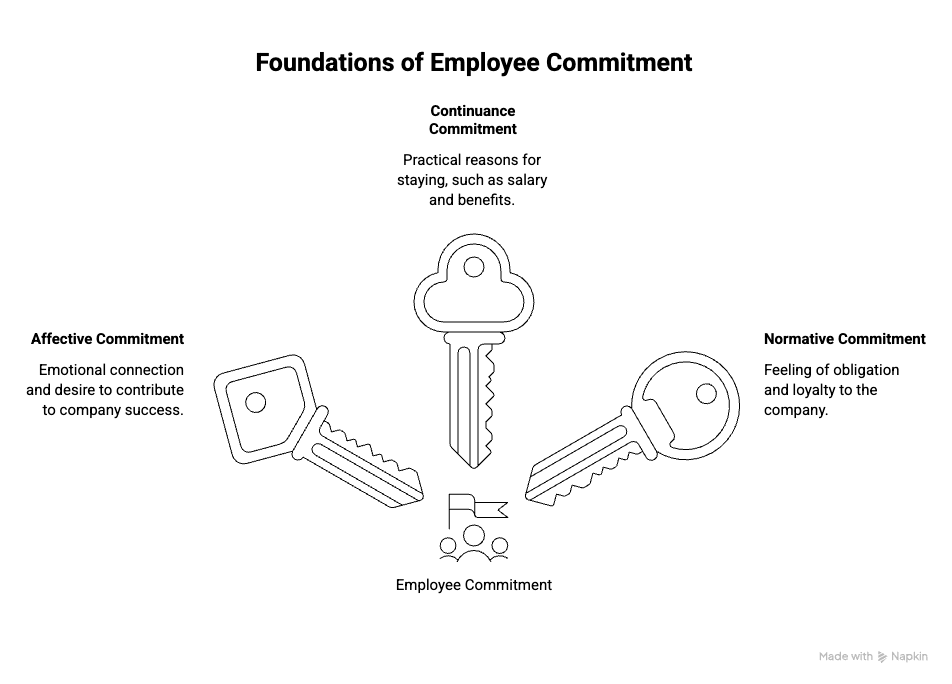
Affective commitment is emotional. People stay because they want to. They connect with the mission and the people around them, and they treat the company's success as their own. This is the strongest form.
Continuance commitment is practical. People stay because leaving would be costly. The salary, the tenure, the benefits, the disruption all add up. It holds people in place, but it does not produce extra effort.
Normative commitment is obligation. People stay because they feel they should, often out of loyalty to a manager who took a chance on them or a team mid-project. A good survey separates these three, because a workforce held together mostly by continuance commitment looks stable right up until a competitor offers more money.
20 employee commitment survey questions to ask
Keep a commitment survey short and mix the formats. Aim for 20 to 30 questions. Rating questions give you trends you can track over time. Open-ended and behavioral questions give you the why behind the number.
Rating questions (1 to 5 scale)
- Rate your overall commitment to your job.
- How likely are you to recommend this organization as a great place to work?
- I feel an emotional connection to the company's values and mission.
- How supported do you feel by your manager day to day?
- I understand the long-term goals and vision of the business.
- I believe there are real opportunities for growth and advancement here.
- How would you rate your work-life balance in this organization?
- I feel a sense of teamwork and collaboration within my department.
- Rate your confidence in the leadership and direction set by management.
- I feel adequately recognized and rewarded for my contributions.
Open-ended questions
- What would make you want to stay here for the next five years?
- What is the one thing most likely to make you leave?
- When did you last feel proud to work here, and why?
- What would you change about how decisions get made?
- How well is information communicated across the organization?
- Is there anything else you would like to share about your commitment to the company?
Behavioral questions
- Describe a time you went beyond your role without being asked.
- Tell us about a moment you felt genuinely supported by your team.
- Recall a decision that made you question whether you wanted to stay.
- When did you last speak positively about the company to someone outside it?
Why measuring commitment is worth the effort
Commitment shows up on the balance sheet. Gallup's meta-analysis of more than 183,000 teams found that the most engaged teams are 23% more profitable than the least engaged, and that low engagement costs the global economy an estimated $8.9 trillion, around 9% of GDP. Commitment is what keeps that engagement from walking out the door.
The mechanics are straightforward. Committed employees stay longer, so you spend less replacing experienced people and more compounding what they know. They put in effort because they want to, not because someone is watching. And commitment spreads: a connected team collaborates more and pulls newer people up faster. Strong teamwork is usually a symptom of commitment, not a substitute for it.
The reverse is just as real. When people feel undervalued, commitment drops first and visibly later. Absenteeism creeps up, discretionary effort fades, and burnout follows. Catching that early is the whole point of measuring. There is a lot you can do to make people feel valued at work once you know where the gap is.
How to measure commitment: the metrics that matter
Survey scores are one input. Pair them with behavioral data and the picture sharpens. Four metrics carry most of the signal.
eNPS asks how likely someone is to recommend you as a place to work, on a 0 to 10 scale. It is the fastest read on commitment you can get, and it tracks well against actual retention. If you are new to it, the fundamentals of employee Net Promoter Score are worth a look before you build it into a survey.
Retention rate is commitment after the fact. Sustained high retention usually means committed people, but it lags. By the time it drops, the survey signal was already there months earlier. Read it alongside the reasons employees actually stay so the number means something.
Absenteeism rate is a quieter signal. Rising unplanned absence in a team often shows up before resignations do.
Employee Satisfaction Score (ESS) rounds out the view. On its own it overstates stability. Read next to eNPS, it tells you whether contentment is turning into loyalty or masking a quiet exit.
How to run a commitment survey in six steps
A commitment survey works when employees believe their honesty is safe and their answers will matter. Six steps get you there.
1. Set one clear objective. Decide what decision the results will inform before you write a single question. Retention risk, leadership trust, and culture alignment each point to a different question set.
2. Keep it short and mix question types. Twenty to thirty questions is plenty. Long surveys lower response rates and skew the sample toward the already disengaged.
3. Protect anonymity, and say so plainly. Honest answers depend on it. Use a dedicated survey platform that keeps individual responses untraceable, and tell people how the data will be handled. The mechanics of running anonymous employee surveys are worth getting right before you launch.
4. Tell people why you are asking. A two-line note about what you will do with the results lifts participation more than any reminder email. Pilot the survey with a small group first to catch confusing questions.
5. Read the data by segment, not just the average. A healthy 70 overall can hide a team scoring 20. The company average is where commitment problems go to hide. Compare against past results and benchmarks where you have them.
6. Act, and close the loop. Share what you heard and what you will change, then follow through. Keep listening with shorter, recurring pulse surveys so you catch the next shift early instead of once a year. Pairing the numbers with a few one-on-one conversations also surfaces the employee sentiment a rating scale never captures.
What the results look like in Vantage Pulse
The hardest part of a commitment survey is not collecting answers. It is finding the one team that is quietly breaking before it costs you three resignations. Vantage Pulse does that read for you.

The heatmap scores every category against every department and colors them red to green. A company-wide number can look fine while one cell sits at 20 in deep red. That single score is the team you call this week, not next quarter.
AccessOne saw this firsthand. Their first pulse hit a 67% participation rate, well above the 30 to 50% industry benchmark, and returned an eNPS of 45 against an industry average of 10 to 30. The data also flagged a Customer Success team scoring 20 on relationship with peers, the kind of signal that stays invisible in an annual review until people start leaving.

Seeing honest feelings in real numbers? Priceless. We could actually watch morale lift after each change.
Cassidi Ross, HR Coordinator, AccessOne
Conclusion
A commitment survey only earns its keep if you act on it. The questions and metrics above tell you where loyalty is strong and where it is thinning. What you do next decides whether people stay. Read the results by team, fix the problems the data points to, and keep listening on a regular cadence. That is how a survey turns into retention instead of a report nobody opens.
FAQs
1. What is the difference between an employee engagement survey and an employee commitment survey?
An engagement survey measures day-to-day energy and involvement in the work. A commitment survey goes deeper into emotional attachment, loyalty, and long-term intent to stay. Engagement can be high in a given week while commitment is already slipping, which is why measuring both gives a clearer read than either alone.
2. How many questions should an employee commitment survey have?
Aim for 20 to 30 questions. That is enough to cover the main drivers of commitment without fatiguing respondents. Longer surveys lower completion rates and bias the sample toward people who are already disengaged.
3. How often should you run a commitment survey?
A full commitment survey once or twice a year works well, paired with shorter pulse surveys every month or quarter. The longer survey gives you depth. The pulses catch shifts in sentiment between them so you are not waiting a year to spot a problem.
4. What is a good response rate for an employee commitment survey?
Many organizations see 30 to 50% on annual surveys. Anything above that signals trust in the process. Clear communication about purpose and anonymity, plus visible follow-through on past results, is what pushes participation higher.
5. Are employee commitment surveys really anonymous?
They can be, if you use a platform that strips identifying details and reports results in aggregate. Anonymity is what produces honest answers, so the tool must guarantee that individual responses are never traceable, and you should tell employees exactly how the data is handled.
6. Which metrics best measure employee commitment?
eNPS and retention rate are the strongest. eNPS gives you a fast, trackable read on loyalty, and retention confirms it over time. Absenteeism and the employee satisfaction score add useful context, especially when one moves while the others hold steady.
Written by