
I've watched this play out somewhere unglamorous: a shift supervisor who stopped waiting for the annual review to say thank you and started doing it out loud, every Monday, for whoever had earned it that week. She never touched a process. Complaints against her team went from eleven a month to six.
That's the service-profit chain working in miniature, a framework mapped first at Harvard in 1994 and tested since across high-contact service industries like hotels, banks, and retail. This guide walks through the model first, then the evidence behind each link, then the levers HR actually pulls and how to measure them. It closes with three companies that built their entire strategy on this one idea.
Employee engagement and customer experience are linked through the service-profit chain, a framework introduced by James Heskett and colleagues at Harvard Business School in 1994. Engaged employees create more service value, which raises customer satisfaction and loyalty, which drives revenue. The link is strongest in frontline, customer-facing roles.
Key Takeaways
- The service-profit chain, mapped at Harvard in 1994, runs from internal service quality through employee satisfaction, retention, service value, customer satisfaction, and loyalty to profit, then reinvests.
- Engaged employees raise service value, the actual quality a customer feels in one interaction. That is the link between engagement and customer experience.
- HR owns the first link. Manager recognition is the fastest lever on it.
- Measure the chain by pairing an employee metric like eNPS with a customer metric like NPS for the same team, then reading the lag. The customer number moves about a quarter after the employee number.
- Southwest, Sears, and the Ritz-Carlton each proved a different link of the chain.
What Is the Service-Profit Chain?
The service-profit chain is a management framework that traces a direct line from how a company treats its own people to how much money it makes.
Five Harvard Business School researchers, James Heskett, Thomas Jones, Gary Loveman, Earl Sasser, and Leonard Schlesinger, published the model in the Harvard Business Review in March 1994 under the title "Putting the Service-Profit Chain to Work." Three years later it became a book. It has been tested in call centers, hotel chains, and retail banks ever since.
The chain runs through seven elements connected by six sequential links.
| Link | What It Means |
|---|---|
| 1. Internal service quality → Employee satisfaction | Strong tools, training, and support raise how satisfied employees feel with their jobs |
| 2. Employee satisfaction → Retention and productivity | Content employees stay longer and get more done |
| 3. Retention and productivity → Service value | Tenured, productive employees deliver more value in every customer interaction |
| 4. Service value → Customer satisfaction | Customers who receive real value rate their experience higher |
| 5. Customer satisfaction → Customer loyalty | Satisfied customers come back and recommend the company to others |
| 6. Customer loyalty → Profit and growth | Loyal customers drive the revenue that funds the next cycle |
Heskett's team had a specific meaning for service value, one term worth holding onto since it recurs through every link below: the actual worth a customer experiences in one interaction, not a rating or a policy, the real thing that happens when someone calls in with a problem.
Seven elements, six links, and the reinvestment loop that gives the chain its name. Service value (orange) is the point where employee engagement becomes customer experience. Two feedback loops run underneath: the satisfaction mirror and the capability loop.
Reinvestment is the part most summaries skip over. Heskett's model never treats profit as an endpoint. It gets funneled back into internal service quality, restarting the cycle, which is what closes the loop and gives the chain its name.
The Two Feedback Loops
The chain has two loops running underneath it, quietly, and most explanations of the model skip both.
One is the satisfaction mirror. Employee satisfaction and customer satisfaction climb together over time. Watch a team long enough and you'll see it happen: an employee gets a warm reaction from a customer, feels better about the job, and brings that back into the next interaction.
The other is the capability loop. Retention builds customer knowledge. An employee who has handled the same accounts for three years catches problems a six-week hire has no way of seeing coming. That alone raises service value. No training budget required.
How Employee Engagement and Customer Experience Are Linked
Engaged employees consistently create more service value than disengaged ones do. Not the org chart. Not the mission statement on the wall.
The mechanism runs through effort, tenure, tone, and turnover, and none of the four show up on a dashboard by themselves.
Take effort first, the extra minute on a call that a disengaged employee just skips. Then there's tenure, an employee who already knows the account's history and the product's quirks, no screen-reading required. Tone spreads on its own. A frustrated voice reaches the customer whether anyone planned for it to or not. Turnover compounds all three of these at once. A new hire needs months to rebuild the service value a departing employee had already built up over years.
Top-quartile engaged business units score 10% higher on customer loyalty and engagement than bottom-quartile units. Separately, and this is the part older write-ups keep collapsing into one figure, they run 23% higher on profitability. Two different outcomes from the same dataset. That comes from Gallup's 11th edition Q12 meta-analysis, published in 2024, the largest test of this relationship so far, covering more than 183,000 business units and 3.3 million employees.
Brands with highly engaged workforces post Net Promoter Scores, or NPS, 24 points higher than less-engaged competitors, plus 12% higher customer advocacy. Engaged employees also report a much clearer read on what customers actually need. Seventy percent say so, against 17% of disengaged employees. Qualtrics ran this analysis in 2022, working the same relationship from the customer side that Gallup measures from the employee side.
Employee experience, or EX, and employee engagement measure related but different things, and the distinction matters before mapping either term onto the chain. Employee experience is not the same as engagement is worth reading first. This guide uses engagement specifically. That's the emotional and behavioral state engagement surveys actually measure. Employee experience is the broader container it sits inside.
The Evidence for Each Link
Each link of the chain has its own paper behind it by now. Two links get tested more than the rest: employee-satisfaction-to-service-value, and customer-loyalty-to-profit.
| Link | Best Evidence | Source |
|---|---|---|
| Internal service quality → Employee satisfaction | Strong internal support consistently raises satisfaction scores across service industries | Heskett, Jones, Loveman, Sasser & Schlesinger, "Putting the Service-Profit Chain to Work," Harvard Business Review, 1994 |
| Employee satisfaction → Retention and productivity | Structural equation modeling across 210 high-contact service businesses in Hong Kong | Yee, Yeung & Cheng, "The Service-Profit Chain: An Empirical Analysis in High-Contact Service Industries," International Journal of Production Economics, 2011 |
| Retention and productivity → Service value | Tenured employees deliver measurably higher service ratings than new hires | Yee, Yeung & Cheng, "The Service-Profit Chain: An Empirical Analysis in High-Contact Service Industries," International Journal of Production Economics, 2011 |
| Service value → Customer satisfaction | 24-point NPS gap between highly engaged and less-engaged brands | Qualtrics, "Customer Experience and Employee Experience: Two Sides of the Same Coin," 2022 |
| Customer satisfaction → Customer loyalty | Higher repeat-purchase and referral rates among satisfied customers | Heskett, Jones, Loveman, Sasser & Schlesinger, "Putting the Service-Profit Chain to Work," Harvard Business Review, 1994 |
| Customer loyalty → Profit and growth | 23% higher profitability in top-quartile engaged business units | Gallup, Q12 Meta-Analysis, 11th edition, 2024 |
Here's a caveat worth sitting with. None of this proves engagement causes profit on its own. These are correlational studies, most of them, and Gallup's own researchers describe engagement and financial performance as reciprocally related. It isn't a clean one-way arrow. Their causal work does find engagement to be the stronger predictor of the two directions, and that's a narrower claim than most posts citing this research let on, and it still holds up.
The Levers: How HR Operationalizes Each Link
HR moves the chain from the first link. Internal service quality and employee satisfaction are where the leverage sits. Manager recognition moves fastest of any lever available. Role clarity, workload, and decent tools matter too, but the piece most companies skip is a feedback loop that actually closes instead of going quiet after the survey.
Internal Service Quality
Nobody puts this in a pitch deck: whether an employee has decent tools, clear process, and enough manager support to do the job without fighting the system just to get started. It's still the link everything else depends on. Broken tools and unclear escalation paths show up in a customer's experience within days. Quarters are too slow to catch it. Employee experience management is the discipline built around fixing exactly this link before it breaks anything downstream.
Employee Satisfaction and Loyalty
Manager recognition is the fastest lever on this link. It works because it's specific and frequent, and because it comes from whoever assigned the work in the first place, not some system three steps removed from the actual job.
Peer-to-peer recognition matters here too, not only praise from the top. A frontline employee acknowledged by a colleague for handling a hard customer well is getting exactly the specific, timely signal Heskett's model says raises satisfaction, and it doesn't wait for a quarterly review to say it.
Employee Productivity and Retention
Tenure equals customer knowledge, and no training manual replaces it. Long-service recognition gets written off as a legacy HR ritual, but inside the chain it marks the exact point where an employee's accumulated product and customer knowledge starts paying off in service value. Lose that employee and the clock resets on every account they knew.
Service Value
This is where individual roles connect to customer outcomes, easy to lose in the abstraction. A high-performance culture ties recognition to specific customer-centric values. Generic praise doesn't do the same work. That turns "be helpful" from a poster in the break room into a behavior that gets reinforced every time a colleague is acknowledged for actually doing it.
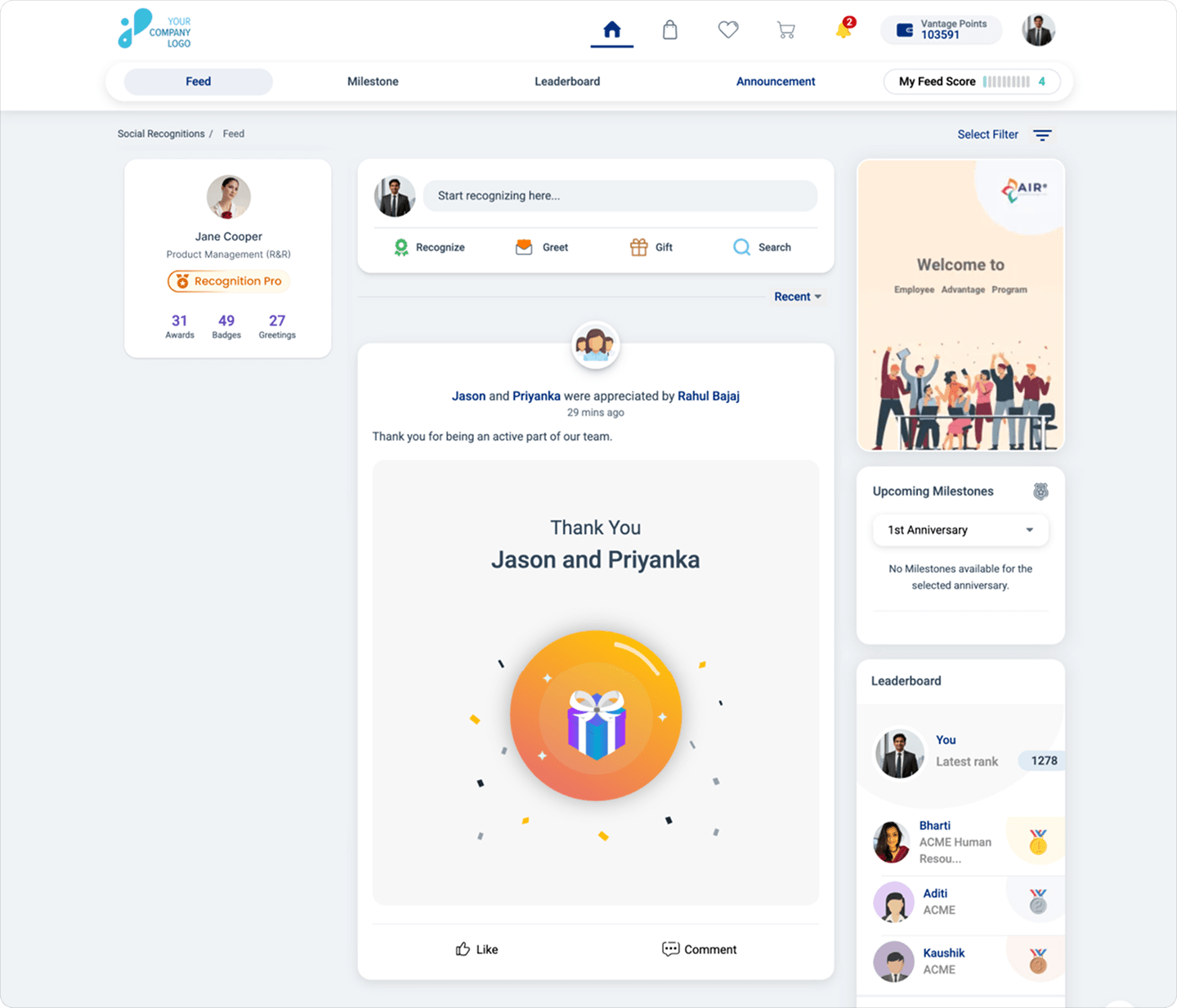
Where recognition sits in the chain. In high-recognition cultures, 94% of employees rate their organization's customer service as excellent, against 78% in organizations with an emerging recognition culture, and intent to stay runs 92% versus 76%, findings from *The Recognition Effect*, a 2025 study by Great Place to Work India and Vantage Circle covering 5.7 million employee data points across more than 1,810 organizations. That customer-service gap is the recognition-to-engagement-to-chain mechanism made visible in a single number.
(Source: Vantage Rewards)
How to Measure the Link
Track an employee metric and a customer metric for the same team, on the same cadence. Read the lag between them. Judging either number alone misses the point.
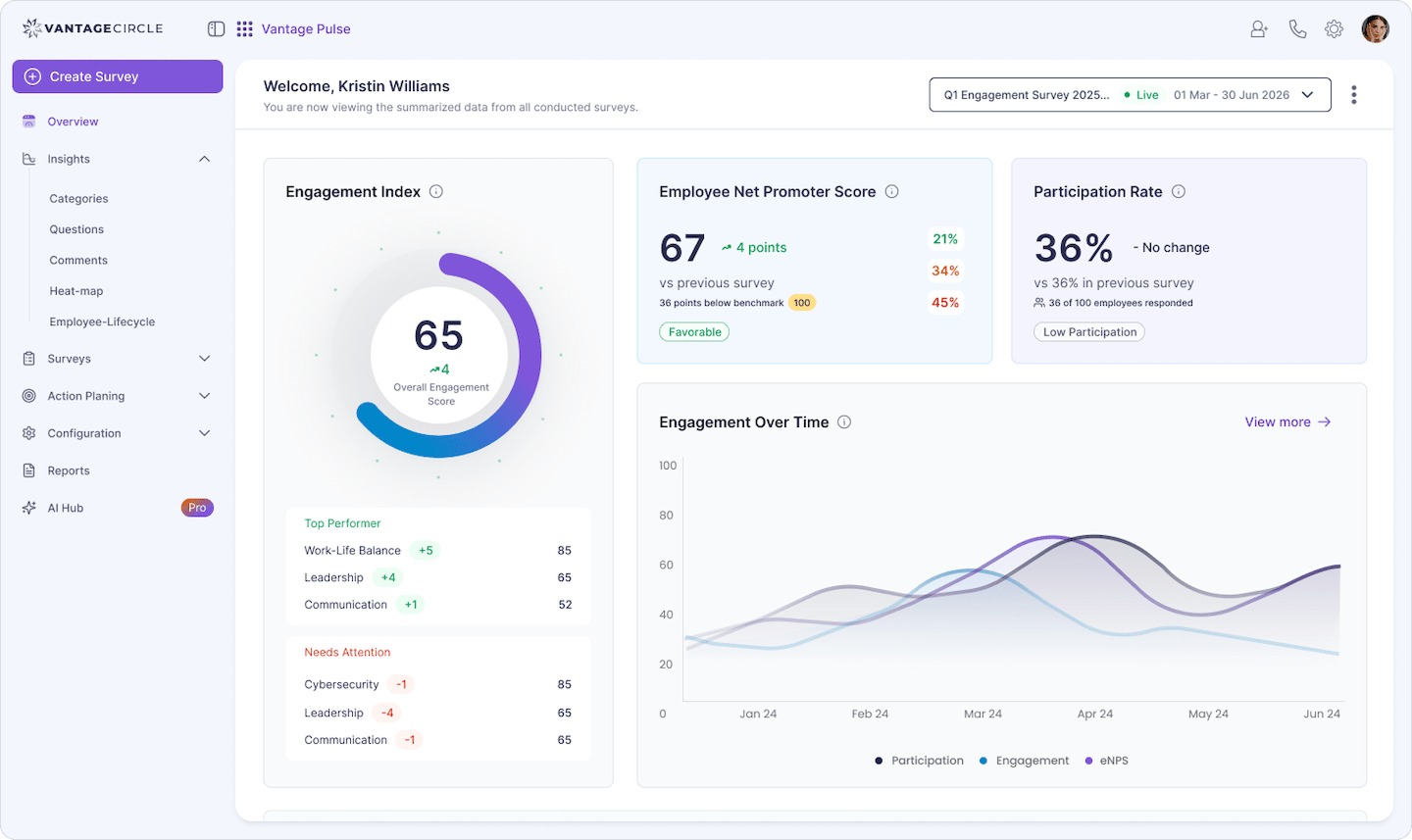
A 40-person support team runs a quarterly eNPS survey, short for employee Net Promoter Score, alongside a customer NPS captured after every resolved ticket. Q1 eNPS sits at 12. Middling. Nothing alarming. Q1 customer NPS comes in at 34. In Q2, the manager starts a five-minute peer recognition ritual at the top of every stand-up, borrowed from a sister team, nothing that shows up on any budget line. Team eNPS climbs to 31 by the end of Q2. Customer NPS for that same quarter barely moves, up two points to 36.
The lag is the whole point. Q3 customer NPS is where the Q2 employee shift actually shows up. It jumps to 44.
The employee line moves in Q2. The customer line barely responds that same quarter, then jumps in Q3. Reading both numbers in the same quarter is how teams wrongly conclude nothing happened.
| Employee-side metric | Paired customer-side metric |
|---|---|
| eNPS (employee Net Promoter Score) | NPS (customer Net Promoter Score) |
| Engagement score | CSAT, customer satisfaction score |
| Retention rate | Repeat-purchase rate |
| First-contact resolution, agent-reported | First-contact resolution, customer-reported |
(Source: Vantage Pulse)
Qualtrics itself has cautioned against relying on eNPS alone, since it's a single question and misses the texture a full engagement survey captures. Fair point, and I'd still call it a reasonable starting signal for this kind of quarter-over-quarter pairing, especially when it runs through a fuller platform like Vantage Pulse. eNPS on its own tells you less than it sounds like it does. Measuring employee experience and running a proper employee survey cadence both feed directly into this measurement loop.
Building a Customer-Centric Culture Through Engagement
A customer-centric culture is one where employees at every level treat customer outcomes as their own responsibility, and that responsibility doesn't stop at the front desk.
A disengaged employee reaches for the process manual the moment something looks unusual. An engaged one reads the situation first and checks the manual second, if at all. That gap is most of the difference right there, and it's genuinely hard to train for.
A customer-centric culture shows up in how leaders spend their attention, not just what they say in a town hall. They prioritize customer outcomes over a short-term metric even when it costs something that quarter, and they hand employees enough real authority to solve a problem without routing it through three layers of approval first. Recognition follows the same logic: it goes to whoever went out of their way for a customer, not only to whoever hit a sales number.
That third point connects straight back to the chain. A culture that names customer-centric behavior out loud when it happens is a cheaper, faster lever than any training program built to teach the same thing from scratch. Company culture work that skips this step just produces a values poster nobody can point to a real example of.
Real Examples: The Chain in Practice
Southwest Airlines, Sears' 1990s turnaround, and the Ritz-Carlton are the three cases the service-profit chain literature returns to most often. Each one proves a different link. None proves the whole chain at once.
Up to 15% of annual operating profit shared with employees, every year since 1974
Since 1974, the airline has shared up to 15% of annual operating profit directly with employees through a formal profit-sharing program, a policy that predates most of the modern engagement research by two decades. Herb Kelleher put employees ahead of customers, and customers ahead of shareholders. Outside consultants thought that ordering was backwards until they saw the retention numbers behind it. Southwest posted a profit every year from 1973 until the pandemic interrupted the streak in 2020, 47 years running. It pioneered the ten-minute gate turnaround, which took real operational discipline. It also trusted gate agents to make judgment calls without waiting on a supervisor.
5-point rise in employee attitude, then a 1.3-point rise in customer satisfaction, then 0.5% revenue growth
After a $3.9 billion loss in 1992, Sears executives Anthony Rucci, Steve Kirn, and Richard Quinn built what they called the employee-customer-profit model and published the results in the Harvard Business Review in 1998. Their headline number was specific: a 5-point rise in employee attitude tracked with a 1.3-point rise in customer satisfaction. That, in the same model, tracked with a 0.5% bump in revenue growth. Small percentage. Against a company doing over $50 billion a year in sales, it added up to real money, and it's the kind of end-to-end precision most companies never bother measuring at all.
$2,000 per guest per day, any employee, no manager sign-off
Horst Schulze, founding president of the Ritz-Carlton, built a number into the company's culture early on: $2,000. That's what any employee, housekeeping included, can spend per guest per day to fix a problem without checking with a manager first. Almost nobody actually spends that much. What the number buys instead is speed, the service-value link happening in the moment a problem occurs rather than after it's already cost the relationship.
I'm skeptical, honestly, of treating the Sears numbers as universal. A five-point swing in employee attitude at a 1990s department store chain isn't going to translate one for one into a SaaS company's NPS or a hospital's patient-satisfaction score. The direction of the relationship has held up across three decades of replication since then. So has the fact that it was measurable at all. The exact multiplier is another matter.
Conclusion
That shift supervisor from the opening, the one who started saying thank you out loud every Monday, never read a page of Heskett's research. She just closed the first link without knowing it had a name.
HR owns that link. Everything downstream of it, customer satisfaction, loyalty, revenue, is a lagging measure of what happened three or four steps earlier, usually a full quarter earlier.
Pair an employee number with a customer number for the same team. Give it a full quarter before checking whether anything moved. Something breaks further down the chain, start at the first link. That's usually where the actual problem lives, however far downstream the symptom shows up.
Frequently Asked Questions
Q. What is the service-profit chain?
It's a 1994 framework from five Harvard Business School researchers, tracing a straight line from how a company treats employees to how much money it makes. The chain itself runs from internal service quality through employee satisfaction, retention, and productivity, then into service value, customer satisfaction, customer loyalty, and finally profit. Each link has since been tested on its own, across industries the original authors never studied.
Q. How are employee engagement and customer experience linked?
Mostly through service value, the actual quality a customer experiences in one interaction. An engaged employee brings more of it: more effort, more product knowledge, more reason to actually care how the call ends. Gallup puts the customer-loyalty gap between top- and bottom-quartile engaged teams at 10%. On the brand side, Qualtrics has clocked a 24-point NPS gap between highly engaged companies and their less-engaged competitors.
Q. What are the 5 C's of employee engagement?
Care, connect, coach, contribute, and congratulate is the version that shows up most in current usage. In practice that means paying attention to people day to day, checking in like an actual person would, coaching instead of just reviewing, giving people room to weigh in, and saying something out loud when someone does good work. A handful of competing versions circulate too, since the framework was never formally standardized.
Q. What are the three C's of customer experience?
The three that keep showing up are consistency, convenience, and customization: the same experience everywhere a customer interacts with you, minimal effort on their end, and something that reflects what that specific person wants rather than a generic template built for everyone.
Q. How do you measure the link between employee engagement and customer experience?
Pair an employee-side number with a customer-side number for the same team on the same reporting cadence, eNPS against NPS, or engagement score against CSAT. Then wait a quarter before reading the customer side of it. The effect shows up with a lag almost every time, and checking both numbers in the same quarter is the most common way teams conclude, wrongly, that nothing happened.
Q. What is a customer-centric culture?
One where customer outcomes are treated as everyone's job, not a department's. It depends entirely on engagement underneath it. Take engagement away, and people default to whatever the process manual says the moment something looks unusual, which rarely serves the customer standing in front of them.

He has worked in the human resources environment and has elevated recognition and rewards through his insightful and detailed writing. He aims to enhance the practice of Recognition in the workplace with new ideas and innovation that will help shape the work culture. For any related queries, contact editor@vantagecircle.com