
HR conversations tend to use "engagement" and "involvement" as if they're the same word said twice for emphasis. They aren't. Engagement is how someone feels about their work. Involvement is how much say they actually get in it. Conflating them is how a company ends up with employees who feel good about the mission but have never once been asked what they'd change, or employees who sit on every committee going and still feel completely disconnected from why any of it matters.
The right employee engagement software supports both dimensions by giving employees a voice and making their contributions visible.
Key Takeaways
- Engagement and involvement measure two different things, not two words for the same thing.
- You can have one without the other, and each failure mode looks different.
- Involvement is one of the more reliable levers that drives engagement, not a guarantee of it.
- Fixing the wrong one wastes budget on a problem the company doesn't actually have.
What Is Employee Engagement?
Employee engagement is the emotional connection and commitment an employee has toward their work and organization. It shows up as discretionary effort, the extra the person puts in that nobody can mandate, because the alternative (doing the minimum) was never really on the table for them.
An engaged employee cares about outcomes well past their own paycheck, whether the team hits its numbers, whether a customer walks away happy, whether the company is actually headed somewhere worth being part of. Productivity and retention numbers pick that up eventually. The feeling comes first, the metrics follow it.
Only 31% of U.S. employees were engaged at work in the first half of 2026, unchanged from 2025 and the lowest mark Gallup has recorded in a decade, down from a 36% peak in 2020. Source: Gallup, 2026
That number has held roughly flat for two years running, which is itself the more useful fact. It means most companies aren't watching engagement crater, they're watching it quietly plateau at a mediocre level nobody is treating as an emergency. That's the part I find more worrying than a sudden drop would be: a slow plateau rarely triggers the kind of urgency that actually gets budget approved.
What Is Employee Involvement?
Employee involvement is the degree to which employees actively participate in decisions and processes that affect their work. Somebody either gets consulted before a call gets made, or they hear about it after. That's a structural question about who gets a seat at the table. Whether they happen to feel good about the outcome is a separate matter entirely.
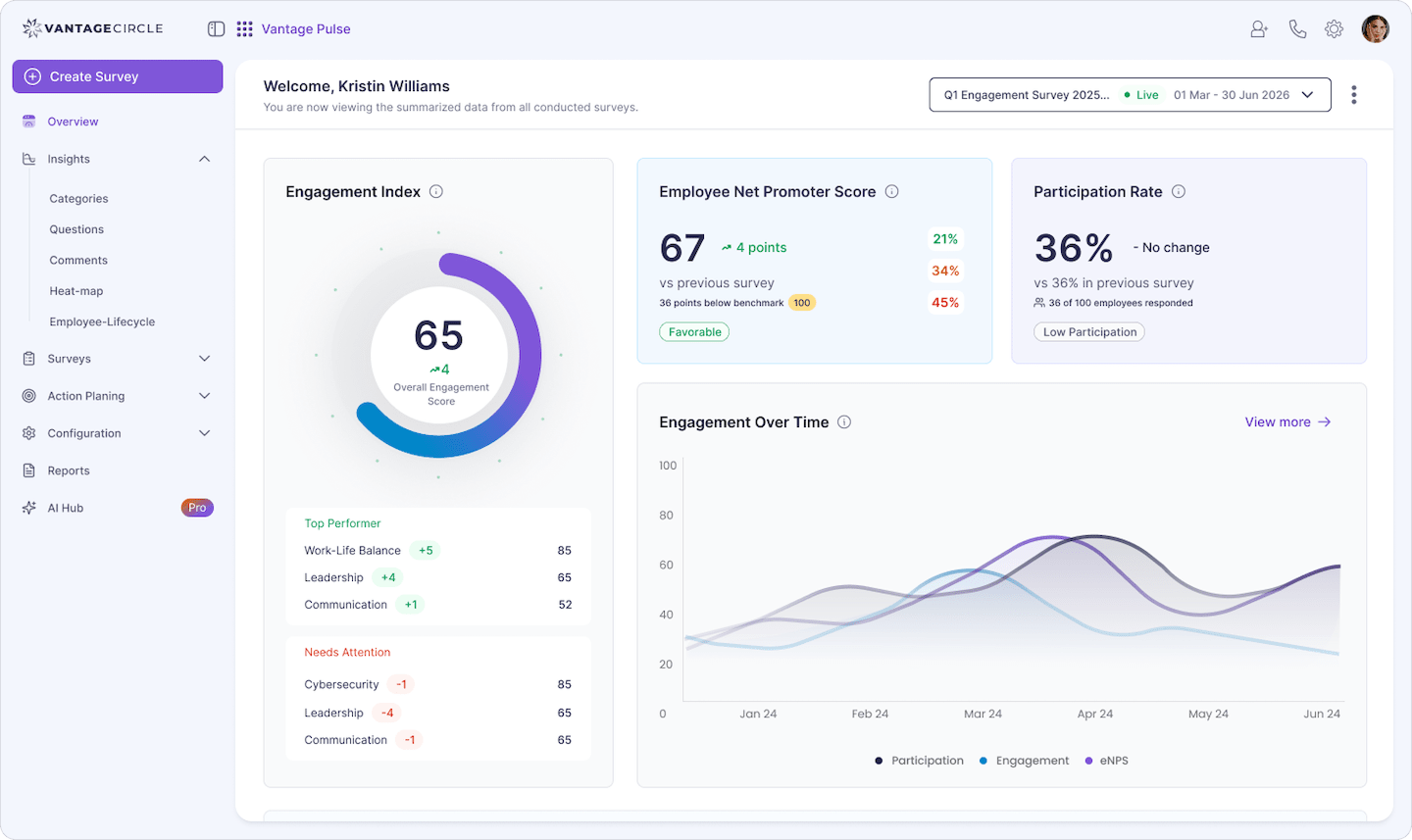
Involvement covers things like being consulted before a policy changes, having a real channel to flag what isn't working, and seeing evidence that feedback actually changes something. None of that requires an employee to feel any particular way about the company. It just requires the company to actually ask, and then to visibly act on what it hears.
(Source: Vantage Pulse)
Only one in four employees worldwide strongly agree that their opinions count at work, and while 81% of leaders believe employees have an easy way to give feedback, just 44% of employees agree that they actually have a voice. Source: Gallup
I've sat through enough leadership reviews to say confidently that most leaders aren't withholding a voice on purpose. They've just never gone back to check whether the channel they built for it actually works, which is a smaller, more fixable problem than it sounds like at first.
Employee Engagement vs. Employee Involvement: The Key Differences
| Employee Engagement | Employee Involvement | |
|---|---|---|
| What it measures | Emotional commitment to the work and organization | Actual participation in decisions and processes |
| Question it answers | Does this person care? | Does this person have a say? |
| Primary driver | Meaning, recognition, trust, growth | Consultation, feedback loops, delegated authority |
| How it's usually measured | eNPS, engagement surveys, sentiment | Participation rates, feedback-to-action ratio, decision involvement |
| Fails silently as | Quiet quitting, going through the motions | Employees who stop bothering to suggest anything |
| Who owns it | Managers and culture | Org design and decision-making structure |
The table is useful for one thing above all: it tells you where to actually look when something's off. I use it as a first gut check whenever a team's numbers look wrong before deciding what to fund. A team that feels emotionally checked out needs a different intervention than a team that feels ignored, and treating both problems with the same all-hands pep talk is why so many engagement initiatives quietly fail.
How Engagement and Involvement Actually Interact
They're related, but the causation mostly runs one direction. Get involvement right and engagement usually follows. The reverse doesn't hold nearly as reliably.
Involvement Drives Engagement, Most of the Time
Being consulted before a decision, rather than informed after one, gives people a reason to care about the outcome. It's a straightforward mechanism, and one I've watched play out the same way on nearly every team I've been part of: contribute to something, and you become invested in whether it works. A team asked to shape a new process before it launches tends to defend that process later. Part of it is theirs by then, and people protect what's theirs.
Engagement Can Exist Without Involvement, but It's Fragile
An employee can feel genuinely connected to a company's mission without ever being consulted on a single decision. That's real, and it's common in early-stage or mission-driven teams. But it tends to be brittle. Without some real input into how things get done, that emotional connection has nothing to anchor to once the honeymoon period ends, and it degrades into disengagement the first time the person feels talked at instead of talked with. I've seen that shift happen fast, sometimes inside a single badly handled rollout, once the novelty of the mission wears off and nobody's actually asked for input since.
(Source: Vantage Recognition)
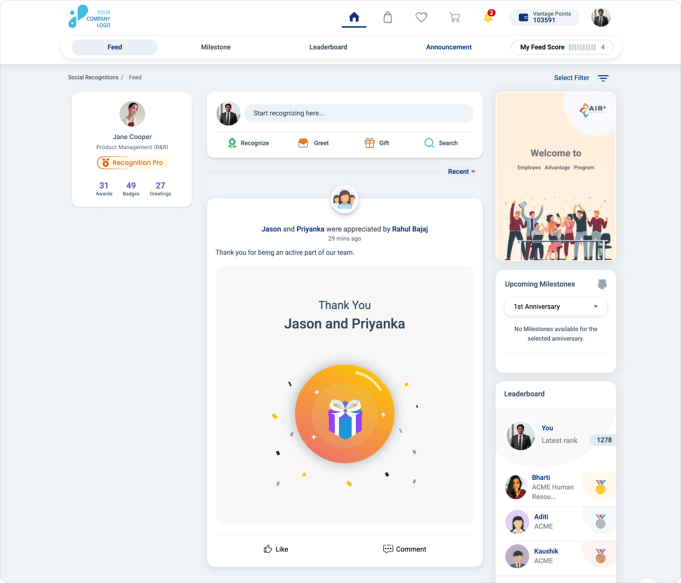
Recognition is where the two most visibly meet. Naming a specific contribution in front of the team does two things at once. It tells the person their work mattered, and it proves their input actually got seen and used. That combination is why a culture of appreciation tends to move both numbers together instead of trading one off against the other.
I saw this play out firsthand. Our team hit a milestone, around 2 million organic visitors to the site, and instead of a passing mention in a meeting, we got recognized for it immediately through our own rewards platform, with redeemable points attached to it.
What stuck wasn't the traffic number. It was that the moment got named, in public, right when it happened. That single gesture did more for how invested I felt than any all-hands recap could have. We kept pushing harder after that. Nobody told us to. The company had just shown us that contributing at that level actually got seen, and that was enough.

How to Strengthen Both, Not Just One
1. Give Leaders Something Concrete to Do, Not Just a Vision to Repeat
Leadership qualities like transparency and active listening drive engagement, but the involvement half only shows up when a leader closes the loop, tells the team what changed because of what they said, and just as importantly, what didn't change and why. Skipping that second part is the single most common way an involvement effort quietly dies. It's rarely deliberate. Closing the loop just takes more discipline than opening it, and most leaders run out of that discipline somewhere around week three.
2. Make Growth Paths Visible, Not Assumed
Investing in employee development, training, mentorship, real career pathways, moves engagement because people can see a future worth staying for. It moves involvement too, when the path is built around what the employee actually asked for rather than a generic ladder handed down from HR.
3. Recognize Specific Contributions, Not Generic Effort
Recognition tied to a named, specific action does more for both metrics than broad praise. "Good job this quarter" barely registers. "Your fix on the Henderson account saved the renewal" does, because it proves someone was watching closely enough to notice the specific thing that mattered.
4. Build Real Feedback Loops, Not Suggestion Boxes
A high-performing team depends on people believing their input goes somewhere. That only holds if there's a visible mechanism, a survey that leads to a stated action, a forum where a raised issue gets a real answer, not silence. An involvement channel with no visible output trains people to stop using it within one cycle.
5. Give People Real Autonomy Inside Their Role
Trusting someone to make calls within their own scope, without every decision routed upward for approval, builds both ownership and emotional investment at the same time. It's also the cheapest lever on this list. It costs a policy decision, not a budget line.
The Bottom Line
Engagement and involvement fail differently, and treating them as one problem means only ever fixing half of it. A team that feels disconnected from the mission needs a different intervention than a team that's stopped bothering to speak up. Diagnose which one you actually have before spending budget on the wrong fix. That's the step worth pushing hardest on. It costs nothing, and it's the one most teams skip.
Frequently Asked Questions
What is the difference between employee engagement and employee involvement?
Engagement is the emotional commitment an employee feels toward their work and organization. Involvement is how much actual say they have in decisions that affect their work. One is a feeling, the other is a structural fact about who gets consulted.
Can employees be engaged without being involved?
Yes, but it tends to be fragile. An employee can feel connected to the mission without ever being consulted on a decision, especially early on. Without some real input over time, that connection has nothing to anchor to and tends to erode.
How do you measure employee involvement?
Track participation rates in decisions that affect a team, the ratio of feedback collected to feedback actually acted on, and whether employees can name a recent example of their input changing something. Engagement surveys alone won't catch an involvement problem, since someone can score as engaged while still feeling unheard.
Does involvement always increase engagement?
No. Involvement raises the odds, but a badly run involvement process, feedback collected and then ignored, can damage engagement faster than no process at all. The mechanism only works if the loop actually closes.

He has worked in the human resources environment and has elevated recognition and rewards through his insightful and detailed writing. He aims to enhance the practice of Recognition in the workplace with new ideas and innovation that will help shape the work culture. For any related queries, contact editor@vantagecircle.com