
57% of employees feel obligated to check work email while they are on holiday, according to a 2025 Modern Health survey of 1,000 full-time US employees. That is the tension December runs on. Your team is out of office and still at the desk.
December engagement works best when it is planned in three phases, not as one event. The first two weeks carry deadline pressure and budget close. The third week runs on partial attendance. The final week, between Christmas and New Year, needs the lightest touch and the smallest commitment from a skeleton crew.
Most December idea lists ignore that split. They hand you twelve activities with no sense of when any of them belong. This one is organized around the calendar your team is actually working to. The employee engagement ideas below are grouped by the phase they belong in, then by the situations that cut across all three.
Key Takeaways
- Why December Needs Its Own Plan
- The Three Decembers: How to Map the Month
- Weeks 1 and 2: Ideas for the December Crunch
- Week 3: Christmas Employee Engagement Ideas
- Week 4: The Quiet Week Between Christmas and New Year
- Virtual and Hybrid December Engagement Ideas
- Inclusive Ideas for Teams That Do Not All Celebrate Christmas
- December Engagement for Teams Working Through the Holidays
Why December Needs Its Own Plan
December breaks the normal engagement cadence because the work does not slow down while attendance does. Deadlines, budget close and annual reviews land in the same four weeks that half your team takes leave.
That collision is what makes generic engagement activities fall flat this month. A team-building session that works in April lands badly on a day when three people are closing the quarter and two are already on a plane.
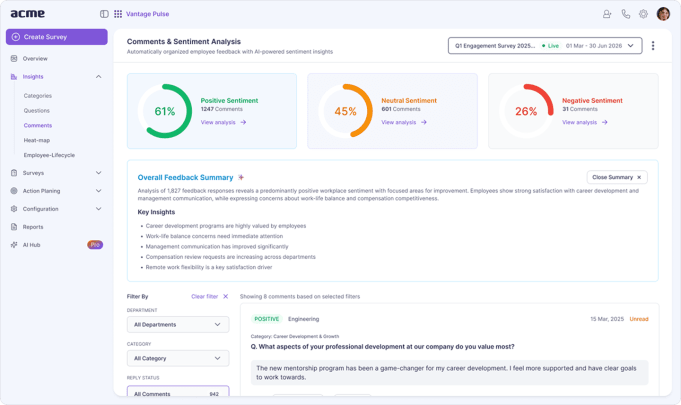
There is also a measurement problem. Most organizations guess at December mood instead of reading it. Vantage Pulse, Vantage Circle's employee engagement and pulse survey tool, surfaces sentiment by department in the first week of the month, which tells you whether your team wants a party or wants to be left alone to finish the quarter. Plan from the answer rather than the assumption.
Here is what December engagement actually has to do:
- Protect recovery. A festive activity is only useful if it gives people something back. Anything that adds a task to a full week makes the month worse.
- Hold attention without demanding it. Distraction peaks in December. The answer is shorter, lighter touchpoints, not bigger ones.
- Close the year properly. People remember how the year ended. Recognition delivered in December carries into January performance.
The Three Decembers: How to Map the Month
December is not one engagement problem. It is three, and each one needs a different kind of activity. Map your month to these phases before you plan a single event.
| Phase | Typical dates | What your team is actually doing | Engagement goal |
|---|---|---|---|
| The crunch | Dec 1 to Dec 14 | Closing deadlines, spending or defending budget, finishing reviews | Relieve pressure. Recognize the push. |
| Christmas week | Dec 15 to Dec 24 | Partial attendance, handovers, the office party | Celebrate together while enough people are present. |
| The quiet week | Dec 26 to Dec 31 | Skeleton crew, low momentum, coverage shifts | Make the week feel chosen, not abandoned. |
Pick one well-run activity per phase rather than twelve half-run ones. Three moments your team remembers beat a calendar full of invitations nobody opens.
Weeks 1 and 2: Engagement Ideas for the December Crunch
The first two weeks need activities that relieve pressure rather than add to it. Keep everything under 30 minutes, make attendance optional, and lead with recognition because this is when the hardest work of the quarter gets done.

1. Run a Year-End Recognition Campaign Before the Rush Peaks
A time-boxed recognition campaign works because it has an end date. Launch it on December 1, name the specific behaviors it rewards, and close it before Christmas week takes everyone's attention.
Only 55% of US companies run monthly, quarterly or annual awards as part of their recognition programs, and the average AIRe score across US programs sits at 60%, according to the Vantage Circle AIRe Benchmarking Report for the United States. A December campaign is a straightforward way to add a recognition moment to a calendar that may not hold many. The reasons to recognize someone are already sitting in your quarter-end numbers.
For a fuller set of formats, our year-end recognition ideas cover awards that work beyond the holiday framing.
2. Launch a Gratitude Wall or Shout-Out Board
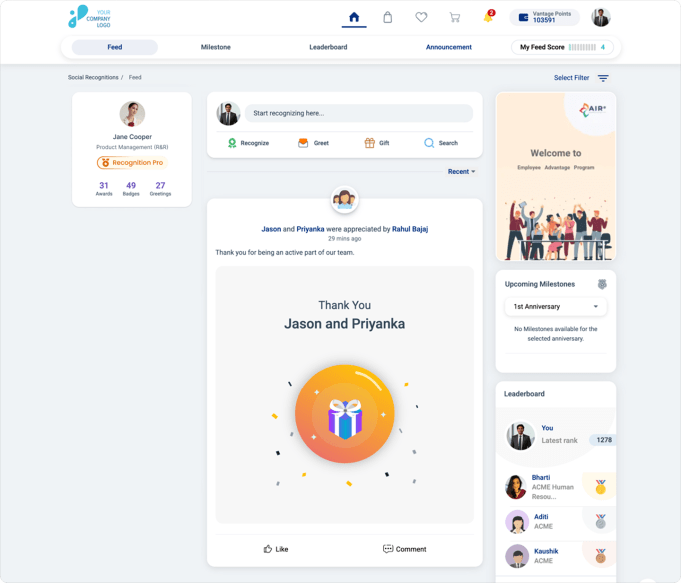
A gratitude wall gives people a two-minute way to appreciate someone during the busiest fortnight of the year. Keep it open all month and let it fill up on its own.
A whiteboard nobody walks past will die by December 5. A company-wide feed keeps shout-outs visible to remote and in-office staff at the same time, and keeps them readable in January when the year-in-review goes out.
3. Hold a Festive Dress-Up or Ugly Sweater Day
An ugly sweater day costs nothing and asks for no preparation, which is exactly why it survives a crunch week. Pick a single Friday, announce it once, and let people opt in.
Add one small prize category to give it a point. "Most committed" and "least effort" both work, and the second one lets people join without shopping for anything.
4. Book a 30-Minute Wellness Reset
A short, optional wellness session gives people permission to stop. Thirty minutes of guided stretching, breathing or a walking break does more in December than a 90-minute workshop nobody can attend.

Pair it with a light step challenge if your team responds to friendly competition. Set a modest daily target, keep the leaderboard visible, and tie it to a charity donation so the goal is shared rather than individual.
5. Start a Holiday Spirit Week
Spirit week spreads celebration across five low-effort days instead of concentrating it in one event. Each day carries a theme, and nobody has to attend anything.
Themed days, a daily trivia question and a desk decoration contest give in-office and remote staff the same entry point. Our Christmas spirit week ideas break down a full five-day lineup you can run as-is.
6. Open a December Calendar of Small Perks
An advent-style calendar turns one gesture into twenty. Reveal one small thing each working day: an early finish, a coffee voucher, a no-meeting afternoon, a quiz.
The value is the rhythm rather than the items. People check in daily, which keeps engagement steady through the weeks when attention is hardest to hold.
Week 3: Christmas Employee Engagement Ideas for the Holiday Week
Christmas week is when celebration belongs, but it runs on partial attendance. Schedule the big moments early in the week, make every one of them optional, and assume a third of your team will miss each event.

7. Secret Santa Gift Exchange
Secret Santa builds connection because it forces people to think about a colleague specifically. Set a firm budget, set a firm date, and draw names at least two weeks ahead so remote staff can post gifts in time.
Themes lift participation. "Homemade only", "under $15" or "something from your hometown" all remove the pressure to spend and raise the quality of the result. Our Secret Santa gift ideas for coworkers cover what actually gets used afterwards.
8. Office Christmas Party or Team Celebration
The office party still works, but only when it is scheduled where people can attend. Early in the week and inside working hours beats a Friday evening that competes with family plans.
Build the agenda around two or three structured moments rather than open socializing, which excludes anyone who does not already have friends in the room. Our office Christmas party games give you that structure without a facilitator.
9. Holiday Potluck Lunch
A potluck is the cheapest celebration that still feels generous, and it carries something a catered lunch cannot. People bring the food they grew up with, which surfaces traditions the team would never otherwise hear about.
Run a signup sheet by category so you do not end up with eleven desserts. Our Christmas potluck ideas for work cover dishes that travel and reheat well.
10. Cookie or Gingerbread Decorating Contest
A decorating contest gives people a creative outlet with no skill barrier. Provide kits with cookies, icing and toppings, and reimburse remote staff for supplies so the whole team competes on equal terms.
Judge on categories rather than quality. "Most creative", "best holiday spirit" and "most likely to be eaten immediately" keep it light and spread the wins around.
11. Christmas Icebreakers for Mixed Teams
Icebreakers matter most in December because the holiday period mixes people who rarely work together. A good question gets a new hire and a ten-year veteran talking in under a minute.
Keep them seasonal but not religious, so everyone has an answer. Our Christmas icebreaker questions are built for exactly this kind of mixed room.
12. Desk or Door Decorating Contest
A decorating contest turns the workspace itself into the activity, which means nobody has to attend anything. People participate at their own pace across the whole week.
Remote employees join by decorating a video background or a home workspace corner. Photograph every entry and post the gallery so the in-office and remote teams see each other's work.
13. Holiday Trivia or Bingo
Trivia and bingo work because they run in the background. A daily question in a chat channel or a bingo card of seasonal moments keeps a thread of engagement alive without taking anyone out of their work.
Bingo squares like "wore a holiday sweater", "heard a carol in a shop" and "ate something homemade" get filled in naturally over the week. First full card wins.
14. Team Gifting Done Properly
Holiday gifting fails when it is generic, and it stalls when it needs a purchase order. A points-based catalog of global-brand gift cards lets employees pick what they actually want and removes procurement from the critical path.
Vantage Perks, Vantage Circle's employee discounts and benefits platform, handles that redemption directly. If you would rather send something physical, our Christmas gifts for employees list covers options that survive the "will anyone use this" test.
Fun award titles help here too. "Elf of the Year" or "Best Gingerbread Architect" give you a reason to recognize someone publicly without the formality of a quarterly award.
Week 4: What to Do in the Quiet Week Between Christmas and New Year
The quiet week needs the lightest touch of the whole month. Nothing should be mandatory, nothing should need more than twenty minutes, and nothing should require a calendar invite from someone who is on leave.

This week matters more than its attendance suggests. Modern Health found that 57% of employees struggle to re-engage with work after the holidays, and 40% have considered leaving their job because of seasonal burnout or dread about going back. The survey measures the return, not the week before it. Still, a re-entry problem that size is reason enough to plan this week rather than write it off.
15. Run an Asynchronous Year-in-Review Thread
An async thread lets people contribute on their own schedule, which is the only thing that works when half the team is away. Post one prompt and leave it open for the week.
"What is one thing you are proud of this year?" collects better material than a meeting would, because people answer it when they have actually thought about it.
16. Offer a No-Agenda Coffee Drop-In
A standing open call with no agenda gives the skeleton crew somewhere to go. Thirty minutes, drop in and out, no updates required.
The people covering this week are often the ones who feel most forgotten. A visible, low-stakes room fixes that at almost no cost.
17. Set Up a Quiet-Week Skill Swap
The quiet week is the only week with enough slack to learn something. Invite anyone working to teach a 20-minute session on something they know, work-related or not.
Spreadsheet shortcuts, photography basics and home baking all make reasonable topics. The point is that it is voluntary and it is not about the quarter.
18. Let People Close Their Own Loops
Protect this week as the one with no new work. Give people explicit permission to clear backlogs, tidy documentation and finish the things that never reach the top of a sprint.
Announce it as a policy, not a suggestion. "No new requests until January 2" is an engagement intervention, even though it does not look like one.
19. Send One Personal Thank-You Per Manager
Ask every manager to send one specific, personal thank-you during the quiet week. Not a group email. One message to one person about one thing they actually did.
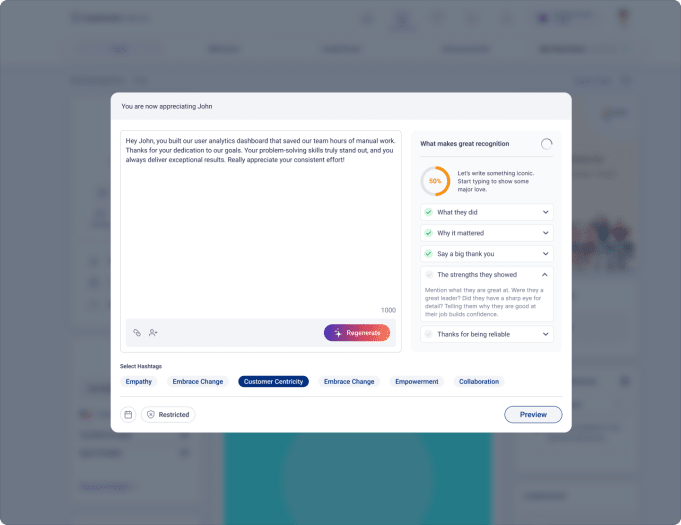
This is the easiest week of the year to do it, because nobody is busy. It is also the week it lands hardest, because so little else is happening.
Nothing scheduled in week four should require more than twenty minutes or a mandatory calendar invite. If it does, move it to week one.
Virtual and Hybrid December Engagement Ideas
Remote teams need December activities built for asynchronous participation, not video calls scheduled across five time zones. An activity that runs in a chat channel usually beats one that needs the whole team online at the same moment.
20. Virtual Secret Santa
Virtual Secret Santa works when the logistics are handled for you. Gift-exchange platforms such as Elfster or DrawNames handle the draw, the budget and the wishlist so nobody has to administer it.
Set the draw early enough for international shipping, or switch to digital gifts entirely. Our virtual Secret Santa gift ideas cover what ships well and what does not.
21. Run an Online Party That is Not Just a Video Call
A video call with no structure is the worst virtual party format. Build the session around a game with rules, and keep it to 45 minutes.
Holiday Pictionary, trivia and a photo-booth thread all give people something to do other than wait for a gap in the conversation. Most team chat and video tools, such as Slack, Zoom or Microsoft Teams, have enough built-in to run these without extra software.
22. Build a Shared Digital Holiday Cookbook
A shared cookbook collects something from everyone without needing anyone online. Ask each person for one recipe that means something to them, and compile it into a single document.
This works particularly well across international teams, because the result is a genuine record of how different people celebrate rather than a themed activity.
23. Send a Remote Care Package
A physical package is the one thing remote staff cannot get from a video call. Keep it small and seasonal, and send it to arrive in the first half of December so it lands before people travel.
For year-round formats, our virtual employee engagement ideas cover what sustains distributed teams outside the holiday period.
Inclusive December Ideas for Teams That Do Not All Celebrate Christmas
A December plan built entirely around Christmas excludes the people on your team who do not celebrate it. Design the month around winter, the year ending and time together, then let Christmas be one part of it rather than the frame.
The season is already hard for a lot of people. Modern Health's survey found that 52% of employees feel lonelier or more isolated during the holidays, and a celebration built on a tradition somebody does not share can deepen that rather than fix it.
| Instead of this | Try this |
|---|---|
| "Christmas party" | "End-of-year celebration" |
| Secret Santa as the only gift exchange | A winter gift exchange with the same rules and a neutral name |
| A Christmas tree as the single decoration | A winter display the whole team adds to |
| Mandatory attendance at a religious-themed event | Opt-in attendance at everything, stated explicitly |
| One December date for everything | Dates checked against Hanukkah, Diwali, Ramadan and local public holidays |
24. Build a Winter Celebration Rather Than a Christmas One
Changing the name changes who shows up. "End-of-year celebration" includes everyone on the team and loses nothing for the people who do celebrate Christmas.
Keep the tree, the music and the food if your team wants them. The framing is what decides whether somebody feels invited or tolerated.
25. Run a Global Traditions Exchange
Invite people to share how they mark the end of the year, whatever that looks like. Some will bring Christmas, others will bring something your team has never heard of.
This turns the inclusion problem into the activity itself. It also works better on distributed teams than almost anything else on this list.
26. Make Every December Event Opt-In and Say So
State plainly that attendance is optional, in writing, on every invitation. Silence on this question reads as pressure, particularly to new joiners and junior staff.
Opt-in events also get better data. If attendance drops, you have learned something real about what your team wants.
27. Check the Calendar Before You Book Anything
Look at the actual dates before fixing yours. Hanukkah, Diwali and local public holidays move each year, and a clash is the most avoidable inclusion failure there is.
Ask the team directly rather than guessing. One message in early November saves a booked-and-rescheduled event in December.
December Engagement for Teams Working Through the Holidays
Retail, healthcare, support and warehouse teams work the days everyone else takes off, and most December engagement plans ignore them entirely. Build their version of the month around compensation and timing first, celebration second.

Not everyone in this group is there for the same reason. Modern Health's survey found that 51% of employees work through the holidays specifically to avoid added personal stress, so some of your team is choosing it. Shift teams usually are not. The plan has to work for both.
28. Stagger the Celebration to the Shift Pattern
Run the celebration more than once so every shift gets one. A single party scheduled on a Tuesday afternoon reaches only the people who were already free.
Two smaller versions on different days reach more people than one large event, and they cost roughly the same.
29. Sort the Premium Before You Plan the Party
Holiday pay, shift differentials and time-in-lieu come before any engagement activity. Getting those wrong makes a celebration read as a deflection.
Confirm the arrangements in writing in November, not the week before. The certainty is worth more than the event.
30. Recognize Holiday Coverage Specifically
Give holiday coverage its own recognition rather than folding it into a general thank-you. Name what the person did and name the day they did it on.
A dedicated badge or award category makes this visible to the whole company, which matters because this work is usually invisible by design. For teams running shift-based operations, our employee engagement ideas for warehouse teams cover the same problem outside the holiday period.
What a December Engagement Plan Should Cost
A December plan does not need a large budget, but it does need a shape. Most of what works costs time rather than money, and December is also when your annual reward budget closes.
| Phase | Activity type | Typical cost per employee | Budget note |
|---|---|---|---|
| Crunch (weeks 1 to 2) | Recognition campaign, spirit week | Low to none | Draws on existing reward points |
| Crunch (weeks 1 to 2) | Wellness sessions | Low | Often covered by an existing provider |
| Christmas week | Party, catering, venue | Highest single line | Book early, confirm headcount late |
| Christmas week | Gifting | Moderate | Gift cards avoid procurement delay |
| Quiet week | Async activities, thank-yous | None | Time cost only |
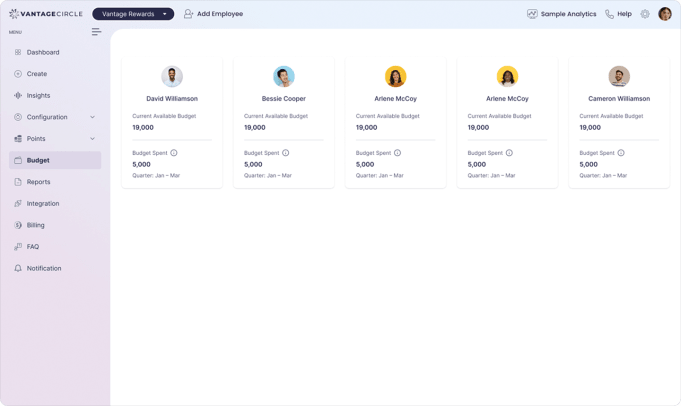
Track December spend against what is left in the annual allocation. The holiday push should not borrow against January, which is when the January employee engagement ideas that carry momentum into the new year need funding.
Summing It Up
December is three engagement problems wearing one name. Plan the crunch weeks for relief, Christmas week for celebration, and the quiet week for recovery, and the month stops feeling like a scramble.
The specific activity matters less than the timing. A Secret Santa in week one is admin. The same Secret Santa in week three is a celebration. A thank-you in the quiet week lands harder than the same words in the busiest fortnight of the year.
Pick one idea per phase, check your dates against who is actually on your team, and sort the holiday pay before you book the party. That is a December plan your people will remember in January.
FAQs
What are good employee engagement activities for December?
The best December activities match the week they run in. Use recognition campaigns, spirit weeks and short wellness sessions in the first fortnight, Secret Santa and the office party in Christmas week, and light asynchronous activities in the quiet week before New Year.
How do you keep employees motivated during the holidays?
Reduce demands rather than adding activities. Shorter optional events, explicit permission to close out existing work instead of starting new work, and specific personal recognition from managers all sustain motivation better than a packed social calendar.
What can you do instead of a Christmas party at work?
Run an end-of-year celebration instead. Keep the same food, music and gift exchange, but name it in a way that includes employees who do not celebrate Christmas, and check the date against other religious and public holidays before booking.
How do you engage employees who work between Christmas and New Year?
Keep it light and voluntary. A no-agenda drop-in call, an asynchronous year-in-review thread and a personal thank-you from each manager work well, because the people covering that week have low momentum and often feel forgotten.
How much should a company spend on holiday employee engagement?
Most high-impact December activities cost little or nothing. The party and gifting are usually the only significant line items. Recognition campaigns, spirit weeks and quiet-week activities draw on existing reward budgets or time alone.
When should you start planning December employee engagement?
Start in early November. Gift exchanges need lead time for shipping, party venues book out, and holiday pay arrangements for shift teams should be confirmed in writing well before the month begins.

Nilotpal M Saharia is an Assistant Manager, Content Marketing at Vantage Circle and a recognition-and-rewards (R&R) strategist with 9 years of experience spanning Marketing, HR, and content strategy. He helps HR leaders turn employee recognition and leadership research into practical workplace programs.
Connect with Nilotpal on LinkedIn.