Six months into a shiny new recognition program, one HR lead had kudos badges, a dedicated Slack shout-out channel, and a quarterly trophy ceremony. The first few weeks were engaging, full of posts, and tagged thank-yous. Then steadily the channel went quiet. By the fourth month, the ceremony felt more like an obligation than a celebration, and when leaders inquired if morale had improved, nobody could say for sure.
This story plays out in many companies because most morale efforts launch well but don't sustain. This is where morale boosters come in.
Employee morale boosters are recognition, wellness, and communication habits that make employees feel more motivated and supported at work. The most effective ones pair visible recognition with a way to track real progress.
Most morale advice repeats the same list: say thank you more, plan a team lunch, offer flexible hours. What it misses is what would've saved the HR lead months of guessing: how to know if it's working.
This blog walks through 35 actionable ideas, organized by how HR teams use them and measure them. A morale plan with no way to track its own progress is just a mere hope.
What Makes a Morale Booster Actually Work
The strongest morale boosters share three common traits: they're specific, well-timed, and repeated often enough to become part of how a team operates. A generic "employee of the month" plaque loses its essence when it becomes routine and impersonal. On the other hand, a specific, well-timed thank-you for quality work hits differently: it tells the receiver their work is seen.
Part of why morale-boosting efforts stall is that people categorize boosters, perks, and rewards together, when they function differently:
Quick definition: morale booster vs. perk vs. reward
A morale booster is any action that measurably improves how employees feel about their work, team, or company, day to day.
A perk is a standing benefit, like free snacks or a gym membership, available regardless of timing or performance.
A reward is tied to a specific achievement or milestone, often monetary or formal. A perk sits in the background of daily work. A reward requires an occasion to trigger it. A booster can happen on an ordinary Tuesday, which is what gives it its pull.
According to the Quantum Workplace study, 22.1% of employees rarely or never receive recognition from their immediate manager or supervisor.
This data shows that recognition has not been built into the daily rhythm of work; hence the gap on the managers' end. Closing that gap is what a real morale strategy is for.
35 Ways to Boost Employee Morale
Don't just skim through it; make sure you implement these morale boosters as early as possible.
Recognition and Rewards
Recognition lands best when it's specific, public, and delivered immediately after the achievement occurs. Saving it for annual reviews diminishes the value and purpose of the recognition in the first place.
Vantage Circle, in association with Great Place to Work, found that in high-recognition cultures, employees don't just feel better, they perform better. 91% feel motivated, and 94% believe their organization is a great workplace. In contrast, emerging recognition cultures report much lower scores, 73% and 78%, respectively.
According to Gallup research, employees who strongly agree that their manager holds them accountable for their performance are 2.5 times more likely to be engaged in their jobs.
Since the data shows that recognition keeps employees motivated and engaged, let's explore how you can leverage your recognition and rewards strategy to boost employee morale.
Give specific, immediate shout-outs as they happen.
Create a public recognition feed where every employee, not just managers, can appreciate a colleague the moment good work is delivered. A shout-out that is visible to the whole team multiplies, but a private message tends to disappear within seconds.
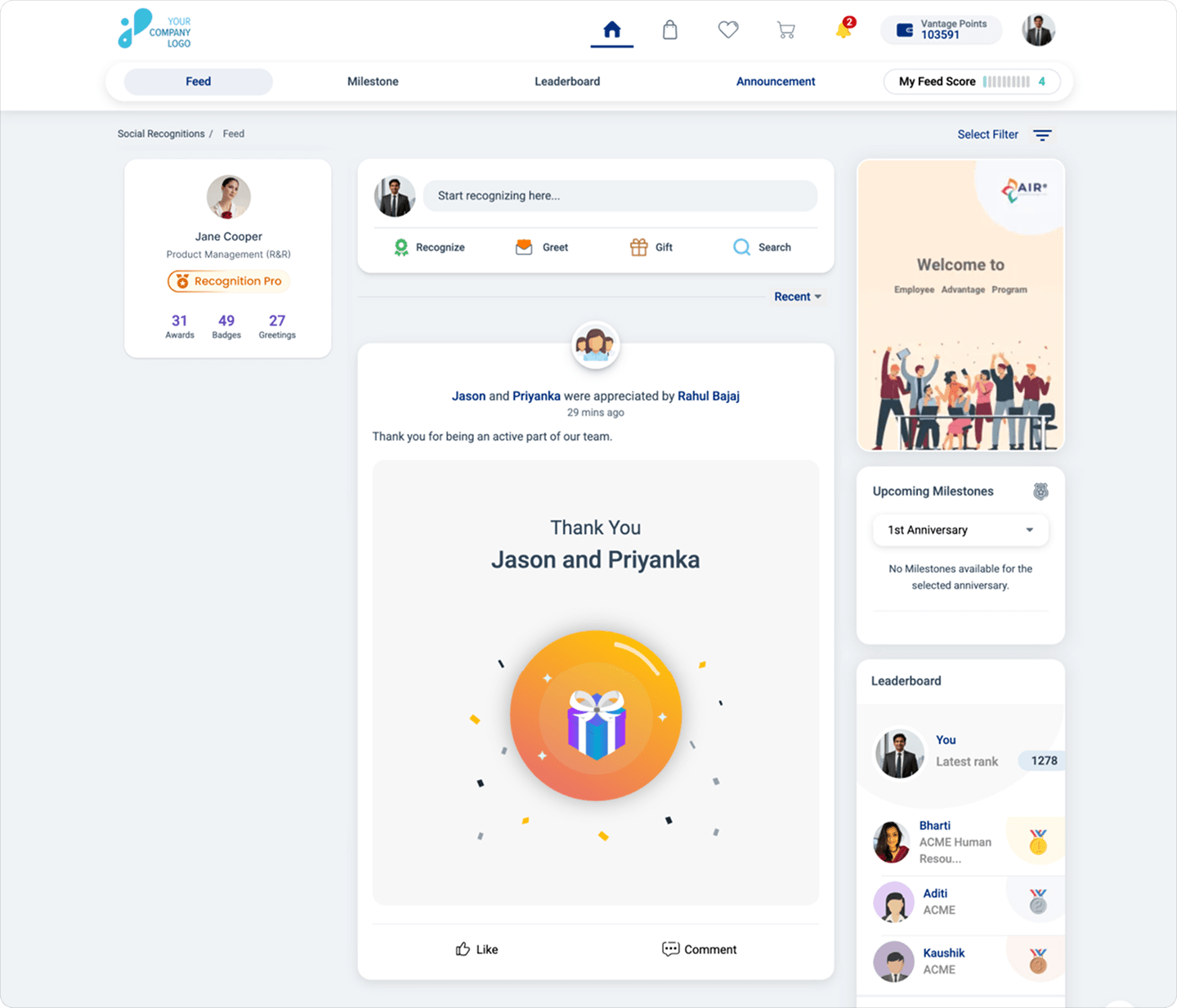
(Source: Vantage Recognition)
Encourage peers to recognize each other publicly.
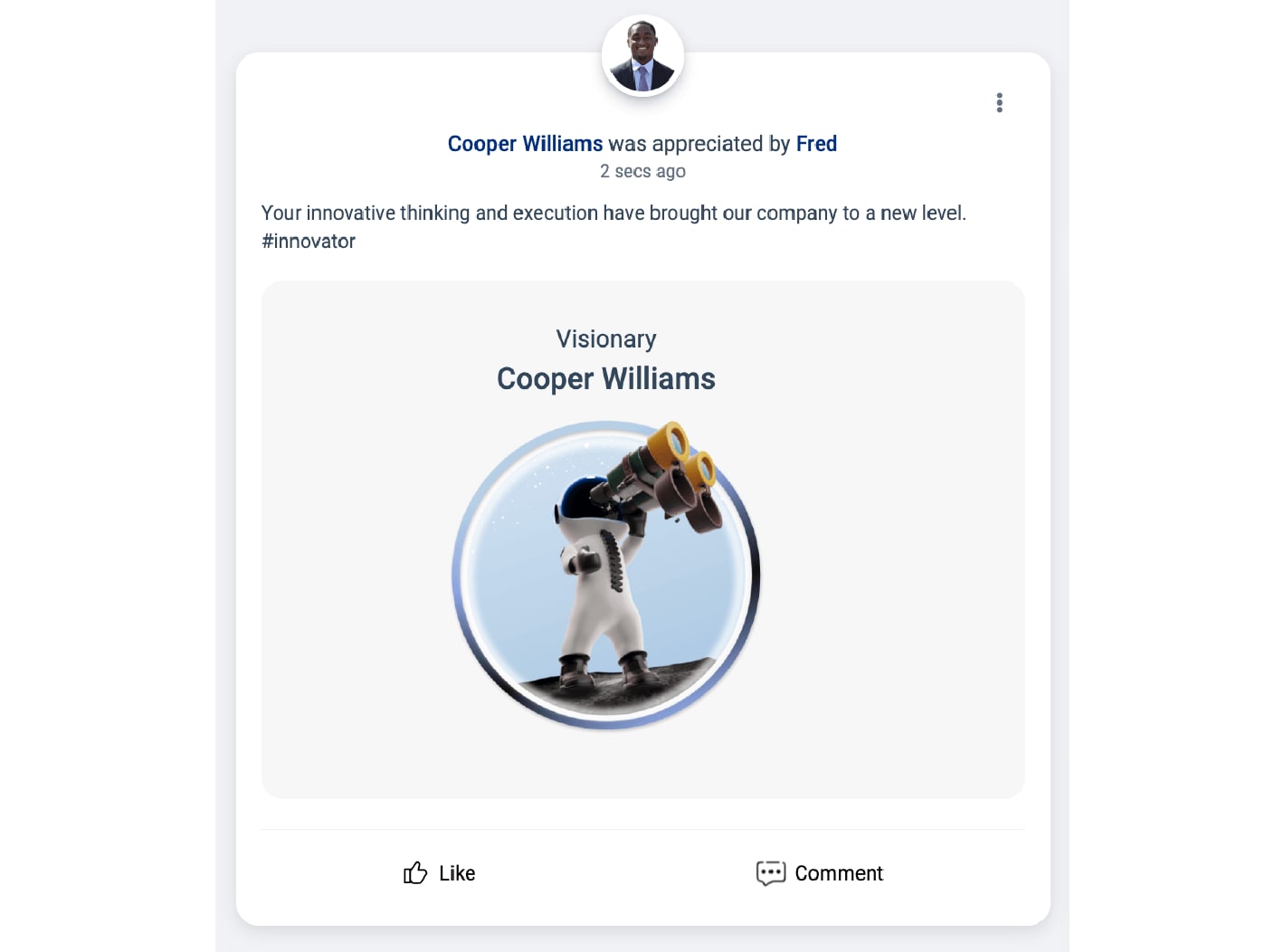
(Source: Vantage Recognition)
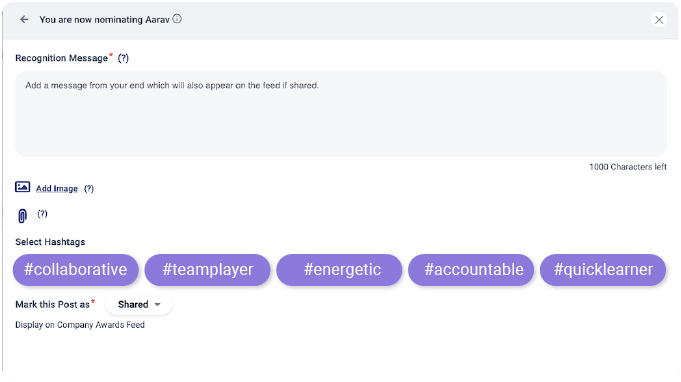
Tie recognition explicitly to a company value so every shout-out reinforces the culture alongside the praise.
(Source: Vantage Recognition)
Enable managers to nominate employees for structured, achievement-based recognition to complement informal peer praise.
Create a leaderboard that surfaces top recognizers and top performers, since it rewards the people actively building the culture.
Recognize effort on failed projects because morale tends to erode faster when only wins are acknowledged.
Ask departing high performers what recognition, if any, they received in their last six months. The pattern usually says more than any survey.
Employee Wellness Initiatives
A wellness initiative works best when it's genuinely easy to fit into someone's day. If it demands extra hours, a long sign-up process, or time employees already lack, most people quietly skip it, no matter how good the intention.
A Zippia study found that 56% of employees participating in company wellness programs report having fewer sick days.
Here's how you can approach the wellness initiatives:
Offer flexible mental health days that don't require a doctor's note.
Bring in a confidential counseling line that employees can access directly, without involving a manager.
Run short, optional mindfulness sessions during the workday.
Add therapy or coaching app subsidies to the standard benefits package by default.
Have leadership take visible midday walks, which normalizes the habit for everyone else.
Set weekly "no-meeting" blocks that give people room to recover between calls.
Survey employees on which wellness benefits they'd use before buying a program that ends up sitting unused.
Professional Development Opportunities
When employees get visibility into what's in store for them in terms of growth, they tend to get motivated in ways a paycheck alone cannot.
Here's what professional development opportunities you can offer:
Offer a modest annual learning stipend that employees can spend on courses, books, or certifications of their choosing.
Pair new hires with a mentor outside their direct reporting line, so career advice happens outside performance conversations.
Let employees shadow a different team for a day each quarter to see how their work connects to the bigger picture.
Build a simple internal mobility policy so moving teams doesn't feel like starting over.
Send one person per quarter to a conference or workshop relevant to their growth, and have them share what they learned.
Team Building Activities
Team building works best when nobody feels forced into it. The moment it feels mandatory, it becomes another task on the calendar instead of something people actually want to show up for.
Explore these following team activities:
Run a short, casual trivia session tied to something the team genuinely cares about.
Organize a volunteer day that employees can opt in together, since a shared purpose builds morale faster than shared snacks.
Host a skills swap where employees teach each other something unrelated to work, from cooking to photography.
Let teams pick their own low-stakes competition, like a step challenge or trivia bracket.
Communication and Feedback Channels
Morale drops fastest when employees are left to wonder what changed and why. Regular two-way communication can help close the gap. Here's what you can do to strengthen communication:
Hold a short weekly team huddle built around wins and blockers.
Create an anonymous suggestion channel that leadership visibly responds to, even when the answer is "not yet."
Share the reasoning behind decisions, especially unpopular ones, so people understand the "why" and not just the outcome.
Ask for feedback regularly, not only during exit interviews.
Fun Ways to Boost Morale at Work
Boosting morale doesn't always require a formal structure. From time to time, you can take a fun detour to boost your employees' morale. Here's what you can do:
Run a themed dress-up day tied to something lighthearted.
Set up a rotating "bring your favorite snack" day, a low-cost habit that gives people something small to look forward to.
Try a short, opt-in wellness challenge, like a step count or hydration streak, with a lighthearted leaderboard.
Host a virtual game session so distributed teams become part of the fun too.
Celebrate personal milestones, like a marathon finished or a course completed, alongside work anniversaries.
Create a rotating "office DJ" or music playlist employees vote on each week.
Give teams an afternoon to work on a passion project unrelated to their usual tasks.
Cost-Effective Strategies to Boost Morale
Some of the most effective morale boosters cost little more than intention and consistency.
| Idea | Cost | Time to Implement |
|---|---|---|
| Handwritten or personal thank-you notes | Free | Same day |
| Flexible start and end times | Free | 1–2 weeks (policy update) |
| Peer shout-out channel | Free–Low | 1 day (Slack/Teams setup) |
| Everyday employee discounts on groceries, travel, and retail | Low | 2–4 weeks (vendor setup) |
| Occasional early-finish Fridays | Free | Immediate |
| Skills swap sessions between employees | Free | 1 week |
| Manager-hosted informal office hours | Free | Immediate |
| Small budget for team-chosen lunch or snacks | Low | Immediate |
Measure Your Morale Efforts, Don't Just Guess
Instead of waiting for complaints to pile up, you can assess whether your morale efforts are working by regularly tracking a few signals. A quietly disengaged team can continue hitting deadlines for months, and it can go unnoticed for months without a structured check-in.
And here's what morale guides or blogs hardly cover. Companies run recognition programs, wellness perks, and team events, and assume they're working. A handful of companies actually check whether they're working.
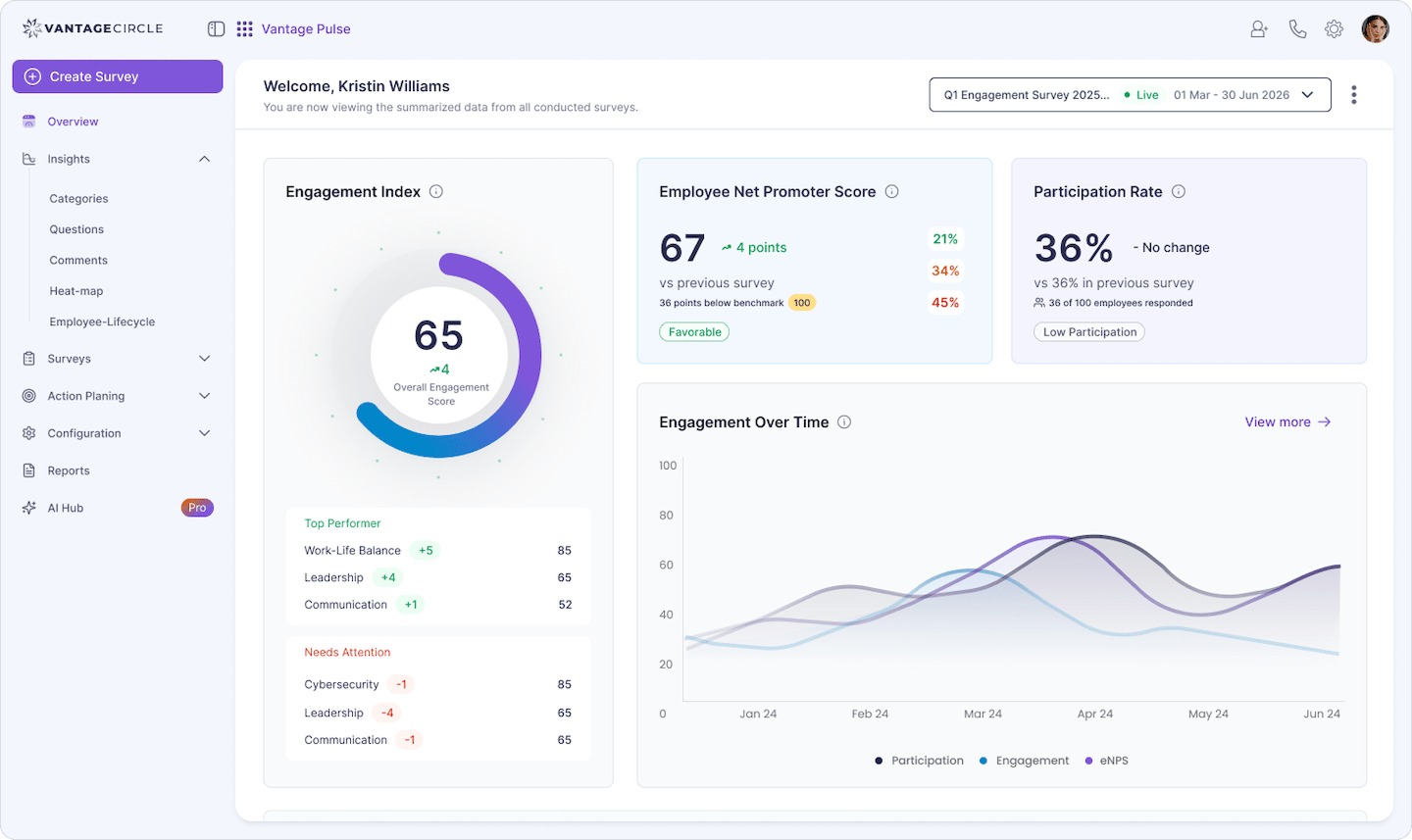
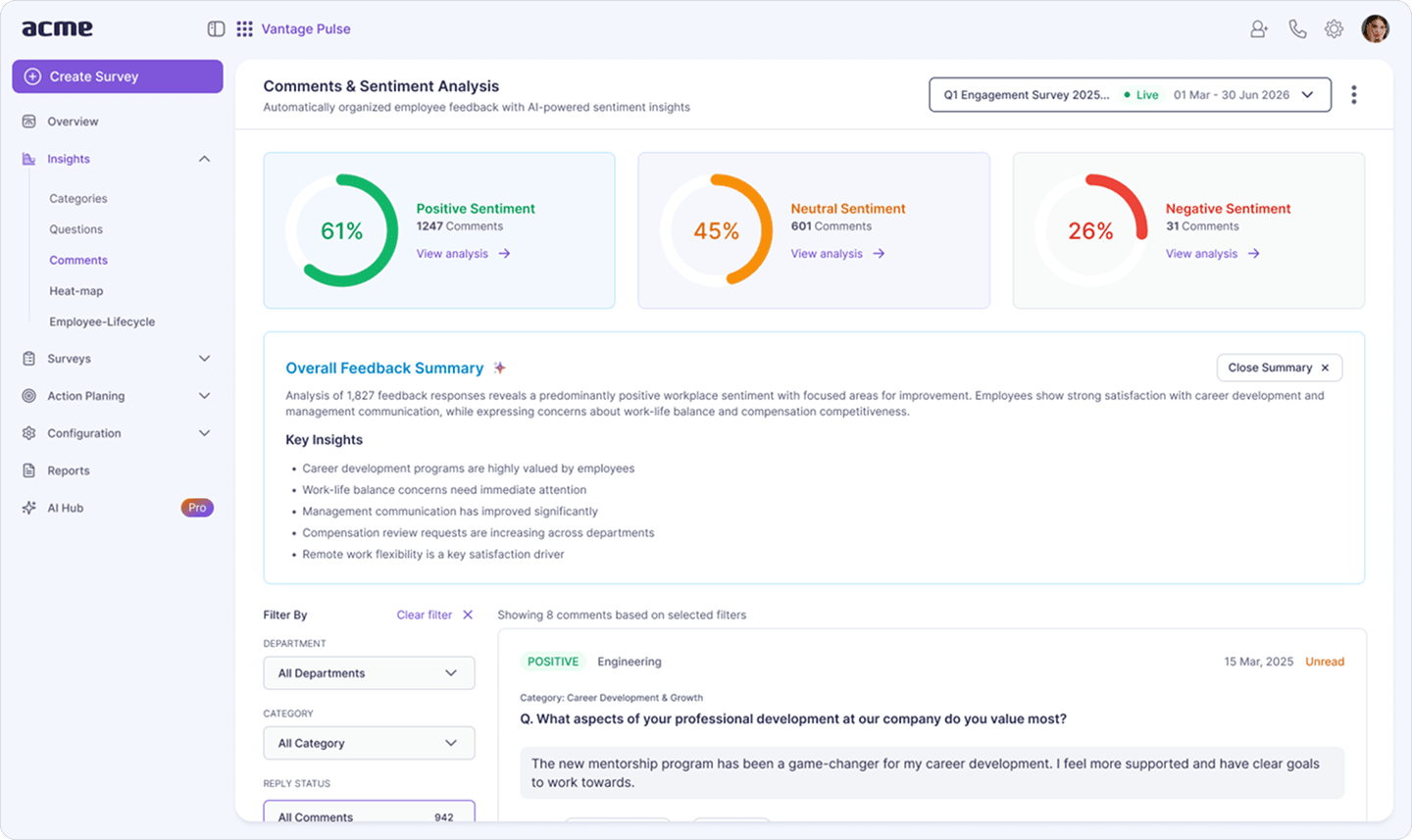
A recurring Employee Net Promoter Score (eNPS) survey turns that assumption into a real number you can track over time. AI sentiment analysis of open-text survey responses can automatically spot recurring themes, catching a morale dip before it leads to resignation.
| Signal | What It Tells You |
|---|---|
| eNPS score | Overall willingness to recommend the company as a place to work, tracked over time |
| Sentiment trend in open-text responses | Whether the tone of employee feedback is improving, flat, or declining |
| Department-wise score gaps | Which specific teams are struggling, beyond the company average |
| Recognition frequency | Whether appreciation is happening day to day |
| Survey participation rate | Whether employees still trust that feedback leads to action |
(Source: Vantage Pulse)
Simply running programs will not suffice. You must know whether the programs are helping you move the needle. So, tracking how your programs perform is essential.
Why Employee Morale Boosters Are Essential
High morale undoubtedly makes a workplace pleasant, but it also affects business outcomes.
Increased Employee Engagement: Employees who feel genuinely appreciated show up mentally present, which is the actual marker of engagement.
Enhanced Productivity: Teams with steady morale divert less energy to managing frustration and focus more on the work itself.
Improved Retention Rates: Turnover is expensive. According to SHRM, the cost of replacing an employee can range from 50% to 200% of their annual salary, depending on their level. Morale boosters can play a key role in keeping people engaged and protect directly against that cost.
Boost Creativity and Innovation: Employees who feel safe and valued are more inclined to engage in creative thinking and have innovative discussions because they spend less mental energy guarding against criticism or blame.
Better Team Dynamics: Recognized, supported employees tend to help teammates more readily, since morale spreads laterally across a team as much as it does top-down from management.
Higher Customer Satisfaction: Employees' satisfaction with their workplace eventually gets reflected in every customer interaction. This makes morale as much a customer-facing metric as an internal one.
What Kills Morale at Work
The biggest morale killers are unclear expectations, lack of recognition, and poor leadership communication. They usually act together rather than in isolation.
Burnout makes them worse. The data below supports this:
Eagle Hill Consulting's 2023 Workforce Burnout Survey, conducted with Ipsos, found that 46% of American employees reported burnout, mainly from workload (53%), staffing shortages (44%), juggling personal and professional lives (41 percent), a lack of communication and support (39 percent), and time pressures (38 percent)
These problems build up quietly over months. That's why measuring morale matters as much as the ideas themselves. One missed thank-you rarely does lasting damage. But an unnoticed pattern, the one nobody tracks, is what eventually results in resignation.
Best Practices for Implementing Employee Morale Boosters
The following best practices will ensure your morale-boosting efforts are working for you, not against you, in the long run.
Understand Employee Needs
Always ask before you make assumptions. A wellness stipend that nobody uses signals that leadership isn't paying attention to what employees want. This is arguably worse than not offering one at all.
Empowerment and Autonomy
Give people real control over how they do their work. Autonomy is one of the cheapest morale boosters available, and also one of the most consistently underused.
Promote Inclusivity and Diversity
Morale efforts that only reach one group of employees, like an in-office happy hour that leaves remote staff out, quietly chip away at morale for everyone excluded.
Leadership Visibility
Morale efforts often stall when recognition stays peer-to-peer only, with leadership standing on the sidelines. Structured tools that let managers recognize specific achievements keep leadership visibly part of the process.
Consistency and Sustainability
A single morale campaign fades within weeks. But sustained morale comes from routines you keep running long after the initial launch buzz fades, like weekly recognition, a regular pulse check, and a standing feedback loop.
Manager tip: If you supervise a team rather than run the whole organization, you don't need a company-wide budget to move morale. A specific five-minute thank-you delivered inside your next one-on-one moves the needle more than most managers expect.
Conclusion
Boosting morale comes down to picking a handful of ideas from this list of 35 that fit your team, making them routine, and then checking whether they work. Recognition, wellness, and honest communication all play a role, but measurement is the piece almost every guide skips.
Track eNPS, watch sentiment trends, and look at department-level gaps rather than focusing only on the company average, and you'll know which of these ideas are landing well before turnover forces the answer.
FAQs
How to boost the morale of employees?
Boost employee morale by combining specific, frequent recognition with genuine flexibility and honest communication about decisions that affect the team. The ideas that work best are the ones repeated consistently rather than saved for a quarterly event.
What is a good morale booster?
A good morale booster is specific, timely, and tied to real work. A detailed, well-timed thank-you for a specific piece of work carries more weight than a generic "great job, everyone" email.
What are 9 quick ways to boost employee morale?
Nine quick ways include public shout-outs, flexible start times, a peer recognition channel, occasional early-finish days, a short team huddle focused on wins, an anonymous suggestion box leadership responds to, small everyday discounts, a rotating snack day, and a five-minute personal thank-you in a one-on-one.
What are some fun ways to boost employee morale?
Fun, low-cost options include themed dress-up days, opt-in wellness challenges with a lighthearted leaderboard, a rotating team playlist, virtual games for remote employees, and celebrating personal milestones alongside work anniversaries.
What are some fun and engaging appreciation games for employees?
Engaging appreciation formats include peer-nominated recognition leaderboards, a "wall of wins" employees can post to themselves, trivia tied to team milestones, and a recurring shout-out round at the start of a weekly huddle.

Riha Jaishi is a Content Marketing Specialist at Vantage Circle and host of the HR Vantage Influencers podcast, sharing insights that help organizations build recognition-rich, people-first cultures!!
Connect with Riha on LinkedIn.