
Most recognition programs are built around the HR calendar.
The work they're supposed to recognize isn't.
Consultants remember client engagements. Recruiters remember difficult placements. Tax professionals remember busy season. Creative teams remember campaign launches.
Yet many organizations still recognize employees according to reporting schedules rather than work rhythms.
That's where recognition often breaks down in business services firms. The issue usually isn't appreciation. It's timing.
A management consulting firm, advertising agency, law firm, accounting practice, IT services provider, recruiting company, and engineering consultancy may all employ knowledge workers, but the moments that matter most are fundamentally different.
This post examines seven business services segments and the reward and recognition strategies that align with their unique work rhythms.
Here's a quick snapshot of how recognition priorities differ across the seven major business services segments covered below.
| Sub-Segment | Focus | Best Reward Pattern | Recognition Cadence |
|---|---|---|---|
| Management Consulting | Project-cycle recognition | RFP-win spot bonuses + post-project decompression | Every 6-12 weeks |
| Advertising & Marketing | Creative output + campaign launches | Craft awards + campaign-launch spot recognition | Campaign-launch-aligned |
| HR & Recruiting | Placement success + talent quality | Placement bonuses + candidate-NPS peer recognition | Monthly + per-deal |
| Legal / Law Firms | Billable performance + partner-track | Billable-milestone awards + mentorship recognition | Quarterly + matter-completion |
| Accounting / Audit | Busy-season decompression | Post-season bonuses + CPA-track milestone awards | Post-busy-season + quarterly |
| IT Services / BPO / KPO | Shift-based + skill development | Client-NPS recognition + certification awards | Monthly + skill-milestone |
| Engineering Consulting | Long project cycles + design craft | Project-milestone awards + PE/AIA recognition | Milestone-aligned + annual |
Why Business Services Firms Need Industry-Specific Recognition
The biggest mistake in business services recognition is assuming fairness means consistency. A law firm, consulting firm, accounting practice, and IT services provider may all employ knowledge workers, but they don't experience work in the same way. Their milestones, pressure points, and definitions of success are fundamentally different.
That's why recognition programs built around fixed monthly, quarterly, or annual cycles often miss the moments that matter most.
Three dynamics make business services recognition different from most corporate programs:
1. Utilization pressure. Billable-hour and utilization-rate cultures mean employees measure their worth in output delivered for clients. Recognition that ignores client outcomes misses what people actually care about.
2. Client-facing visibility. High performance in business services is often invisible internally. A consultant who saves a client relationship, an accountant who catches a critical error, an IT team that delivers ahead of deadline: these moments need a recognition system that can capture them in real time.
3. Matrix-org reporting. Most professional services firms run practice areas, geographies, and client accounts simultaneously. Recognition needs to reach across these structures, not just up the management line.
A consulting HR leader once told me that her firm's annual awards ceremony recognized a project team nearly four months after delivery. By then, half the team had moved to new engagements. One consultant had already left the firm. The award wasn't wrong. It was just too late. That's the recognition problem in business services: not generosity, but timing.
Also read: The Complete Guide to Employee Recognition
Employee Rewards Across 7 Business Services Sub-Segments
No single reward pattern works across all business services. The seven sub-segments below each have a different work rhythm, a different pressure point, and a different definition of a win worth celebrating.
1. Management Consulting
In consulting, every engagement has a clear winner: the team that delivered. The problem is that most recognition programs aren't built to see it. Consulting cultures celebrate client wins publicly and measure contribution by engagement impact, but only when the recognition system is calibrated across levels. A program that rewards partners and ignores analysts, or vice versa, demotivates the half it missed.
Reward Patterns:
- RFP-win spot bonuses for the proposal team
- Post-engagement decompression rewards (extended leave, remote-work flexibility, wellness stipends) after high-intensity project delivery
- Partner-track milestone awards at key career inflection points
- Peer nominations for consultants who mentor or develop junior colleagues
Recognition Cadence: Every 6-12 weeks, aligned to project delivery cycles, not monthly.
Most Common Mistake: Annual-only recognition misses 10 months of meaningful moments in a profession that runs on 6-12 week cycles.
SHRM research shows that companies with effective recognition programs are 31% less likely to face voluntary turnover. In consulting, where client-relationship transfer costs are measured in months of ramp-up time, that retention effect has direct revenue implications.
Vantage Rewards' Campaign Management lets HR teams schedule time-bound recognition tied to RFP wins, project launches, and partner-track milestones rather than arbitrary monthly cycles.
2. Advertising and Marketing Services
Award-show culture defines recognition in advertising and marketing. Agencies benchmark craft against external industry standards, Cannes Lions, Effies, Webbies, and a recognition program that mirrors that standard resonates in a way that a generic spot bonus never will. The goal is to celebrate craft and innovation, not just business outcomes.
Reward Patterns:
- Campaign-launch spot awards for the full team (account, creative, strategy, production)
- Peer-voted craft awards for the most innovative brief, concept, or execution
- Industry-conference sponsorships for top performers
- Public recognition tied to external award submissions and shortlists
Recognition Cadence: Campaign-launch-aligned. Recognition lands when work ships, not when the calendar says it should.
Most Common Mistake: Ignoring below-the-line production roles. Account directors and creative directors receive the spotlight; producers, coordinators, and project managers who actually delivered the campaign are often invisible in recognition programs.
McKinsey (2025) found that 52% of employees are more motivated when financial rewards are combined with non-financial recognition, and 44% say combined rewards improve company performance. For advertising teams, the non-financial element, including public craft recognition, award nominations, and visible peer appreciation, often carries more weight than the bonus itself.
3. HR and Recruiting Services
HR and recruiting teams carry a built-in paradox: they design recognition programs for everyone else and are often the least recognized group in the organization. SHRM (2024) found that 79% of employees say increased recognition would make them more loyal. The teams building those programs are not exempt from needing the same.
Reward Patterns:
- Placement-tied spot bonuses for difficult-to-fill roles
- Candidate-NPS-driven peer recognition for recruiters who deliver exceptional candidate experience
- Milestone-deal celebrations for first senior hire, first executive placement
- "People Champion" awards for HR team members who improve employee experience beyond their direct role
Recognition Cadence: Monthly plus per-deal. Placement recognition should land within days of a successful close, not at the end of the quarter.
Most Common Mistake: Treating quota achievement as the only recognition trigger. The real value HR and recruiting teams create is in candidate experience and long-term quality of hire. Recognition that only rewards volume misses the relationship dimension.
4. Legal and Law Firms
Law firms lose their most valuable people at precisely the wrong moment: the 2-4 year mark, when senior associates are productive enough to lead matters but not yet partner-track committed. Most law firm recognition programs over-index on billable hours and miss the relationship-building, mentorship, and pro-bono work that actually predicts who stays.
Reward Patterns:
- Billable-milestone awards at 1,800, 2,000, and 2,200 hours annually
- Mentorship recognition for partners and senior associates who develop junior talent
- Pro-bono contribution awards for high-impact work that doesn't appear on a timesheet
- Matter-completion bonuses for high-complexity or high-stakes case deliveries
Quarterly recognition is the right baseline, but the real moment is at the matter level. In a profession where significant work happens case by case rather than month by month, tying awards to matter completion captures what annual reviews always miss.
Most Common Mistake: Recognizing billable hours only. The lawyers who build client relationships, mentor junior associates, and contribute to firm culture are the retention risk, not the top billers.
5. Accounting and Audit Firms
Ask any tax manager when their team is most receptive to recognition. It isn't February. It's the first week of May, when everyone can finally breathe again. US tax season (January to April) and audit cycles create predictable pressure windows where recognition either lands or is drowned out entirely. Most firms spend months preparing for busy season and almost no time planning what happens after it.
Reward Patterns:
- Post-busy-season bonuses and wellness packages delivered in May and June for US tax teams
- CPA, CMA, or CFA passage awards that celebrate professional certification visibly
- Client-retention spot recognition for account managers who maintain long-term relationships
- Team decompression experiences (off-site retreats, team dinners) in the week after filing deadlines close
The most impactful recognition in accounting firms happens in May and June, immediately after the deadline. The same budget spent in February, competing with 60-hour weeks, lands in a room that isn't listening.
Most Common Mistake: Running recognition campaigns during busy season. Save the investment for May.
6. IT Services, BPO, and KPO
The recognition challenge in IT services and BPO/KPO is not motivation. It is geography. A delivery chain spanning Bangalore, Manila, Eastern Europe, and the US cannot run on a US-only rewards catalog. When offshore teams receive rewards redeemable only in American retail stores, the recognition signal breaks regardless of the intent behind it.
Reward Patterns:
- Client-NPS-tied recognition for account and delivery teams when client satisfaction scores improve
- Skill-certification awards for technical upskilling: AWS, Azure, Salesforce, Six Sigma, ITIL
- Shift-leader peer recognition that works across time zones
- Multi-currency rewards catalog accessible from any delivery geography
Monthly recognition works in IT services for a simple reason: delivery never really stops. Unlike consulting engagements that close and reset, IT services teams are always mid-cycle. Recognition has to keep pace with work that doesn't have a natural endpoint.
Most Common Mistake: US-only rewards catalog for a global delivery team. Vantage Rewards' catalog of 10M+ rewards across 100+ countries is designed specifically for distributed services teams.
7. Engineering Consulting and Architecture
Engineering and architecture firms often have the most misaligned recognition programs in professional services. When a project runs 18 months, monthly recognition cycles have nothing meaningful to attach to. The recognition rhythm has to follow the project, not the calendar. That requires a deliberate program design decision, not just a platform setting.
Reward Patterns:
- Project-milestone awards at key design phases: schematic design approval, construction document completion, project handover
- Design-award nomination sponsorships for standout projects
- Professional registration recognition: PE (Professional Engineer), AIA (licensed architect), LEED certification
- Peer recognition for cross-disciplinary collaboration in multi-team project deliveries
Recognition tied to project milestones is the only cadence that makes sense in engineering firms. These are the moments people remember, not the end of a quarter. Annual recognition serves as a secondary anchor, but it cannot carry the full weight of retention in a 36-month engagement.
Most Common Mistake: Monthly recognition programs in firms with 12-36 month project cycles. Tie recognition to actual milestones, not the calendar.
What This Looks Like in Practice
Marriott International, with over 170,000 US employees across properties in all 50 states, has embedded recognition into its management culture for decades. The work is client-facing, shift-based, and distributed, structurally similar to the delivery pressures in IT services, consulting, and accounting.
The outcome: a 6% reduction in US property turnover, saving $30 million annually. Marriott has appeared on Fortune's 100 Best Companies to Work For for over 28 consecutive years. 85% of its employees call it a great place to work, compared to 57% at a typical US company.
5 Reward Types That Work Across All Business Services Sub-Segments
Regardless of sub-segment, the most effective business services recognition programs draw from five reward categories. The mix shifts by sub-segment; the categories remain constant.
1. Spot Recognition and Bonuses (Client-Win Moments)
Spot bonuses and awards delivered within 48-72 hours of a client win, project delivery, or exceptional performance event are the strongest recognition signal available. Delayed recognition loses most of its motivational effect in fast-moving services environments where the next engagement cycle begins almost immediately.
2. Tenure and Service Awards (Retention Anchors)
Senior consultants, partners, and account leads cost $200,000-$500,000 or more to replace when you account for client-relationship transfer and ramp-up time. Service anniversary awards at 3, 5, 10, and 15-year marks are among the most cost-effective retention investments a professional services firm can make. Automating these milestone triggers removes a manual tracking burden that grows unsustainable as firms scale across geographies.
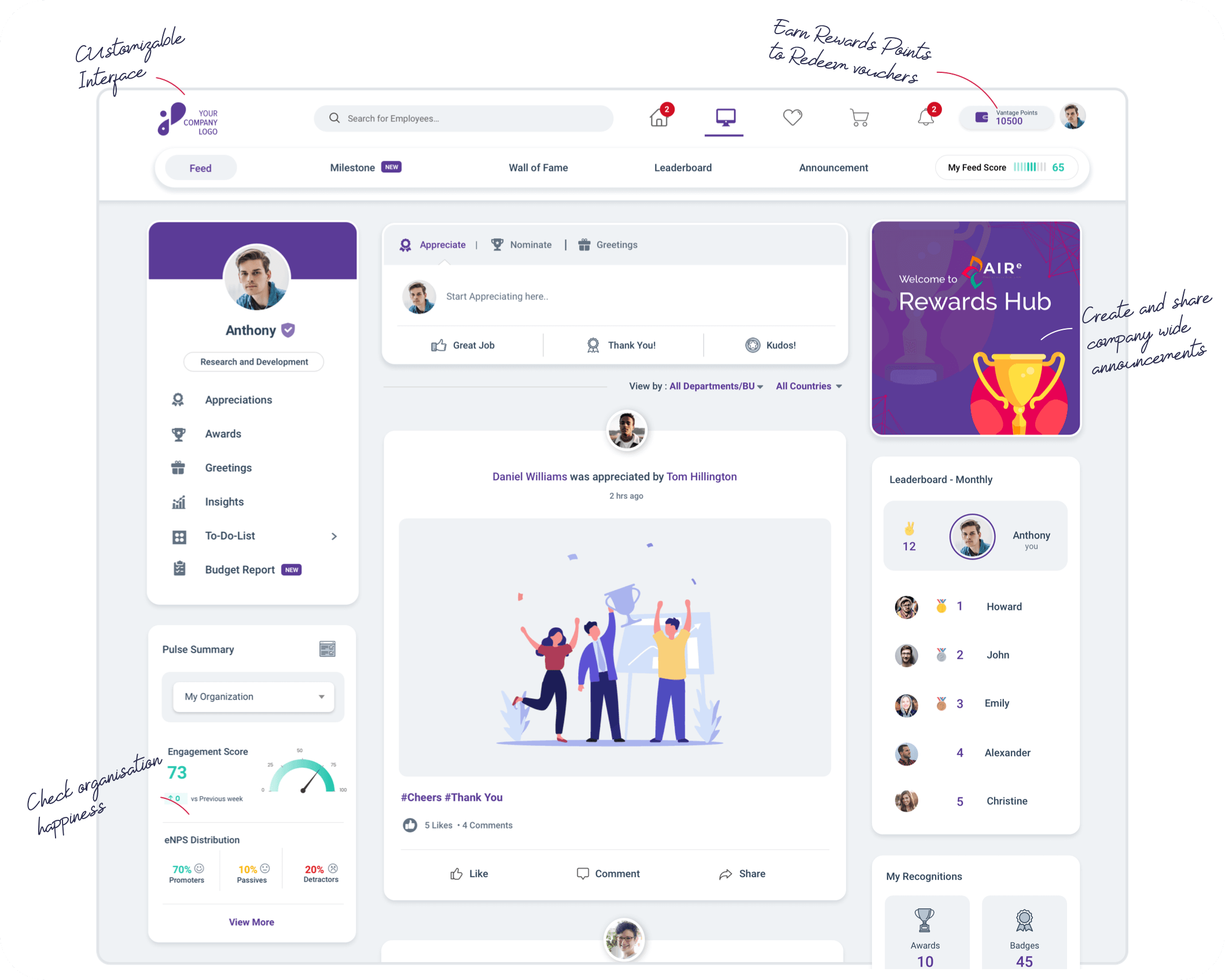
3. Peer-to-Peer Recognition (Matrix-Org Collaboration)
In matrix organizations running across practice areas, geographies, and client accounts, the direct manager is often not the person who observes the best work. Peer-to-peer recognition lets the people who worked alongside a colleague celebrate their contribution, regardless of reporting structure.
Source: Vantage Rewards
4. Learning and Certification Awards (Career-Track Investment)
Professional services are credential-driven. Recognizing CPA passage, PE registration, AWS certification, or partner-track completion signals that the firm invests in careers, not just output. These awards have disproportionate retention impact at the 2-4 year mark, when business services professionals most commonly decide whether to stay or move to a competitor.
5. Wellness and Decompression Rewards (Post-Project and Post-Season)
Extended leave, wellness stipends, or team retreat experiences after high-intensity delivery windows are the reward category most specific to business services. Consulting firms, accounting practices, and law firms all have predictable pressure windows followed by natural decompression opportunities. Recognition that lands in this window shows an understanding of how the work actually feels to the people doing it.
Read more: How to Build an Employee Reward Program
The Retention Math: Recognition Pays for Itself in Business Services
Business services firms run on human capital. Unlike manufacturing or technology, there is no equipment or intellectual property that retains value when people leave. The value walks out with them.
Gallup research estimates that replacing an employee costs between 50% and 200% of their annual salary. For senior consultants, partners, and account leads who carry client relationships, the actual cost lands at the upper end of that range once you account for client-relationship disruption, recruitment fees, onboarding, and the 12-18 months it takes a replacement to reach full productivity.
The AIRe Benchmarking Report found that recognition-driven cultures maintain 92% retention rates compared to 76% in low-recognition cultures. A 16-percentage-point retention advantage in a professional services firm with high replacement costs translates directly to the bottom line.
A recognition program at benchmark investment levels runs at approximately 1-2% of payroll, or $500-$2,000 per employee per year. For a 300-person professional services firm:
- Program cost: approximately $300,000-$600,000 annually
- If recognition reduces voluntary turnover by 2 percentage points (from 15% to 13%, a realistic range for recognition-driven improvement), that prevents roughly 6 exits per year
- Cost avoided: 6 exits x $200,000 average replacement cost = $1,200,000 in recruitment, onboarding, and transition costs
The program pays for itself on retention alone.

Source: Vantage Pulse
Read more: Employee Engagement and Productivity: The Connection HR Leaders Need to Understand
2026 Trends Reshaping Recognition in Business Services
Three developments are reshaping how business services firms approach employee recognition this year.
1. AI-Augmented Services Delivery
As AI takes over routine work, firms face a new question: how do you recognize judgment? The work that remains: client judgment, relationship management, and complex problem-solving. It is harder to measure but more valuable. Recognition programs need to shift from output-based rewards toward recognizing the decisions and relationships that AI cannot replicate.
2. Skills-Based Recognition Replacing Tenure-Only Anchors
Tenure still matters. But it no longer tells you who your best people are. As credential-driven firms move toward skills-based talent models, recognition programs anchored only to years of service are losing relevance at the 2-4 year mark, precisely when attrition risk peaks. The shift means firms need to recognize demonstrated capability, certification completion, and cross-practice contribution alongside tenure. For business services HR leaders, this is less a trend than an alignment problem: the recognition program has to match how the firm actually values talent.
3. Billable-Hour Evolution
When firms stop measuring hours, they face an uncomfortable follow-up question: what do you measure instead? Value-based billing and fixed-fee engagements are replacing pure billable-hour models across professional services. Recognition programs that reward output, impact, and client outcomes become structurally aligned with the business model, rather than running as a parallel administrative system that no longer reflects how the work is priced.
How to Build a Recognition Program for Your Business Services Firm
Step 1: Identify Your Dominant Work Rhythm
Is your firm project-cycle-driven (consulting, engineering), campaign-launch-driven (advertising), shift-based (IT services and BPO), cyclically intense (accounting), or deal-based (recruiting)? The answer determines when recognition should land and when it will be ignored regardless of how generous the reward is.
Step 2: Map the 5 Reward Types to Your Rhythm
Match each reward type to your work cycle. Post-project decompression awards require project-cycle data. Certification awards require integration with L&D tracking. Spot bonuses require a fast-track approval workflow.
Step 3: Choose a Platform With Multi-Currency and Matrix-Reporting Support
Most business services firms operate across geographies, practice areas, and client accounts simultaneously. A recognition platform that only reports by department, rather than by practice area, client account, or geography, will not give HR leaders the visibility they need.
Step 4: Tie Recognition to Client Outcomes, Not Just Internal Milestones
The most credible recognition in business services connects to client results: a client NPS score that improved, a project delivered ahead of schedule, a contract renewed. Internal-milestone-only programs feel disconnected from the work that defines success in client-facing firms.
Step 5: Measure Recognition Coverage by Practice Area and Retention by Tenure Tier
The two metrics that matter most are coverage (the percentage of employees who received at least one recognition in the last 90 days, broken down by practice area) and retention by tenure tier (whether recognized employees stay longer at the 1-year, 3-year, and 5-year marks). These two metrics give HR leaders the data to defend the program's budget and identify gaps before they become attrition problems.
Read more: How to Run an Employee Engagement Survey That Actually Drives Change
Bottom Line
Business services recognition works when it matches the rhythm of the work, not the calendar of the HR department. A consulting firm that recognizes only at annual reviews, an accounting practice that runs recognition campaigns in February, or an IT services organization with a US-only rewards catalog are all running programs that are structurally misaligned with how their work actually happens.
The 7 sub-segments above each have a distinct work rhythm, a distinct pressure point, and a distinct definition of a win worth celebrating. Building a recognition program means starting from that rhythm and working backward to the reward type, cadence, and platform capabilities you need.
The firms that get this right aren't running more generous programs. They're running better-timed ones.
Frequently Asked Questions
How do I build a business case for a recognition program in a professional services firm?
Calculate the fully loaded replacement cost for your most valuable role tier and estimate how many exits a 1-2 percentage point turnover reduction would prevent. In professional services, that math typically returns the full program cost within the first year. Frame it as a retention investment, not a culture initiative.
How often should business services firms give recognition?
Match the cadence to the work rhythm: project-cycle firms every 6-12 weeks, campaign-based firms at launch, continuous-delivery firms monthly, accounting firms immediately post-busy season. Monthly HR-calendar recognition imposed on a 12-week engagement cycle is the most common mismatch.
What should a recognition platform handle for a global consulting or IT services firm?
Multi-currency catalog, matrix-org reporting by practice area and geography, and HRIS integration for milestone automation. For firms with offshore delivery centers, catalog coverage across 50+ countries is a baseline requirement, not a premium feature.
How do we design recognition across different billing models?
In hourly-billed firms, explicitly recognize non-billable contributions alongside utilization milestones. In fixed-fee and retainer models, tie recognition to client outcomes rather than hours.

Supriya is a Content Marketing Lead at Vantage Circle, where she writes on employee engagement, recognition, workplace communication, and culture. Her work on remote team recognition draws on primary research from Vantage Circle's platform data and customer deployments across distributed workforces. She spent the earlier part of her career in corporate communications at Burson, ESPN Star Sports, and CBRE, advising organizations on the messages employees actually hear.
Connect with Supriya on LinkedIn.