Every company claims its people are its greatest asset. The training budget is usually where you find out whether it means it.
For years, development was treated as a welcome-week ritual: a few slide decks, a compliance module, a handbook nobody finished. After that, employees were expected to keep up on their own, in a world where their tools change faster than most job descriptions.
That approach is quietly expensive. People rarely resign over a missing course. They resign when they can no longer picture a version of themselves that is better than today's, and they usually reach that conclusion long before HR hears about it. The companies getting this right have stopped treating training as a cost to justify and started treating it as the clearest signal of whether someone has a future there. Below is what separates a training budget that actually sends that signal from one that doesn't: the types of programs worth running, how to design them, and how to make sure a new skill survives past the course.
Key Takeaways
- What Is Employee Training and Development?
- Training vs. Development: What's the Difference?
- 6 Measurable Benefits of Employee Training and Development
- 8 Types of Employee Training Programs
- The Most Effective Training Methods
- The 5 Stages of Training and Development (ADDIE)
- How to Make Training Stick After the Course
- Real Examples of Training and Development
What Is Employee Training and Development?
Employee training and development is how an organization builds the skills its people need today and the capabilities it will need tomorrow, covering everything from a single onboarding course to a multi-year leadership pipeline. The Association for Talent Development (ATD) defines it similarly: a function focused on developing the knowledge, skills, and abilities of employees so an organization can meet its current and future goals.
Most of what people call "L&D" (learning and development) sits inside this function, covering identifying a skills gap, choosing and running a program, and checking whether it worked.
Training and Development in HRM
Within the HR function, training and development in HRM covers four recurring steps: a needs analysis to find the actual skills gap, a budget to fund the response, a delivery method suited to the skill, and an evaluation to confirm it worked. None of these steps is optional. Skipping the needs analysis means training the wrong skill; skipping the evaluation means never knowing whether the money was well spent.
That budget line is real money. US companies spent $102.8 billion on training in 2025, a 4.9% increase from the year before, according to Training magazine's 2025 Training Industry Report.
Training vs Development: What's the Difference?
Training builds skills for the current job in the short term; development grows capability for future roles over the long term. The two get used interchangeably, but a program built for one rarely works for the other.
| Dimension | Training | Development |
|---|---|---|
| Time horizon | Immediate, often days to weeks | Months to years |
| Focus | One specific skill or task needed now | Broader capability for a future role |
| Trigger | A skills gap, a new tool, or a compliance requirement | A career path, a succession plan, or a promotion |
| Owner | The direct manager or the L&D team | The employee, with manager and HR support |
| How it's measured | Task performance, completion rate, error rate | Promotion readiness, internal mobility, retention |
| Example | Learning the new CRM before go-live | A two-year stretch-assignment plan toward a team-lead role |
Training responds to a problem that exists right now: a skills gap, a new tool, a compliance requirement. Because the problem is current, the response stays short, days to weeks rather than months, and it's owned by whoever is closest to the gap, usually the direct manager or the L&D team. It's judged by whether the person can now do the task correctly: completion rates, task performance, error rates.
Development starts from a different place: a future role the person doesn't hold yet, not a current problem. With no deadline forcing it, it plays out over months or years instead of weeks. Ownership shifts too: the employee has to drive it, since no one else can build their career for them, with the manager and HR supporting rather than directing. And because there's no single task to grade, it's judged by proxies for whether someone is actually getting closer to that future role: promotion readiness, internal mobility, retention.
That mismatch in time horizon, ownership, and measurement is exactly why a program built for one so rarely works for the other. A short, task-focused module won't build the judgment a future leader needs over years, and an open-ended development track won't close a skills gap that needs fixing this week. Employee development plan covers how to build the longer-term kind properly.
Employee development goes deeper into the development side specifically, including the 4 common approaches and how to build a development plan.
6 Measurable Benefits of Employee Training and Development
Training lifts performance in the current role, and development keeps people growing inside the company instead of outside it. Six benefits show up consistently when organizations invest in both.
1. Faster Time to Productivity
A new hire or a newly promoted employee reaches full performance faster when the specific skills their role needs are taught directly, instead of picked up by trial and error on the job.
2. Higher Retention and Internal Mobility
Companies with strong learning and development programs are 50% more likely to retain employees, according to LinkedIn's 2023 Workplace Learning Report. When people can see a path to grow inside the company, they look for it there first instead of outside it.
See employee retention strategies for the fuller picture of keeping people, training and development included.
3. Fewer Errors and Safer Operations
Skills taught deliberately, rather than assumed, show up directly in fewer mistakes, less rework, and fewer safety incidents, especially in technical, compliance, and frontline roles.
4. Stronger Engagement
Only 20% of employees worldwide were engaged at work in 2025, according to Gallup's 2026 State of the Global Workplace report. Investing visibly in someone's skills is one of the more direct ways to counter that, because it signals the company sees them as worth developing, not just staffing.
Employee engagement covers the broader drivers beyond training specifically.
5. A Bench for Future Leaders
Development programs that build capability ahead of need, not after a role opens up, are what let a company promote from within instead of hiring externally under time pressure.
6. Employer Brand That Attracts Learners
Candidates notice when a company visibly invests in people. Amazon's Career Choice program now prepays up to 100% of tuition for eligible frontline employees in several countries, up from its original 95% prepayment, according to Amazon's own program updates. The exact terms vary by country, but the direction is the same: visible investment in learning has become a recruiting advantage.
8 Types of Employee Training Programs
The 8 most common types of employee training programs are onboarding, technical, soft-skills, compliance, leadership, product, safety, and cross-training. Each fixes a different problem, and each reinforces best in a different way.
| Type | What It Fixes | Best Method | How to Reinforce It |
|---|---|---|---|
| 1. Onboarding | New hires don't know how the company actually works | Blended: instructor-led plus self-paced modules | Manager check-ins at 30/60/90 days |
| 2. Technical and digital skills | A tool, system, or technical process has changed | E-learning plus hands-on practice | Recognize the first real task completed with the new skill |
| 3. Soft skills | Communication, feedback, and collaboration gaps | Coaching and role-play | Manager observation and peer feedback |
| 4. Compliance | Legal, safety, or policy requirements | Short e-learning modules, repeated on a schedule | Spaced refreshers, not one annual module |
| 5. Leadership and management | New or struggling people managers | Coaching, cohort programs, external facilitation for senior levels | Ongoing coaching, not a single workshop |
| 6. Product and customer-facing | Teams don't know the product well enough to sell or support it | Instructor-led plus simulations | Recognize successful customer outcomes |
| 7. Safety (frontline) | Physical risk on the job | Hands-on, in-person demonstration | Immediate recognition of safe behavior observed |
| 8. Cross-training and job rotation | Single points of failure, narrow skill sets | Structured job rotation | Badges or certificates for each role mastered |
Most organizations front-load budget into onboarding and compliance, since both come with a hard deadline attached. Leadership and cross-training tend to get what's left over, because nothing forces them to happen on a schedule. That ordering works against retention, since leadership and cross-training are the two types most tied to whether a skilled employee can see a future for themselves inside the company, rather than having to leave to grow.
1. Onboarding Training
Onboarding training means teaching a new hire how the company and their specific role actually work, not just company policy. It's the one type of training almost every employee goes through, which makes it the highest-leverage place to get right.
2. Technical and Digital Skills Training
Technical and digital skills training keeps employees current as the tools and systems they use change. This is the type of training with the shortest shelf life, since it needs refreshing every time the underlying technology does.
3. Soft-Skills Training
Soft-skills training builds the communication, feedback, and collaboration abilities that technical training doesn't touch. See soft skills in the workplace for which ones matter most and how to build them.
4. Compliance Training
Compliance training covers the legal, safety, and policy requirements an organization is obligated to teach, regardless of role. It is also the type most likely to feel like a checkbox, which is exactly why reinforcement matters more here, not less.
5. Leadership and Management Training
Leadership and management training prepares people to manage other people, a skill set that technical competence alone doesn't produce. Christine Rumble, founder of Dawn Consulting Services and former Chief Talent and Culture Officer for a hotel group spanning 23 countries, makes the case for a mix of internal and external trainers here: "If you have good quality internal trainers, highly skilled trainers, they can actually be very valuable to the organization, because they understand the company values and can be the custodian of the culture, making sure the right culture is filtered through every layer in the business." She adds that bringing in an external facilitator for senior leadership still has real value, since it "gives new insights, new perspectives, and stops silo thinking." You can hear the full conversation in our podcast with Christine Rumble.
6. Product and Customer-Facing Training
Product and customer-facing training makes sure the people talking to customers actually know what they're selling or supporting. Gaps here show up directly in customer experience, which makes this one of the easier types to tie to a business outcome.
7. Safety Training
Safety training is non-negotiable in frontline, manufacturing, and field roles, where a skipped step carries physical risk. It's also one of the few training types where the cost of under-investing is measured in injuries, not just inefficiency.
8. Cross-Training and Job Rotation
Cross-training and job rotation means teaching people to do more than one role, which removes single points of failure and gives employees a broader view of how the business works. Experiential learning in the workplace covers the learning-by-doing approach this type of training depends on.
What Are the Most Effective Employee Training Methods?
The most effective training methods mix on-the-job practice, coaching, and short, spaced digital lessons. One-off classroom sessions on their own are consistently the least effective, because nothing reinforces the material afterward.
- On-the-job training and shadowing works best for technical and role-specific skills, but it's only as good as the person being shadowed; it falls apart if that "shadow" isn't actually skilled at teaching.
- Coaching and mentoring is the strongest method for leadership and soft skills, but only if the coach puts in real time. A title alone doesn't make someone a coach.
- Micro-learning is built for reinforcement and just-in-time skills. It doesn't hold up for deep, complex topics on its own.
- Instructor-led training suits onboarding and complex or nuanced topics, but it's expensive to scale and easy to forget without follow-up.
- E-learning via an LMS or LXP scales self-paced knowledge transfer cheaply, though completion rates stay low without a manager following up.
- Simulations and role-play are worth the effort for high-stakes or customer-facing scenarios, but they're time-intensive to build and run well.
None of these methods holds up well in isolation for long. The strongest programs pair a method that delivers information, like e-learning or an instructor-led session, with one that reinforces it on the job, like coaching or micro-learning. A course with no reinforcement step attached is usually where a training budget quietly goes to waste, regardless of how good the course itself was.
A learning management system (LMS) hosts and tracks formal courses and compliance training. A learning experience platform (LXP) goes further, surfacing short, relevant content the way a streaming service surfaces a show, often blending micro-learning with social and informal learning. Team coaching covers the coaching and mentoring method in more depth.
What Are the 5 Stages of Training and Development?
The 5 stages of training and development are analysis, design, development, implementation, and evaluation, known together as the ADDIE model. Treating it as a straight line from analysis to evaluation is the most common mistake; the stages work better as a loop that feeds back into the next round of analysis.
Stage 1: Analyze the Skills Gap
Analysis means confirming the actual skills gap before building anything, using a mix of manager input, performance data, and direct employee input.
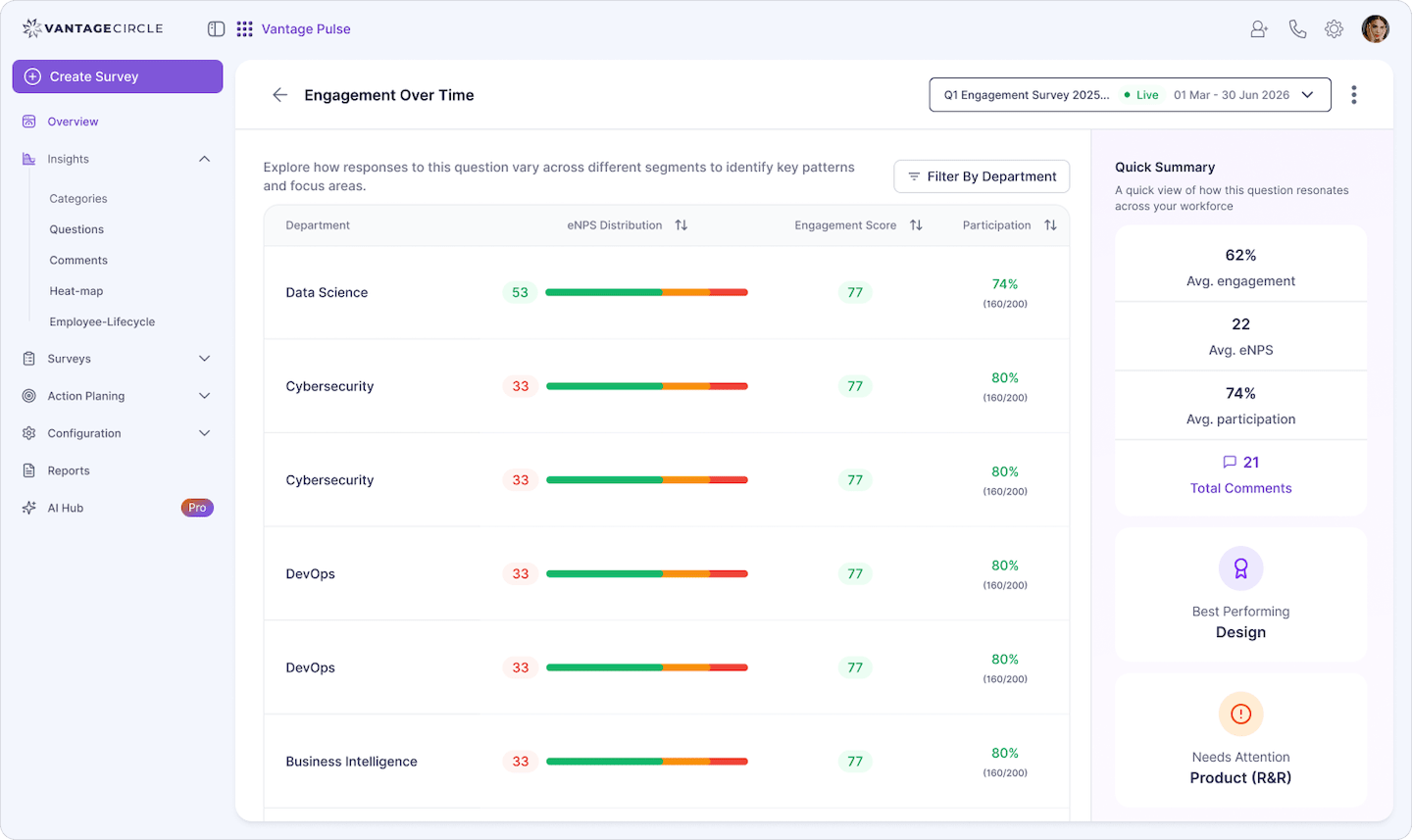
A short pulse question, such as which skill would make someone's job easier this quarter, compared by department, shows where the real gaps are before a single course gets bought.
Stage 2: Design the Program Around One Behavior Change
Design means deciding what behavior should look different after the program, before deciding on content or format. A program designed around a vague goal like "better communication" is much harder to evaluate than one designed around a specific behavior change.
Stage 3: Develop the Content
Development is the build-buy-or-borrow decision: write the content in-house, license an existing course, or bring in an outside facilitator. Christine Rumble's point on budget applies directly here: making digital tools and libraries available to everyone, regardless of age or seniority, is what keeps a limited L&D budget from quietly excluding entire segments of the workforce.
Stage 4: Implement With Managers, Not Around Them
Implementation works best when managers are actively involved, not treated as a scheduling obstacle. A manager who never mentions the training again signals, more loudly than any email, that it didn't matter.
Stage 5: Evaluate With Kirkpatrick's 4 Levels
Evaluation is where most training programs stop short, usually at a completion certificate instead of a real answer about return on investment (ROI). Kirkpatrick's model gives four levels to actually check.
| Level | Question | What to Collect | When |
|---|---|---|---|
| 1. Reaction | Did people find it useful and relevant? | Post-session survey | Immediately after |
| 2. Learning | Did they actually learn the material? | Quiz or skills assessment | Immediately after |
| 3. Behavior | Are they using it on the job? | Manager observation, pulse survey | 30 to 90 days after |
| 4. Results | Did it move a business metric? | Performance, error rate, or sales data | 90 days or more after |
Levels 1 and 2 are the easiest to collect and tell you the least: people can rate a session highly and pass the quiz without ever changing what they do back at their desk. Levels 3 and 4 are harder to collect, since they mean checking in weeks or months later, but they're the ones that actually tell you whether the training was worth running. If a team can only reliably add one level beyond the basics, level 3, behavior, is the one worth the effort, because it's the direct link between what was taught and what the business gets back. Level 3 is also the level most teams skip, which is exactly where training quietly fails to translate into results.
See training effectiveness survey questions for how to build the survey for levels 1 and 3.
How Do You Make Training Stick After the Course?
Training sticks when people practice it in spaced intervals and get recognized for using the new skill on the job. This is the stage most training programs skip entirely, and it's where most of the value quietly leaks out.
Sahar Khan, Head of Learning & Development at BMW Group India, grounds this in the psychology of forgetting. On Vantage Circle's HR Influencers podcast, she explains it through the century-old Ebbinghaus forgetting curve: "There's a concept called the curve of forgetting: in the 1880s, a German psychologist named Hermann Ebbinghaus formulated what's now called the Ebbinghaus forgetting curve, which shows that the more time passes between learning a concept and putting it into use, the more likely that material is to be forgotten." She cites research suggesting up to 90% of what's learned fades within two months without reinforcement at intervals. "The antidote is spaced learning," she says, "presenting concepts at regular intervals to reinforce retention." You can hear the full conversation in our podcast with Sahar Khan.
Space the Practice
Spacing practice means revisiting a new skill at intervals after the initial training, rather than expecting one session to make it permanent. Continuous learning culture covers how to build spaced, ongoing learning into daily work rather than treating it as a one-time event.
Recognize the Behavior, Not the Certificate
A completion certificate proves attendance, not change. 77% of high-effectiveness recognition programs choose award recipients mainly on observed behaviors, compared with 27% of other programs, according to The State of Recognition & Rewards 2025 (Vantage Circle). Recognizing the first time someone actually uses the new skill on a live task tells them, and the team watching, that the behavior is what counts, not the badge of having sat through the course.
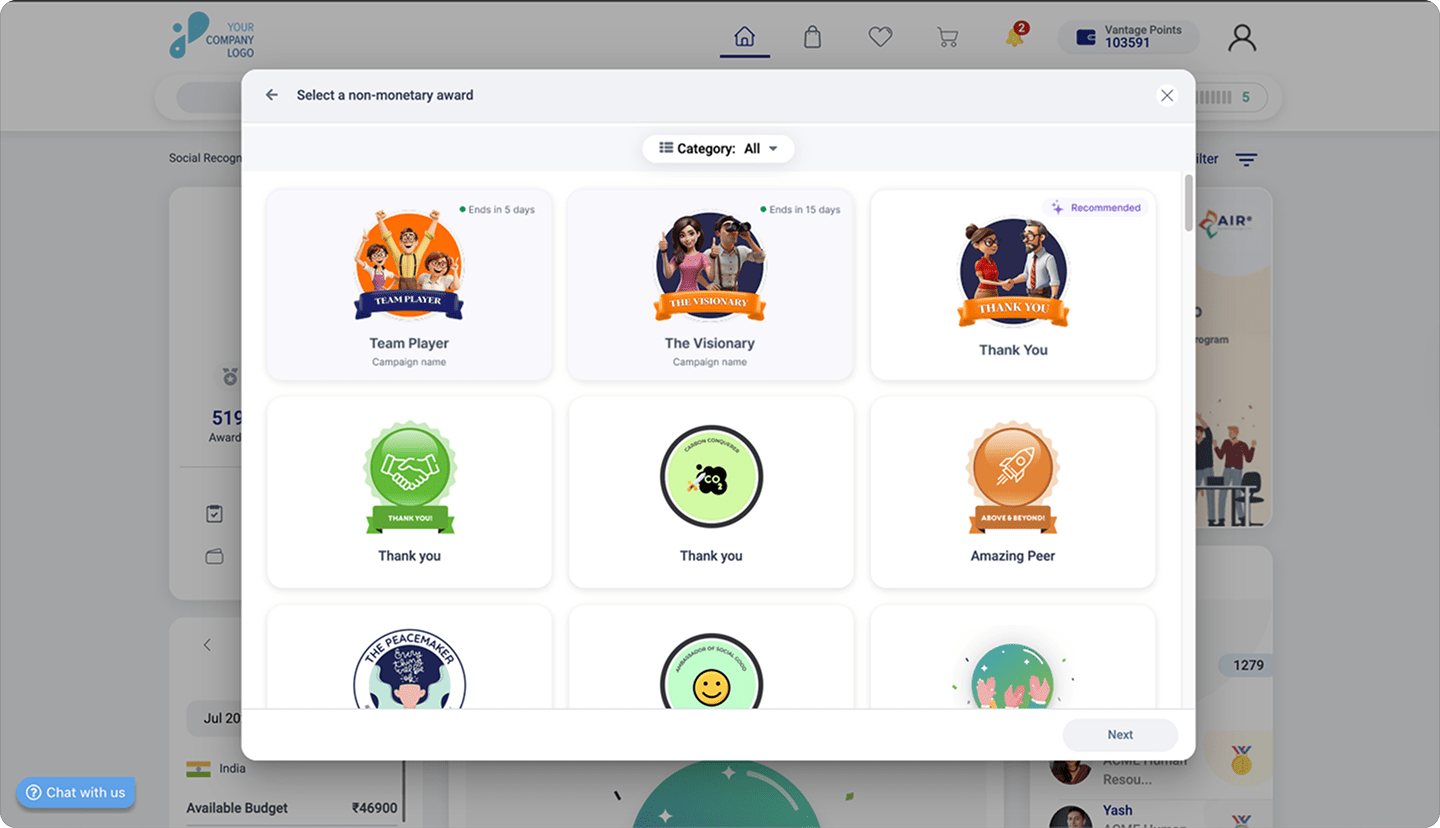
Reward Repeat Use With Escalating Badges
A single badge marks that a skill was used once. 60% of high-effectiveness recognition programs use escalating rewards, badges, or titles for employees who repeatedly show a desired behavior, compared with just 13% of other programs, according to The State of Recognition & Rewards 2025 (Vantage Circle). Tiered skill badges, practitioner, coach, expert, turn one-off use into a habit, and make the people who've actually mastered a skill visible to colleagues who need help.
Keep Learners Motivated Past Week One
Motivation to practice a new skill tends to fade fast once the course itself is over. 91% of employees in high-recognition cultures feel motivated, compared with 73% in emerging-recognition cultures, an 18-point gap, according to The Recognition Effect, a study of 5.7M+ employees (Great Place To Work® India × Vantage Circle, 2025).
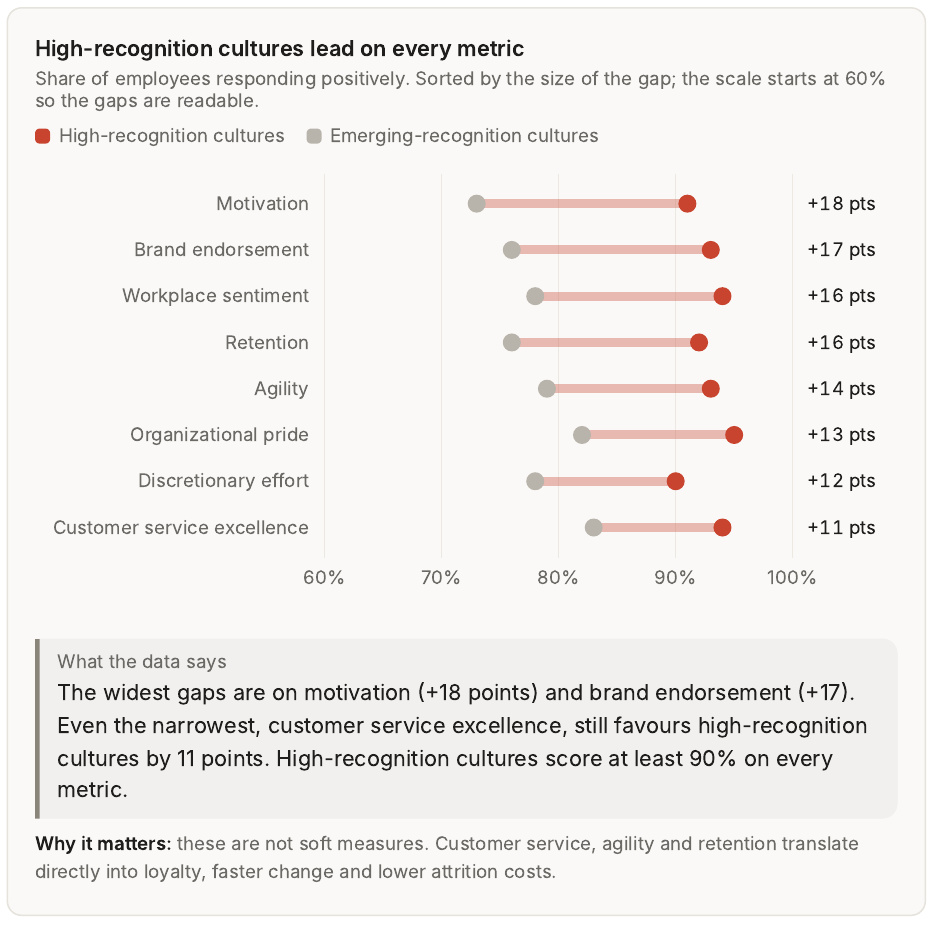
That gap doesn't close itself. Peer-to-peer recognition covers how to spread it beyond the manager, so motivation to keep practicing a new skill doesn't depend on one person noticing.
Employee Training and Development Examples
Good training programs pair one skill with one method and one way to reinforce it. The following are illustrative patterns, not specific company claims.
- A frontline team runs safety training as short, in-person micro-sessions rather than one long annual session, and supervisors recognize safe behavior observed on the floor the same week.
- A new-manager cohort goes through a coaching program together, with their own managers checking in at 30, 60, and 90 days instead of treating the program as complete at graduation.
- A software rollout trains a small group of "champions" first, who then support their teams directly, with badges marking who's reached proficiency.
- A sales team earns a product certification tied to a specific new feature, with recognition for the first confirmed sale that used it.
Employee development plan covers how to turn examples like these into an actual written plan for one person.
Conclusion
Training builds the skill. Reinforcement is what turns it into proof that a company meant what it said about its people being its greatest asset. The 8 types of programs and the 5-stage process get a new skill into someone's hands, and that part is table stakes now, since most competitors can match it. What happens after the course, whether practice gets spaced out, whether someone recognizes the first real use of the skill, is what decides whether that skill is still visible on the job two months later, and whether the person who learned it experienced the training budget as an investment in them or as a line item that happened to include their name.
FAQs
What is an L&D team?
An L&D (learning and development) team is the group responsible for identifying skills gaps, designing or sourcing training programs, delivering them, and evaluating whether they worked. In smaller organizations this sits inside HR; in larger ones it's often its own function with dedicated instructional designers, facilitators, and an LMS or LXP administrator.
What are the most effective employee training methods?
The most effective methods combine on-the-job practice, coaching, and short, spaced digital lessons rather than relying on any single format. One-off instructor-led sessions with no follow-up are consistently the least effective, since nothing reinforces the material once the session ends.
What are 5 areas of improvement for employees?
The areas that come up most often in training needs analyses are communication, time management, delegation, giving and receiving feedback, and technical or digital skills specific to the role. Which ones matter most depends entirely on the actual skills gap a manager or pulse survey surfaces, not a generic list.
What are the 5 stages of training and development?
The 5 stages are analysis, design, development, implementation, and evaluation, known together as the ADDIE model. Analysis confirms the real skills gap, design and development build the program around one behavior change, implementation runs it with managers involved, and evaluation checks whether it actually worked.
What are examples of training and development?
Common examples include onboarding programs, compliance e-learning, technical certifications, leadership coaching cohorts, mentorship and reverse-mentoring pairings, and stretch assignments that build a skill ahead of a future role. Training examples tend to target a current task; development examples tend to target a future one.
What are the five P's of professional development?
There is no single, research-backed "five P's" framework for professional development the way there is for the ADDIE process. Different trainers and consultancies use the phrase for different lists, commonly some mix of Purpose, Personalization, Priority, and Passion, or an alternative built around Planning, Positioning, Promotion, and Progression. Treat any version you come across as one consultancy's framework rather than an agreed industry standard.

Shaoni Gupta is a content marketing specialist at Vantage Circle, with expertise in scriptwriting and copywriting in the field of employee rewards and recognition.
Connect with Shaoni on LinkedIn.