
Imagine an employee whose work schedule includes checking emails, joining team meetings, completing assignments on time, and consistently delivering good work. From a manager's perspective, everything seems to be going well.
But there's another side to this story, which nobody pays attention to.
The employee rarely hears whether their work has made a difference. Conversations with colleagues mostly focus on deadlines and project updates. Even when they go the extra mile, their efforts sometimes go unnoticed. It gradually dwindles their connection to the team and the organization.
This is a challenge many remote teams face. While remote work offers flexibility and independence, keeping employees engaged requires consistent communication, meaningful recognition, and a sense of belonging.
So, how can HR leaders and managers keep remote employees engaged, motivated, and connected?
This blog best answers the question. Explore eight practical strategies to engage remote employees, along with simple ways managers can build engagement into their daily routines and measure what's working.
Why Remote Employees Disengage
Remote employees don’t get the same exposure as office employees do. This becomes a major barrier that puts employees on the path to disengagement.
Erupting from this setting are three common workplace challenges that can contribute to disengagement.
Buffer's 2023 State of Remote Work found that 23% of surveyed remote workers identified loneliness as a struggle. The same study found that 19% experienced difficulty working across time zones.
1. Employees feel their work goes unnoticed
Given the remote setting, remote employees often complete tasks independently or collaborate through digital platforms. Hence, managers may see the final output without fully understanding the effort involved.
According to The Recognition Effect 2025, developed by Great Place to Work India and Vantage Circle, 30% of employees still feel unseen at work.
This finding rather covers a broader employee population. However, it highlights a concern worth addressing. If the office workers continue to feel unseen, imagine what remote workers must endure, given the distance involved.
2. Physical Presence Influences Opportunities
In regular office and hybrid settings, employees who make regular or partial visits to the office have more opportunities to interact with decision-makers.
Remote colleagues miss important conversations, high-visibility assignments, and informal career development discussions.
3. Employees Struggle to Disconnect
When home becomes the workplace, employees struggle to set clear boundaries because the line between work and life gets blurred.
Meetings across time zones, frequent messages, and expectations of immediate responses can gradually extend work hours.
8 Strategies to Engage Remote Employees
The eight strategies discussed below fall under the three important areas of the remote employee experience.
Communication and alignment
Strategy 1: Set a Predictable Communication Rhythm
It is a known fact that remote employees work across multiple communication platforms, including email, Microsoft Teams, Slack, and project management tools.
Even when employees use multiple communication platforms, employees need clear communication guidelines. Without proper guidelines, employees struggle to grasp which conversations require immediate attention and which can wait.
Managers can assist employees by setting up a simple communication schedule.
For example, a distributed marketing team could follow this routine:
Daily updates: Employees share their priorities, progress, and challenges through a common communication channel.
Weekly team meetings: The team discusses project updates, upcoming deadlines, and areas requiring collaboration.
Monthly discussions: Managers review broader priorities, team challenges, and opportunities for improvement.
For teams distributed across different time zones, asynchronous communication will be particularly useful. This lets employees respond when their schedules allow, without requiring everyone to be available simultaneously. Also, documenting important decisions can also help employees refer to them later.
Organizations can explore additional ways to improve remote team collaboration.
Strategy 2: Conduct Regular One-on-One Check-Ins
Remote employees may hesitate to raise concerns during group meetings, especially when conversations center on completing tasks.
That’s when a dedicated one-on-one meeting creates an opportunity to discuss issues more openly. Managers can set aside 15 to 30 minutes every week, based on employee needs and team size.
Begin the conversations with simple questions:
How has your workload been this week?
Is anything making your work difficult?
Do you need additional support or resources?
Is there something you would like to learn or work on?
For instance, an employee can highlight that coordinating with colleagues in another time zone has become difficult. The manager can then follow up by reviewing meeting schedules, clarifying communication expectations, or adjusting responsibilities wherever possible.
One-on-one discussions should also encompass conversations about employee accomplishments, career interests, and wellbeing, moving beyond issues.
Managers who regularly cancel these meetings may unintentionally signal that employee concerns are a low priority. Regular conversations help employees feel comfortable sharing feedback and asking for support.
Strategy 3: Focus on Outcomes Instead of Online Activity
One of the haunting challenges of remote management is understanding how work progresses without observing employees directly.
Some managers associate productivity with constant availability on messaging platforms or responding immediately to every notification.
However, online presence has little to no insight into work quality. Gauging productivity from online presence is a faulty yardstick that does not guarantee accuracy.
For instance, an employee preparing a detailed research report may need several uninterrupted hours to concentrate. Frequent check-ins could make the task harder to complete.
That said, managers should establish clear expectations at the beginning of an assignment.
These should include:
The expected outcome and quality standards
Project deadlines and milestones
Individual responsibilities
Opportunities to discuss challenges
How progress will be reviewed
Now consider a software development team. Instead of tracking how long developers stay active on a messaging platform, the manager can review completed development tasks, testing outcomes, project milestones, and collaboration.
Employees gain greater clarity on expectations, while managers have a more meaningful way to assess performance.
HR teams can support this approach by establishing consistent performance management guidelines for both remote and office-based employees.
Recognition and growth
Strategy 4: Make Employee Recognition Visible and Meaningful
In an office, a manager can personally congratulate an employee after a successful presentation. Team members may also acknowledge one another during everyday conversations. But remote employees have fewer opportunities for these spontaneous moments.
Therefore, managers need to be more deliberate about recognizing contributions. Recognition is especially meaningful when employees understand exactly what they did well. Specificity is key here.
For example, instead of writing "Great job on the project," a manager could say: "Thank you for coordinating with the client and making sure we completed the project ahead of schedule. Your planning helped the entire team stay on track."
This message validates the employee's contribution and the impact of their work.
Research also emphasizes the relationship between recognition and motivation.
The Recognition Effect 2025, developed by Great Place To Work India and Vantage Circle, found that 91% of employees in high-recognition cultures felt motivated, compared with 73% in emerging-recognition cultures.
The difference highlights how employees' experiences of recognition heavily influence their motivation at work.
Here’s how managers can make recognition more meaningful through a few practices:
Recognize employees soon after an achievement.
Explain what the employee did and why it mattered.
Encourage colleagues to appreciate one another.
Celebrate contributions from employees across different locations.
Recognize consistent efforts, including work that happens behind the scenes.
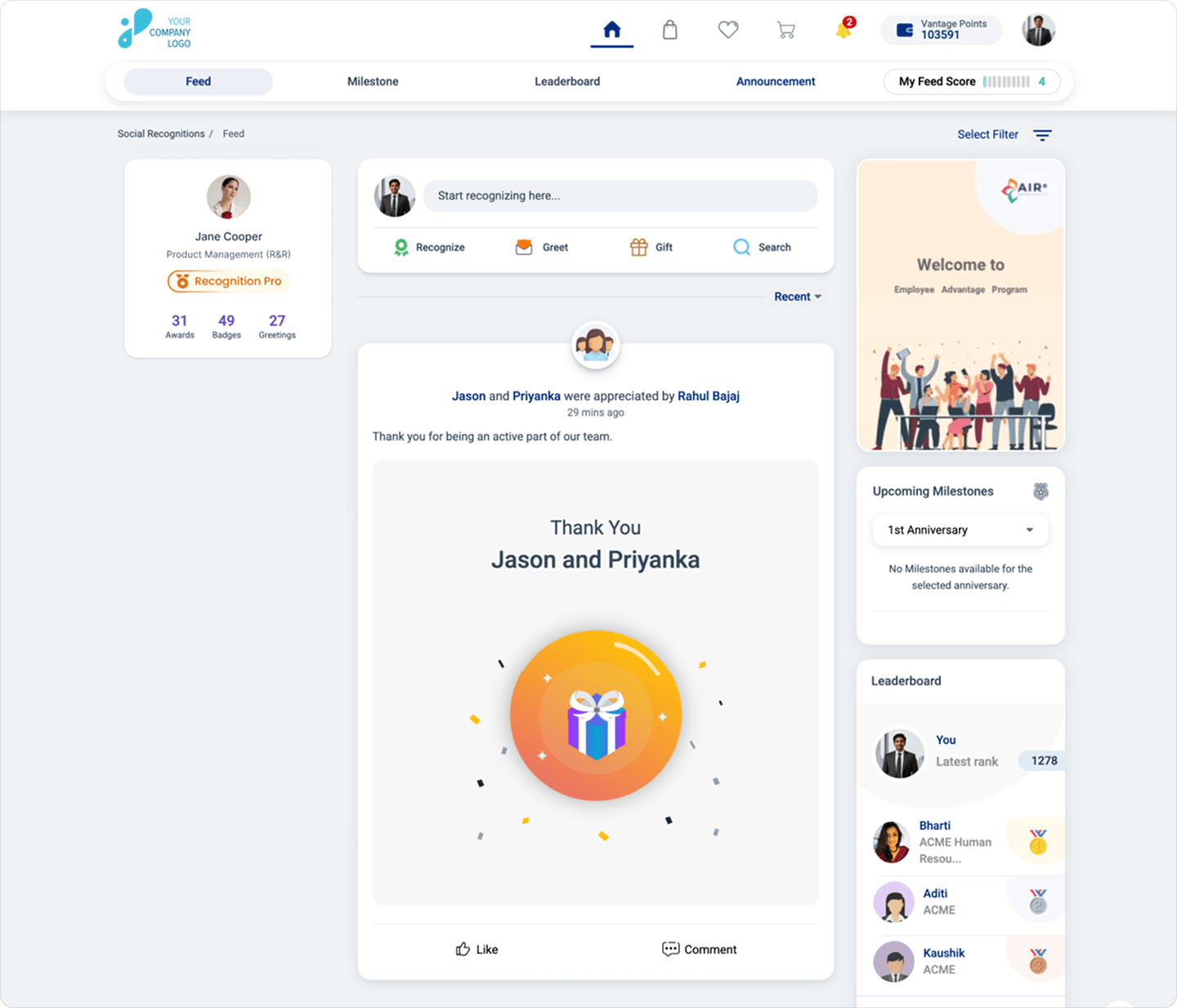
Digital recognition platforms like Vantage Recognition tick these listed practices across distributed teams. It has simplified recognition like no other. Employees can recognize colleagues through peer-to-peer recognition and a shared social recognition feed. Employees in different locations can view appreciation messages and celebrate their colleagues' contributions.
Source: Vantage Recognition
By incorporating recognition into regular team interactions, you can create more opportunities to acknowledge employees throughout the year.
Strategy 5: Celebrate team achievements and individual contributions
Remote projects involve employees collaborating across different departments, locations, and time zones. Each team member may contribute in a distinct way.
For example, consider a team that successfully launches a new product. The development team builds the product, the design team improves the user experience, and the marketing team prepares the launch campaign.
Celebrating overall achievement helps everyone feel part of the success. At the same time, recognizing specific contributions ensures that employees understand the value of their individual work too.
Managers can pull this off through team meetings, recognition posts, internal newsletters, or project completion updates.
A team recognition message could highlight the overall result and mention the employees who handled particularly challenging responsibilities. This approach also encourages employees to appreciate the contributions of colleagues outside their immediate teams.
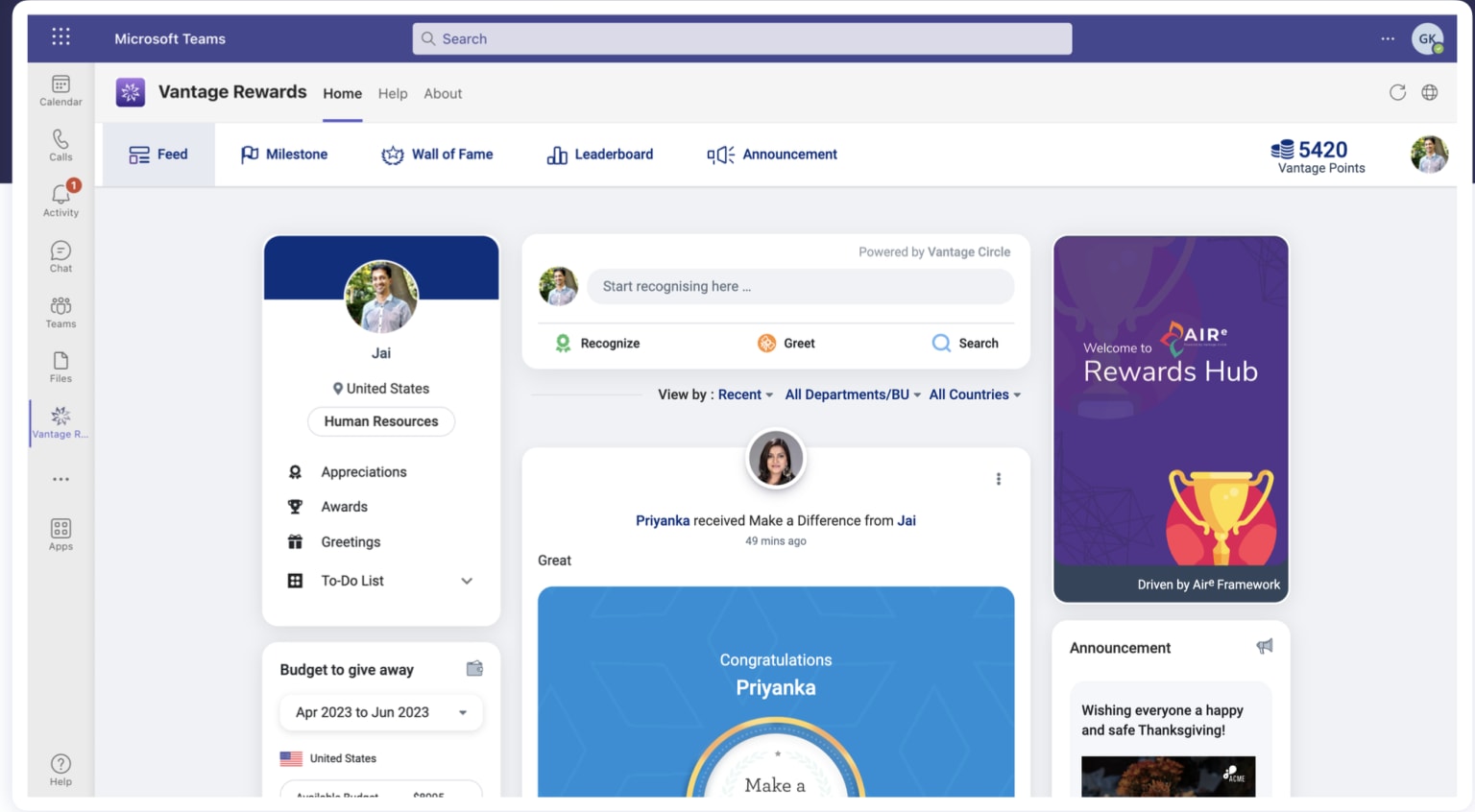
Peer-to-peer recognition can be especially useful because colleagues often observe contributions that managers may not see directly.
Source: Vantage Recognition
Managers should also pay attention to employees who consistently support others, share knowledge, or resolve problems without seeking attention. These contributions are valuable to the team and deserve acknowledgment.
Strategy 6: Provide equal opportunities for career development
Career development is pivotal in sustaining employee motivation.
Employees want to understand how to develop their skills and what opportunities they can get to gain experience. In distributed teams, managers need to ensure remote employees are included in these conversations.
Buffer's 2023 State of Remote Work found that 28% of surveyed remote workers believed remote work made career growth more difficult.
This data shows that organizations should consider career progression when evaluating the remote employee experience.
HR teams can support equitable growth through several measures:
Make learning and development resources accessible online.
Communicate internal job opportunities across all work locations.
Establish transparent promotion criteria.
Include career development discussions in regular check-ins.
Provide access to mentoring and cross-functional projects.
For example, an employee interested in moving into a managerial position could be offered leadership training and opportunities to manage smaller projects. Their manager can review progress and identify areas for further development.
Organizations should also examine whether remote employees receive opportunities for promotions and high-visibility assignments.
Employee discounts, learning benefits, and other workplace perks should remain accessible to employees regardless of their location, subject to local availability and eligibility.
Culture and connection
Strategy 7: Create Opportunities for Informal Team Interactions
When teams work remotely, conversations often revolve around deadlines, meetings, and project updates. Employees get limited opportunities to learn about their colleagues' interests, experiences, or personalities. Over time, this can make workplace relationships feel distant.
Here's when managers can step up and encourage informal interactions through short virtual social sessions, occasional team conversations, or informal catch-ups.
For example, a team could begin its weekly meeting with a few minutes of casual conversation. Employees can share a recent achievement, discuss something interesting they learned, or recommend a film or book.
Organizations can also arrange optional virtual team activities that bring colleagues together. These activities should account for different time zones, cultural backgrounds, interests, and personal schedules.
Employees should feel comfortable declining activities when they have other commitments.
For organizations looking for inspiration, here are 25 virtual employee engagement ideas and additional virtual team building activities.
Informal interactions can also make professional collaboration easier. Employees who know one another may feel more comfortable sharing ideas, asking questions, or seeking help.
Managers can encourage these connections without making every interaction another compulsory meeting.
Strategy 8: Support Employee Wellbeing and Work-Life Boundaries
Remote work can make it difficult for employees to separate professional responsibilities from personal time, as one of the challenges discussed above.
Employees may find themselves checking messages after dinner, attending meetings outside regular hours, or working through breaks to complete assignments.
Microsoft's 2025 Work Trend Index research found that chats sent outside standard working hours increased by 15% year over year. Meetings starting after 8 p.m. also increased by 16%, partly due to collaboration across time zones.
These findings reflect wider changes in digital work patterns, including those affecting remote and hybrid teams.
Here, managers can establish healthier boundaries by:
Defining working hours and expected response times.
Avoiding unnecessary communication outside agreed schedules.
Encouraging employees to take regular breaks.
Reviewing workloads when employees repeatedly work overtime.
Respecting leave and personal commitments.
Before asking others to follow these practices, a manager should follow them first.
Organizations can further support wellbeing by offering accessible resources and voluntary wellness activities.
For example, a team step challenge can encourage colleagues to stay active and connect through a shared experience.
Platforms such as Vantage Fit can support employee wellness challenges across locations, allowing employees to participate remotely.
The goal should be to make healthy work habits part of the team’s everyday practices.
A Weekly Engagement Rhythm for Managers of Remote Teams
Managers have several responsibilities on their plate, including delivering projects, conducting performance reviews, and coordinating teams.
A clear engagement routine helps them incorporate employee support into existing workflows.
The following schedule provides a starting point.
| Frequency | What managers can do | Suggested time |
|---|---|---|
| Daily | Review asynchronous updates, clarify priorities, and recognize a meaningful contribution when appropriate | 5–10 minutes |
| Weekly | Conduct one-on-one meetings, discuss obstacles, and acknowledge team achievements | 15–30 minutes per employee |
| Monthly | Review employee pulse survey feedback, discuss recurring concerns, and arrange an optional team interaction | Around 1 hour |
| Quarterly | Review engagement trends, recognition patterns, career opportunities, and employee retention | Half-day review |
Note: These timings are suggested planning estimates, not research-based benchmarks.
Managers can adjust this routine based on team size, time zones, and the nature of their work. For example, a small remote team may find it practical to hold weekly individual conversations with every employee. Managers handling larger teams may need additional support or a more flexible schedule.
The important consideration is whether employees regularly receive the communication, guidance, and recognition they need.
HR teams should periodically review these practices and identify where managers may require additional resources or training.
How to Measure Remote Employee Engagement
Organizations need reliable ways to determine whether their engagement initiatives are improving employees' experiences.
A team may attend regular meetings and complete its assigned work while some employees continue to feel disconnected.
Employee feedback can help identify these concerns. Short monthly pulse surveys are one way to gather feedback. HR teams can ask employees whether they feel recognized, receive sufficient support, understand their responsibilities, and have opportunities to grow.
For example, a survey might include the following statements:
I feel connected to my team.
My contributions are recognized and appreciated.
I receive the support I need from my manager.
I understand how my work contributes to team goals.
I have opportunities to develop my skills.
Employees can respond using a consistent rating scale, allowing HR teams to observe changes over time.
Anonymous responses can also help employees express concerns more comfortably. Organizations should protect confidentiality and avoid reporting results for groups small enough to identify individual respondents.
A Remote Employee Engagement Scorecard
A practical scorecard combines employee feedback with workplace data to identify engagement patterns and areas that require attention.
| Metric | How to collect it | What HR teams should watch |
|---|---|---|
| Pulse survey participation | Monthly employee surveys | Declining participation or recurring concerns |
| Employee Net Promoter Score (eNPS) | Quarterly eNPS survey, segmented by work arrangement where appropriate | Significant changes over time and differences between remote and office employees |
| Recognition received | Recognition platform analytics | Whether remote employees receive recognition as consistently as office employees |
| One-on-one meeting completion | Manager check-in records or calendars | Frequently missed or cancelled conversations |
| Voluntary employee attrition | Human resource information system (HRIS) | Differences in voluntary turnover across work arrangements |
| Internal mobility and promotions | HRIS and talent management records | Whether remote employees receive growth opportunities |
These metrics should be interpreted in context.
For instance, a lower recognition rate among remote employees may require further investigation into team size, job roles, reporting structures, or recognition practices.
A single metric rarely provides a complete picture of employee engagement. HR teams should look for patterns across several indicators and follow up with employee conversations where needed.
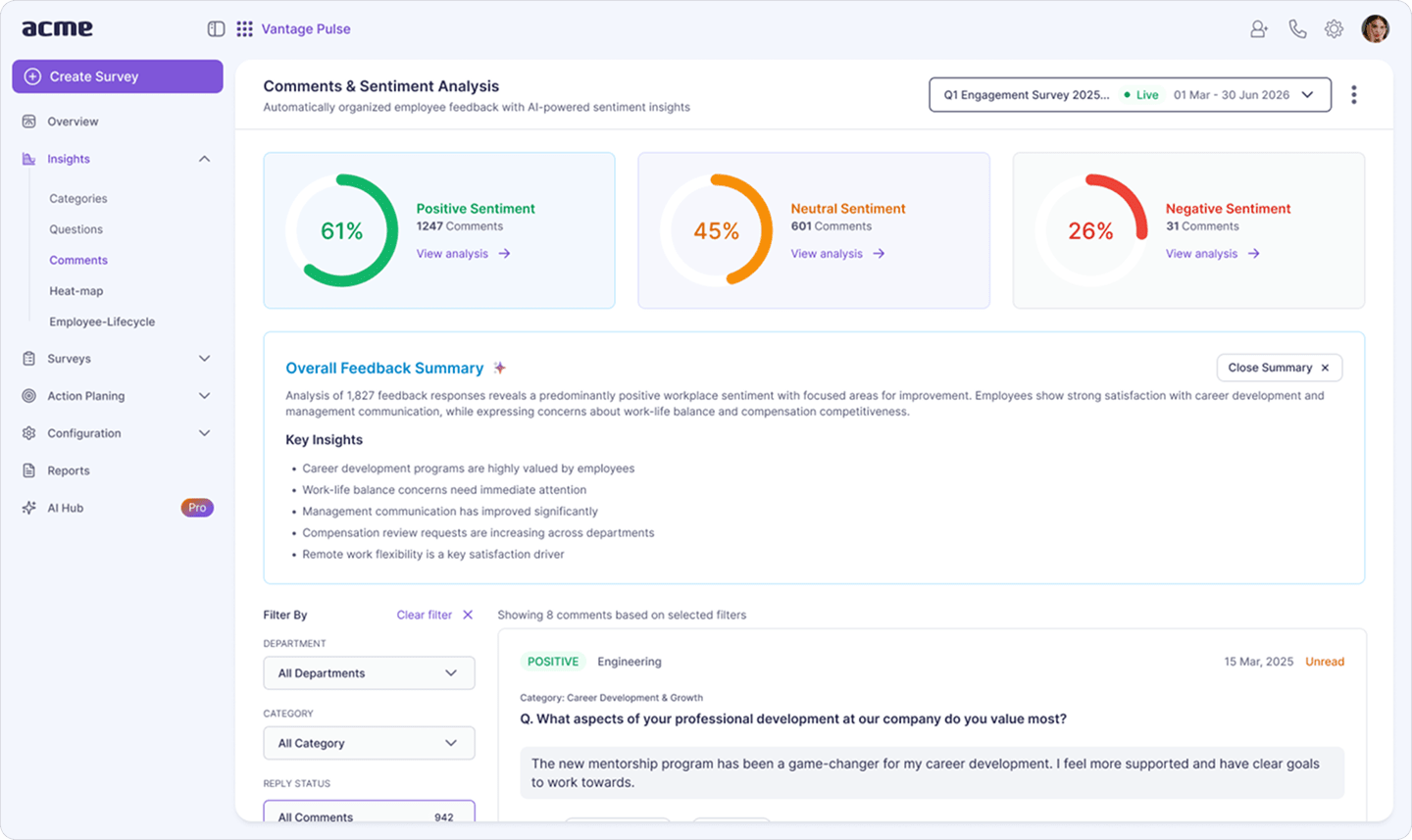
Digital tools can simplify the process of collecting and reviewing feedback. For example, Vantage Pulse allows organizations to conduct employee pulse surveys and analyze workplace sentiment. HR teams can examine department-level insights and monitor changes in employee feedback.
Source: Vantage Pulse
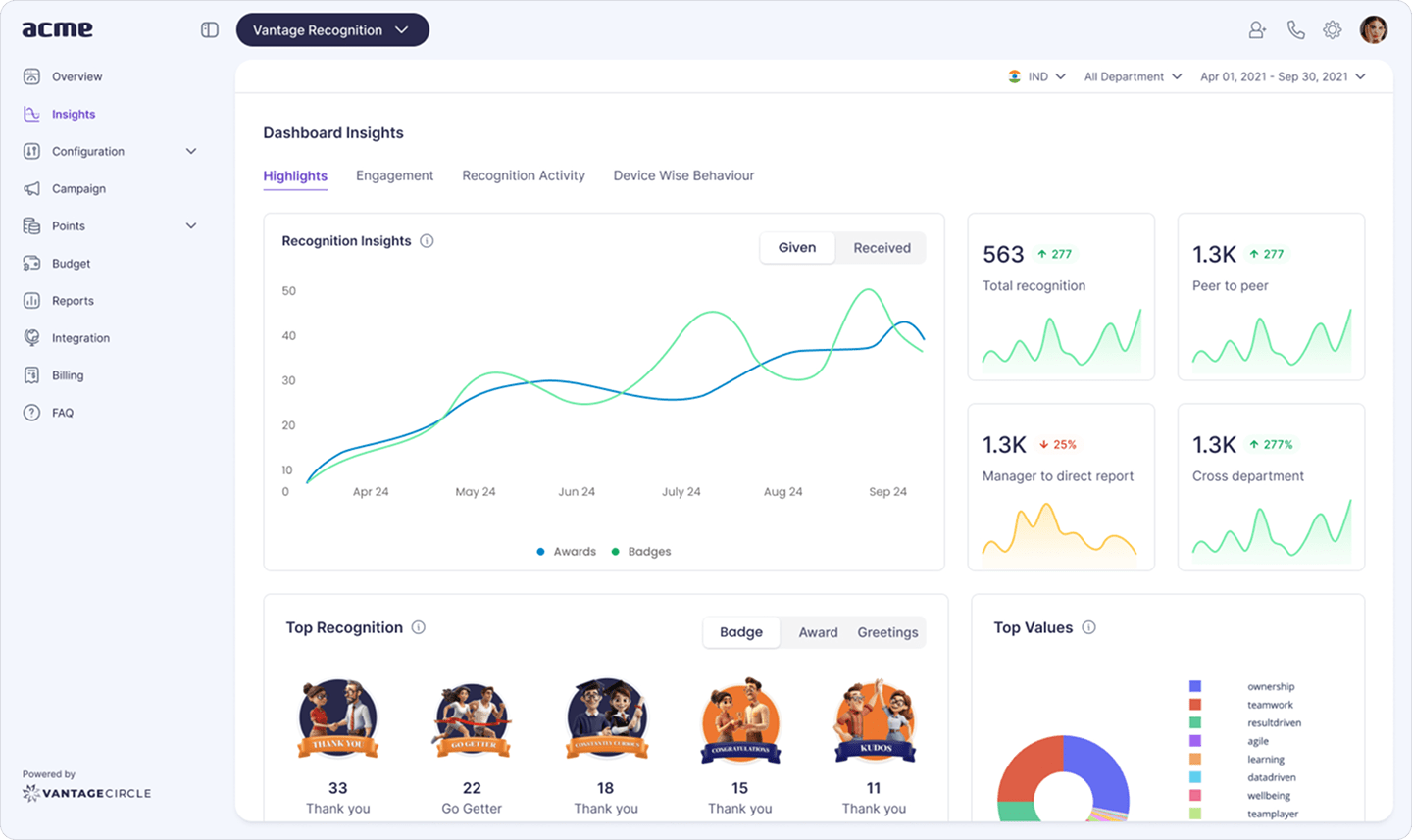
Recognition analytics can provide another useful perspective by showing how recognition is distributed across teams and locations. Combining employee feedback with relevant workplace data helps HR leaders identify concerns and take appropriate action.
Source: Vantage Recognition
What to Avoid When Engaging Remote Employees
Even well-intentioned engagement efforts can lose their essence when organizations overlook employee preferences and working conditions.
Here are four practices managers should avoid.
1. Monitoring every minute of employee activity
Constantly tracking online status, screenshots, or keyboard activity can create unnecessary pressure and weaken trust.
Managers should set clear performance expectations at the very beginning and review outcomes through regular conversations.
2. Scheduling too many meetings
Frequent meetings can interrupt focused work and leave employees with limited time to complete their responsibilities.
Before arranging a meeting, managers should consider whether the information could be shared through a written update.
3. Recognizing only employees who are most visible
Employees who frequently speak during meetings or interact directly with leadership may receive more recognition.
Managers should also acknowledge contributions from employees who work independently or support colleagues behind the scenes.
4. Making every social activity compulsory
Some employees enjoy virtual games and group activities, while others prefer smaller conversations or informal connections.
Organizations should provide different opportunities for interaction and respect employees' preferences. Remote engagement practices work best when employees have a voice in how they are implemented.
Conclusion
Keeping remote employees engaged begins with clear communication, meaningful recognition, regular feedback, and healthy work boundaries. By listening to employees and responding to their needs, HR leaders and managers can create a supportive work environment where remote teams feel valued, connected, and motivated to contribute.
FAQs
How to motivate remote employees?
Remote employees can be motivated through clear goals, regular feedback, recognition, and opportunities for professional development. Managers should acknowledge individual contributions, provide appropriate autonomy, and ensure employees have the support needed to complete their work. Regular conversations also help managers understand employees' personal challenges and career aspirations.
What must be avoided during remote work?
Remote organizations should avoid excessive monitoring, unclear communication, unnecessary meetings, and expectations of constant availability. Managers should also be mindful of unequal recognition and career opportunities. Establishing boundaries, evaluating performance fairly, and encouraging employee feedback can help build a healthier remote working environment.
What is the remote work paradox?
The remote work paradox describes the tension between the benefits of remote work, such as flexibility and independence, and potential challenges, including isolation, communication difficulties, and blurred work-life boundaries. Employees may value remote work while still experiencing these challenges. Organizations need practices that support both flexibility and workplace connection.
How to tell if remote employees are working?
Managers can assess remote employee performance by reviewing agreed goals, completed assignments, work quality, and project milestones. Regular progress discussions help identify challenges and provide support. Online availability should not be treated as the primary measure of productivity because employees may complete meaningful work without constant digital activity.
What are some fun and engaging activities for employees who work from home?
Virtual coffee sessions, team quizzes, informal catch-ups, collaborative challenges, and online celebrations can help remote employees connect with colleagues. Activities should be inclusive, accessible, and voluntary. Organizations can explore more virtual employee engagement ideas to find suitable options for different teams.

Riha Jaishi is a Content Marketing Specialist at Vantage Circle and host of the HR Vantage Influencers podcast, sharing insights that help organizations build recognition-rich, people-first cultures!!
Connect with Riha on LinkedIn.


