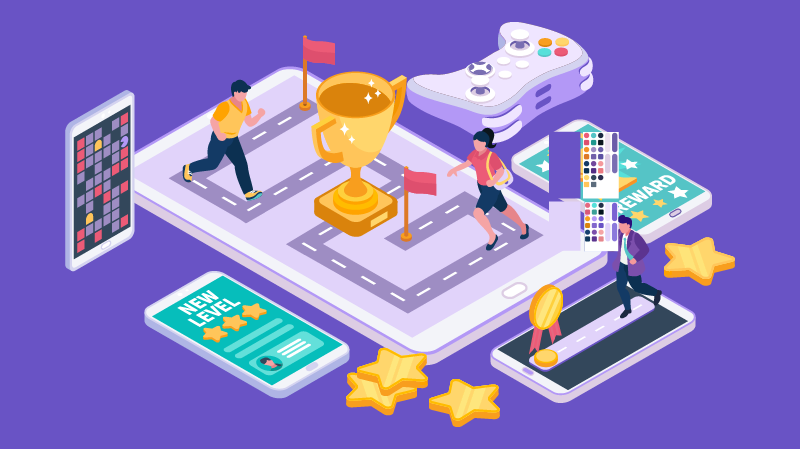
We've all fallen for a game we couldn't put down at some point or another. Naturally, we expect gamification for employee engagement to click just as easily. It doesn't. Getting there is more intricate than that.
The mechanics are simple enough to describe: points, badges, leaderboards, and challenges, borrowed from games and applied to everyday work tasks so effort feels more visible and progress feels more rewarding. What's intricate is making that signal honest and tied to real effort, the same loop that keeps someone opening a fitness app or finishing a language streak, just harder to pull off at a desk than on a phone.
Here's what actually moves engagement, what doesn't, and what a gamified recognition program looks like once real usage data sits behind it.
Most of these mechanics are built into comprehensive employee engagement platforms that combine recognition, challenges, and rewards.
What Is Gamification in Employee Engagement?
Gamification in employee engagement means borrowing the mechanics that make games satisfying, points for progress, badges for milestones, leaderboards for visibility, and levels for growth, and building them into the recognition and performance systems employees already use. It's not about turning the office into a game room. It's about closing the gap between doing good work and having that work noticed.
At its core, gamification taps into three things people are wired to respond to: clear goals, fast feedback, and social recognition. A quarterly performance review tells an employee how they did three months ago. A point earned the moment a task closes, or a badge that shows up on a colleague's profile the same day they solved a hard problem, tells them right now. That immediacy is the entire mechanism. Games aren't fun because of fictional dragons or racetracks. They're fun because they turn effort into a signal you can watch change in real time.
Applied to work, that signal shows up as a leaderboard rank, a completed challenge, or a peer recognition post a manager can point to in a one-on-one. Gamification in the workplace works when that signal is honest, tied to real effort, and visible enough to change behavior, not just decoration on top of a system nobody opens.
Why Gamify Work? The Benefits, With Current Data
Gamification earns its place in an engagement strategy because it produces effects that show up in the numbers: higher output, faster learning, better retention, and a culture people want to stay in. Here's what the current data actually says about each.
Increased Motivation and Productivity
A distant goal doesn't move anyone day to day. Gamification breaks it into a series of smaller, visible wins instead.
Instead of a single far-off target ("hit this quarter's number"), employees get a string of smaller, visible wins along the way, a point earned, a rank climbed, a badge unlocked, and each one reinforces that the effort is being tracked and noticed.
The link between engagement and business outcomes is well established: teams in the top quartile of employee engagement achieve 23% higher profitability than teams in the bottom quartile (Gallup, "3 Key Insights Into the Global Workplace", 2024, meta-analysis of 183,000+ business units). Gamification won't manufacture engagement out of nothing, but for teams already close to that top quartile, it's one of the more direct ways to keep effort visible enough to sustain it.
Enhanced Learning and Skill Building
Gamified training keeps people engaged with material they'd otherwise tune out.
Long training modules lose people fast. Not because the content is wrong. Because there's no feedback loop until a final quiz score. Add points, progress bars, and small challenges to the same material, and that loop closes much sooner.
TalentLMS's 2019 survey on gamification at work found that 83% of employees who received gamified training reported feeling motivated, compared to 61% of employees in non-gamified training who reported feeling bored and unproductive. The same employees reported gamification made them more productive at work (89%) and happier (88%) overall.
Better Employee Retention
Employees who feel consistently recognized are measurably less likely to leave.
Gamification supports retention when it makes recognition frequent instead of occasional. A once-a-year award doesn't change how someone feels about staying. A system that surfaces small wins every week does.
Employees are 7 times more likely to stay another year when recognition helps them build real relationships at work, according to O.C. Tanner's State of Employee Recognition Report 2026, based on a survey of more than 4,200 employees across 10 countries. That gap comes down to whether people feel their contributions are seen day to day, which is exactly what gamified recognition mechanics are built to do.
A Thriving Company Culture
A well-designed gamification system builds camaraderie by making other people's contributions visible, not just your own.
The clearest evidence here isn't anecdotal. A 418-employee study found that gamified HR management significantly strengthens work engagement, with intrinsic motivation partially explaining the effect, and the effect was stronger for employees with a natural gaming preference and for those who already felt supported by their organization (Zhang et al., "Gamified Human Resource Management as a Driver of Employee Engagement Through Intrinsic Motivation", Frontiers in Psychology, 2026). Gamification amplifies a healthy culture more than it creates one from scratch.
Practical Gamification Ideas and Tactics
Most gamification programs succeed or fail on four mechanics: points, challenges, progress tracking, and personalized rewards. Here's how each works in practice.
Points, Badges, and Leaderboards
Points give effort a running score, badges mark specific milestones, and leaderboards make both visible.
Assign points for completing tasks, hitting milestones, or demonstrating a behavior worth reinforcing. Award badges for skill mastery or standout contributions, ones specific enough to mean something ("Client Save," "First Cross-Team Assist") rather than a generic "Great Job."
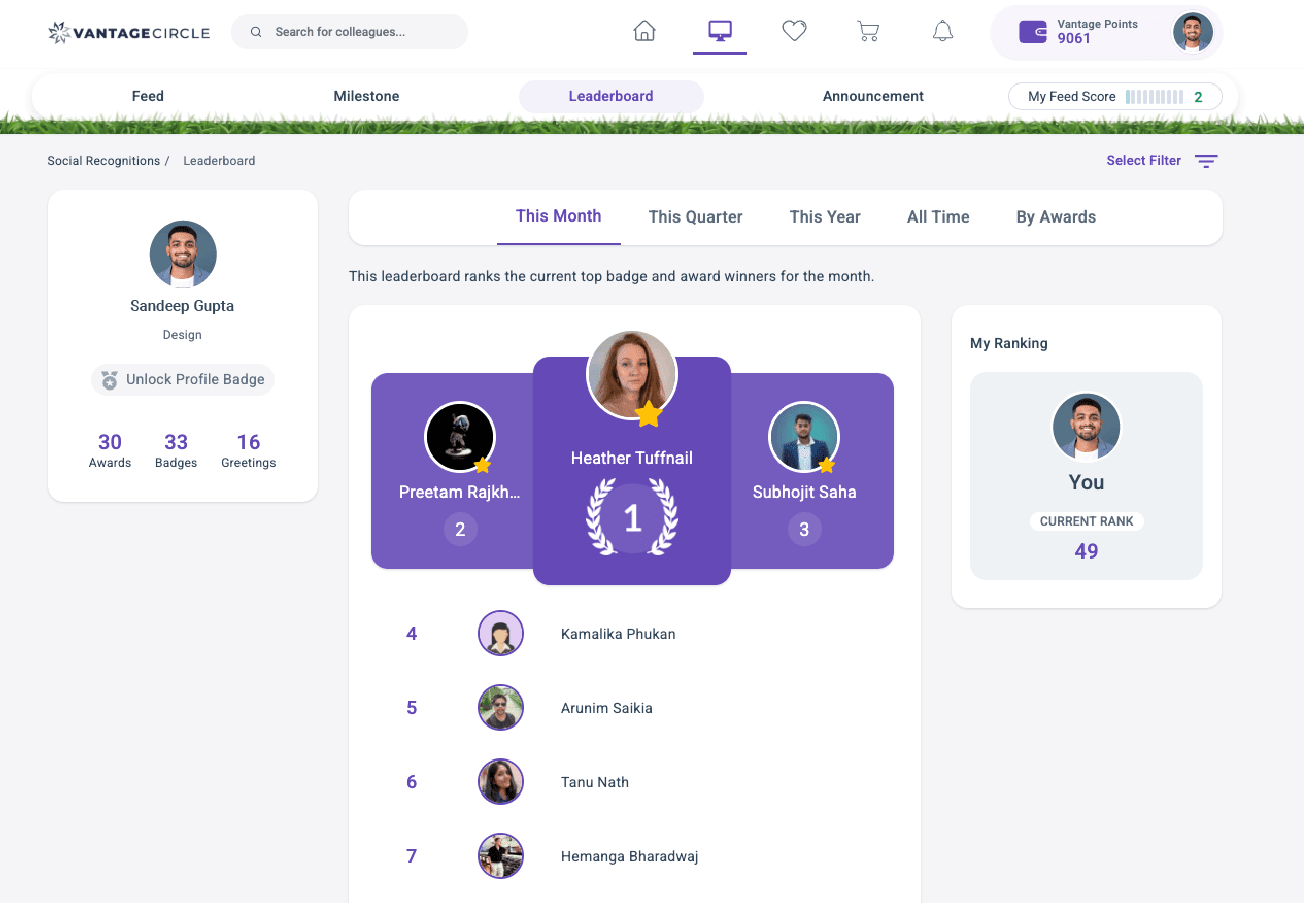
A leaderboard only motivates if the scoring is transparent and the prize is worth chasing. Vantage Recognition ties leaderboard standing directly to redeemable points, not just bragging rights, so climbing the board has a payoff beyond visibility. Team-based leaderboards, run alongside individual ones, help keep the competition friendly instead of divisive.
Source: Vantage Recognition
Challenges and Quests
Challenges give gamification a start and end date, which is what keeps it from feeling stale.
Roll out short, time-boxed challenges tied to a specific goal, a sales push, a wellness month, a documentation sprint, rather than leaving points running indefinitely with no finish line. For more complex projects, break the challenge into a multi-step quest, rewarding participants at each stage instead of only at the end.
A time-boxed recognition challenge works the same way a game event does: a clear window, a clear goal, and visible progress. Campaign Management is built to run exactly that kind of push, letting HR teams launch, track, and close out a themed recognition drive without building the mechanics from scratch each time.
Progress Bars and Levels
A visible progress bar keeps a distant goal from feeling abstract.
Show employees how far they have come with a simple visual indicator, a bar, a percentage, a step count, so the goal stays in sight instead of becoming a number they only think about at quarter-end. Pair this with a leveling structure, where reaching a new tier unlocks a new perk or responsibility, and progress itself becomes something worth checking in on.
Personalized Rewards and Recognition
Gamification only feels meaningful when the reward matches what the person actually values.
Offer a mix of rewards, gift cards, extra leave, curated experiences, rather than one fixed prize for everyone. A global rewards catalog that lets employees choose their own reward tends to land better than a prize picked on their behalf.
The best gamified systems don't just reward output. They let colleagues call out effort in real time. Peer-to-peer recognition adds the social layer that keeps a points system from feeling hollow, turning a private score into a public, specific thank-you.
Real Examples of Gamification in the Workplace
Gamification works differently depending on the function it's applied to. Here's what that looks like in four of the most common ones.
Sales Teams: Energizing Targets
Sales is the easiest function to gamify because performance is already a number.
Turn a sales goal into a points-based challenge: award points for deals closed, qualified follow-ups, or upsells, and display standings on a live leaderboard. Recognize top performers with a mix of monetary and non-monetary rewards, a bonus, a public shout-out, an extra day off, so the incentive isn't purely financial. Keep some leaderboards team-based, so quieter contributors aren't permanently buried under a handful of top closers.
Customer Service: Recognizing Excellence
Customer service gamification rewards resolution quality, not just ticket volume.
Award badges for high satisfaction ratings, fast resolution of difficult cases, or a stretch of zero escalations, criteria that reward doing the job well, not just doing a lot of it. A support agent who spends more time on a complex case shouldn't be outranked by one who closes easy tickets quickly. Design the scoring around outcomes customers actually felt, not just speed.
Onboarding: Making First Days Fun
Gamified onboarding gives new hires a visible checklist instead of a vague sense of where they stand.
Turn the first days or weeks into a structured set of milestones: badges for meeting the team, completing setup tasks, finishing first training modules, and hitting a first small win. New hires who can see exactly how far along they are tend to feel less lost during a period that's disorienting by default.
Training and Development: Building Skills With Fun
Gamified training keeps completion rates up because the feedback is immediate instead of deferred to a final exam.
Add points, badges, and leaderboards to training modules so employees see progress as they go instead of waiting for a pass or fail result at the end. Vantage Fit applies the same logic to wellness training, using streaks and milestones to keep participation up rather than relying on a single deadline to drive completion.
A stronger example set than a generic profile-progress-bar pairing: IBM built a company-wide digital badge program for skill development, letting employees post earned badges to social profiles to showcase verified expertise. Vantage Fit runs step-count and hydration-tracking challenges with team-based leaderboards, applying the same points-and-progress mechanics to employee wellness instead of pure performance. Both tie gamification to a specific, ongoing behavior, not a one-time feature.
For a deeper set of gamified recognition mechanics specifically, see Gamification in Employee Recognition: 15 Ideas That Actually Work.
What the Data Shows: Gamification's Real Impact on Engagement
The clearest proof that gamification works isn't a generic engagement percentage. It's what happens to participation once a gamified recognition system is actually live on a real platform.
Most of the data cited across gamification articles, including this one up to this point, comes from third-party surveys measuring how employees say they feel. That's useful, but it isn't the same as watching what employees actually do.
Tata Motors, a 78,000-employee automaker, saw peer-to-peer recognition rise 82% and overall engagement rise 20% after rolling out a point-based recognition system built around badges and social visibility. At IBS Software, platform adoption grew 235% and voluntary attrition dropped from 21.7% to 13.2% over the same period the platform was in place.
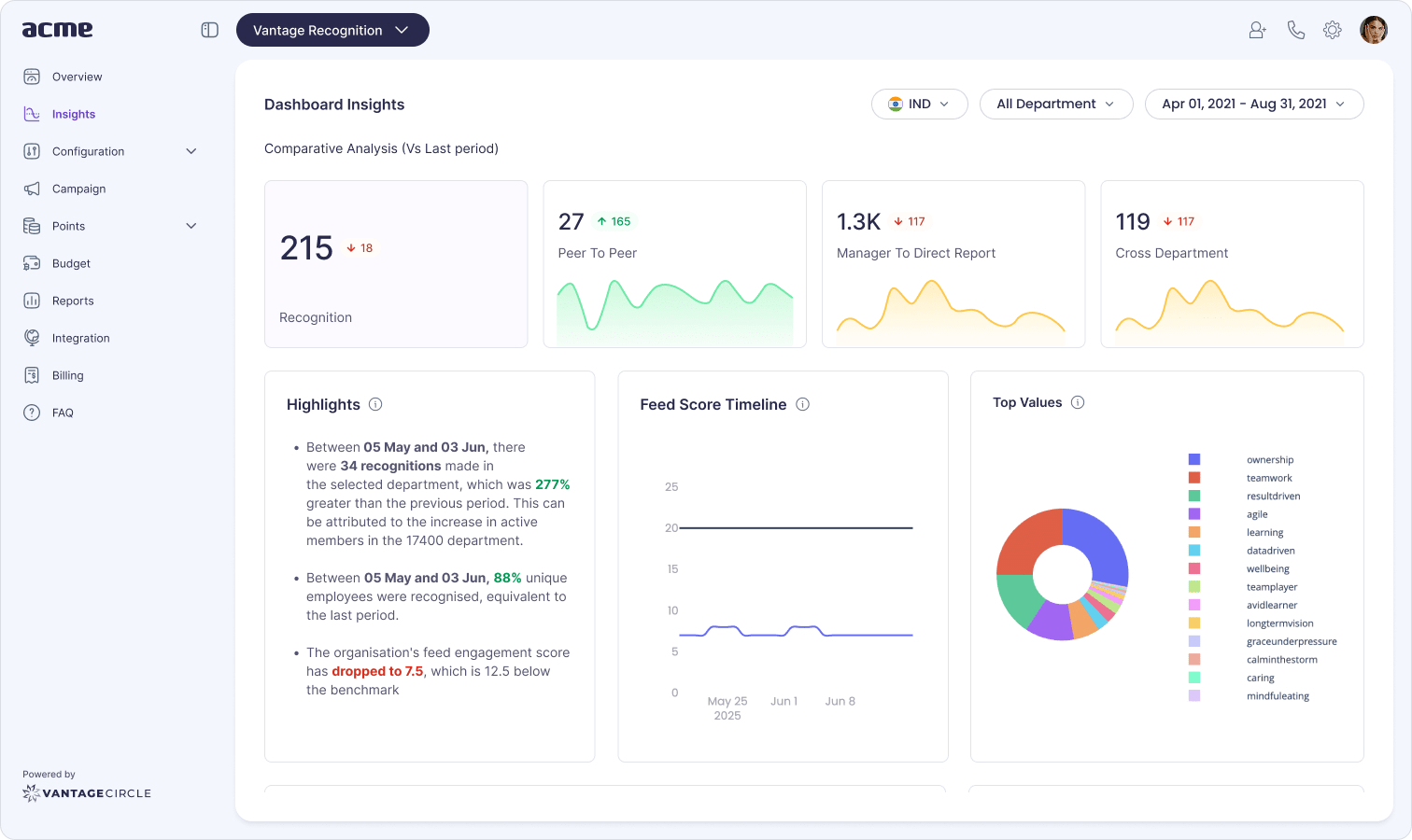
Gamified recognition only proves itself with numbers behind it. Rewards Analytics tracks whether a leaderboard or challenge actually lifted participation, not just whether people noticed it, which is the only way to tell a genuinely effective program from one that just felt busy.
Source: Vantage Recognition
Participation numbers only tell half the story. To confirm a gamified recognition program is improving sentiment and not just activity, pair recognition data with an eNPS pulse survey run before and after rollout. Vantage Pulse is built for exactly that kind of before-and-after check, so a spike in leaderboard activity can be confirmed against an actual shift in how people feel, rather than assumed from participation numbers alone.
Gamification Tools and Platforms
The right platform depends on what you're trying to gamify, recognition, sales performance, or training, and how much setup you're willing to do.
What to Look for in a Gamification Platform
The best gamification apps for employee engagement combine four things: real-time leaderboards, flexible badge and point rules, redeemable rewards, and analytics that show whether the mechanics actually changed behavior.
A platform without real-time visibility loses the immediacy that makes gamification work in the first place, a points update that shows up a week later defeats the purpose. Look for configurable badge rules so recognition can be tied to specific values or behaviors, not just generic milestones. Reward flexibility matters too, since a fixed catalog of prizes won't motivate everyone equally. Finally, insist on analytics. A platform that can't show participation, adoption, and completion data is asking you to run a program on faith.
Vantage Circle: Gamified Recognition in Practice
Gamification without leadership involvement tends to feel like a game rather than genuine recognition, which is why Vantage Circle builds manager participation directly into the mechanics.
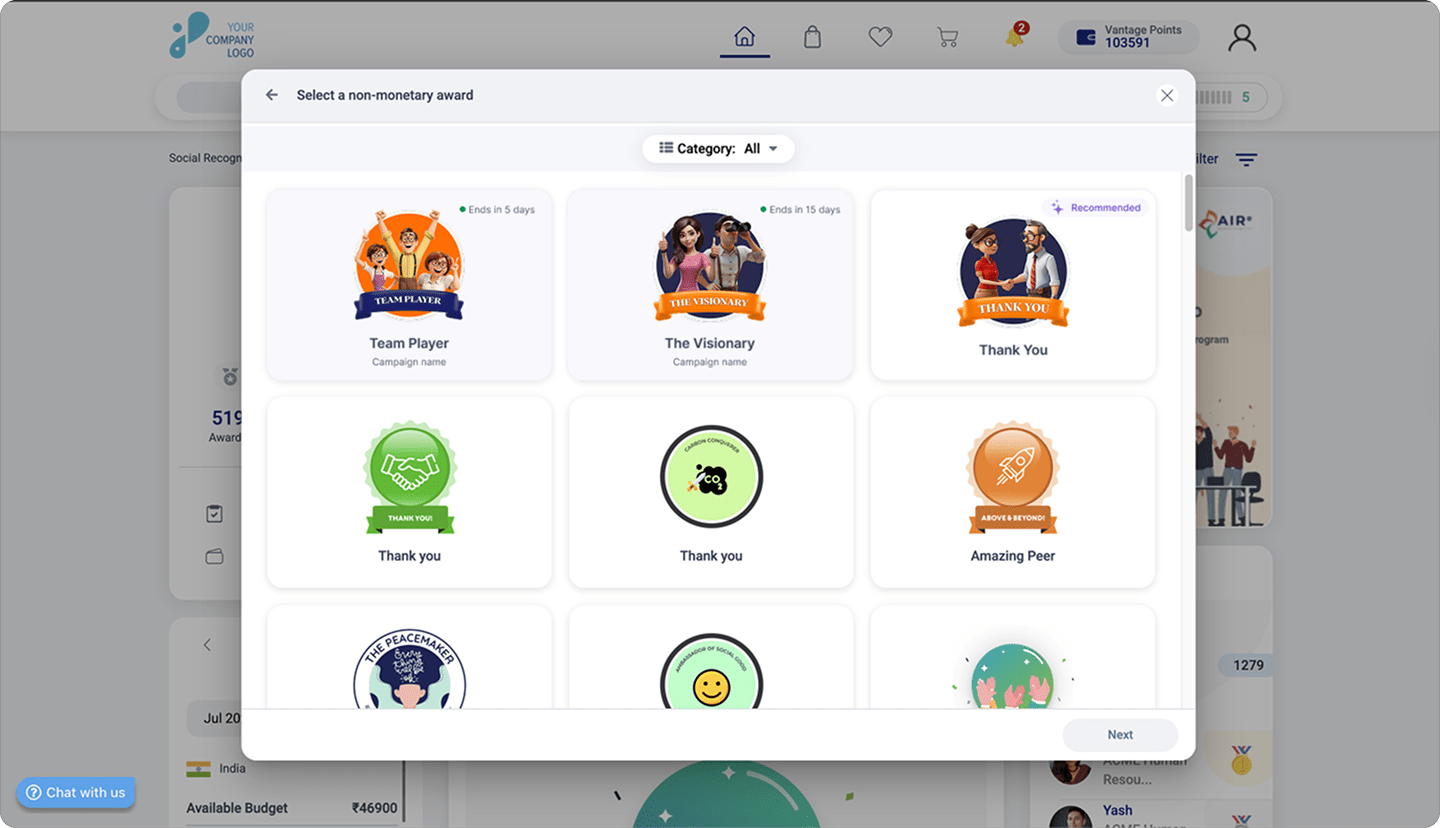
A leaderboard without manager involvement reads as a game. A manager calling out a specific win by name reads as real recognition. Manager SPOT Awards makes that easy to act on: a manager can pick from a wide range of non-monetary awards, each tied to a specific behavior or value rather than a generic "great job," and post it straight to a direct report's profile for everyone to see, not held back for a review months later.
Paired with customizable reward programs, social recognition feeds for peer-to-peer visibility, and the Campaign Management and Rewards Analytics features covered earlier, this turns gamification from a set of isolated mechanics into one measurable recognition system.
Source: Vantage Recognition
Other Notable Platforms for Gamification
Outside recognition-first platforms, a handful of specialized tools focus on narrower gamification use cases.
Bunchball Nitro, now run under BI Worldwide, offers enterprise gamification mechanics that plug into existing workflows and applications. Spinify focuses specifically on sales and performance gamification, with real-time leaderboards pulling directly from CRM data. Centrical combines gamification with learning and performance management for frontline and contact-center teams. Pairing a recognition-first platform with one of these more specialized tools can round out a strategy that needs both broad recognition coverage and a narrow, function-specific use case.
| Platform | Best For | Standout Mechanic |
|---|---|---|
| Vantage Circle | End-to-end recognition and rewards | Manager SPOT Awards + Rewards Analytics |
| Bunchball Nitro (BI Worldwide) | Enterprise gamification bolted onto existing workflows | Configurable point and badge engine |
| Spinify | Sales and performance gamification | Real-time, CRM-fed leaderboards |
| Centrical | Frontline learning and performance | Combined gamification and coaching |
Trends and the Future of Employee Gamification
Three shifts are shaping where workplace gamification goes next: immersive formats, deeper personalization, and AI-driven adjustment.
VR and AR Integration
Virtual and augmented reality turn training simulations into a gamified experience without needing points or badges at all.
Immersive training lets employees practice a real scenario, operating machinery, handling a difficult customer conversation, in a simulated environment where mistakes are free and progress is visible in real time. The gamification here is built into the format itself: a simulation with a clear objective and immediate feedback is a game mechanic even without a leaderboard attached.
Personalized Gamification Experiences
A single leaderboard motivates competitive employees and demoralizes everyone else, which is why personalization is replacing one-size-fits-all mechanics.
Instead of one fixed challenge for an entire team, personalized gamification adjusts the goal, the reward, and the pacing to the individual, tailoring a challenge to someone's role, tenure, or working style rather than applying the same mechanic to everyone regardless of fit. This matters because leaderboards, in particular, tend to favor employees who are naturally extroverted or highly visible, while quieter, equally valuable contributors get overlooked.
AI-Powered Gamification
AI is starting to adjust gamification mechanics in real time instead of leaving them static for a full quarter.
Artificial intelligence can analyze participation and recognition patterns to flag when an employee's engagement with a gamified system is dropping, then adjust the challenge, reward, or difficulty before disengagement sets in. Instead of running the same badge structure for a year and hoping it stays effective, AI-assisted systems can rotate challenges and personalize incentives continuously, closing the gap between a static program and one that actually adapts to how people are responding to it.
The Road Ahead
Gamification stays effective only when it keeps changing, since a static system is the fastest way to lose the people it was built to engage.
Start with a small, well-scoped mechanic rather than launching points, badges, leaderboards, and quests all at once. Gather feedback early and be willing to retire a badge or challenge that has stopped meaning anything. Extend gamification mechanics beyond pure recognition where it makes sense: Vantage Fit's wellness challenges already apply the same streaks-and-milestones logic described throughout this article to employee health, proof that the mechanics travel well outside a single use case. Done this way, gamification stops being a feature you switch on and becomes a design discipline you keep tuning.
FAQs About Gamification for Employee Engagement
What are some fun activities for employee engagement?
Team trivia, themed recognition campaigns (a Women's Day or Founder's Day badge push, for example), step-count challenges through a wellness platform, and short skill-building quizzes with a leaderboard attached all combine genuine engagement value with a gamified structure, points, progress, or a visible result, rather than functioning as one-off morale events.
What are some fun and engaging games I can play with my employees?
Team trivia tournaments, a department-wide scavenger hunt tied to onboarding or a new policy rollout, a points-based prediction game around a product launch, and short, timed problem-solving challenges all work well because they are structured, time-boxed, and produce a visible outcome, the same qualities that make workplace gamification effective more broadly.
What are the best gamification apps for employee engagement?
The strongest options combine real-time leaderboards, flexible badge and point rules, a redeemable rewards catalog, and analytics that show whether the mechanics changed behavior. Recognition-first platforms like Vantage Circle cover the broadest use case, while specialized tools like Spinify for sales and Centrical for frontline learning and performance suit narrower needs. See the Gamification Tools and Platforms section above for a fuller breakdown.
What are some fun games I can play at work?
Beyond trivia and scavenger hunts, a rotating mystery-challenge board, a bracket-style prediction contest tied to a real business metric, and short daily or weekly micro-challenges, fastest response time, most cross-team shout-outs given, all work as light, low-effort games that fit around actual work instead of replacing it.
What are good employee engagement activities?
The activities that hold up over time share three traits: they are recurring rather than one-off, they produce something visible, a badge, a leaderboard rank, a completed milestone, and they connect back to real recognition or growth rather than existing purely for entertainment. A one-time pizza party rarely moves engagement. A recurring, gamified recognition habit does.
Conclusion
Gamification for employee engagement isn't about turning work into a game. It's about closing the gap between doing good work and having that work noticed, using the same mechanics, points, badges, leaderboards, and challenges, that make progress visible everywhere else. The organizations getting real results from it aren't the ones with the flashiest badge design. They're the ones treating gamification as a measurement discipline: running time-boxed campaigns, tracking whether participation actually moved, and pairing recognition data with sentiment checks like eNPS to confirm the lift is real. Start with one mechanic, measure it honestly, and expand from there.

Lupamudra is a content marketing specialist at Vantage Circle, where she has written 50+ articles on employee recognition, rewards, and workplace culture, alongside employee engagement, diversity and inclusion, and HR compliance topics, including how India's tax rules apply to recognition and rewards programs.
Connect with Lupamudra on LinkedIn.