
One of the hardest parts of managing performance is not getting people to work harder. It is helping them understand where their effort will make the greatest difference. When everything feels urgent, even the most capable employees can spend their days getting things done without making much progress on what matters.
That is where employee goal setting comes in. It gives employees a clear sense of what they need to achieve, why it matters, and how their work contributes to larger business priorities. Good goals also give managers something more useful than a year-end rating: a starting point for regular conversations about progress, challenges, and development.
Yet setting goals at the beginning of the year is only half the job. Priorities change, projects take unexpected turns, and employees often take on responsibilities that were never part of the original plan. Goals that go untouched until the annual performance review rarely help anyone navigate those changes.
For HR leaders, the real opportunity is to make goal setting an ongoing practice rather than a once-a-year exercise.
Vantage Influencers Podcast
Performance Management Beyond Review Cycles
What is Goal Setting for Employees?
Goal setting for employees translates business priorities into specific outcomes individuals are responsible for achieving, with clear timelines and a way to measure progress. It gives employees direction without dictating every step they must take to get there.
The thinking behind this approach has a strong foundation in decades of research. Psychologists Edwin Locke and Gary Latham in their influential 2002 review published in American Psychologist found that specific, challenging goals generally lead to better performance than vague instructions such as “do your best.”
The distinction matters. Good intentions may motivate people, but clear goals help them focus their effort, assess their progress, and understand what success looks like.
For HR leaders, the point of goal setting is not to give employees another target to chase, but to establish a shared understanding of what matters, what achievement looks like, and how progress will be evaluated.
Measurable Benefits of Setting Goals for Employees
Sharper Focus and Prioritization
Clear goals help employees distinguish important work from work that merely feels urgent. When priorities are agreed upon in advance, employees have a stronger basis for allocating their time, managing competing requests, and making decisions about what can wait. For managers, this means fewer competing interpretations of what deserves attention.
Greater Motivation Through Visible Progress
A distant target can feel abstract. Milestones make it tangible. When employees can see how far they have come and what remains, they have a clearer sense of progress and a reason to keep going. Breaking larger goals into achievable steps also creates opportunities for timely feedback and recognition.
More Productive Manager-Employee Conversations
Goals give regular check-ins a clear purpose. Instead of simply reviewing completed tasks, managers and employees can discuss progress, identify obstacles, and agree on what needs to change. These conversations make it easier to address problems early, before they affect the final outcome.
Faster Skill Development
Development goals turn broad ambitions into concrete learning priorities. Whether an employee wants to strengthen leadership skills, learn a new tool, or prepare for greater responsibility, specific milestones make progress easier to track. Linking these goals to an employee development plan also helps protect learning from being repeatedly postponed by immediate deadlines.
Fairer Performance Reviews
When expectations and success measures are documented early, managers have a clearer basis for evaluating performance. They can assess results against agreed goals rather than relying too heavily on recent events or general impressions. Goals may need to change as circumstances evolve, but recording those changes helps keep evaluations grounded in context.
Stronger Alignment With Business Priorities
Individual goals are most useful when employees understand how their work contributes to team and organizational outcomes. This connection gives everyday tasks a clearer purpose and helps managers identify when individual priorities have drifted from business needs. The result is a more coordinated approach to work, with employees better equipped to make decisions that support shared objectives.
What are the 7 Types of Employee Goals?
Not every employee goal should measure the same thing. Some goals focus on results, others on skills, collaboration, or the way work gets done. A well-rounded approach accounts for both what employees deliver today and what they need to contribute more effectively tomorrow.
1. Performance Goals (Results Against KPIs)
Performance goals define the results an employee is expected to deliver, such as revenue generated, customer tickets resolved, or units shipped. They give managers concrete measures of success and employees a clear target to work toward.
The key is to choose a small number of meaningful outcomes rather than turning every metric into a goal. Too many targets can dilute attention and encourage employees to prioritize what is easiest to measure over what matters most.
2. Development Goals (Skills and Learning)
Development goals focus on building the knowledge and capabilities employees need to perform better or prepare for future responsibilities. These might include learning a new software tool, completing a certification, or improving presentation skills.
For HRs, the challenge is making development part of the work rather than an ambition employees pursue only when time permits. Access to relevant learning resources and benefits, can help employees take practical steps toward their learning objectives.
3. Behavioral Goals (How Work Gets Done)
Results matter, but so does how employees achieve them. Behavioral goals define observable actions that reflect an organization's values, such as sharing customer insights with product teams or actively mentoring colleagues. These goals require more thoughtful evaluation than simple numerical targets, but they help make workplace expectations concrete.
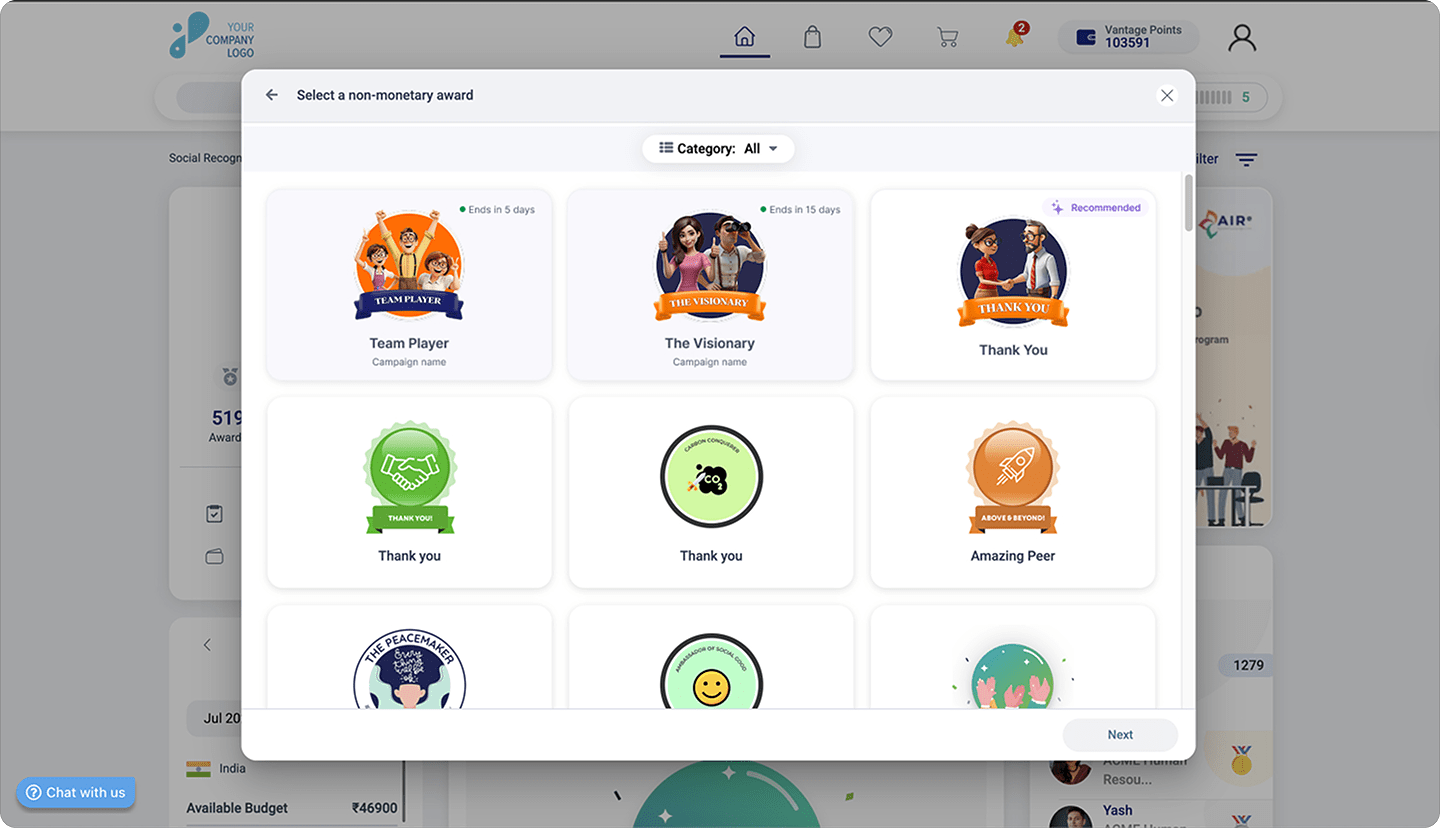
Recognition can reinforce the behaviors an organization wants to see repeated. For example Vantage Recognition allows managers and peers to recognize actions associated with company values through values-based badges.
4. Collaboration Goals (Contribution to Shared Work)
Many business outcomes depend on several people working together. Collaboration goals clarify an employee's contribution to a shared result, whether that means coordinating across departments, sharing expertise, or helping a project team meet a deadline.
The goal should identify both the collective outcome and the individual's responsibility for advancing it. Without that distinction, employees can be held accountable for results they have little control over.
Recommended Read: Team Goals: Definition, Examples, and How to Set Them
5. Improvement and Innovation Goals (Better Processes, New Ideas)
Improvement goals encourage employees to identify inefficiencies, solve recurring problems, and test better ways of working. Because employees often encounter process problems firsthand, they may have valuable ideas for reducing delays, improving quality, or simplifying routine tasks.
A useful goal gives those ideas a clear scope, a timeline, and a way to evaluate the outcome. This turns innovation from a general expectation into work employees have the opportunity to pursue.
6. Productivity and Time-Management Goals
Productivity goals help employees use their time and resources more effectively. Depending on the role, that might mean reducing avoidable rework, improving response times, or protecting focused time for complex assignments.
The distinction is important: productivity should not become a measure of how constantly busy someone appears. Well-designed goals focus on better outcomes and sustainable ways of working, not simply more activity.
7. Career and Stretch Goals (Next Role, Bigger Scope)
Career and stretch goals help employees prepare for greater responsibility, explore new career paths, or take on work beyond their current remit. They might involve leading a cross-functional project, developing managerial capabilities, or gaining experience in a new business area. These goals connect individual ambition with workforce development. They also give managers an opportunity to discuss future roles, the capabilities required to reach them, and the experiences that can help employees get there.
SMART, OKR, or MBO: Which Goal-Setting Framework Fits?
Choosing a goal-setting framework is less about finding the most popular method and more about understanding what the organization needs its goals to accomplish. A team working toward a clearly defined quarterly target has different requirements from an organization aligning multiple departments around a strategic shift. The framework should fit the work, not the other way around.
Three approaches are particularly useful:
SMART
Specific · Measurable · Achievable · Relevant · Time-bound
What it is
SMART goals help employees turn broad expectations into specific, measurable, achievable, relevant, and time-bound outcomes.
Works well when
They work well for individual performance targets, development plans, and tasks with clearly defined success measures.
OKR
Objectives and Key Results
What it is
OKRs connect an ambitious objective to measurable key results.
Works well when
They are useful when teams need to align around shared priorities, track progress frequently, and adapt as business needs change.
MBO
Management by Objectives
What it is
MBO is a management approach in which managers and employees agree on objectives and evaluate performance against them.
Works well when
It works well when individual accountability and alignment with organizational goals are central to performance management.
These frameworks are not mutually exclusive. An organization can use OKRs to establish strategic priorities, SMART criteria to sharpen individual targets, and MBO principles to structure performance conversations.
But the real test is whether employees understand what they are working toward, how success will be measured, and when priorities need to be revisited. A framework is useful only when it makes those answers clearer.
How to Set Goals for Employees in 5 Actionable Steps
Setting employee goals is not simply a matter of assigning targets at the beginning of the year. The real work lies in agreeing on the right outcomes, making expectations clear, and creating the conditions for employees to achieve them.
These five steps help managers turn business priorities into goals that guide everyday work.
Step 1: Write Goals Together in a One-on-one
Managers understand the business priorities, but employees understand the demands of their roles. Effective goal setting brings those two perspectives together.
On the Vantage Circle podcast, Zubair Bhura, a senior HR professional with more than a decade of experience in Australian HR, emphasizes that employees who are consulted during goal setting are more involved than those who are not. He also advocates shorter-term goals supported by regular conversations, rather than leaving employees to work toward distant targets without guidance.
A useful starting question is: “If we look back in three months, what would make you proud of this quarter?” It invites employees to think about meaningful outcomes while giving managers an opening to connect individual ambitions with business needs.
Step 2: Choose the Framework and Cap it at 3 to 5 Goals
A long list of goals can create the illusion of thorough planning while making it harder to identify what deserves attention. Three to five meaningful goals provide a practical starting point for most employees, although the right number depends on the role and the scope of the work.
Choose the framework according to the outcome you need. SMART goals help clarify individual targets, OKRs align teams around measurable results, and MBO connects agreed objectives with performance evaluation. The aim is not to use a framework for its own sake, but to give every goal a clear purpose, an owner, and a way to assess progress.
Step 3: Define the Mid-point Milestone and How Success is Measured
Before work begins, managers and employees should agree on what successful completion looks like, how it will be measured, and what meaningful progress looks like along the way. Without these definitions, employees may discover too late that their understanding of success differs from their manager's.
Research reinforces the importance of clarity. In its January 2026 analysis of declining employee engagement, Gallup reported that only about one in five managers and individual contributors strongly agreed that they had a clear definition of exceptional performance. Those who did were nearly four times as likely to be engaged.
Milestones also create opportunities to acknowledge progress before the final result arrives. If a team is working toward a quarterly OKR, for example, recognition can coincide with meaningful achievements along the way. Tools such as Vantage Recognition can help managers and peers make those contributions visible while the work is still underway.
Step 4: Agree on a Check-in Rhythm (Biweekly or Monthly)
Goals rarely unfold exactly as planned. A project gets delayed, a new priority emerges, or an employee needs support they did not anticipate. Regular check-ins give managers a chance to address these issues before they become missed targets.
A brief conversation every two weeks or once a month can focus on three questions:
- Where are you against the agreed milestone?
- What is getting in the way?
- What support do you need from me?
The purpose is to remove obstacles and adjust the plan, not simply ask employees to report what they have been doing. When progress falls short, specific and timely feedback helps employees understand what needs to change. These constructive feedback examples can help managers approach difficult conversations productively.
Step 5: Review and Reset Goals Every Quarter
A goal that made sense in January may no longer serve the business in June. Market conditions change, customer needs evolve, and strategic priorities shift. Continuing to measure employees against outdated objectives can reward the completion of work that no longer matters.
Quarterly reviews give managers and employees an opportunity to assess results, discuss what has changed, and revise goals where necessary.
On the Vantage Circle podcast, Bunmi Olaniyan, Senior Consultant at Deloitte, discussed a technology company that moved from annual to quarterly goal setting, allowing teams to respond to market changes and accelerating product releases. The measure of good goal setting is not how faithfully the original plan survives, but how effectively it continues to guide the work.
How Do You Keep Employees Motivated After Goals Are Set?
The Recognition Effect 2025, a study of 5.7M+ employees by Great Place To Work and Vantage Circle, found a clear motivation gap between cultures that recognize well and those still building the habit.
That gap doesn't come from bigger rewards. It comes from timing and specificity. Three habits make the difference.
Recognize the Milestone, the Behavior and the Result
Recognition should acknowledge the progress employees make, the behaviors that drive it, and the results they ultimately deliver.
Recognizing milestones reinforces progress, recognizing behaviors encourages employees to repeat the actions that support success, and recognizing results connects their efforts to business outcomes. Together, these signals show employees what the organization values, not just what it measures.
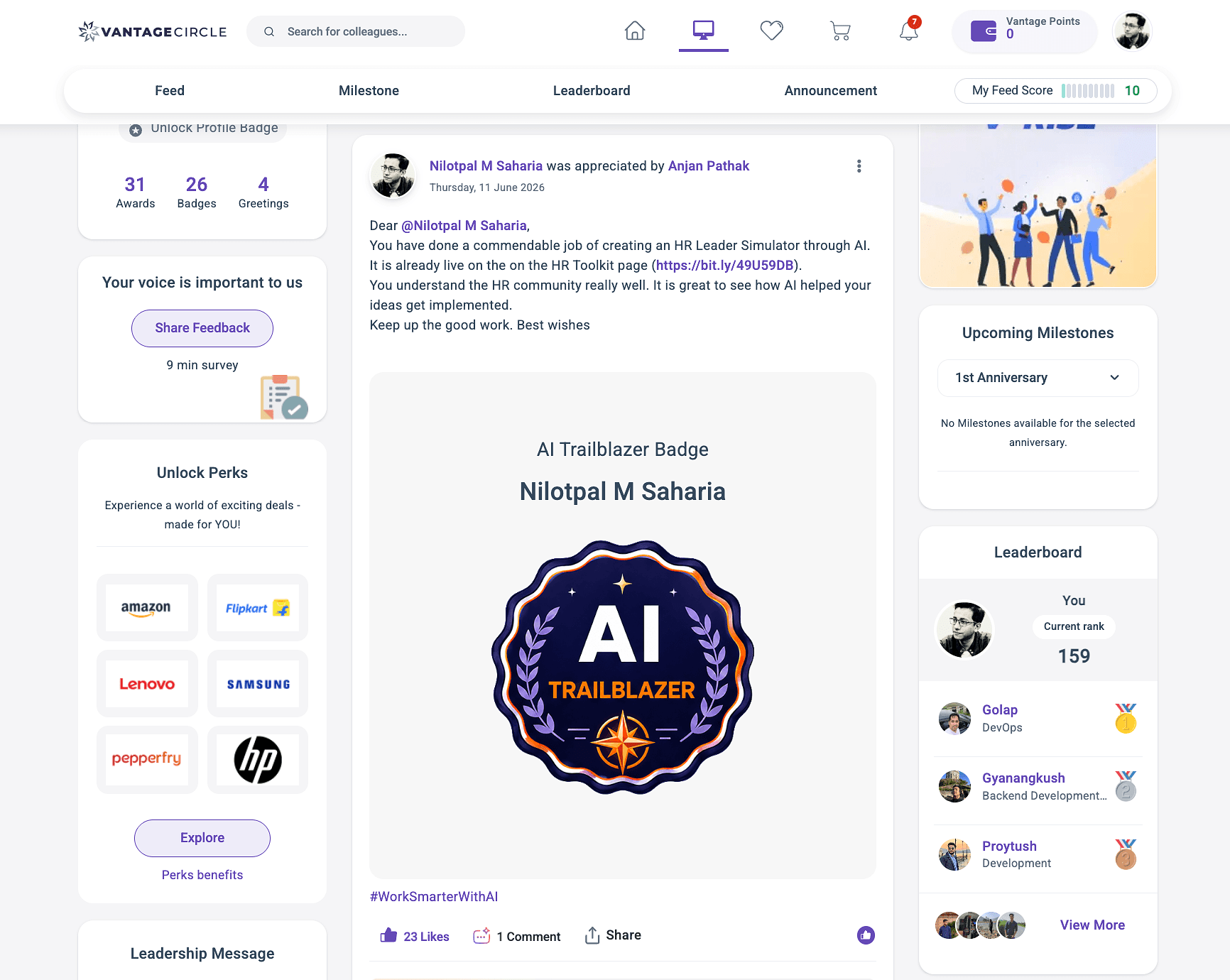
The strongest recognition practices make this appreciation timely and consistent. When employees see that meaningful contributions are noticed throughout the goal cycle, recognition becomes part of how work gets done, rather than a reward reserved for the finish line.
Recognize the Team and the Standout Individuals on Shared Goals
Shared goals call for recognition at two levels: the collective achievement and the individual contributions that made it possible. Celebrating only the team can leave exceptional effort unnoticed, while recognizing only individual performers can undermine the collaboration the goal depends on.
Managers should acknowledge what the team accomplished together while naming the people who made a meaningful difference along the way. Peer-to-peer recognition can strengthen this practice because colleagues often see the contributions behind a shared result that managers may miss. The aim is to make collaboration visible without overlooking individual effort.
Track Which Managers Recognize Progress
Recognition is only as consistent as the managers who practice it. Some acknowledge meaningful contributions throughout the quarter; others wait until the performance review to offer appreciation. That inconsistency can shape how employees experience the same goal-setting process across different teams.
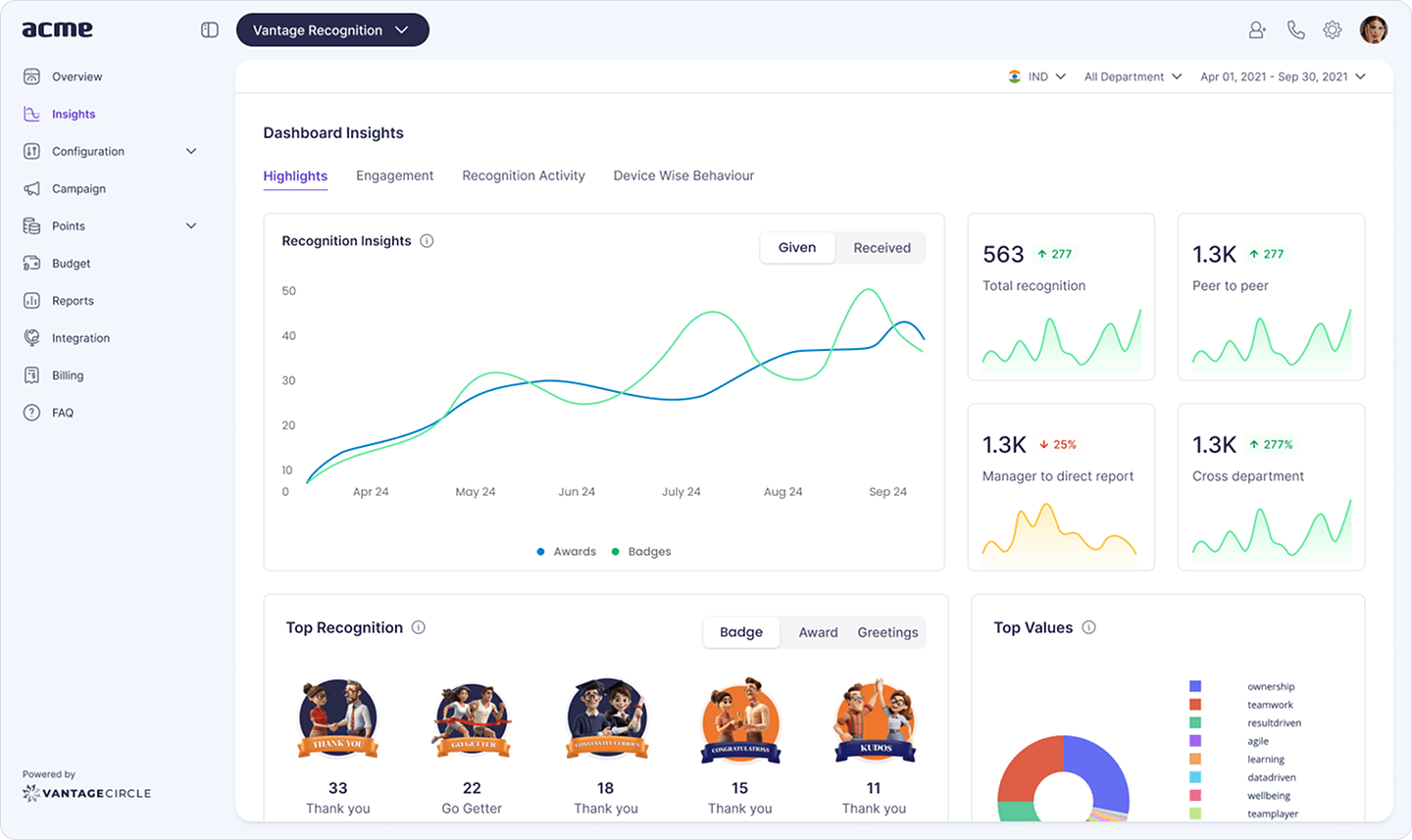
HRs can use manager-level recognition data in Vantage Recognition to identify these differences and determine where coaching may be needed. Rather than treating recognition as a company-wide initiative alone, they can focus on the managers whose teams may be missing out on timely feedback and appreciation.
30 Employee Goal Examples by Role (with milestones)
| Role | Goal type | Goal | Mid-point milestone | Recognition moment |
|---|---|---|---|---|
| Sales | Performance | Close $450K in new annual revenue by the end of Q2 | $225K closed or committed by week 6 | First deal won from a newly opened account |
| Sales | Development | Complete negotiation training and apply it on 5 enterprise deals this quarter | Training done and used on 2 deals | First deal that holds price after a discount request |
| Sales | Collaboration | Hand off every closed deal to customer success within 48 hours using the full notes template | 100% on-time handoffs in month one | A customer success lead calls out a clean handoff |
| Customer support | Performance | Raise first-contact resolution from 68% to 75% by June 30 | 71% by the end of month two | Crossing 71%, shared in the team channel |
| Customer support | Improvement | Publish 10 help-center articles for the top repeat tickets this quarter | 5 articles live, ticket volume tracked | First article that measurably cuts a ticket type |
| Customer support | Behavioral | Flag one evidence-backed bug pattern to engineering every sprint | 3 consecutive sprints flagged | Engineering ships a fix traced to the flag |
| Marketing | Performance | Grow organic demo requests 20% over last quarter | Up 10% by week 6 | Reaching the halfway number ahead of schedule |
| Marketing | Productivity | Cut campaign launch time from 15 working days to 10 | 2 launches under 12 days | First 10-day launch |
| Marketing | Development | Learn the new experimentation tool and run 3 A/B tests | First test live with clean results | Presenting test learnings to the wider team |
| Software engineering | Performance | Reduce p95 API latency from 800 ms to 500 ms by the end of Q3 | 650 ms | Crossing 650 ms in production |
| Software engineering | Collaboration | Pair with 2 junior engineers for one session each per week this quarter | 6 weeks of sessions logged | A junior engineer ships their first solo feature |
| Software engineering | Improvement | Raise automated test coverage on the billing service from 55% to 75% | 65% coverage | First release with zero billing regressions |
| HR | Performance | Cut average time-to-hire from 45 days to 35 | 40 days | First role filled in under 35 days |
| HR | Improvement | Redesign the new-hire onboarding checklist and pilot it with 2 teams | Pilot live with the first cohort | Positive 30-day feedback from the pilot cohort |
| HR | Development | Earn SHRM-CP certification by year-end | Exam booked, study plan half complete | Passing the full practice exam |
| Finance | Productivity | Close the monthly books in 5 working days instead of 8 | A 6-day close | First 5-day close |
| Finance | Improvement | Automate 3 manual reconciliation reports this quarter | 1 report automated and verified | Hours saved shared with the team |
| Finance | Behavioral | Walk one non-finance team through a plain-language budget insight each month | 2 sessions delivered | A team changes a spending decision because of it |
| Warehouse (frontline) | Performance | Raise order-picking accuracy from 98.5% to 99.5% by quarter-end | 99% for 4 straight weeks | 30 error-free shifts in a row |
| Warehouse (frontline) | Behavioral | Complete every pre-shift safety check and report near-misses the same day | 6 weeks with zero missed checks | A reported near-miss that prevents an incident |
| Warehouse (frontline) | Development | Earn forklift certification and cross-train on receiving by Q3 | Certification passed | First full shift covering receiving solo |
| Retail store (frontline) | Performance | Lift average transaction value from $42 to $48 this quarter | $45 by week 6 | First full week above $48 |
| Retail store (frontline) | Collaboration | Train 2 new associates on point of sale and returns within their first month | First associate fully signed off | A new associate's first solo closing shift |
| Retail store (frontline) | Behavioral | Earn 25 named customer compliments in reviews or surveys this quarter | 12 by mid-quarter | Each named compliment, shared by peers |
| People managers | Behavioral | Hold a 30-minute one-on-one with every direct report every two weeks | 100% completion for 6 weeks | Team pulse score on goal clarity rises |
| People managers | Development | Agree on one development goal with each direct report by the end of Q1 | Half of all goals agreed | A report completes their first development milestone |
| People managers | Performance | Hold regrettable attrition at zero for the half-year | A stay conversation done with every report | A stay conversation that leads to an internal move instead of an exit |
| New hires (first 90 days) | Development | Complete product certification and shadow 5 customer calls in the first 30 days | Certification done by day 15 | Passing the certification |
| New hires (first 90 days) | Collaboration | Meet one-on-one with 10 colleagues across 4 teams in the first 60 days | 5 meetings by day 30 | A colleague pulls them into real work |
| New hires (first 90 days) | Performance | Own one deliverable end to end by day 90 | Scope approved by day 45 | Shipping it, recognized publicly by the manager |
Conclusion
Good employee goals are focused, measurable, and built together. But setting them is only the beginning. What matters is how managers support progress, adapt to changing priorities, and recognize the effort behind the results.
The strongest goal-setting practices don't wait for the annual review to acknowledge achievement. They make progress visible throughout the quarter.
FAQs
1. What is the process of guiding the efforts of Employees to accomplish the desired goal?
The process of guiding the efforts of employees to accomplish the desired goal is known as employee goal setting and alignment.
2. Why is it Advantageous to have Employees Participate in Goal-setting?
It boosts engagement, accountability, and motivation while ensuring goals are realistic, meaningful, and aligned with organizational objectives.
3. How many goals should an employee have at one time?
Three to five meaningful goals is a practical starting point for most employees, though the right number depends on the role and the scope of the work. A longer list makes it harder to see what deserves attention.
4. How often should employee goals be reviewed?
Check in every two weeks or once a month to review progress against the agreed milestone, remove obstacles, and adjust the plan. Then review and reset goals every quarter, so employees are not measured against priorities that have since changed.

Shikha Gogoi is a Content Marketing Specialist focused on SEO-driven content around employee engagement, recognition, and workplace culture, helping build people-first workplaces.
Connect with Shikha on LinkedIn.