
Nobody gets hired for being a bad communicator. And yet most of what goes wrong at work, from slipped deadlines to good people walking out, can be traced back to a conversation that went sideways or never happened at all.
Communication is the skill everyone claims and almost no one is taught. This guide fixes that. You’ll see what each skill sounds like in practice, what it isn’t, and how to measure it across your team with a simple scorecard.
Key Takeaways
- What Are Communication Skills in the Workplace?
- Why Communication Skills Matter at Work
- 10 Good Communication Skills With Examples
- Signs of Poor Communication at Work
- How Managers Can Assess Communication Skills on a Team
- How to Improve Communication Skills: 6 Practical Methods
- How to Describe Communication as a Strength
What Are Communication Skills in the Workplace?
Communication skills in the workplace are the abilities to listen, speak, write, and read nonverbal cues well enough that your message lands the way you meant it. They fall into four core types, plus a fifth group of adaptive skills that decide how well you apply the first four in a real conversation.
| Type | What It Covers | Skills in This Guide |
|---|---|---|
| Verbal | Speaking clearly in meetings, calls, and 1:1s | Clarity and Conciseness, Asking Good Questions |
| Written | Emails, chat messages, and documentation | Written Communication |
| Nonverbal | Tone, posture, facial expression, eye contact | Nonverbal Communication and Tone of Voice |
| Listening | Taking in and confirming what others say | Active Listening |
| Adaptive | Judgment calls on tone, channel, and audience | Empathy and EQ, Feedback, Recognition, Channel Choice, Adapting to Styles and Cultures |
Communication is one piece of the broader soft skills every employee needs at work, and it overlaps with the wider set of interpersonal skills that shape how people work together. This guide focuses on individual-level skills. If you're building an organization-wide communication plan instead, see workplace communication.
Why Communication Skills Matter at Work
Communication skills matter because nearly every workplace outcome, from a clear handoff to a resolved conflict, depends on a message being understood the way it was meant.
Good communication solves problems before they escalate. A clarifying question in a meeting catches a wrong assumption before it becomes a missed deadline. Specific, early feedback catches a performance issue before it becomes a formal complaint. The cost of skipping that step shows up in the data:
- NACE's 2026 Job Outlook Spring Update found that "employers want to see that candidates have the ability to work in a team, problem-solve, and communicate effectively," placing communication among the small set of attributes that show up on nearly every hiring checklist.
- Firstup's research on hourly workforces found that 70% of managers say they struggle to communicate effectively with their teams, in a setting where only 16% of hourly workers already trust senior leadership.
- A 2022 Grammarly and Harris Poll study estimated poor communication costs U.S. businesses up to $1.2 trillion a year, up to $12,506 per employee, mostly in time lost to confusion and rework.
Those numbers show up as the same handful of patterns in day-to-day work: repeated rework, decisions people learn about secondhand, and conflict that drags on because nobody named the actual issue. For a closer look at how that happens, see real examples of miscommunication at work.
10 Good Communication Skills in the Workplace (With Examples)
Here are the 10 communication skills that make the biggest difference at work, with what each one sounds like in practice and what it isn't.
1. Active Listening
Active listening is giving someone your full attention and checking back what you heard before responding, so the other person knows the message actually landed.
It matters because it catches wrong assumptions early and builds the kind of trust that makes people willing to raise problems before they become bigger ones.
2. Clarity and Conciseness
Clarity means leading with the point of your message instead of burying it under context, so the reader or listener knows what you need from the first sentence.
This matters most on fast-moving teams, where every extra sentence before the ask is a few more seconds someone has to spend figuring out what you actually want.
3. Written Communication
Written communication is writing emails, chat messages, and docs clearly enough that the reader doesn't need a follow-up call to understand them.
With most teams now working async across time zones, a message that needs a meeting to clarify it costs everyone more time than writing it properly the first time.
4. Nonverbal Communication and Tone of Voice
Nonverbal communication is what your posture, facial expression, and tone of voice say, often louder than your actual words.
It matters because when what you say conflicts with how you say it, people tend to trust the nonverbal signal over the words. A calm tone during difficult feedback makes the feedback easier to hear; a clipped one undercuts even a well-worded message.
5. Empathy and Emotional Intelligence
Emotional intelligence, or EQ, is the ability to recognize your own emotions and other people's, and use that awareness to communicate without becoming reactive or dismissive. Empathy, understanding a situation from the other person's point of view, is the part of EQ that shows up most directly in conversation.
It matters because people are more honest with someone who has shown they can hear a hard message without getting defensive or shutting the conversation down.
6. Giving and Receiving Feedback
Giving feedback well means naming a specific behavior and its impact, not a vague judgment, so the other person knows exactly what to repeat or change.
Managers with strong communication skills treat feedback as a regular habit, not a once-a-year event tied to a performance review.
7. Specific, Positive Recognition
Specific recognition is naming the exact behavior you're praising, not a generic compliment, so the person knows what to keep doing.
Most praise at work is too vague to repeat. "Great job" tells someone nothing about what worked. Naming the behavior and its impact turns appreciation into a communication skill people can actually practice.
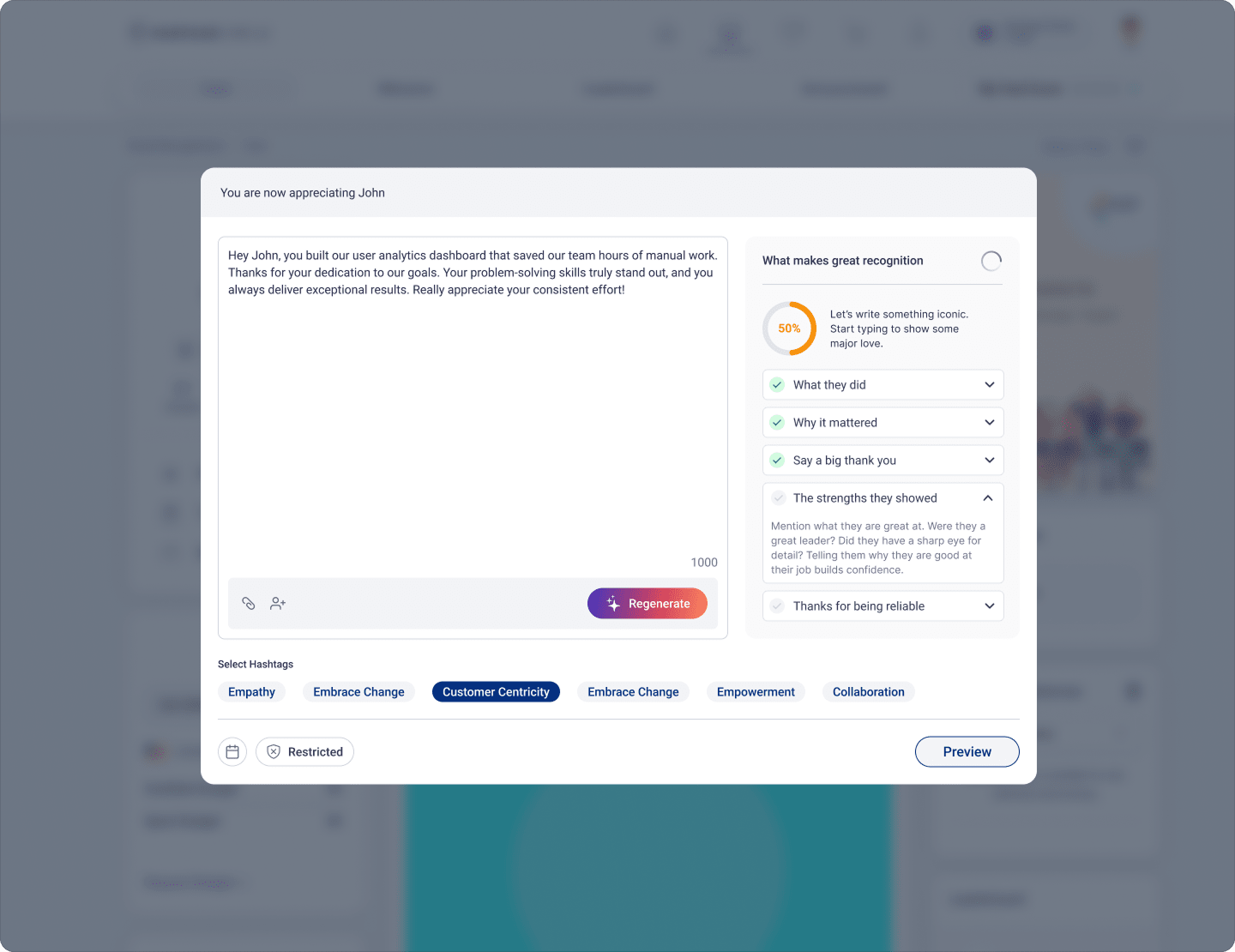
A guided composer that prompts you to name the behavior and its impact, rather than leaving you to default to "great job," is one way to build this habit at scale.
Explore: See how Vantage Rewards guides specific recognition
8. Asking Good Questions
Asking good questions means asking something that moves the conversation forward instead of one that only confirms what you already believe.
Open, specific questions surface the information a meeting actually needs; leading or rhetorical ones shut the conversation down before it starts.
9. Choosing the Right Channel
Choosing the right channel means matching the message to the medium: a quick chat ping for a status check, a call for anything emotionally loaded or ambiguous, a document for anything people will need to reference later.
Getting this wrong is one of the most common, and most avoidable, communication mistakes at work.
10. Adapting to Different Communication Styles and Cultures
Adapting your communication style means adjusting how directly you speak and how much context you give based on who you're talking to, instead of using the same script with everyone.
"Flexing your style depending on your audience is really important. In a direct communication culture, the message is the words themselves, the words that are being said. In an indirect communication culture, also referred to as a high-context culture, the message is not only the words, it's also about how, where, and when it's said."
— Hisham ElSaied, Regional HR Head, MENA, Helmerich & Payne, on the Vantage Influencers Podcast
Reading a direct culture's bluntness as rudeness, or an indirect culture's context-heavy style as evasiveness, is one of the most common cross-cultural misreads at work.
Signs of Poor Communication Skills at Work
The clearest signs of poor communication are repeated rework, meetings that end without a clear owner for the next step, and people learning about decisions secondhand.
Watch for these patterns on a team:
- Instructions have to be repeated or clarified more than once before work can start.
- Meetings end without anyone naming who owns the next step.
- People hear about a decision from a colleague instead of from the person who made it.
- A written message gets followed almost immediately by "can we just hop on a call."
- Feedback is vague enough that it can be denied or ignored later.
- The same misunderstanding keeps happening with the same person or team.
None of these point to one bad actor. They usually point to a gap in one of the 10 skills above, most often clarity, channel choice, or feedback.
How Managers Can Assess Communication Skills on a Team
Managers assess communication skills by observing specific behaviors in meetings, writing, and 1:1s against clear anchors, not by rating "communicates well" on a 1 to 5 scale.
The scorecard below gives a behavioral anchor for each skill at three levels, useful in 1:1s and performance reviews alike.
| Skill | Developing | Proficient | Strong |
|---|---|---|---|
| Active Listening | Interrupts or responds before the speaker finishes | Waits, then responds to what was actually said | Paraphrases back to confirm understanding before replying |
| Clarity | Buries the ask in background context | States the ask early, with some context | Leads with the ask, then adds only the context needed |
| Written Communication | Messages regularly need a follow-up call to clarify | Messages are understood on first read, occasionally need a follow-up | Messages state decision, owner, and deadline without prompting |
| Nonverbal / Tone | Tone often conflicts with the message's intent | Tone generally matches the message | Tone and body language reinforce the message, even under pressure |
| Empathy / EQ | Dismisses or argues with others' concerns | Acknowledges others' concerns before responding | Names the emotion in the room and addresses it directly |
| Feedback | Avoids giving feedback or keeps it vague | Gives feedback when asked, names the behavior | Gives unprompted, specific feedback on a regular cadence |
| Recognition | Praise is generic ("good job") or rare | Praise names the task, occasionally the impact | Praise names the specific behavior and its impact, regularly |
| Questioning | Asks leading or rhetorical questions | Asks clarifying questions when something is unclear | Asks open questions that surface information others missed |
| Channel Choice | Defaults to one channel regardless of the message | Picks a reasonable channel most of the time | Matches channel to urgency and sensitivity every time |
| Adapting to Styles | Uses the same style with everyone | Adjusts tone for a few known colleagues | Reads the room and adjusts directness and context in real time |
A scorecard like this only works if managers can see patterns, not just individual conversations. Open-text survey comments are often where communication gaps surface first, phrases like "no updates" or "found out from Slack" show up before anyone files a formal complaint.
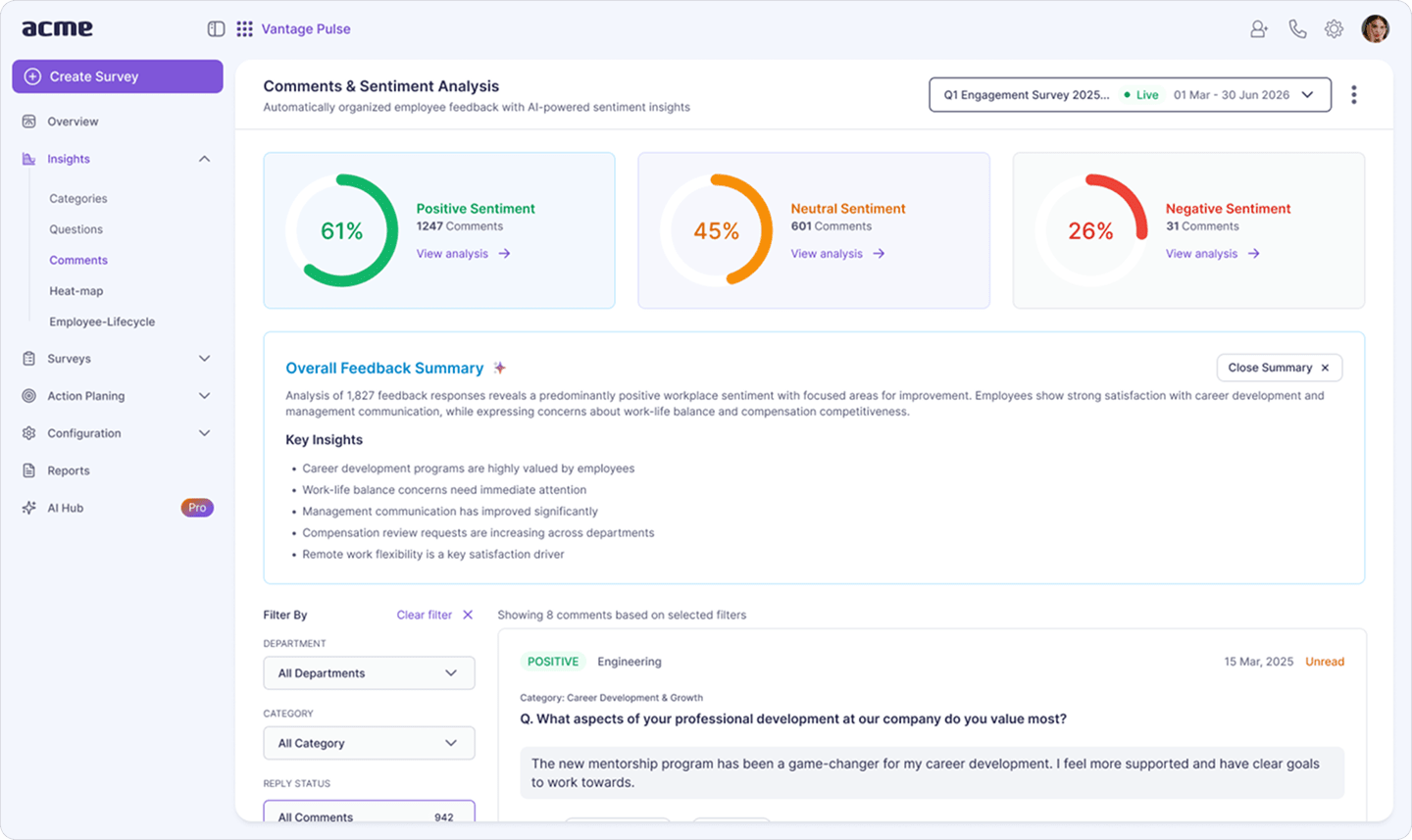
Sentiment and theme analysis on anonymous feedback turns those comments into a team-level signal instead of scattered anecdotes, and comparing results by department shows where to focus training first instead of sending the whole company to the same workshop.
Explore: See how Vantage Pulse surfaces communication gaps
How to Improve Communication Skills at Work: 6 Practical Methods
The fastest way to improve communication skills at work is to get specific feedback on how your messages land, then practice one skill at a time in real meetings and messages.
1. Ask for Feedback on One Skill at a Time
Pick a single skill from the 10 above, tell a trusted colleague or manager you're working on it, and ask them to flag it specifically for a few weeks. Trying to fix everything at once rarely sticks.
2. Write the Headline First
Before sending a message, write the one sentence you want the reader to walk away with. Put that sentence first, then add whatever context supports it.
3. Practice Storytelling: Instruction, Imitation, Practice
"Stories are easy to understand. Stories are easy to remember, and stories are easy to retell." That, he argues, is what makes storytelling learnable the same way any other communication skill is: through instruction from a mentor, book, or course, imitation of someone who does it well, and practice.
— Indranil Chakraborty, Founder, Story Works, on the Vantage Influencers Podcast
A specific story about a real outcome is more persuasive and more memorable than a general claim, in a pitch, an update, or an employer brand message.
4. Use Anonymous Channels to Hear What People Won't Say
People raise communication problems with their manager far less often than they actually experience them. Anonymous, two-way channels let someone flag an issue and let HR ask a clarifying follow-up, without ever exposing who wrote it.
5. Make Specific Recognition a Weekly Habit
Public, specific praise teaches a whole team what good communication looks like without a training session. When people read "Ana's two-line summary saved the client call," the standard becomes visible.
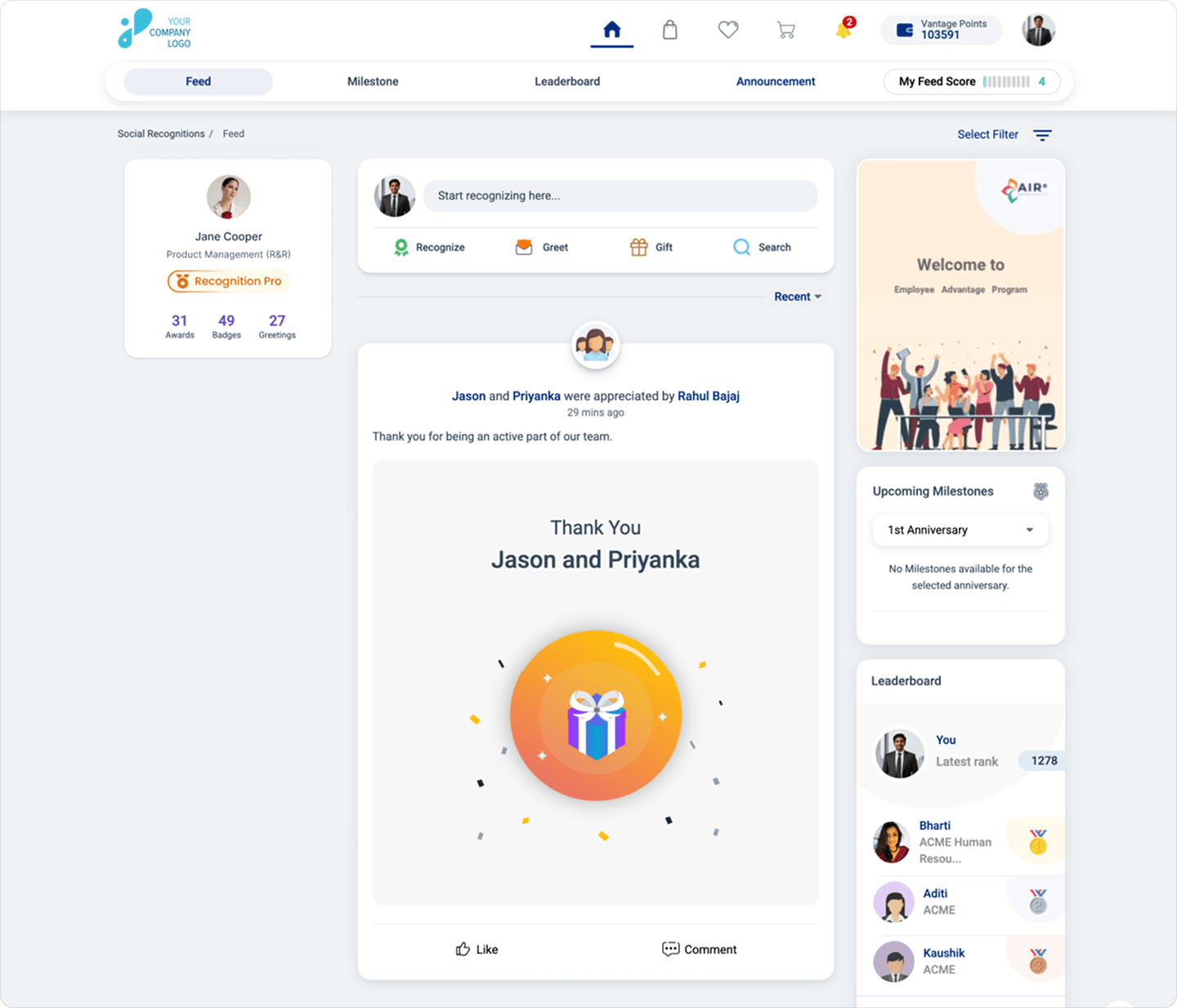
Explore: Explore the Vantage Rewards social recognition feed
6. Agree on Team Communication Norms
A lot of friction disappears once a team agrees on basics: which channel is for what, how fast a reply is expected, and when a meeting beats a message. See how to improve team communication for a fuller framework, or communication strategies for the workplace if you're building this at the organization level.
How to Describe Communication as a Strength
Skip the word “communication.” Name the specific skill instead, then prove it with something that changed because of it.
“Strong communication skills” tells a hiring manager nothing, because everyone writes it. “Rewrote our handoff doc and cut clarification requests on new tickets by half” tells them exactly what you do and why it matters. One is a claim. The other is evidence.
The same rule works in reverse when you’re the one evaluating. If your job descriptions list “excellent communication” as a requirement, or your performance reviews rate it on a scale of one to five, you’re measuring something nobody can define. Get specific about the skill you actually need, whether that’s active listening, clear writing, or giving feedback that lands, and describe the behavior that shows it. That way candidates know what you’re looking for, and employees know what “good” looks like before review season, not after.
Conclusion
The 10 skills above aren't traits some people are born with and others aren't. Each one is a specific, practiced behavior, and each one is visible in how a person runs a meeting, writes a message, or responds to feedback. Start with the one skill that's costing your team the most right now, practice it deliberately, and use the scorecard above to track whether it's actually changing how the team works together.
Explore: See how Vantage Rewards turns specific recognition into a daily communication habit
Frequently Asked Questions
Q1. What are the top 10 communication skills?
A. The top 10 communication skills at work are active listening, clarity and conciseness, written communication, nonverbal communication and tone of voice, empathy and emotional intelligence, giving and receiving feedback, specific and positive recognition, asking good questions, choosing the right channel, and adapting to different communication styles and cultures.
Q2. What are 7 good communication skills?
A. Seven of the most important are active listening, clarity, written communication, nonverbal communication, empathy, feedback, and asking good questions. These cover the core of most day-to-day workplace conversations, from meetings to written updates.
Q3. What are the 5 good communication skills?
A. The five most foundational are active listening, clarity and conciseness, written communication, nonverbal communication, and empathy. Together they cover the four communication types (verbal, written, nonverbal, listening) plus the emotional awareness needed to apply them well.
Q4. What are the three most important communication skills?
A. Active listening, clarity, and empathy are generally considered the three most important, since they influence nearly every other skill on this list. Without active listening, feedback and questions miss the point. Without clarity, even a well-intentioned message gets lost. Without empathy, feedback and recognition both fall flat.
Q5. What is the most used communication skill?
A. Active listening is arguably the most used, since it underlies nearly every workplace interaction, from a quick status update to a difficult performance conversation, even when it isn't the skill people think to name.
Q6. What are the negative consequences of miscommunication?
A. Miscommunication leads to repeated rework, missed deadlines, damaged trust, and unresolved conflict that resurfaces later. On a team level, it shows up as duplicated work, decisions that get reversed because the wrong people were informed, and employees who stop raising concerns because they don't believe they'll be heard. See real examples of miscommunication at work for specific scenarios.
Q7. How do you professionally say "poor communication"?
A. Instead of telling someone they communicate poorly, describe the specific gap: "the message wasn't landing clearly," "we had a misalignment on expectations," or "the update didn't reach everyone who needed it." Naming the specific breakdown, rather than labeling the person, keeps the conversation focused on what to fix.

Shaoni Gupta is a content marketing specialist at Vantage Circle, with expertise in scriptwriting and copywriting in the field of employee rewards and recognition.
Connect with Shaoni on LinkedIn.