
The most consequential thing you do as a leader this week will probably look like nothing. Not the all-hands, not the reorg, not the carefully worded announcement. It will be whether you kept a promise nobody wrote down. Whether you let someone else make the call. Whether you noticed.
We like to picture leadership as a performance, staged for big rooms and bigger moments. The people who work for you experience it differently. To them, it is a pattern, built from hundreds of small, forgettable decisions that turn out to be anything but.
That pattern is not a personality trait, and it does not arrive with a bigger title. It can be learned, repeated, and sharpened like any other skill. What follows are five practices that separate the leaders people remember from the ones they simply report to. Most leaders have a couple of them down. Almost nobody gets to the fifth.
What Are Leadership Practices?
Leadership practices are the repeatable, observable actions a leader takes to guide a team toward a shared goal, not a fixed set of traits someone is born with. The most researched model of them comes from James M. Kouzes and Barry Z. Posner, who introduced the Five Practices of Exemplary Leadership® in their book The Leadership Challenge®, first published in 1987 and now in its seventh edition. The model came out of their research into leaders' "personal-best" experiences: thousands of accounts of people leading at their most effective, coded for the behaviors that kept showing up.
That research base is why practices, not traits, are the more useful lens for building leadership skill. A trait like "charisma" is hard to coach. A practice like "ask one direct report how their work connects to the team's goal" can be taught, repeated, and measured. The five practices below are built the same way: each one is something you can start doing this week, not something you either have or don't.
If you want the fuller picture of what leadership means before narrowing in on practices specifically, this guide to leadership is a useful starting point.
Leadership Practices vs. Behaviors vs. Qualities vs. Styles
A leadership practice is a repeatable discipline, a behavior is one observable action, a quality is a trait, and a style is an overall approach to leading people. These four terms get used interchangeably, but they answer different questions, and mixing them up is why so much leadership advice feels repetitive.
| Term | What It Is | Example |
|---|---|---|
| Leadership Practice | A repeatable discipline a leader builds into daily work | Modeling the way by naming a value in every team meeting |
| Leadership Behavior | A single observable action tied to a practice | Admitting a mistake in front of the team |
| Leadership Quality | A trait or disposition a leader has | Honesty, resilience, decisiveness |
| Leadership Style | An overall approach to leading people | Democratic, transformational, servant leadership |
If you are looking for the specific actions that make up good leadership day to day, see 18 key leadership behaviors. For the traits leaders are expected to carry, see leadership qualities. For the broader approaches leaders take to the job itself, see leadership styles.
The 5 Practices of Exemplary Leadership, Explained
Kouzes and Posner's 5 evidence-based practices are Model the Way, Inspire a Shared Vision, Challenge the Process, Enable Others to Act, and Encourage the Heart. Each one is a discipline, not a single event, which is why the habit underneath each practice matters more than any one grand gesture.
1. Model the Way
Model the Way means clarifying the values you hold and then acting on them consistently enough that your team can predict your decisions before you make them.
This is also the practice most leaders say they believe in and most organizations fail to reinforce. According to the AIRe Benchmarking Report India 2024-25 (Vantage Circle), only 38% of organizations currently target the behaviors that their own business leaders say they prioritize, which creates a gap between what leaders claim to value and what their recognition programs actually reward. If what gets rewarded is not what gets said in the all-hands, people will follow the reward every time.
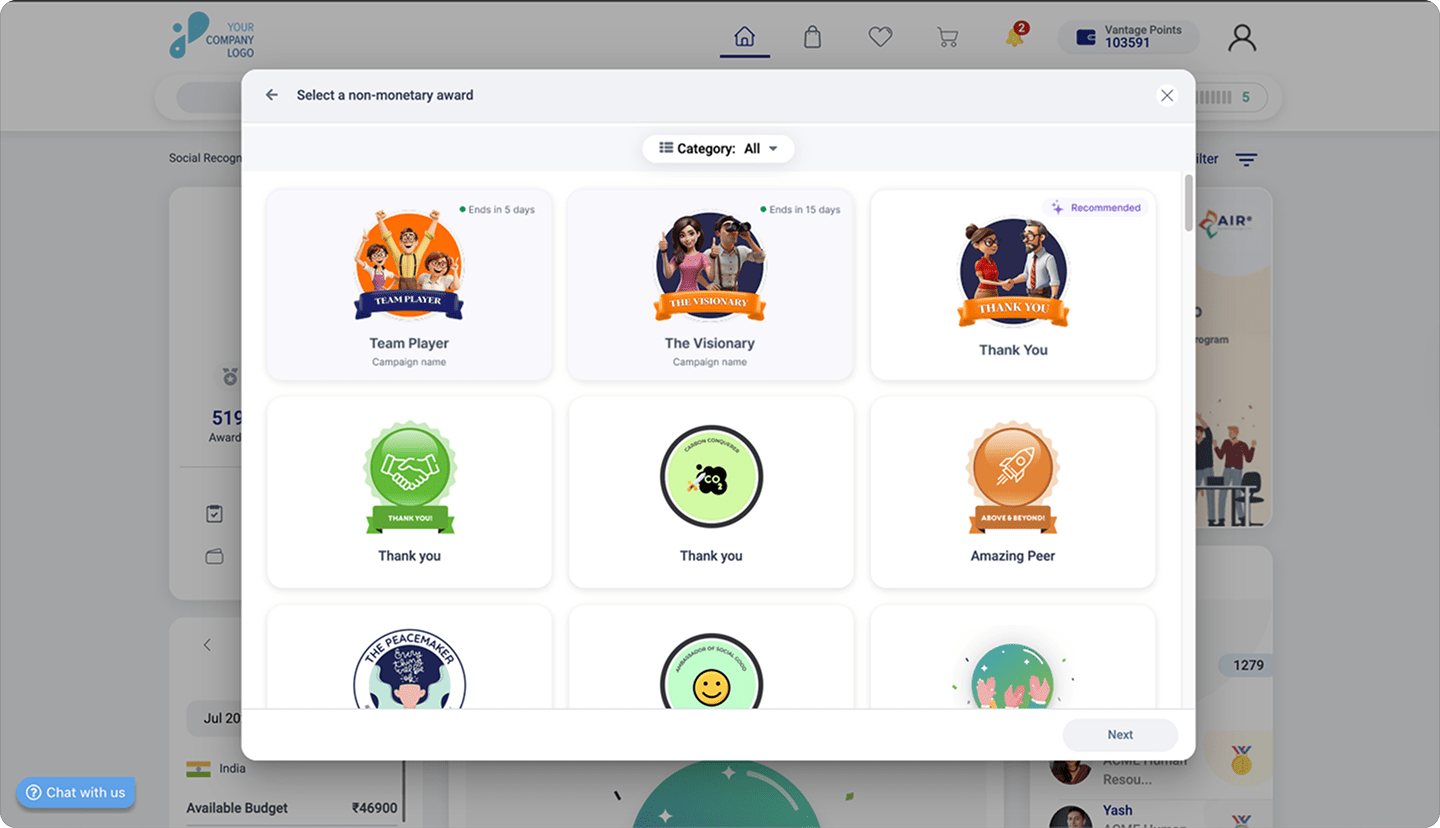
Tagging recognition to a specific value, the way Vantage Rewards' badge catalog does, is one way to close that gap. It gives leaders an actual record, over a quarter, of which values their team lives and which ones only ever show up on the office wall.
Weekly habit: Name one value in your team meeting and point to a specific person who lived it that week.
Closing that gap starts with being explicit about what those values are in the first place. For how to define and operationalize them, see company core values.
2. Inspire a Shared Vision
Inspire a Shared Vision means describing a future people actually want, and inviting them to help shape it, rather than announcing a destination and expecting people to follow.
Most teams can recite a company's mission statement. Far fewer can explain how their own work moves that mission forward, which is the actual test of whether a vision is shared or just posted on a wall.
Weekly habit: Ask each direct report, in your next one-on-one, how they see their current work connecting to the team's larger goal. Where the answer is vague, that is the gap to close next.
Vague answers usually trace back to goals that were never made concrete in the first place. For how to set goals people can actually see themselves in, see team goals.
3. Challenge the Process
Challenge the Process means actively looking for better ways of working and treating mistakes as information rather than failures to punish.
Leaders who practice this well are the ones who ask "why do we do it this way" before they ask "who approved this." They also protect the person who raises an uncomfortable question, because the moment that question gets punished once, it stops getting asked.
Weekly habit: Ask "what should we stop doing?" once a week in a team meeting, and publicly recognize whoever raises an answer, even an imperfect one.
This is the practice most closely tied to how a team handles change and new ideas. Innovation in the workplace goes deeper on building that habit at a team level.
4. Enable Others to Act
Enable Others to Act means building enough trust that people can make real decisions without you, and sharing power instead of hoarding it.
Trust is the hinge this practice turns on. Leaders who do not trust their teams tend to approve every small decision themselves, which slows the team down and quietly tells people their judgment is not trusted either. Trust gets built the unglamorous way: by making the actual decision-making process visible, by involving people in decisions that affect them, and by treating everyone's input the same regardless of title.
Enabling others also means hearing what people will not say in a meeting. A direct report is far more likely to flag a real problem anonymously than to raise it in front of the team, which is why leaders who only collect feedback in open forums tend to miss the feedback that matters most.
Weekly habit: Hand over one decision this week that you would normally make yourself, and let the person who owns it make the call without you weighing in first.
Trust in the workplace and active listening both go deeper on the two disciplines this practice depends on most.
5. Encourage the Heart
Encourage the Heart means recognizing individual contributions and celebrating shared values and victories together, so people feel both valued and connected to something larger than their own task list. Kouzes and Posner consistently find this the hardest of the five practices for leaders to sustain, and the data on who actually gets recognized at work explains why.
According to The Recognition Effect (Great Place To Work® India × Vantage Circle, 2025), a study of 5.7M+ employees, 44% of organizations sit in what the report calls the recognition blind spot, where neither leaders nor systems consistently make people feel seen. For most organizations, Encourage the Heart is not a practice leaders have mastered. It is one most have not started.
Shridhar Sampath, founder of Motivaluate Consulting and Training and a guest on Vantage Circle's HR Influencers podcast, makes the sharpest version of this point from his own career. He once received a McDonald's voucher as an "employee of the month" reward, despite disliking McDonald's. In his words: "I did not like McDonald's, so what was the value of that gift to me? I received it, I thanked them for it, but it didn't really warm my heart." He has said he would have valued two hours off to spend with his family far more during that stressful stretch of work. That distinction, personalizing the reward instead of defaulting to a generic one, is what he calls the basis of encouraging the heart. You can hear the full conversation in our podcast with Shridhar Sampath.
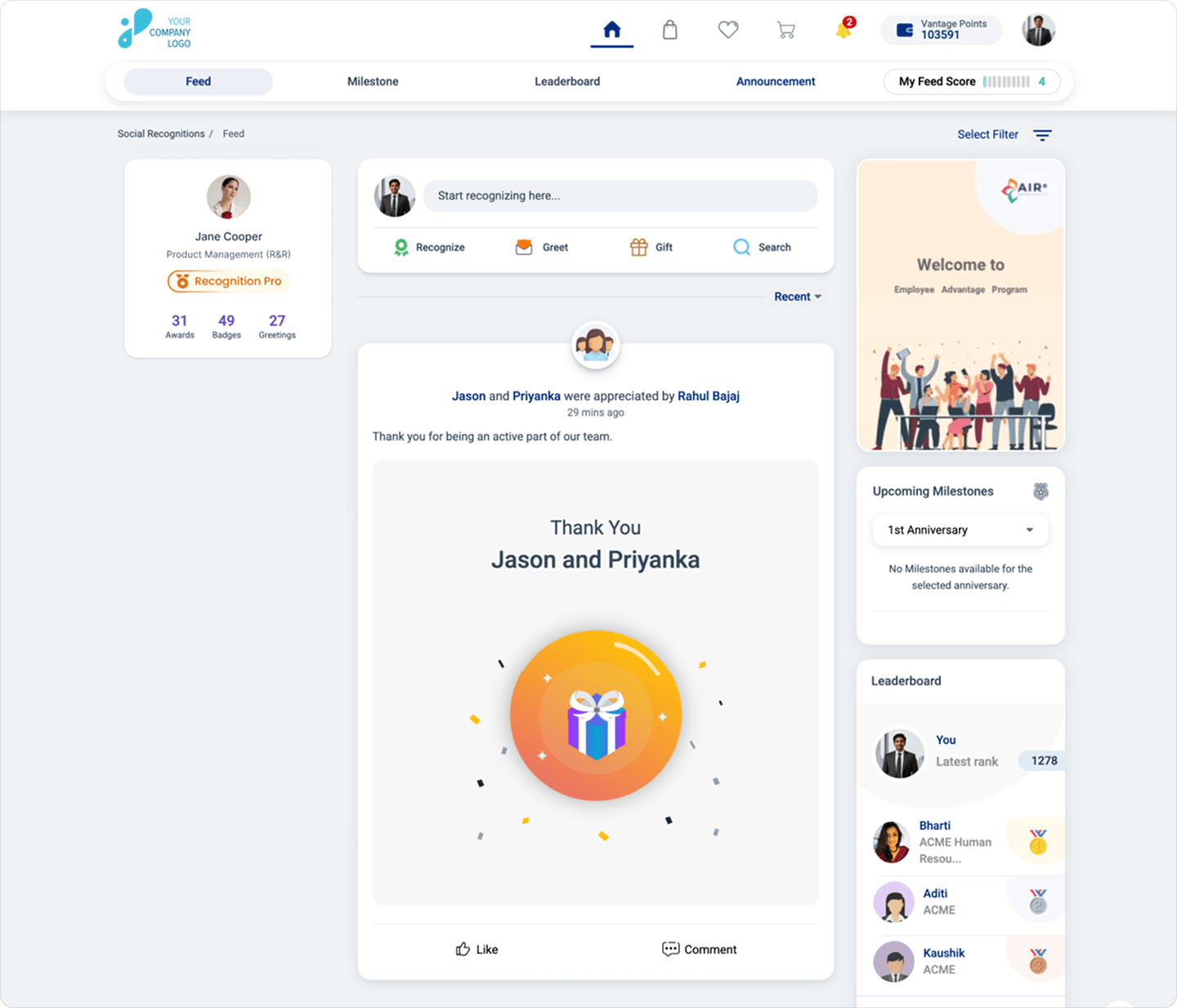
Kouzes and Posner pair recognizing individuals with celebrating together, and a shared recognition feed like this one does both at once: one person is thanked by name, and the rest of the team sees what good work actually looks like.
The same report also found a hierarchy effect: recognition rises with rank, reaching 78% of senior leaders but only 66% of non-supervisory employees. Encouraging the heart has to reach the front line, not stop at the leadership team, or it is only working for the people who already feel seen.
How leaders recognize matters as much as how often. The State of Recognition & Rewards 2025 (Vantage Circle) found that 79% of high-effectiveness recognition programs recognize both the team and standout individuals when celebrating a collective win, compared with just 37% of other programs, almost exactly the two commitments Kouzes and Posner describe: recognize the person, and celebrate together.
Weekly habit: Recognize one specific contribution publicly, and one privately, every week. Not a generic "great job," but the actual thing the person did and why it mattered.
Manager recognition and personalized recognition both go further into making recognition land the way Shridhar describes.
How to Put the 5 Leadership Practices Into Action Every Week
Turn each practice into one small weekly habit, then measure whether your team notices a difference. None of the five practices requires a grand gesture. What they require is that you do the small version of each one often enough that it becomes expected.
| Practice | One Weekly Habit | How to Know It's Working |
|---|---|---|
| Model the Way | Name one value in your team meeting and point to who lived it | People start naming the same value unprompted |
| Inspire a Shared Vision | Ask each direct report how their work moves the team's goal forward | Reports answer without having to pause and think |
| Challenge the Process | Ask "what should we stop doing?" weekly, and recognize whoever answers | People start raising ideas before you ask |
| Enable Others to Act | Hand over one decision you would normally make yourself | The decision gets made well without your input |
| Encourage the Heart | Recognize one contribution publicly and one privately | Peers start recognizing each other, not just you |
"Leadership research consistently shows that leadership is an aspiration and a choice. We need to aspire to be a leader and be willing to stretch ourselves. At the same time, we need to make a choice on a daily basis. We wake up every morning with a choice: do I want to be a leader today or not? And this is true regardless of profession, industry, or where you are in your stage of life."
– Shridhar Sampath, Founder, Motivaluate Consulting and Training, on Vantage Circle's HR Influencers podcast
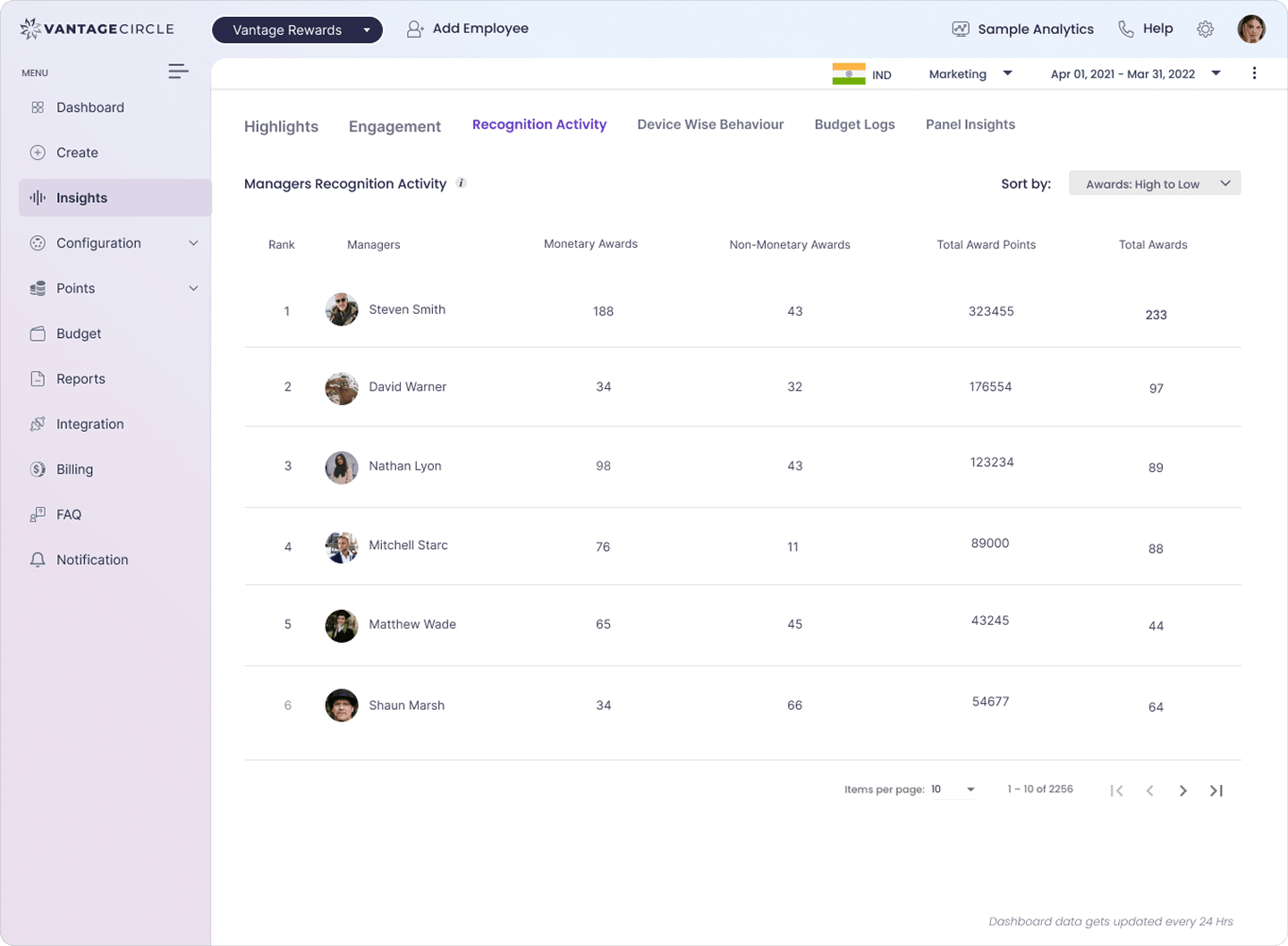
A habit you cannot see is hard to keep. A monthly view of how often each manager actually recognizes their team, and who they have missed, is what turns Encourage the Heart from an intention into a practice you can hold yourself to.
If you want to go further than habits and actually track whether these practices are landing, measuring leadership effectiveness covers the metrics worth watching.
How Leaders Measure Their Practices: The Leadership Practices Inventory
The Leadership Practices Inventory (LPI) is Kouzes and Posner's 360-degree assessment that measures how often a leader uses each of the five practices, scored by the leader and the people around them. It is the formal instrument behind the framework in this post, built from the same research base as The Leadership Challenge® and refined over more than three decades of use.
The LPI itself, including its specific items and scoring, is proprietary to Kouzes, Posner, and Wiley. You can learn more about it directly from the official Leadership Challenge site rather than through a secondhand summary. What you can do without it is still track your own use of each practice informally: the weekly habits above are a reasonable starting point, and a structured 360-degree feedback process is the more rigorous way to get a fuller picture from the people who report to you.
Conclusion
The five practices work as a system, and Encourage the Heart is the one that keeps people willing to follow the other four. You can model the way, paint a compelling vision, challenge the process, and hand over real decisions, and still lose people if nobody ever feels seen for doing the work.
See how leaders put Encourage the Heart into practice: Explore Vantage Rewards
FAQs
What are the best practices for leadership?
Researchers point to one evidence-based model more than any other: Kouzes and Posner's Five Practices of Exemplary Leadership®, built from decades of research into leaders' most effective moments. The five are Model the Way, Inspire a Shared Vision, Challenge the Process, Enable Others to Act, and Encourage the Heart, and they hold up as a system rather than a checklist you complete once.
What are the 5 P's of leadership?
There is no single, research-backed "5 P's of leadership" framework the way there is for the five practices. Different trainers and consultants use the phrase for different lists, commonly some combination of Purpose, People, Process, Performance, and Passion, but none of these versions trace back to a consistent research base. If you want a framework that does, Kouzes and Posner's Five Practices of Exemplary Leadership® is the more rigorously studied alternative.
What are the 7 main leadership styles?
Leadership style and leadership practice answer different questions: a style is the overall approach a leader takes, while a practice is a specific repeatable action. Commonly cited leadership styles include autocratic, democratic, transformational, servant, laissez-faire, transactional, and situational leadership. See leadership styles for more depth on each.
What are the top 3 leadership qualities?
Kouzes and Posner's research, spanning more than three decades, actually points to four qualities people consistently want in their leaders rather than three: honesty, a forward-looking vision, the ability to inspire, and competence. These four have held steady across financial crises, wars, and pandemics as the baseline people expect before they will follow anyone. See leadership qualities for what each one looks like in practice.

Shaoni Gupta is a content marketing specialist at Vantage Circle, with expertise in scriptwriting and copywriting in the field of employee rewards and recognition.
Connect with Shaoni on LinkedIn.