Most managers can name the one skill they're missing the moment you ask. Fewer can name all ten they actually need, because nobody ever laid the full set out for them in one place.
Management skills are the abilities a manager uses to lead people, run processes, and hit business goals, and they fall into three groups: technical, human, and conceptual. Only about 1 in 10 people naturally have what it takes to manage well (Gallup), which means everyone else builds these skills on purpose or not at all. This post defines what management skills actually are, breaks down the 10 every manager needs, gives you a quick way to score your own, and shows you how to build each one.
What Are Management Skills?
Management skills are the capabilities a manager relies on daily to plan work, guide people, and translate strategy into results. Robert Katz, a management theorist, organized them into three categories in his 1955 Harvard Business Review (HBR) article "Skills of an Effective Administrator," and seven decades later the framework still holds.
The 3 Types of Management Skills
| Type | What It Is | Example Skills |
|---|---|---|
| Technical | Job-specific know-how: the tools, processes, and procedures behind the work itself | Delegation, time management, budgeting |
| Human | The ability to work with and through people | Communication, empathy, emotional intelligence, motivation, conflict resolution |
| Conceptual | Seeing the organization as a whole and how its parts connect | Strategic thinking, problem-solving, decision-making |
Frontline managers lean more on technical and human skills day to day. The higher a manager rises, the more conceptual thinking the role demands, since the job shifts from running a task to running a function.
Management Skills vs Leadership Skills
Management and leadership overlap, but they aren't the same job. Management skills are about execution: planning, organizing, and controlling work to hit a known goal. Leadership skills are about direction: setting a vision and getting people to want to follow it, even before the goal is fully defined. A team can survive a manager who's short on vision far longer than it can survive one who can't execute, which is why management skills, not leadership charisma, are what most organizations should build first.
Why Management Skills Matter
Managers account for at least 70% of the variance in how engaged their teams feel, according to Gallup's "State of the American Manager" report (2015). That single number explains why a company can have a strong product and strategy and still lose its best people to disengagement: the manager, not the mission statement, is what employees experience every single day.
The manager effect. Gallup's same research found that only 1 in 10 people naturally possess the talent to manage. The other 9 in 10 can still become effective managers, but only by deliberately building the skills rather than inheriting the title.
Google ran its own version of this test. Project Oxygen, Google's internal study of what makes its managers effective, ranked technical expertise dead last among the 8 traits shared by its best managers, behind coaching, communication, and caring about the team's wellbeing (Google re:Work). Technical skill still earns a place in the 10 below, but it's rarely the skill that separates a good manager from an average one.
This gap stays invisible until someone measures it. Vantage Pulse scores "relationship with manager" as its own category alongside eNPS and participation, turning "is my manager good at this" from a hunch into a number you can track over time. Vantage Circle's own 2025 State of Recognition & Rewards Report found that recognition tied to specific behavior, not generic praise, is 2 to 3 times more effective at driving engagement than praise alone.
10 Essential Management Skills Every Manager Should Have
The 10 essential management skills are communication, emotional intelligence, empathy, motivation and recognition, problem-solving and decision-making, building healthy work relationships, delegation, time management, conflict resolution, and strategic thinking. Six sit mostly in the human category, three lean technical, and one, strategic thinking, is fully conceptual.
1. Communication
Communication is the skill that makes every other management skill visible, because a manager with good judgment who explains it badly loses the team's trust anyway. It covers setting expectations, giving feedback that actually lands, and explaining the "why" behind a decision, not just the "what." Teams led by managers who communicate well waste less time redoing work, because they understood the assignment the first time.
How to develop it: After every project kickoff, ask one person to repeat back what they think the goal is. If their version doesn't match yours, the gap is in your communication, not their listening.
2. Emotional Intelligence
EQ, short for emotional intelligence, is the read a manager keeps on their own emotional state and their team's, plus the discipline to act on it instead of just react. It shows up as staying composed under pressure, sensing when someone is struggling before they say so, and adjusting your tone without losing your point. Emotional intelligence rarely comes from a single training; it's built by handling the same kind of moment repeatedly until the response becomes automatic.
How to develop it: Before reacting to bad news from your team, name the emotion you're feeling before you respond out loud. That five-second pause is most of what separates a reactive manager from a composed one.
3. Empathy
A manager with real empathy understands what an employee is going through, not just what they're saying, and responds accordingly. It shows up in small decisions: adjusting a deadline for someone handling a personal issue, or noticing that a normally reliable person has gone quiet before it becomes a performance problem. The Center for Creative Leadership recommends building it through active listening and deliberately considering an employee's perspective before responding to a request.
How to develop it: In your next 1:1, spend the first five minutes only asking questions, no advice, no redirecting to your own agenda. Most managers skip straight to solving; empathy starts with listening long enough to understand the actual problem.
4. Motivation and Recognition
Keeping a team motivated comes down to recognition more than any single pep talk, since people repeat behavior that gets acknowledged and quietly stop doing what never gets noticed. A manager who recognizes good work in the moment gets more of it than one who saves all feedback for the annual review. Vantage Recognition's recognition insights dashboard shows a manager how much recognition they're giving relative to peers, so "am I recognizing enough" becomes a number instead of a guess.
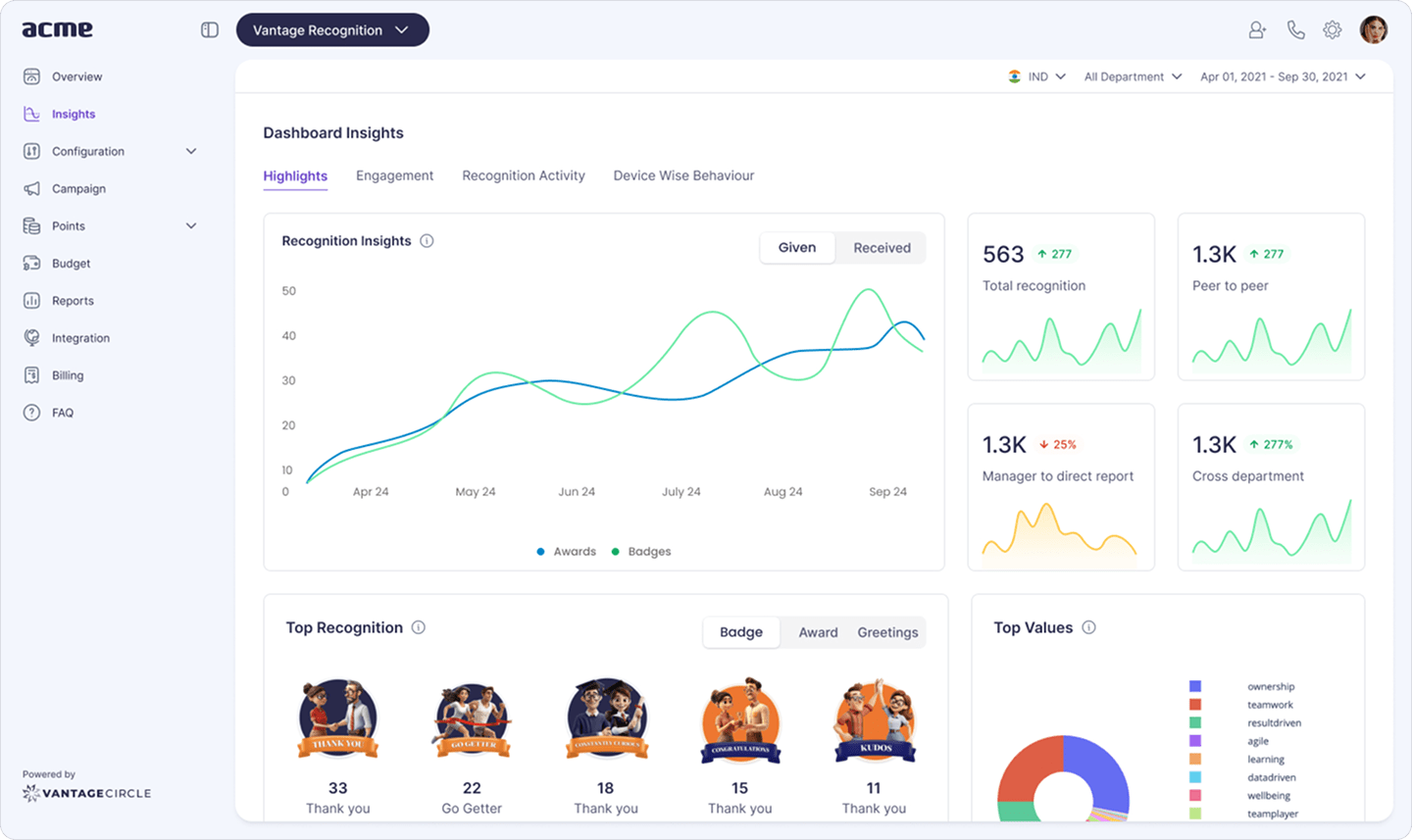
How to develop it: Recognize one specific action, not a person's general attitude, before the end of every week. "Good job this week" builds nothing; "the way you handled that client call on Tuesday" is what people remember and repeat.
5. Problem-Solving and Decision-Making
Problem-solving and decision-making means diagnosing the real cause of an issue and choosing a path forward instead of freezing or guessing at a fix. It calls for separating symptoms from root causes, bringing the team into a decision when their input sharpens it, and still being willing to decide alone when something can't wait for consensus. Managers who are weak here tend to either avoid decisions until they're forced, or make them without input and lose the team's buy-in.
How to develop it: Before deciding on the next problem that lands on your desk, write down the actual root cause in one sentence. Most bad decisions come from solving the symptom that was easiest to see, not the cause that was actually driving it.
6. Building Healthy Work Relationships
Healthy work relationships give a team the trust and transparency to function without constant oversight, and building them is squarely a manager's job. It means giving people an equal forum to raise ideas, staying neutral instead of playing favorites, and encouraging competition that pushes people forward rather than pitting them against each other. A team with healthy workplace relationships solves problems faster, because people raise issues early instead of hiding them until they're unavoidable.
How to develop it: Ask a quieter team member for their opinion in your next meeting before the louder voices weigh in. Healthy relationships break down fastest when the same two people get heard every time.
7. Delegation
Delegating well means handing off real ownership of a task, not just the busywork, to the person best positioned to run with it. Managers who can't delegate become the bottleneck on their own team, since every decision routes back through them. It isn't "assign and disappear"; it's matching the task to the person's skill level, being clear about what "done" looks like, and stepping back enough that they actually own the outcome.
How to develop it: Pick one task you're doing yourself purely out of habit, not necessity, and hand it off this week with a clear definition of done attached.
8. Time Management
A manager who can't guard their own calendar can't guard their team's time either, and that's what time management really comes down to. Deadlines slip and priorities shift without warning the moment a manager lets urgent-but-unimportant work fill every hour. Effective time management at the manager level means protecting blocks for real thinking work, not just reacting to whatever meeting request lands next.
How to develop it: Block 90 minutes this week for the task you keep pushing to "later," and protect that block the same way you'd protect a client meeting.
9. Conflict Resolution
Stepping into disagreement early, before it hardens into resentment or spills into the rest of the team, is what conflict resolution actually looks like in practice. Conflict rarely announces itself directly; it usually shows up first as disengagement, a dip in collaboration, or two people who used to work fine together suddenly avoiding each other. Vantage Pulse's sentiment analysis flags that kind of shift in employee feedback before it turns into a resignation letter, giving a manager the lead time to step in while the issue is still small.
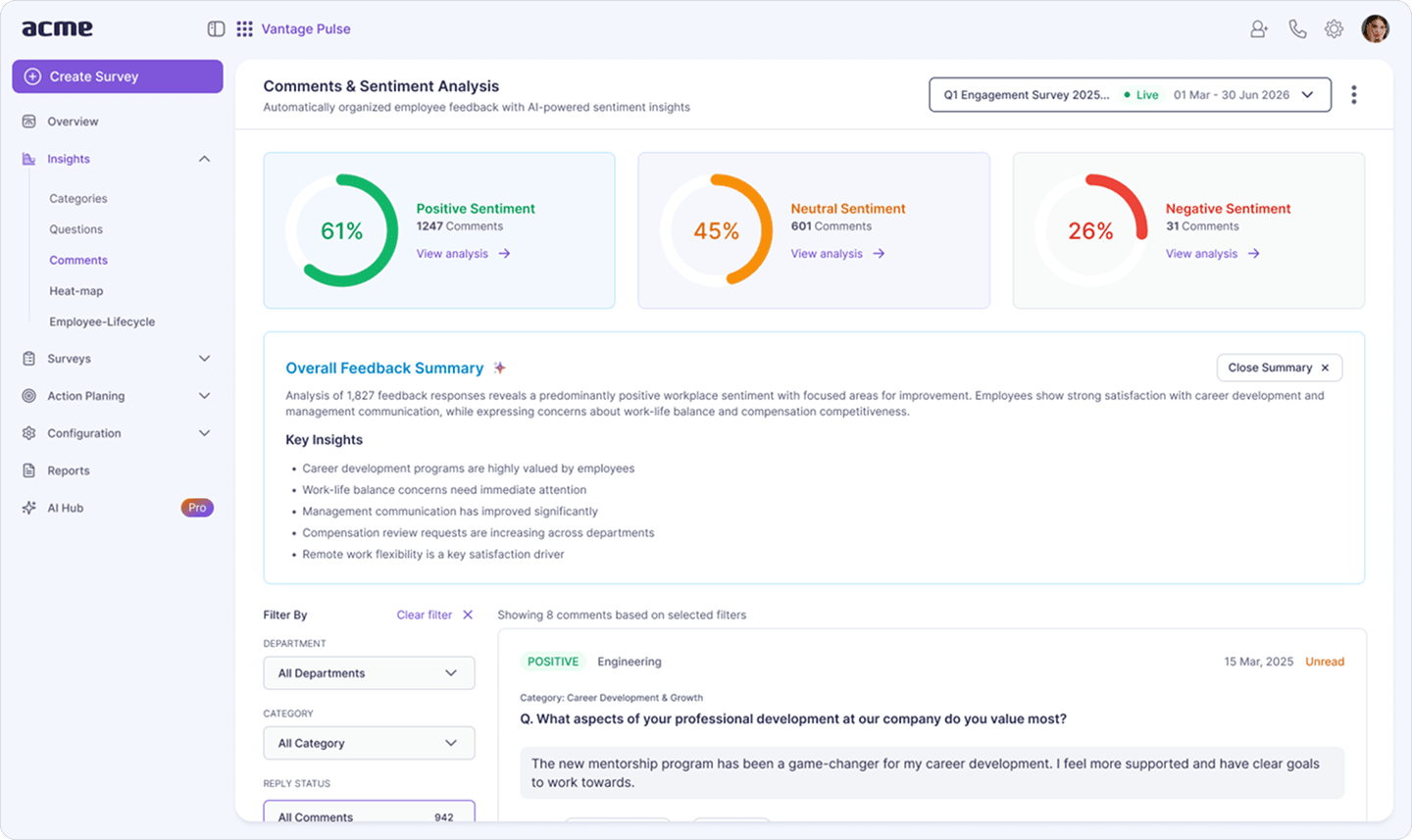
How to develop it: The next time you notice tension between two team members, name it directly and privately with each of them within the week, rather than hoping it resolves on its own. It rarely does.
10. Strategic and Conceptual Thinking
Strategic thinking connects a team's daily work to the organization's bigger goals, and it's what lets a manager see how a decision in one area ripples into another. It's the most conceptual of the 10 skills, and the one that matters most as a manager moves up: a frontline supervisor can succeed almost entirely on technical and human skills, but a department head who can't think past their own function will eventually make a decision that damages a team they don't even manage.
How to develop it: Before your next planning session, spend 15 minutes writing out how your team's top priority this quarter connects to a company-wide goal. If you can't draw a clean line, that's the gap to close first.
The 10 skills above cover the full management skill set. If your role is specifically about leading people day to day rather than running a function, people management skills and team management skills go deeper on that people- and team-specific slice.
Quick Self-Assessment: Where Do You Stand?
Score yourself 1 to 4 on each skill below (1 = rarely, 4 = consistently) to see where to focus first.
| Skill | Type | Your Score (1-4) |
|---|---|---|
| Communication | Human | |
| Emotional intelligence | Human | |
| Empathy | Human | |
| Motivation and recognition | Human | |
| Problem-solving and decision-making | Conceptual | |
| Building healthy work relationships | Human | |
| Delegation | Technical | |
| Time management | Technical | |
| Conflict resolution | Human | |
| Strategic thinking | Conceptual |
Add up your total out of 40:
- 32-40: You're operating across all three skill types. Focus on mentoring someone else now.
- 20-31: Likely solid on the human side and thinner on technical or conceptual skills. Check which type has your lowest individual scores, not just your total.
- 10-19: Pick one skill from each of the three types and commit to a single development action from above for the next 90 days, not all ten at once.
How to Develop Your Management Skills
The fastest way to build a management skill is to attach it to a specific, repeatable action, not a training that happens once a year.
- Ask for feedback on a schedule, not just after something goes wrong. A standing question in your monthly 1:1s, like "what's one thing I could do differently," surfaces problems while they're still small.
- Find a mentor doing the skill you're weakest in. Watching how someone who's already strong at delegation or conflict resolution actually handles it in the moment teaches more than reading about it.
- Measure your own management, not just your team's output. Vantage Pulse's engagement dashboard scores your team's leadership and communication experience as its own metric, alongside eNPS and participation, so you get an honest read on how your management actually lands instead of relying on how it feels in the room.
- Practice the skill in low-stakes moments before you need it in high-stakes ones. Deliver small pieces of feedback weekly so the skill is already automatic when a bigger, harder conversation comes up.
Frequently Asked Questions
What are the 5 key management skills?
The 5 key management skills most often cited are communication, delegation, problem-solving, time management, and motivating others. Together they cover a manager's core responsibilities: explaining what needs doing, handing off ownership, fixing what goes wrong, protecting time, and keeping the team engaged along the way.
What are the 10 managerial skills?
The 10 managerial skills covered above are communication, emotional intelligence, empathy, motivation and recognition, problem-solving and decision-making, building healthy work relationships, delegation, time management, conflict resolution, and strategic thinking. They map onto Katz's three types: six lean human, three lean technical, and strategic thinking is fully conceptual.
What are the 7 basic management skills?
The 7 basic management skills are usually communication, planning, decision-making, delegation, problem-solving, motivation, and time management. This shorter list strips the set down to the skills every manager needs from day one, before adding the more advanced conceptual and interpersonal skills as they grow into the role.
What are the skills of a good manager?
A good manager's skills span all three types: technical skills like delegation and time management, human skills like communication and empathy, and conceptual skills like strategic thinking and decision-making. For a deeper breakdown of the traits behind these skills, see 10 qualities of a good manager.
What are the 5 qualities of a good manager?
The 5 qualities most commonly linked to good management are integrity, empathy, accountability, adaptability, and strong communication. These are the traits that make the 10 skills above stick; a manager can learn every skill on this list and still fail a team if the underlying qualities aren't there to back it up.
The Bottom Line
Management skills aren't a fixed trait some people are born with and others aren't. Only 1 in 10 people naturally have the talent, which means the other 9 build it, one deliberate habit at a time, the same way the actions above are built: repeatable, specific, and attached to real moments instead of an annual review.
Start with whichever skill scored lowest on your self-assessment, not all ten at once, and revisit your score again in 90 days.


Lupamudra is a content marketing specialist at Vantage Circle, where she has written 50+ articles on employee recognition, rewards, and workplace culture, alongside employee engagement, diversity and inclusion, and HR compliance topics, including how India's tax rules apply to recognition and rewards programs.
Connect with Lupamudra on LinkedIn.