
If you have sat through an annual review and thought "this tells me nothing I can actually use." That reaction is data. Not about your performance. About the method.
Modern performance appraisal has moved on. The approaches that hold up in 2026 (360-degree feedback, MBO, OKR-based appraisal, BARS, continuous performance management) share one thing: they try to evaluate how someone actually works, not how they appeared to work from one manager's desk twelve months ago. SHRM's Global Culture Report found that 94% of employees prefer real-time feedback to formal reviews. That's not a trend anymore. It's the baseline.
This piece covers seven methods. What they are, where they break down, and how to pick the right one for your team. Performance management that works has to start with a method that fits the reality of the role.
Key Takeaways
- Understand the definition of Performance Appraisal.
- Explore the 7 Modern Methods of Performance Appraisal that work in 2026.
- See the difference between Traditional and Modern Methods in a comparison table.
- Learn how to choose the Right Method for Your Organization.
What is Performance Appraisal?
Most people conflate this with the annual review conversation. They're not the same thing. A performance review is one event. A performance appraisal is the whole system behind it: the criteria, the method, the cadence, what gets documented and what gets acted on.
What gets assessed varies by role and organization. Output quality and volume, turnaround time, whether someone brings original thinking to problems, how they conduct themselves with colleagues and clients. Managers decide the weighting. Some add more criteria. Most don't revisit whether those criteria still make sense from one cycle to the next.
The part that deserves more attention than it usually gets: most appraisal systems are measuring manager impressions, not employee performance. PeopleBox tracked this in 2024 and found 67% of employees saying their evaluations come primarily from their manager's observations, with 54% pointing to performance ratings as the main driver. Read that again. Two-thirds of employees are being evaluated based on what one person noticed. A person who was in the room for maybe a fifth of the work, on a good week. The method shapes what gets captured. And most traditional methods have a very narrow aperture.
When appraisals work, people walk out knowing where they stand and what to work on next. When they don't, something more corrosive happens than just frustration. People stop believing the system reflects anything real. That's harder to recover from than a bad score.
Performance appraisal is one of six distinct ways to evaluate someone at work. For where it fits alongside skills, behavioral, 360-degree, self, and potential assessments, see what employee assessment covers.
Modern vs Traditional Performance Appraisal Methods
Traditional methods were scaffolding built for a different era. Stable roles, homogeneous teams, top-down authority. Most of these systems were designed in the 1950s and 60s, when that description fit most organizations. It does not fit them now.
| Method | Type | Best For | Key Limitation |
|---|---|---|---|
| Ranking / Forced Distribution | Traditional | Large headcount calibration | Creates forced competition; corrodes collaboration |
| Rating Scales | Traditional | Simple, fast assessments | Rater bias; strips out context entirely |
| Essay Appraisal | Traditional | Narrative feedback | Inconsistency; quality depends on manager writing skill |
| Critical Incident Method | Traditional | Documentation and compliance | Recency bias; time-intensive to maintain |
| Management by Objectives (MBO) | Modern | Goal-driven roles | Falls apart when initial goals are written poorly |
| 360-Degree Feedback | Modern | Leadership and complex roles | Quality depends entirely on psychological safety |
| OKR-Based Appraisal | Modern | Fast-moving, cross-functional teams | Requires goal-setting culture that already has traction |
| Continuous Performance Management | Modern | All knowledge-work roles | Breaks down without consistent manager discipline |
Most organizations do not pick one and discard the rest. Two or three methods, matched to the majority of roles, is the more honest approach.
The 7 Most Effective Modern Methods of Performance Appraisal
1. Management by Objectives (MBO)
MBO is the simplest structural fix for a problem that most appraisal systems have: the evaluation criteria get invented at the end of the cycle, not the beginning.
Peter Drucker put the term in circulation in 1954, in The Practice of Management. The mechanism has not changed. Manager and employee agree, at the start of a review period, on a handful of specific and measurable objectives. Usually three to five. When the cycle ends, the appraisal is a comparison between those commitments and what actually happened. No reconstruction of impressions. No debate about whether someone "seems" like a strong performer. Just: here is what we agreed, here is what occurred.
I've seen MBO implementations fail repeatedly in one specific way: the goals are written badly. Too vague, too easy, too disconnected from anything that genuinely mattered to the business. The method is only as useful as the goal-setting conversation that precedes it. Get that wrong and you have a framework that produces confident-looking numbers about the wrong things.
Where it performs well: sales, operations, project-based roles, anywhere the link between an individual's output and the organization's results is traceable. Where it runs out of road is in roles where the contribution is largely relational or where what "success" looks like is only apparent after the fact.
Take Arjun, a team lead on an enterprise sales desk. His MBO going into Q4: close 12 accounts. He closes 10. The appraisal conversation does not spend twenty minutes on whether he "seems like someone with potential." It spends twenty minutes on which two accounts slipped, why, and what changes to the approach would bring those numbers in line. That is a more useful conversation. And it is only possible because the target was defined in January, not December.
2. Psychological Appraisals
Most appraisal methods look at what someone did over the last year. Psychological appraisals are trying to answer a different question: what is this person likely to be capable of, and under what conditions?
I/O psychologists run these: structured interviews, psychometric tools, situational judgment exercises. The deliverable isn't a rating or a score. It's more like a profile of how someone functions under pressure, in ambiguity, or in a role with significantly more complexity than the one they're in. For succession decisions, that information is genuinely hard to get any other way.
The halo problem that this corrects is one I've watched organizations make over and over: promote the high performer into leadership, then discover two years later that what made them excellent individually is exactly what makes them difficult to work for. Strong task performers are not automatically strong leaders. Psychological appraisals exist partly to interrupt that assumption before it becomes an expensive mistake.
Cost and scale are the real constraints. You need qualified practitioners, which most organizations cannot staff internally, and the process doesn't work at volume. It also needs careful setup. Employees who walk into these sessions expecting a development conversation and feel like they're being assessed for fitness can shut down fast, and then you've spent a significant budget on data that doesn't reflect the person.
Practically, these work best in a narrow set of situations: building a leadership pipeline, preparing for succession, or making high-stakes external hires where the interpersonal and cognitive demands of the role are the whole job. Healthcare and financial services use them most, for exactly that reason.
3. 360-Degree Feedback
Think about how much of an employee's work a manager actually witnesses. On a normal week, with competing demands and their own deliverables, that slice is small. Maybe 20%. The people who see the rest are peers, direct reports, and cross-functional partners. None of whom typically have any formal input into the appraisal.
That's the structural problem 360-degree feedback is designed to fix. Input comes from multiple directions: the manager, colleagues at the same level, people the employee manages, sometimes external stakeholders. Together, the picture is meaningfully closer to what the person's work actually looks like. The 360-degree feedback software market is heading toward USD 2.59 billion by 2032 at an 11.2% CAGR, per Fortune Business Insights. I'd be careful about reading that as validation of effectiveness. It reflects how many organizations are buying the software, not how many are running it well. Those are different numbers.
Anonymity is what determines whether this method delivers real data or polished noise. Without it, peer feedback gets political fast. I've watched programs fold inside eighteen months because people figured out who wrote what. Once that happens, the honest feedback stops. What you're left with is performance theater wearing a multi-rater label.
Recommended Resource: What is 360 Degree Feedback? Benefits, Best Practices, Alternatives
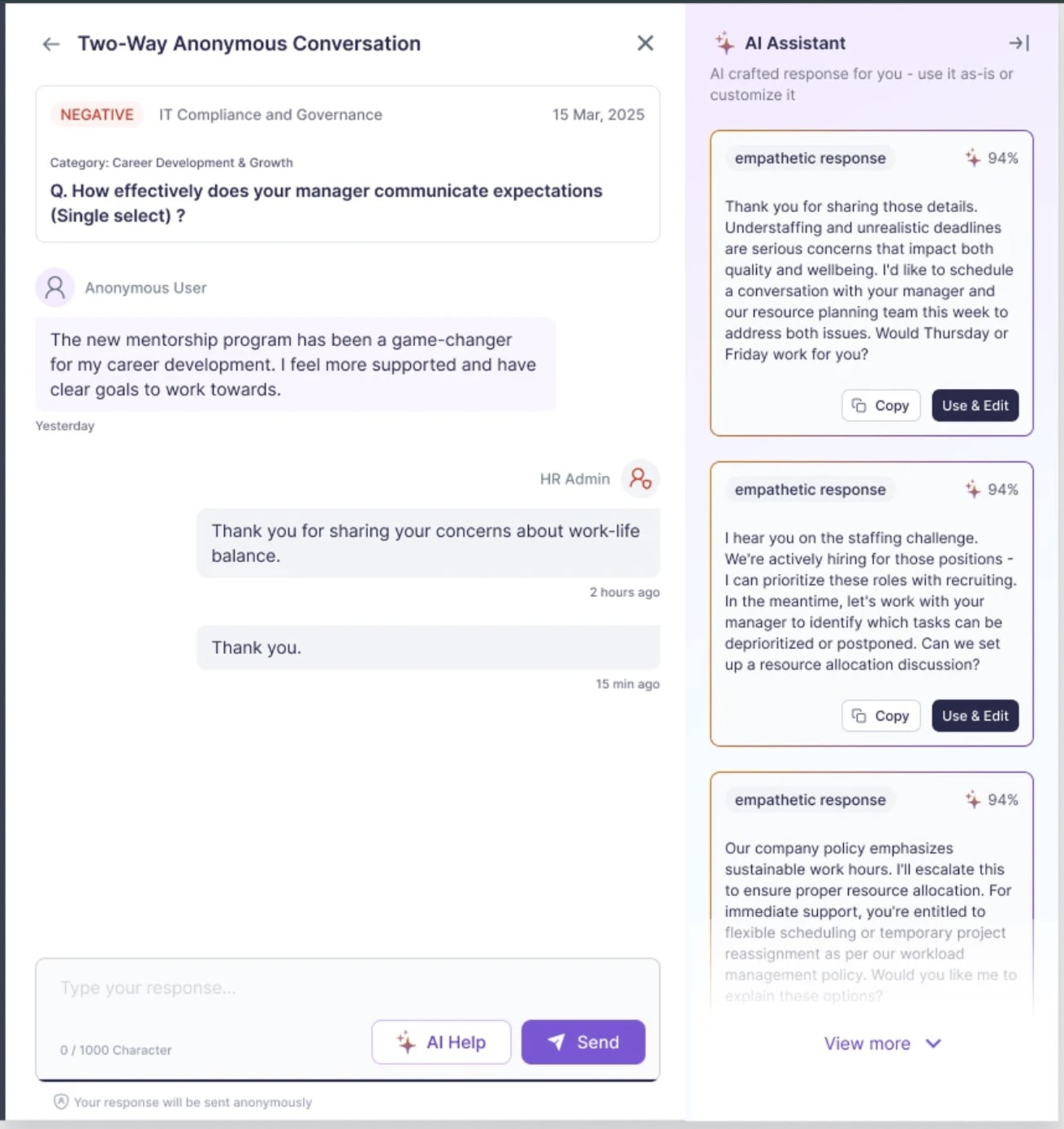
(Source: Vantage Pulse)
Vantage Pulse collects anonymous multi-rater input so feedback reflects the actual working relationships, not the visible ones.
Advantages: Provides a structurally complete picture. Creates accountability to the full team, not just the line manager.
Disadvantages: Highly sensitive to team culture. In competitive environments, bias contaminates peer feedback quickly. Trust collapses if anonymity is compromised even once.
Ideal for: Senior individual contributors, managers, executives. Anyone whose effectiveness is primarily relational rather than transactional.
What I find is that organizations underinvest in the debrief process. The data collection is meticulous. The conversation about what to do with the data is fifteen minutes at the end of a review meeting. That imbalance explains most 360 failures.
4. OKR-Based Appraisal
OKR stands for Objectives and Key Results. The method was popularized at Intel and later at Google, and has since spread into sectors with no obvious connection to technology. Which tells you something about the underlying appeal.
The structure is a meaningful qualitative objective paired with two to four measurable key results that indicate progress toward it. Where MBO evaluates whether a task was completed, OKR-based appraisal evaluates whether the work moved the organization forward on something that matters. That is a different level of question.
Here is my honest read on OKRs: they work when the goal-setting culture already has traction. Organizations that treat OKRs as a plugin fix for a broken appraisal system are going to be disappointed. If your teams do not already write goals with some rigor, OKR appraisals produce beautifully formatted noise. The method surfaces the quality of your strategic thinking, for better or worse.
Advantages: Connects individual appraisal directly to organizational strategy. Limits the number of priorities under evaluation, which forces real focus.
Disadvantages: Penalizes ambitious teams who set genuine stretch goals and land at 70%. That 70% can represent exceptional output. The appraisal framework may not capture that without a calibration conversation built in. Also requires goal-writing skills that most organizations have not systematically developed.
OKRs tend to land best in technology companies, startups, and cross-functional product teams, though they're spreading into professional services and healthcare as those organizations start demanding more explicit connections between individual output and strategy. Google and Intel are the origin story. Spotify, and most organizations where "what are we actually trying to move" is a live question at every level, have adopted them since.
Here's what the worked example actually looks like. A content team's OKR: become the authoritative source on employee recognition in their market. The key results they commit to: 12 original research-backed articles, a 40% improvement in organic traffic from the target cluster, 3 backlinks from publications with real domain authority. At appraisal, one writer isn't being evaluated on how many pieces she published. The question is how much her work moved the needle on topical authority. That reframe changes what she prioritizes when she sits down on a Monday morning.
When managers can recognize progress against a key result in the moment rather than saving it for the year-end meeting, the OKR system starts to feel like it's connected to the actual work. That timing is not a soft benefit. Vantage Circle's joint 2025 study with Great Place to Work® India found that when employees consistently feel recognized, motivation rises by 18 percentage points and intent to stay by 16. Vantage Rewards is built for exactly that: closing the gap between when something happened and when someone hears about it.
5. Continuous Performance Management
The annual review was designed for a world where work moved slowly enough that a yearly snapshot was sufficient. That world is gone.
The basic idea: swap the single annual cycle for a regular cadence of check-ins, goal updates, and in-the-moment feedback. Monthly for most teams. Quarterly at minimum. Goals get updated when priorities shift, not preserved in amber until December. Feedback reaches people while something can still be done with it.
Here is what actually happens when you wait twelve months. A project from March gets discussed in December. The manager's memory of it is partial. The employee's memory is different. The emotional charge around what went well or badly has flattened into a general impression. Neither of them is really talking about March anymore. They are talking about a reconstruction of it. That conversation is useful to almost no one.
What managers genuinely need is a low-friction way to track how their team feels between the formal touchpoints. Not just at year-end when the review is already scheduled. Vantage Pulse builds that into the workflow, so sentiment data accumulates continuously rather than arriving as a surprise at appraisal time.
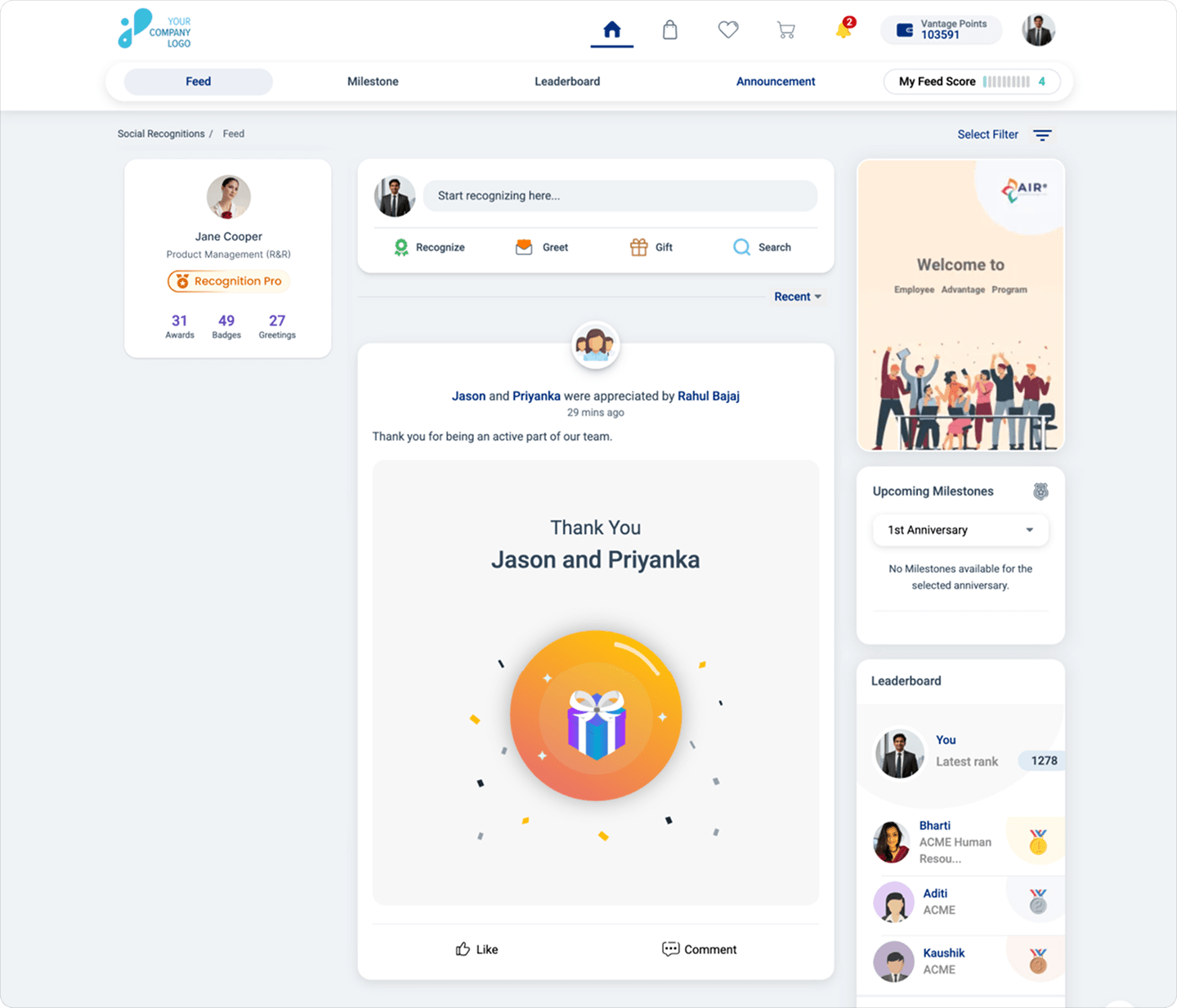
(Source: Vantage Recognition)
The case for this method is not complicated: feedback that arrives when someone can still act on it is more valuable than feedback that documents what happened nine months ago. Development conversations work when they happen close to the situation they are about.
The genuine challenge is manager discipline. Without a structural cadence, informal check-ins default to status updates. The method works when organizations invest in building that consistency. Not just announcing it.
Adobe, Accenture, and IBM have all moved away from annual reviews toward continuous feedback. Not because annual reviews were theoretically wrong but because the pace of work made annual feedback functionally inert.
A customer success team switches to monthly 30-minute check-ins. A support specialist quietly struggling with a new CRM flags it at her second check-in, in February. Her manager identifies a training gap and gets her into a skills session in March. By June, she is the person onboarding new hires on the same system. Under annual reviews, that struggle surfaces in December as a performance concern. Eight months too late. The development window is closed.
6. Behaviorally Anchored Rating Scale (BARS)
BARS replaces "exceeds expectations" with a description of exactly what exceeding expectations looks like in this role, at this level, in observable behavioral terms.
A "3" to one manager and a "3" to another are often assessments of entirely different things. BARS solves this upstream. Before the cycle starts, not during the calibration meeting. Each rating level is defined by specific behavioral examples, constructed with input from people who actually do the work. A "4" on client communication is not "above average communicator." It is "proactively flags potential issues in writing before the client raises them." That is a different instrument.
The investment is real. Building the anchors for a job family takes time and genuine organizational knowledge. What you get in return is calibration across raters. Something most appraisal systems talk about and almost none achieve.
Advantages: Reduces inter-rater variance significantly when anchors are well constructed. Makes criteria discussable before the cycle begins, not after the rating is already in.
Disadvantages: Time-consuming to build and to maintain as roles evolve. Does not translate cleanly to emerging or highly variable roles where the behavioral anchors are not yet stable.
Ideal for: Organizations with clearly defined job families. Particularly strong in regulated environments where legal defensibility of appraisal decisions matters: healthcare, financial services, retail operations.
A hospital implements BARS for nursing roles. "Professionalism" has five anchor levels. Level 3: "Addresses patient complaints directly and documents follow-up actions without prompting." Level 4: "Identifies potential patient concerns before they escalate and proactively communicates with the care team." The nurse manager evaluating two nurses is no longer debating whether each one is "professional." She is identifying which behavioral level each consistently occupies. That conversation is specific enough to drive actual development.
Vantage Rewards links each recognition moment to a core value, reinforcing the same behavioral standards that BARS is designed to measure. Rather than creating a separate, parallel system that pulls in a different direction.
7. 720-Degree Method
This builds on 360-degree feedback by running two cycles and pulling in external stakeholders (clients, vendors, partners) alongside the internal sources.
The logic is most compelling for customer-facing roles. A sales leader can receive strong internal feedback from her team and her manager. Her key accounts describe a different relationship entirely. Standard 360 never surfaces that gap. The 720 does.
Let's be honest about the practical limits here: this method carries real administrative weight. External respondents are often reluctant to give candid critical feedback, particularly if they want to preserve the commercial relationship. The data is harder to benchmark. For most organizations and most roles, the marginal insight does not justify the complexity. For roles where the external relationship is the performance (account managers, client-facing executives, business development leaders), it earns its place.
Advantages: Closes the feedback loop with the people the organization actually serves. Integrating real-time external input alongside internal review creates a fuller performance picture for roles where external relationships are core.
Disadvantages: Volume of input can overwhelm both employees and managers. Feedback candor from external sources is structurally compromised in a way internal feedback is not.
Ideal for: Progressive organizations deeply integrated with their client base. Professional services firms, large enterprise sales teams.
How to Choose the Right Appraisal Method
Here is what most leaders miss when choosing an appraisal method: they select the one that sounds most sophisticated, not the one their managers can actually sustain.
The most rigorous method your organization cannot implement consistently is worse than a simpler method run with discipline. That constraint should come first. Then work backward to the right approach.
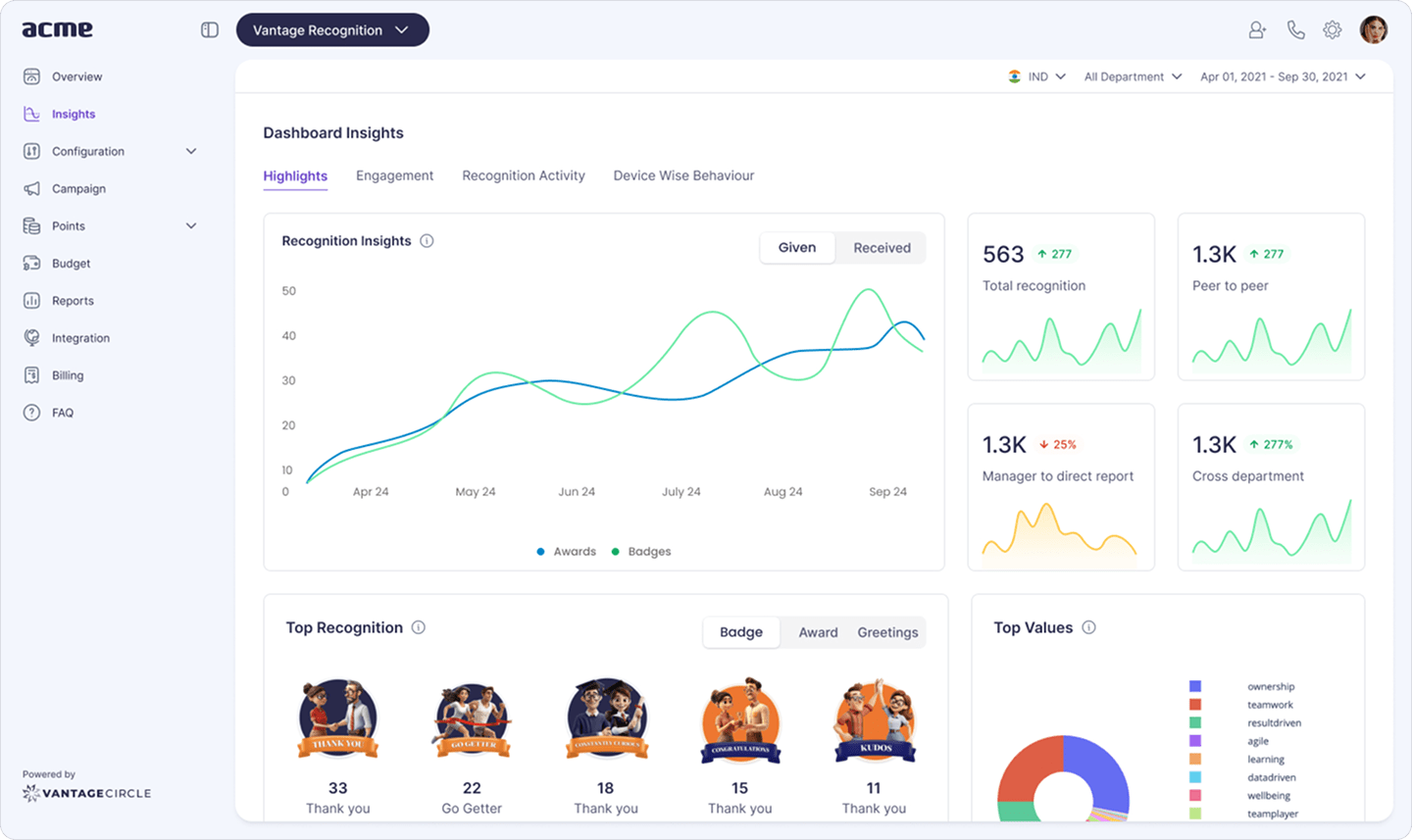
(Source: Vantage Recognition)
Vantage Circle's analytics connect recognition and sentiment data to engagement trends, so the choice of method is evidence-based rather than intuitive. Track what happens to engagement before and after a method change. That data tells you what is working and what is performative.
When selecting a method, four things matter more than anything else:
Alignment with your actual goals. Not your stated goals. Your actual ones. If the real goal is legal defensibility, build toward BARS. If it is leadership pipeline identification, invest in 360 or psychological appraisals. If it is connecting individual output to organizational strategy, OKRs. The method should be derived from the purpose, not the reverse.
Honest feasibility. The assessment centre method requires facilitators, trained assessors, and significant time. Continuous performance management requires manager capability that many organizations have not yet built. Before committing to a method, assess whether management can support it without strain. Be honest about what that assessment reveals.
Employee acceptance. When people understand how they will be evaluated and experience the system as fair, resistance drops. Opaque appraisal criteria generate anxiety rather than development. Constructive feedback only lands when the person receiving it trusts the process that produced it.
Legal and ethical requirements. Appraisal methods must comply with relevant labor laws. Methods that are invasive or that compromise privacy create exposure, both legal and cultural. The method should protect employees, not surveil them.
Quick method-picker by company size and stage
Early-stage startup (under 50 people): Continuous performance management + OKRs
Scaling company (50–500 people): MBO or OKRs as the core, 360 for managers
Enterprise (500+ people): BARS for calibration, 360 for leadership, continuous feedback for retention
Performance Appraisal Examples by Method
Abstract definitions only go so far. What these methods look like in practice is where the real understanding lives.
MBO in a marketing team. A marketing director sets Q3 objectives with her team lead: two gated content campaigns launched, 300 qualified leads generated, 25% email open rate across the nurture sequence. At quarter-end, the appraisal reviews actual numbers against each target. The conversation is about what drove the gaps. Not about whether she "performed well."
360 catching what managers miss. A team lead receives input from her three direct reports, two engineering peers, and her department head. A consistent theme surfaces across raters: she communicates decisions clearly to her reports but rarely explains her reasoning to peers. Her manager rated her highly. The 360 identified the development area he could not see. The focus for the next cycle becomes stakeholder communication, not technical delivery.
OKRs in engineering. A squad sets an OKR to ship an onboarding flow redesign, with key results around time-to-first-value, support ticket reduction, and CSAT. At appraisal, each KR is measured. Two of three hit. The conversation is specific and actionable in a way that "did you do a good job?" structurally cannot be.
Continuous PM compressing the feedback loop. A customer success manager has monthly check-ins throughout the year. The December review takes ten minutes. It is a summary of conversations already had. Not the first real conversation of the year.
BARS removing interpretive drift. A retail operations manager is evaluated on "inventory management" at Level 4: identifies discrepancies within 48 hours, documents root cause, prevents recurrence. Both the manager and the assessor know exactly what separates Level 4 from Level 3. The criteria were defined before the cycle began, not reverse-engineered from an impression at the end.
Conclusion
Performance appraisals are how organizations signal what they actually value. Not what is on the poster, but what gets measured, discussed, and rewarded.
The annual review survived longer than it deserved to. Not because it worked but because replacing it requires manager capability that most organizations have not yet built, and forces honest developmental conversations that a once-a-year ritual makes structurally easy to avoid.
The methods in this guide work when they are matched to the actual demands of the role, implemented with discipline, and treated as a development tool rather than a compliance mechanism. For any of them to stick, employee development and the appraisal system need to be designed as one thing. Not two events that happen to share a calendar year.
Frequently Asked Questions
Q1. What are modern methods of performance appraisal?
A. Modern methods of performance appraisal replace once-a-year manager ratings with continuous, multi-source feedback tied to clear goals. The most widely used in 2026 are 360-degree feedback, MBO, OKR-based appraisal, BARS, and continuous performance management. What distinguishes them from traditional approaches is not just the frequency. It is the shift from evaluating impressions to evaluating evidence.
Q2. What are the five methods of performance appraisal?
A. Five commonly referenced methods are MBO, 360-degree feedback, BARS, continuous performance management, and psychological appraisals. MBO and continuous performance management are the most broadly adopted. BARS offers the strongest legal defensibility in regulated industries. OKR-based appraisal is the fastest-growing approach, particularly in organizations where connecting individual output to strategic direction is a live priority.
Q3. What are the 7 ways of appraising performance?
A. The seven modern methods in this guide are management by objectives, 360-degree feedback, OKR-based appraisal, continuous performance management, behaviorally anchored rating scales, psychological appraisals, and the 720-degree method. In practice, most organizations select two to three based on their workforce composition and organizational maturity. Using all seven simultaneously would create more administrative load than developmental value.
Q4. What are the latest trends in performance appraisal?
A. Three shifts are reshaping appraisal practice in 2026. Annual-only cycles are giving way to continuous or quarterly structures, driven by the pace of work in most knowledge industries. OKR adoption is spreading beyond technology into professional services and healthcare. And AI-assisted calibration tools are beginning to enter HR workflows, helping organizations identify rater bias at scale before final decisions are made. That last development is worth watching carefully. The tools are promising, but the quality of the underlying appraisal data they are calibrating still determines the output.

He has worked in the human resources environment and has elevated recognition and rewards through his insightful and detailed writing. He aims to enhance the practice of Recognition in the workplace with new ideas and innovation that will help shape the work culture. For any related queries, contact editor@vantagecircle.com