Performance management was never meant to be a yearly formality. At its best, it is the operating system that connects people's everyday work to the larger direction of the business.
Its purpose is simple but powerful: to give employees clear goals, help them improve, measure progress in real time, and recognize the accountability that drives results. When done well, performance management turns scattered effort into focused progress. It helps managers coach instead of simply evaluate. It helps employees understand not just what they are doing, but why it matters.
Yet most organizations are still falling short of that promise. According to Gallup (2022), only 2 in 10 employees strongly agree their performance is managed in a way that motivates them to do outstanding work.
That gap matters. Because when performance management fails, the impact is not limited to appraisal season. It shows up in unclear priorities, disengaged teams, missed goals, weak feedback habits, and employees who do not see a clear path to growth.
To close that gap, HR leaders need to look beyond the process and focus on the purpose. Below are the 8 core objectives of performance management, grouped into the four goals every HR leader manages, with SMART examples you can apply this quarter.
What Are the Objectives of Performance Management?
The 8 core objectives of performance management are:
- Setting and defining goals that support company objectives
- Clarifying expectations for managers and employees
- Identifying training and development needs
- Building career paths and future capability
- Setting performance standards and measuring against them
- Enabling continuous, two-way feedback
- Recognizing and rewarding high performance
- Identifying and supporting underperformers
These objectives fall under four themes that mirror how the most effective performance systems are designed:
- Strategic Alignment
- Employee Development
- Performance Tracking and Feedback
- Reward and Accountability
Objective Group 1: Strategic Alignment
Strategic alignment is where performance management begins. When individual goals connect directly to company objectives, employees understand how their daily work moves the business forward. Without it, even motivated employees can work hard in the wrong direction, producing effort that does not translate into results the business actually needs.
Setting and Defining Goals That Support Company Objectives
Goal-setting converts business strategy into individual action. Managers who set clear, cascaded goals give employees a direct line of sight from their daily tasks to the organization's priorities.
Effective goal-setting under this objective means:
- Cascading company-level targets into team and individual goals
- Using OKRs (Objectives and Key Results) or KPIs (Key Performance Indicators) to make progress measurable
- Reviewing goals quarterly rather than annually to stay responsive to business change
- Aligning individual effort with the values and behaviors the business wants to reinforce
OKRs are one of the most effective frameworks for this: they connect team-level targets to company-level strategy in a format that is visible, revisable, and measurable at every level.
McKinsey research suggests that companies that focus on people's performance are 4.2 times more likely to outperform their peers, while also seeing stronger revenue growth and lower attrition.
Clarifying Expectations for Managers and Employees
Clear expectations remove guesswork from the working relationship. When employees know exactly what is expected and why those expectations matter to the business, consistency and productivity follow naturally. Holding managers to poorly defined expectations produces equally poor management decisions, so clarity must run in both directions.
Effective performance management documents expectations formally, explains how they connect to business objectives, and revisits them whenever strategy shifts. Once people understand their roles, responsibilities, and accountabilities, they are more likely to be consistent, productive, and committed.
Alignment is not just about cascading goals. It is about making sure the behaviors employees repeat every day reflect what the company says it stands for. When recognition is tied to core values, as it can be through Vantage Rewards, employees do not just receive appreciation. They receive a clearer signal of what progress looks like in practice.
Objective Group 2: Employee Development
Development distinguishes performance management from performance monitoring. Monitoring tells you what happened. Development shapes what happens next. Organizations that treat performance management as purely evaluative miss the objective that delivers the longest return: growing the capability of their people.
Identifying Training and Development Needs
A performance management system surfaces capability gaps before they become performance problems. Managers who regularly review performance data can identify which skills are missing and design targeted interventions rather than relying on generic, one-size-fits-all training.
Identifying development needs means:
- Asking employees which skills they need to perform their current role more effectively
- Analyzing performance data to spot consistent shortfalls (a pattern in one skill area signals a training gap, not a motivation problem)
- Linking training investments to specific role requirements and career paths
- Building structured training plans with clear budgets and timelines
Performance planning is the formal output of this objective: a documented roadmap that connects identified development needs to agreed actions and timelines, giving both the manager and the employee a shared reference point.
Building Career Paths and Future Capability
High-potential employees leave organizations where growth is invisible. A structured performance management process makes career progression concrete: here is where you are, here is where you could go, and here is what it takes to get there.
Growth is also a retention issue. SHRM's 2022 Workplace Learning & Development Trends report found that 76% of employees are more likely to stay with a company that offers continuous training. But development cannot stop at courses or annual plans. Building future capability means identifying emerging leaders early and giving them the kind of challenging assignments that help them grow before the business urgently needs them. DDI's Global Leadership Forecast 2025 found that only 20% of HR leaders say they have leaders ready to fill critical roles, which makes structured development a business continuity issue, not just an HR initiative.
Objective Group 3: Performance Tracking and Feedback
Tracking and feedback are the operating mechanisms of performance management. Without them, goals remain aspirational and development plans remain theoretical. This group of objectives is where the system proves its value day to day, not just at year-end.
Setting Performance Standards and Measuring Against Them
Performance standards create a shared definition of what good looks like. Without clear standards, managers evaluate subjectively and employees experience the process as arbitrary. With standards in place, performance reviews become objective conversations grounded in evidence rather than impressions.
Setting standards under this objective involves:
- Defining role-specific KPIs and behavioral benchmarks
- Making standards visible to employees before the review period begins
- Using data from project delivery, quality scores, or customer feedback to assess performance consistently
- Documenting outcomes so performance decisions are defensible and fair
Without a performance management system in place, it is almost impossible to know whether a shortfall stems from insufficient effort, unrealistic standards, inadequate resources, or a breakdown in team collaboration. Clear standards make the source of the problem visible.
Enabling Continuous, Two-Way Feedback
Annual reviews alone cannot drive behavior change. Continuous performance management closes the gap between a behavior and its correction, giving employees the signal they need to adjust in real time rather than discovering the problem at year-end.
Gallup research shows that 80% of employees who received meaningful feedback in the past week are fully engaged, reinforcing the value of timely, regular performance conversations.
Standards and feedback only work if you know how employees actually experience them. Sentiment analysis reveals whether reviews feel fair or demoralizing. Vantage Pulse reads open-text feedback at scale, so HR can identify a broken review process before it drives attrition. Regular eNPS (Employee Net Promoter Score) surveys give you a recurring pulse on engagement between reviews, so managers act on signal rather than guesswork.
Objective Group 4: Reward and Accountability
Reward and accountability are two sides of the same objective. Performance management that only holds people accountable without recognizing achievement drives compliance, not commitment. Recognition without accountability produces a culture where performance standards erode over time, because there is no visible consequence for falling short.
Recognizing and Rewarding High Performance
The reward objective fails when good work goes unseen. Timely, specific recognition closes the gap between performance and reward.
The reward objective means:
- Recognizing achievement close in time to the behavior it reinforces
- Tying rewards to specific goals or values, not generic tenure milestones
- Ensuring recognition reaches all levels of the organization, not only employee of the month winners at the top
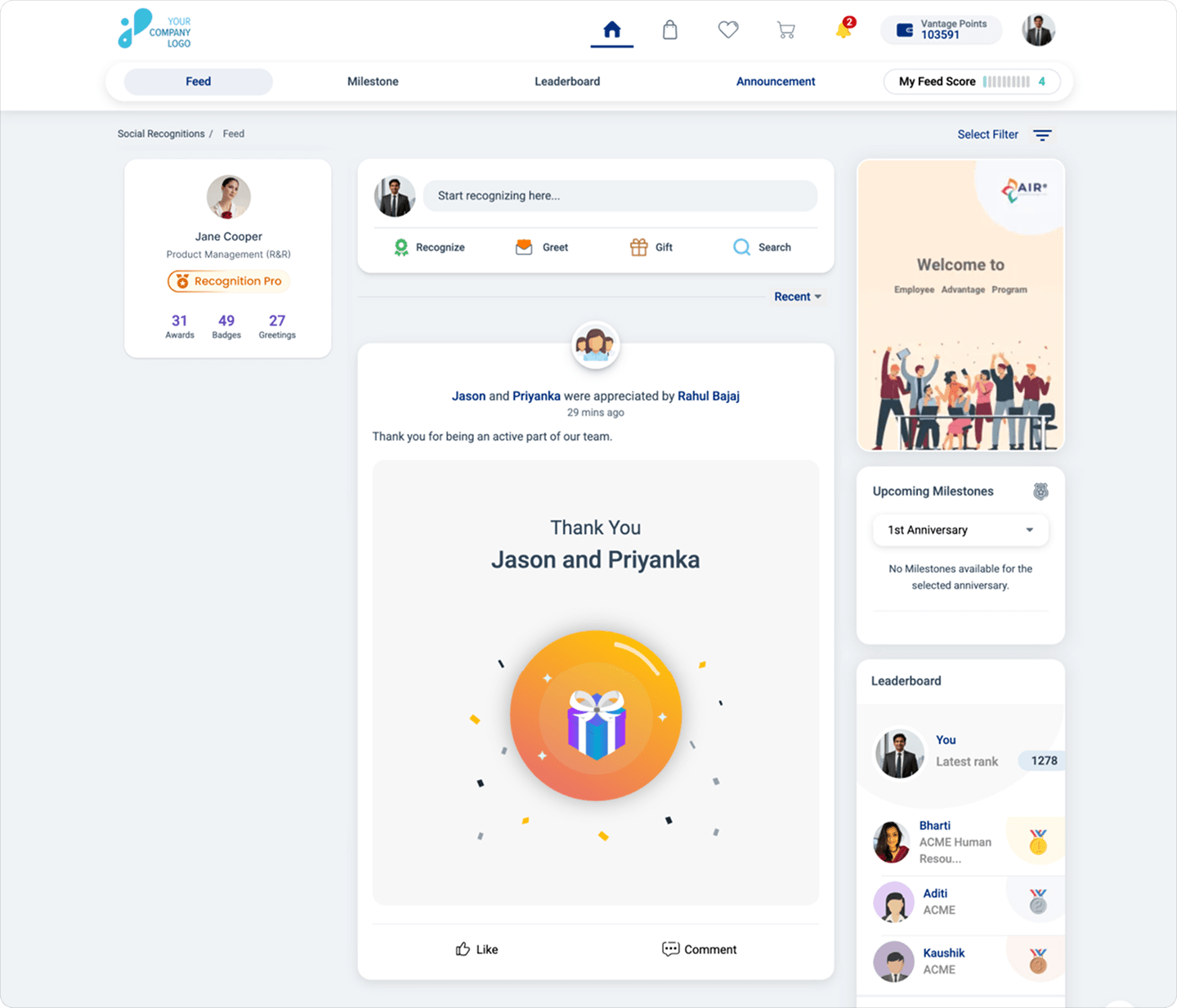
Vantage Rewards gives managers points-based recognition they can send the moment a goal is hit, making accountability feel motivating rather than punitive.
Identifying and Supporting Underperformers
Accountability also means identifying when someone is falling short and acting on that signal constructively. Performance management provides the data and documentation to distinguish a motivation problem from a capability gap, and to design a support plan that gives the employee a fair path forward rather than a surprise termination.
Employee recognition programs that surface contribution transparently, through peer appreciation feeds and visible leaderboards, help underperformers understand what good looks like without making the accountability conversation feel punitive.
Examples of Performance Management Objectives (SMART)
One of the most common related searches on this topic is "what are examples of performance objectives?" The answer depends on the role, but the framework is always the same: SMART (Specific, Measurable, Achievable, Relevant, Time-bound). The table below shows how each of the 8 objectives translates from a vague intention into a SMART goal.
| Objective | Vague Version | SMART Version | Metric |
|---|---|---|---|
| Goal alignment | Improve individual contribution | Increase sales pipeline by 20% against Q3 targets by September 30 | Pipeline value |
| Expectation clarity | Be a better communicator | Complete one structured weekly check-in with every direct report through Q2 | Check-in logs |
| Training needs | Improve technical skills | Complete AWS Cloud Practitioner certification by August 31 | Certificate attained |
| Career development | Grow into a senior role | Lead two cross-functional projects by year-end to qualify for the team lead shortlist | Projects delivered |
| Performance standards | Meet customer expectations | Resolve 95% of support tickets within 24 hours across Q3 | CSAT / resolution rate |
| Continuous feedback | Give better feedback | Deliver written feedback within 48 hours of each monthly milestone review | Feedback submissions |
Benefits of Achieving These Objectives
When the objectives of performance management are done well, they create clearer priorities, stronger feedback habits, better retention, and a culture where people know what great performance looks like.
Clearer goal alignment
Employees are more motivated when their goals are clearly linked to company goals.
McKinsey, 2025Stronger engagement
Employees are five times as likely to be engaged when they strongly agree they receive valuable feedback.
Gallup + Workhuman, 2024Higher retention
Employees say they are more likely to stay with a company that offers continuous training.
SHRM, 2022Lower turnover
Well-recognized employees are less likely to have turned over after two years.
Gallup, 2024How Objectives Fit the Performance Management Process
The 8 objectives do not operate in isolation. They map onto a recurring performance management cycle that most organizations run quarterly or annually.
The cycle moves through four phases:
- Planning — set goals and expectations (Strategic Alignment objectives)
- Development — identify gaps and create growth plans (Employee Development objectives)
- Monitoring — track standards and exchange feedback (Performance Tracking and Feedback objectives)
- Review and reward — evaluate outcomes, recognize achievement, and address shortfalls (Reward and Accountability objectives)
Understanding where each objective sits in the cycle helps HR leaders prioritize interventions. If your system is stalling at the monitoring phase, the fix is in feedback frequency and standard clarity, not in setting more goals at the planning stage. The most common failure mode is a system that does planning well and skips directly to annual review, leaving development and continuous feedback entirely unaddressed.
Frequently Asked Questions
What are the 5 performance objectives?
The five most widely cited performance objectives are goal alignment, expectation clarity, training and development, performance standards, and recognition and reward. A fully structured performance management system expands these into 8 objectives grouped under four themes: Strategic Alignment, Employee Development, Performance Tracking and Feedback, and Reward and Accountability.
What are examples of performance objectives?
Examples of performance objectives include increasing sales pipeline by 20% in a quarter, resolving 95% of support tickets within 24 hours, completing a technical certification by a set date, and leading two cross-functional projects to qualify for a promotion shortlist. Effective performance objectives follow the SMART framework: Specific, Measurable, Achievable, Relevant, and Time-bound.
What are the 5 elements of performance management?
The five elements of performance management are goal-setting, measurement, feedback, development, and recognition. These elements work as a continuous cycle rather than a one-time checklist: goals are set, performance is measured against standards, feedback is exchanged regularly, development gaps are addressed, and achievement is recognized promptly.
What are the 5 C's of performance management?
The 5 C's of performance management are Clarity (clear goals and expectations), Communication (continuous dialogue between managers and employees), Coaching (ongoing development support), Consistency (applying standards fairly across the team), and Consequences (linking outcomes to recognition or corrective action).
What are the 7 objectives of management?
The seven objectives of management are typically defined as planning, organizing, staffing, directing, controlling, coordinating, and reporting. In the context of performance management specifically, these translate into the goal-setting, resource allocation, talent placement, feedback, standards monitoring, cross-functional alignment, and reporting functions that HR teams and line managers share.
Before You Go
Performance management works when its objectives are clear, consistent, and connected to what the business actually needs. The 8 objectives above give you a framework for building or auditing a system that does all four: aligns strategy, develops people, tracks progress, and rewards accountability.
If your current system covers some of these objectives but not others, that gap is where performance breaks down. Start by assessing which of the four groups your system is weakest in, and build from there. A strong foundation in employee engagement makes every performance objective more achievable.

Shaoni Gupta is a content marketing specialist at Vantage Circle, with expertise in scriptwriting and copywriting in the field of employee rewards and recognition.
Connect with Shaoni on LinkedIn.