
Recognition is everywhere. Platforms that log every high five, a badge that fires automatically on a work anniversary, a Slack channel built just for shout-outs. And still, something in the numbers does not add up.
Only 55% of employees feel genuinely recognized at work, according to The Recognition Effect Report (Great Place To Work® India and Vantage Circle, 5.7 million responses across 1,800+ companies). When all four emotional signals behind recognition are present, 98% of employees report strong workplace sentiment. When none are, that number falls to just 10%.
That gap is not a rounding error. It is the difference between a program that looks busy on a dashboard and one that actually changes how people show up to work. Most HR teams already know recognition matters in the abstract. What the report makes harder to ignore is how specific the mechanism is: which signals matter, who gets left out when the mechanism breaks, and what it costs when it does. Let's look at what the data says, and what it says to do about it.
Recognition is not the result of great performance. It's what makes it possible. ~Balbir Singh, CEO, Great Place To Work® India
What "Feeling Recognized" Actually Means
Recognition is not about what a company says. It is about what an employee feels, and The Recognition Effect Report defines that feeling through four distinct emotional signals. Miss one, and the whole thing loses its charge.
| Signal | What It Captures |
|---|---|
| Appreciation | Being thanked for effort, not just results |
| Acceptance | Feeling like a genuine part of the team, not tolerated on it |
| Validation | Having your perspective and contribution treated as legitimate |
| Accomplishment | Seeing your work connected to something that mattered |
Most recognition programs are built to deliver one of these, usually appreciation, in the form of a badge or a point. Very few are designed to deliver all four at once. That is the actual gap the 55% figure is describing, and it is also why a program can look completely healthy on a usage dashboard, awards sent, points redeemed, participation up, while the people receiving all of it still do not feel seen.
The Employee Recognition Statistics That Matter Right Now
Here is where the numbers get specific, and where a lot of the "recognition matters" conversation stops being vague.
| Statistic | Source & Year | What It Means for HR |
|---|---|---|
| Only 55% of employees feel genuinely recognized at work | Recognition Effect Report, GPTW India & Vantage Circle, 2025 | Nearly half your workforce is showing up without the emotional buy-in recognition is supposed to create |
| When all four signals are present, 98% report strong workplace sentiment | Recognition Effect Report, 2025 | Sentiment is not the hard part. Consistency is |
| 97% of employees who feel all four signals intend to stay | Recognition Effect Report, 2025 | Recognition is a retention lever with a measurable ceiling |
| 96% feel motivated and agile when all four signals land | Recognition Effect Report, 2025 | Motivation tracks emotional completeness, not reward value |
| 94% believe their company delivers great customer service | Recognition Effect Report, 2025 | Internal recognition shows up in how people treat customers |
| Only 1 in 3 US employees strongly agree they were recognized for good work in the past 7 days | Gallup, 2024 | Weekly recognition is the exception, not the norm, even outside this study |
| Employees who feel under-recognized are twice as likely to say they'll quit within a year | Gallup, 2024 | Recognition gaps show up as attrition risk months before an exit interview |
| Manager (28%), senior leader (24%), manager's manager (12%), customer (10%), and peers (9%) are who employees most often name for their most meaningful recognition | Gallup, 2024 | Peer recognition is the smallest slice, which lines up with the "favors the visible" pattern below |
| Separately, in high-recognition cultures broadly, 91% of employees report feeling motivated and 93% report higher organizational agility | Recognition Effect Report launch data, Vantage Circle & Great Place To Work® India, June 2025 | A second, independent cut of the same research, and it points the same direction as the signal-level numbers above |
| 92% of employees in high-recognition cultures express an intent to stay, and 94% say their organization is a genuinely great place to work | Recognition Effect Report launch data, Vantage Circle & Great Place To Work® India, June 2025 | Retention and trust move together, not as separate initiatives |
Why the Recognition Gap Keeps Widening
Most R&R dashboards track volume: how many awards went out, how many were redeemed. Almost none track emotional completeness, and that is exactly where the report's steepest finding shows up.
| Signals Present | Employees Reporting Strong Sentiment |
|---|---|
| All 4 signals | 98% |
| 3 of 4 (one missing) | 83% |
| 2 of 4 (two missing) | 60% |
| 0 of 4 (none present) | 10% |
Source: Recognition Effect Report, GPTW India & Vantage Circle, 2025
That is not a gentle slope. One missing signal costs 15 points. A second one costs another 23. By the time none of the four are landing, sentiment has fallen by 88 points from where it started. A program that feels thorough on paper can still be one missing signal away from doing almost nothing.
Who Gets Left Out, and Why It Matters
Recognition also has a distribution problem, and it is not a subtle one.
| Comparison | Recognition Gap | Source |
|---|---|---|
| Men vs. women | Men are 5 percentage points more likely to feel recognized | Recognition Effect Report, 2025 |
| Gen X vs. Gen Z | Gen X employees feel 14 percentage points more recognized | Recognition Effect Report, 2025 |
| Leaders vs. frontline employees | Leaders feel appreciated at nearly twice the rate of frontline employees | Recognition Effect Report, 2025 |
None of this reads like a resource problem, and it is not really an intent problem either. It is a design flaw. When recognition is left to individual discretion, or routed only through top-down channels, it tends to reflect whoever already has visibility, tenure, or proximity to leadership. People doing quietly excellent work, especially in frontline or less visible roles, are the ones who fall through, not because anyone decided to overlook them, but because the system never asked anyone to look in the first place.
This is worth sitting with for a moment, because "5 percentage points" and "14 percentage points" can read as small on a page. They are not small when you multiply them across an entire workforce, year after year, review cycle after review cycle. A gap that size, left uncorrected, is how a company ends up with a retention problem it cannot explain from exit interviews alone, because the people most likely to leave quietly are also the ones least likely to say why on the way out.
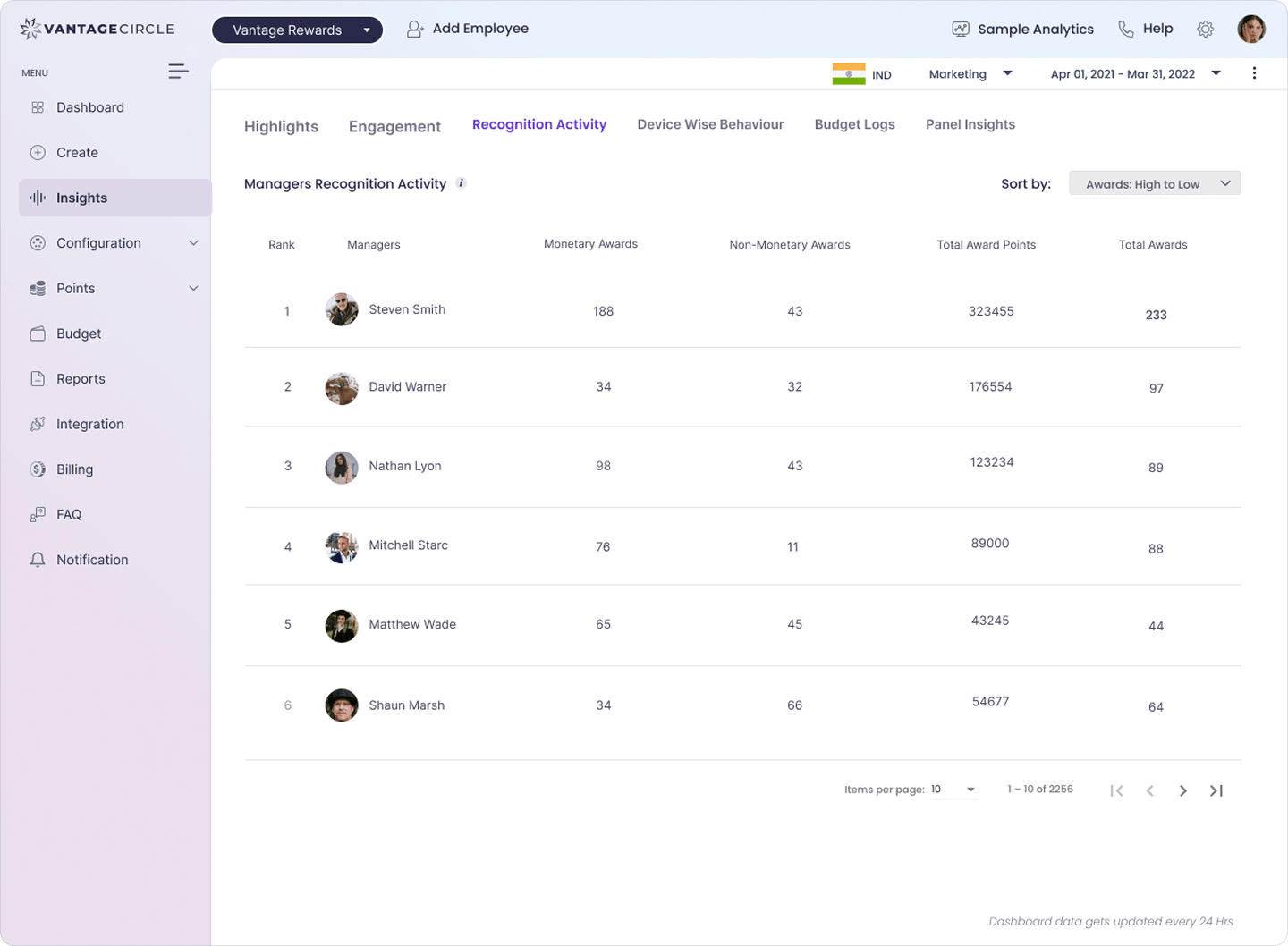
This is also where the gap becomes visible operationally, not just in survey data. A Recognition Analytics view that shows who is actually being recognized, by team, role, and tenure, is what turns "recognition favors the visible" from a suspicion into something HR can see and correct before it hardens into attrition.
How Often Should You Actually Recognize Someone?
Gallup's answer, drawn from its own research, is roughly weekly. Fewer than one in three employees currently get there. That is a wide gap between the benchmark and the reality most companies are operating in, and it explains why so much recognition still reads as an annual-review event rather than a habit.
Frequency alone will not close the gap covered above. Someone can be recognized every week and still miss all four emotional signals if the recognition is generic or one-directional. The two problems, low frequency and low emotional completeness, tend to compound each other. For a more practical look at what daily, felt recognition looks like in specific moments, our piece on ways to make employees feel valued at work walks through it in more detail.
What Smarter Recognition Signals Look Like in Practice
The organizations closing this gap are not sending more awards. They are changing what a signal is built from.
| Old Approach | What the Data Supports Instead |
|---|---|
| Recognize output and results | Recognize identity: who someone is while doing the work, not just what they produced |
| Occasional, milestone-based praise | Everyday recognition: peer kudos, in-the-moment nudges, manager rituals |
| One format for everyone | Contextual formats: public for some, private for others, digital for some, handwritten for others |
| Recognition flows top-down | Recognition flows in every direction, including peer to peer |
That last shift matters most, because it is also the simplest one to fix. Manager-only recognition misses most of the day-to-day work that colleagues see and managers do not. Opening recognition to peer-to-peer recognition is the single biggest lever for closing the gap between who is visible and who is actually valuable.
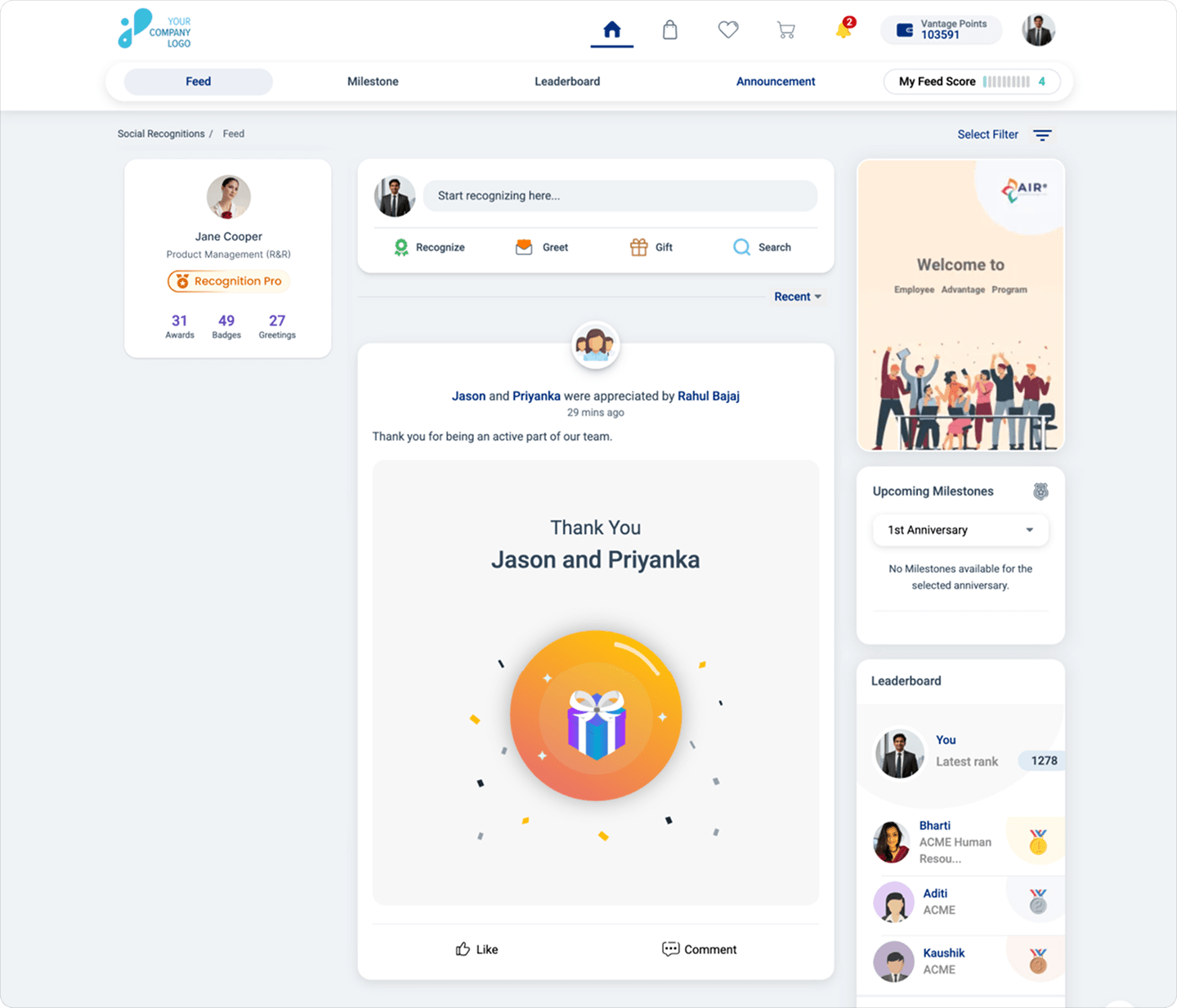
A public, visible feed is what turns recognition into a signal instead of a private transaction between two people. Tying that same recognition to a stated company value through core values alignment does double duty: it reinforces the specific behavior and it reinforces the culture around it, instead of functioning as disconnected praise that nobody remembers by the following week.
None of this works if it stays a one-off effort. A time-boxed recognition campaign around a quarter-end or a product launch is a reasonable way to build the habit initially, but the report's own conclusion is that recognition has to become routine, not an event. That is as much a platform design question as a culture one.
Tracking whether any of it is actually landing is a separate problem from delivering it. This is precisely where sentiment analysis and eNPS tracking earn their place in the conversation. Rather than waiting for an annual engagement survey to confirm what a manager already suspected, a pulse-based read on sentiment turns "half your team feels unseen" from a once-a-year shock into a number HR can watch move, month over month, long before it shows up as a resignation letter.
The Business Case: What Changes When Recognition Works
None of this is a soft argument. The report's outcome data, comparing high-recognition cultures against emerging ones, is stark.
| Outcome | High-Recognition Cultures | Emerging Cultures |
|---|---|---|
| Motivation | 94% | 73% |
| Retention | 93% | 76% |
| Customer service excellence | 94% | 78% |
| Discretionary effort | 91% | 76% |
| Organizational pride | 95% | 82% |
Source: Recognition Effect Report, GPTW India & Vantage Circle, 2025
These are double-digit gaps across every outcome that HR is already accountable for, and none of them come from bigger budgets or flashier platforms. They come from whether recognition is emotionally complete. Frame it as a cost, not a nicety, and the case gets easier to make in a budget conversation: an "emerging" recognition culture is not a company doing nothing, it is a company running the same programs as a high-recognition one and getting meaningfully less out of every one of them, quarter after quarter.
So, What Should HR Do Now?
Four things, based on what the data actually supports:
- Build recognition into the flow of daily work, not just end-of-year town halls
- Train managers to recognize with empathy, not just execute recognition efficiently
- Give every employee an equal chance to be seen, not just the loudest or most senior ones
- Design for emotional completeness, not just for participation or engagement scores
None of these four require a bigger budget. They require a program that is built to notice, not just to dispense, which is the harder and less glamorous half of the work.
At Vantage Circle, we co-authored this research because it confirmed something we had already built a framework around. People do not just want to be appreciated. They want to be recognized for who they are, what they bring, and how they show up, and that is the gap our AIRe Framework and the Vantage Recognition platform were built to close.
Ask yourself a simpler version of the same question the report asks: are your people feeling all four? Because when they do, recognition stops being a moment, and starts becoming momentum.
FAQ
What are the 5 C's of employee engagement?
There is no single official version, several frameworks use the same name. The version we use most often is Connection, Communication, Congratulate, Collaboration, and Care, five pillars covering whether employees feel known, heard, recognized, able to collaborate freely, and genuinely looked after. Read the full breakdown in our 5 C's of employee engagement guide.
What are the top motivators for employees?
Three factors consistently top employee motivation research, including Gallup's long-running Q12 studies: feeling genuinely recognized for good work, having work that feels meaningful rather than just busy, and having a supportive relationship with a manager or team. Of the three, recognition is the one most companies already believe they are delivering and most consistently are not. Only 1 in 3 US employees strongly agree they were recognized in the past week, which is the gap this article is built around.
What are some examples of what makes an employee feel valued?
Based on the four-signal framework above: a manager naming the specific thing someone did well, not just that they "did a good job" (appreciation), being included in decisions that affect their work (acceptance), having a colleague or leader act on their input instead of quietly filing it away (validation), and seeing a clear line between their effort and a real outcome, a launched project, a solved customer problem, a metric that moved (accomplishment). Generic, one-size-fits-all praise tends to miss all four at once, which is exactly why it so rarely lands the way a specific comment does.
How can I make my employees feel truly valued?
Start with frequency and specificity rather than budget. Recognize weekly, not just at milestones, since the data above shows how quickly sentiment falls once recognition becomes occasional instead of routine. Open recognition to peers, not only managers, given how small a share of meaningful recognition currently comes from colleagues. Vary the format, public praise for some, a private note for others, instead of running one channel for an entire company. And check, honestly, whether your program is delivering all four emotional signals, or just one of them dressed up as a program.

Lupamudra is a content marketing specialist at Vantage Circle, where she has written 50+ articles on employee recognition, rewards, and workplace culture, alongside employee engagement, diversity and inclusion, and HR compliance topics, including how India's tax rules apply to recognition and rewards programs.
Connect with Lupamudra on LinkedIn.