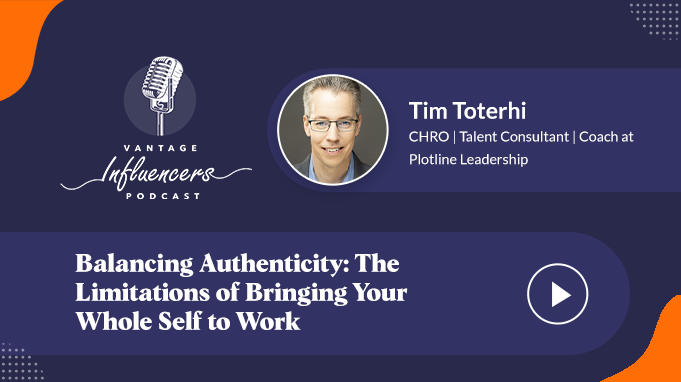
Balancing Authenticity: The Limitations of Bringing Your Whole Self to Work
Episode Overview
Tim Toterhi, President of Plotline Leadership, challenges one of the most repeated pieces of workplace advice: bring your whole self to work. He argues that authenticity in a professional setting has little to do with oversharing or removing every filter. Real authenticity, in his framing, is simply the verified truth of who you are as a leader, something earned through title, opportunity, or (most reliably) hard won experience, and then proven day after day through consistent action.
His sharpest point lands on two workplace buzzwords he thinks have gone off the rails: authenticity and imposter syndrome. He points out that everyone naturally adjusts how they show up between a family dinner and a client meeting, and calling that adjustment "inauthentic" misreads ordinary human nuance. On imposter syndrome, he draws a hard line between people who are genuinely still learning a role (not a syndrome, just growth) and people who are actively misrepresenting their qualifications (a credibility problem, not a psychological one). He closes by connecting genuine humility, being secure enough to admit what you don't know and let others take the spotlight, to concrete outcomes like retention and engagement.
Episode Highlights
- Authenticity in leadership isn't a value judgment. It simply confirms you're an actual leader, whether that leadership came through title, opportunity, or years of hard won experience.
- Bringing your whole self to work isn't always the goal. People naturally adjust how they show up for different audiences, and that's nuance, not dishonesty.
- True imposter syndrome is different from being an imposter. Learning on the job is normal; misrepresenting your qualifications is a credibility problem, not a syndrome.
- Leaders and coaches should first diagnose what's really happening before labeling someone's self doubt as imposter syndrome, since some cases need a mental health referral instead of coaching.
- Humble leaders build strength from where they stand today, admit their gaps openly, and create workarounds instead of pretending to be experts at everything.
- Humble leadership pays off in hard metrics like retention and engagement, because putting other people's needs first naturally attracts people who want to work for you.
About the Guest
Tim Toterhi, CHRO, TEDx Speaker, ICF-Certified Career Coach, and Author
Tim Toterhi has spent more than 20 years in human resources leadership across the Americas, Europe, and Asia, moving from corporate trainer and instructional designer into performance and talent management, HR-led M&A work, and multiple head-of-HR roles. He now serves as President of Plotline Leadership, where he helps organizations change culture, improve performance, and develop talent. Tim is also a TEDx speaker, an ICF-certified career coach, and an author known for a direct, no-nonsense take on leadership and authenticity.
Host
Susmita Sarma, Vantage Influencers Podcast Host
What You Will Learn
- Why authentic leadership is built on consistent action, not personality or self-disclosure
- How to tell the difference between adjusting your presentation for an audience and being inauthentic
- How to distinguish real imposter syndrome from someone who is simply new and still learning
- What humble leadership looks like in practice, and why it drives retention and engagement
- How to build workarounds for your own skill gaps instead of hiding them
Key Topics & Timestamps
| Timestamp | Topic |
|---|---|
| 00:35 | Introducing Tim Toterhi and his path into HR leadership |
| 02:52 | What authentic leadership actually means |
| 06:18 | Why "bring your whole self to work" isn't always good advice |
| 08:46 | Balancing authenticity with professionalism |
| 09:50 | What imposter syndrome really is |
| 12:39 | How organizations can support employees through imposter syndrome |
| 16:43 | Humility and authenticity in leadership |
| 22:15 | The future of authenticity at work |
Full Transcript
Click to read the full episode transcript
Welcome to the Vantage HR Influencers Podcast. This podcast is sponsored by Vantage Circle, the simple and AI-powered rewards and recognition platform for employee engagement. Authenticity, it means being true to yourself even in a professional setting. It's about being genuine, transparent, and sincere in your actions and directions. Let's delve into why authenticity matters so much in our work lives and how it can positively impact both individuals and organizations.
Susmita Sarma: Hello everyone, welcome to the Vantage Influencers Podcast. I'm your host, Susmita, and today I have with me Tim Toterhi, the CHRO, talent consultant and coach at Plotline Leadership. Hi Tim, welcome to the show.
Tim Toterhi: Thanks so much for having me.
Susmita Sarma: It's great to connect with you, Tim. Before we delve into our discussion today on authenticity in the workplace, could you provide a brief overview of your corporate journey and share some interesting anecdotes or experiences that have influenced your perspectives about life?
Tim Toterhi: Sure, I'd be happy to. I used to joke that mine is the classic tale of a former karate instructor and nuclear fuel broker who switched gears to chase a career in human resources. But actually, I just did what most people do throughout their careers, in that I leveraged transferable skills. So early on, I leveraged my sales experience to get a job selling training products, and I leveraged my teaching skills to thrive as a corporate trainer. Once I was in that environment, I was able to stay in learning mode. Over time I transitioned through being an instructor and a designer to roles in performance and talent management. Then I leveraged skill to skill and took advantage of some fantastic mentors throughout the course of my career, and just listened, learned, and made my way from L&D to ultimately running a project management office for strategic HR initiatives. Then I went into M&A and did work there, and ultimately took a couple of turns as head of HR for a variety of different companies. And today, as president of Plotline Leadership, I help organizations change culture, enhance performance, and optimize talent. So that's the snapshot view of what I've been doing.
Susmita Sarma: Brilliant, Tim. What a remarkable journey you have had. Your professional experiences undoubtedly offer a wealth of wisdom that we are excited to tap into today. And as we delve into the captivating realm of authenticity in the workplace, we are very much eager to hear your insights. So let's begin by exploring what authenticity truly means in the context of work, and how your journey has illuminated this concept throughout your career.
Tim Toterhi: Sure. You know, typically people associate authenticity with value. But what works for diamonds and collectibles doesn't necessarily work for leadership, it's a very different thing. I believe that before you discuss something, you have to make sure you have a shared definition of what you're talking about. For me, authenticity, especially when it focuses on leadership, just means an undisputed truth: you're thinking about something that's the actual, factual, bona fide, verified truth of a thing. So when you think about it from a leadership perspective, authenticity doesn't place a value judgment. It just confirms that you are, in fact, a leader. From that perspective, there's no fluff, there's no feeling, nothing dressed up around it. It just comes down to being that one thing. So what's really important to look at is how you became a leader. If we set aside nepotism for a second, there are really only three ways you can become an actual leader. Number one is by title. You can get it by opportunity, or you could have it through hard won experience. When you think about each of those in turn, consider the person who gets leadership by title. We've all come in contact with these folks throughout our careers, I call them the corporate kings and queens. They have the VP, the senior VP title, and maybe it's legitimate and they earned it. But whether you feel they do or not, it really doesn't matter, they have to prove it day over day. So they were given that, and that's great. The second way is through opportunity. This is that classic thing where everybody steps back and somebody steps up, that hero moment, if you will. Think about the soldier taking a hill, or the firefighter rushing into a building, or, in an appropriate sense, one of your colleagues stepping up to challenge a tough issue or a popular topic. They assume that leadership role by chance, by opportunity. That's also great, but you can't schedule that, you can't schedule serendipity, you don't know when it's going to happen. So while those two things can occur, most often people obtain a leadership role through hard won experience. They get it over time, through professional development, practical experience, and personal hardship. Think about the karate sensei, or the athlete turned coach, or the long-time business executive who's done this for quite a while. It's really the most valuable type of leadership you could have, because it's not based on title, or luck, or serendipity, or knowing someone. It's based on consistent action, and thus your legitimacy is beyond question. So to get back to the original question: when I think of authenticity in the context of leadership, it comes from actually having the title, but then backing it up through consistent action over time.
Susmita Sarma: Yeah, definitely, that makes sense. Obviously, and it's a great point. What do you think about, generally, when we talk about authenticity, it's about bringing your whole self to work. So do you think that's always the best approach to authenticity in the workplace?
Tim Toterhi: No, I laugh about this all the time. The whole concept of bringing your whole self to work drives me clinically insane, it really makes me nuts. And the reason I say that is, think about it: some of history's most notoriously ruthless leaders were completely authentic too. They brought their whole selves to work every day.
Susmita Sarma: Yeah, I don't know about that, I don't want to work for that guy.
Tim Toterhi: Right, and obviously that's an extreme example, but the corporate world is littered with people who bring their whole selves to work, and you'd say, I would never want to be part of that team, or that culture, or those people. To me, authenticity is a buzzword that has gone completely berserk. It's a cliche that really just allows folks to justify any behavior, whether it's professional or appropriate or not. And there's a distinction here: I think people should feel very comfortable and should be allowed and free to be themselves. But the difference is, we're not the same self everywhere, all the time. If you think about it just from a personal context, you might explain something and use different language with your grandparents than you do with your college or university friends. It's a different environment, so you're going to show up differently. People do this in the business environment too, adjusting their presentation to the audience they're working with. It's a natural thing. But somehow we've convinced ourselves that that's inauthentic. It's not.
Susmita Sarma: Totally. I think it's not changing who you are, it's just nuance.
Tim Toterhi: And so when we think about bringing your whole self to work and authenticity, for me, we really need to allow ourselves the freedom to be complex, different, and nuanced. If we do that, it's a much smoother experience for everybody. To me, there are a lot of people running around pretending to be authentic, and that's probably the worst thing you could possibly do.
Susmita Sarma: And we have these two different words that we generally use, personal and professional. So we don't have to be inauthentic in either. It's not like, if you're not personally you in your professional world, that means you're being inauthentic, right?
Tim Toterhi: Exactly, that's a great way to put it.
Susmita Sarma: But then how do you balance authenticity with professionalism in different work environments?
Tim Toterhi: Well, when you think about being professional, you look at the audience, I look at it as a presentation. One of the things you have to remember is it's really not about you. It's about the folks you work with, who you're serving, and the company you're part of. If you go into an environment bringing baggage, bringing things that aren't of service to the people around you, you're going to lose. You want to be someone who can really focus on the needs and wants of other people, and if you do that by serving others, people will gravitate toward you. That doesn't mean you're being somebody else or faking it, you're just sharing what's most appropriate about you at that time. That attracts people, and it keeps them, it hits retention, it hits engagement, all of it, because at the end of the day, like I said, it's about others. It's not about you.
Susmita Sarma: Make sense. Again, on a related note, Tim, imposter syndrome is something many people experience in their workplace. Would you like to shed some light on what imposter syndrome is and how it impacts employees?
Tim Toterhi: Yeah, I don't know if you've ever seen the movie The Princess Bride, it's a classic movie, but one of the famous lines from it is, "You keep using this word. I don't think it means what you think it means." I think that's what's happened with imposter syndrome, because it's another one of those buzzwords that's been floating around for quite a while. I think there's a big difference between having imposter syndrome and being an imposter, between learning on the job and pretending that you have it all figured out. That's a huge distinction. One of the worst pieces of advice folks can get, especially early in their careers, is to fake it until you make it, to act as if you're already the boss. When you do that, the only person you're fooling is yourself. Somewhere along the line, I think we got this notion in our heads that authentic leadership was about acting, about putting something out there that's supposed to be the Instagram version of yourself. We were led to believe that we were all instantly worthy of leadership. If we didn't feel that way, then that's what imposter syndrome is, and that's just completely ridiculous. You hear all these stories about folks just out of college, or freshers, lamenting so-called imposter syndrome because they don't feel worthy of being CEO. Well, guess what? You're probably not worthy yet, and that's okay, you're not there yet. So that's a big difference. When we think about imposter syndrome, we really have to get specific about whether that's legitimate imposter syndrome or just a feeling that means you need more proof in the pudding. There are always outliers. There are people in every industry, every profession, who are simply smarter, better, faster, and who achieve things earlier than everyone else, and that's okay. But for most of us normal humans, we have to take time to learn and grow, and that's natural. That's not imposter syndrome.
Susmita Sarma: And how can leaders and organizations as a whole address this phenomenon, to support their employees if they're suffering from something like this?
Tim Toterhi: Well, that's a really important question. I think one of the things you can do to support your staff on this topic is to first diagnose, with their help, what problem you're actually trying to solve. Because there are legitimate cases of imposter syndrome that are quite serious. I've been a coach for 20 years, and this comes up quite often in practice. So you really have to be thoughtful about the situation you're facing. As an example, if you have a well seasoned, highly experienced, and effective CEO who feels unworthy of the job despite a long history of accomplishment, that could certainly be imposter syndrome, but it might actually be something more serious that a coach, an L&D practitioner, or an organization isn't qualified to solve. Frankly, that might be more of a clinical psychology matter, and it needs to be referred out, that's not really the business's place to handle. That's probably the most pronounced example, but there are other, less serious situations that do legitimately fall into imposter syndrome. Take someone who recently went through a layoff, and because of that, their confidence is shaken. They're a great performer, they do really well, but they've had this experience, and now they're shaky and wondering, am I really worthy of doing this job, did I have it all wrong? That's something you can work through with training, mentoring, and coaching. Another example: someone moving into a bigger role. They've had success in their career, and now they're taking another step, and part of them is asking, am I ready for this, am I worthy of this? Well, everybody else is saying yes, because they got the job, and that might genuinely be imposter syndrome you need to work through, because you need to show them the mirror everybody else sees. In those two cases, if it's diagnosed properly, you can get people the time, attention, and help they need. On the other side, though, there are folks who are just imposters. Let's face it, these are people who are posing, who don't have the skill, experience, or resources they think they do. I'll give you a far example: there are a lot of people in the coaching world who get a certificate after being an intern for a bit and then brand themselves as a consultant to the C-suite. Are they really doing that? I don't know, maybe, but I seriously doubt it. Or another example I use all the time: I've never met a writer who wasn't a bestselling author. Well, everybody can't be the bestselling author on the block, what is that? It's concerning to me when people stray into that fake it territory. And the reason I say that is, I'm a hundred percent supportive of people's goals, dreams, and ambitions, I think that's all healthy, you should have them. But if you stray into misrepresenting your qualifications, then you lose credibility, and that's the difference. So, to your question about what we can do about it: I think companies can provide people with mentors or coaches who have the ability to look at those two different things and then give people the push or the pull. They can tactfully share reality, or they can lift someone up and say, here's what I see that you don't see, and that's a great thing. That's the part of the balance that makes sense.
Susmita Sarma: Yeah, brilliant insights, and absolutely, overall, creating a supportive environment is key to supporting employees who suffer from something like imposter syndrome. Shifting gears a bit, Tim, humble leadership, as we see, is gaining traction as an effective leadership style nowadays. So what are your thoughts on the connection between humility and authenticity in the workplace?
Tim Toterhi: Yeah, this is really important. I'm pretty passionate about this as a concept, and it's a great way to frame leadership in general, because humble leadership is different from any other style or form of leadership. When you think about it, humble leaders find strength and confidence in their now. What I mean by that is, they think about striving for tomorrow, but they're very rooted and balanced in today. They don't pretend to be something they're not, but they also don't shrink from the greatness within themselves or the greatness within others, it's quite unique, if you will. If they're new to a company or a leadership role, they embrace that newness and leverage it as a strength, and that's another important thing. When I think about people who are junior in their careers, sometimes we don't value newness, and newness is actually a great thing. You look at things differently, you bring fresh perspectives, all of that is incredibly valuable, and humble leaders can do that. But if they do have experience and a lot of background, they'll leverage that wisdom and continue to learn in service of others. So when you think about a humble leader, they take pride in building others up, it's all about other people. And I think they do a few specific things differently than every other type of leader. Number one, they consistently develop on the job, and not just their own development, they develop others too. They'll also transparently share their shortcomings. If there's something they don't know yet, they let people know, because they're not perfect and they understand that. That's where you get into the legitimate vulnerability aspect of things, they're secure enough to say, look, I'm not a finance expert, or I'm not a presentation expert, whatever it is, and they'll share that. The other thing they do, probably one of the most important things, is they create workarounds for those limitations. They joke that you can't teach a fish to climb a tree, and that's true, but there are things you can do to compensate. If I'm short and I need to reach the top shelf, I'll grab a ladder, that's my workaround, and they consistently look for that. Finally, it's also hugely important that humble leaders leverage their team's expertise to fill some of those gaps. Again, they're secure enough that it doesn't have to be their win, it can be someone else's win, and they'll help put the spotlight on that person, because frankly, that makes everyone look better. So at the end of the day, I think humble leaders drive value, and they understand that while everything is on them from an accountability point of view, it's not about them. That's the difference, and the benefits show up in both hard and softer ways. On the metrics side, look at humble leaders' staffing numbers: retention goes up, engagement goes up, quality of hire goes up, and the reason is simple, people want to work for them, because you're going to make me better in December than I was in January. There are people lined up to work for those leaders, it just becomes an easier thing. On the softer side, when you place other people's needs first, your own needs get filled instantly. You don't have to carry the burden of oversharing or pretending, because again, it's not about you, it's about them. So you put the spotlight on other people, and it becomes much easier to drive focus onto them. There's no need to posture, to pretend, or to act as if for the sake of appearances.
Susmita Sarma: So they're the perfect example of leading with integrity and empathy, serving as powerful role models, demonstrating that true strength lies in humility and authenticity.
Tim Toterhi: Absolutely, that's a great point. The authenticity piece of it is about being of service. I think sometimes social media has tricked us into thinking we need to share everything, but having a private life is good, it's healthy, it's normal. So as a leader, if your focus is on others, you're sharing part of yourself, but not the whole thing, and you're really putting the spotlight where it needs to be, on your team, on your coworkers. Everybody knows who's who in the zoo. So even if you're sharing the spotlight, or sharing the credit, people worry, well, if I share it, people will forget about me. Actually, it's the reverse. People will see you as a talent leader, a talent developer, someone who attracts, retains, and grows people, and that's usually valuable. So it's counterintuitive, but it actually works to your benefit in the long term.
Susmita Sarma: That's a very powerful perspective, Tim. As we wrap up, I'd like to know, what do you envision as the future of authenticity in the workplace? How do you see work dynamics and organizational cultures evolve with authenticity growing as part of working environments?
Tim Toterhi: Well, I'm sure you've probably picked up by now that I'm a bit of a contrarian, if everybody runs left, I always look to the right. Part of that's a natural tendency, but over time, I've come to the view that people talk about the wisdom of crowds, well, sometimes crowds aren't so smart. So I always like to look at the other side of things. When it comes to authenticity in the workplace and some of these softer issues, I actually see some of that fading away and morphing a little, and it's a good thing, because many times when you look at something like authenticity, you have to watch the price tag. I think about who's selling that message and just being mindful of what it is. And it's funny, there are a lot of coaches and service providers out there willing to teach you how to be yourself, your authentic self, and to me, that's crazy town, can you imagine, someone else is going to teach you to be you? So I think people will soon realize that learning about others, community, understanding, all of that is really important. But what's most important is producing results in the workplace. As a relationship evolves between manager and employee, and between coworkers, understanding what they like, their hobbies, their passions, their goals, all of that will strengthen the relationship. But the bond of that relationship is based on the work, that's the primary driver of why you're there in the first place. So I think that becomes really important. To put it plainly, if I'm hiring a bookkeeper, I want them to keep the books. All the other stuff is great, but that's the foundation, and we can't lose sight of that. So authenticity, being yourself, being comfortable in the culture and the work, is important, but you really can't lose sight of the other stuff, because that's primarily why you're there.
Susmita Sarma: Thank you so much for sharing your insights on this crucial topic, Tim. Your expertise has been invaluable, and it's been a pleasure having you on the podcast today. Our audience has undoubtedly benefited from your perspectives, and we look forward to having you back to explore more such interesting topics. Until then, we'll be eagerly awaiting the next opportunity to learn from you.
Tim Toterhi: Thanks so much for the pleasure.
Thanks for listening to the Vantage HR Influencers Podcast. Please subscribe to the Vantage HR Influencers Podcast on Apple Podcasts, Spotify, and our YouTube channel for new episodes.
FAQ
What does Tim Toterhi mean by authenticity in leadership?
Tim Toterhi defines authenticity in leadership as an undisputed, verifiable truth: you either are a leader or you are not, based on title, opportunity, or hard won experience. He argues the term carries no value judgment. It simply confirms legitimacy, and that legitimacy is only proven through consistent action over time.
Is bringing your whole self to work always the right approach?
No. Tim Toterhi argues that people naturally adjust how they present themselves across different audiences, whether that's grandparents, college friends, or coworkers, and that adjustment is nuance, not dishonesty. He believes constant oversharing at work can do more harm than good, since the workplace relationship is built primarily around the work itself.
How is imposter syndrome different from actually being an imposter?
According to Tim Toterhi, imposter syndrome is the discomfort of still learning and growing into a role, which is normal and temporary. Being an imposter means misrepresenting skills, experience, or qualifications you don't actually have. He says confusing the two leads to bad advice, like telling people to fake it until they make it.
What makes humble leadership different from other leadership styles?
Humble leaders openly admit what they don't know, build workarounds for their own limitations, and rely on their team's expertise to fill the gaps instead of pretending to have all the answers. Tim Toterhi connects this style to measurably better retention, engagement, and quality of hire, because people want to work for leaders who are secure enough to put others first.
Related Reading
Also listen on