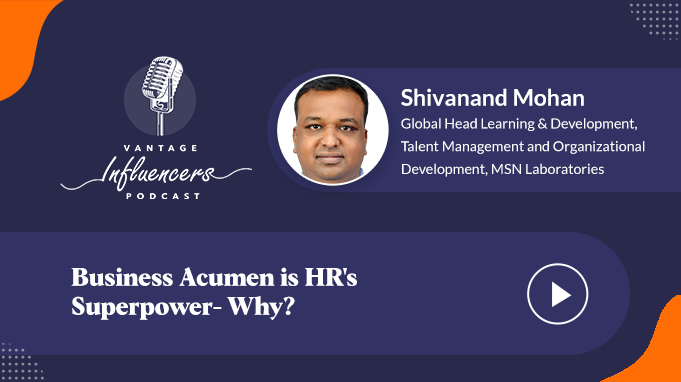
Business Acumen is HR's Superpower- Why?
Episode Overview
Shivanand Mohan argues that business acumen is not an HR add-on. It is the difference between being invited into strategic conversations and being handed a form to fill out. In this episode, he walks through what it actually looks like when HR understands how a business makes money: recruiters who know the balance sheet before they open a requisition, learning and development teams that redesign training around what happens on the shop floor instead of running generic workshops, and performance management that challenges every goal instead of just recording it. He is direct about why so many HR teams get stuck in an administrative box: it is a confidence problem as much as a skills problem, and it changes the moment HR starts speaking the language business leaders already use.
The conversation also gets into how HR professionals can actually build this skill, not just why it matters. Shivanand shares a very specific example from his own pharmaceutical organization, where treating quality control errors as a behavioral problem rather than a technical one cut error rates dramatically, and he lays out a practical playbook: network deliberately across departments, use publicly available data to understand how competitors and other functions operate, and read business material instead of relying only on HR content. He closes with a longer view of where the profession is headed, describing a shift from HR as a data-entry function to HR as an insight-generating advisor, and the three traits, drive, influence, and judgment, that define success at each career stage.
Episode Highlights
- Business acumen means understanding how customers buy, how the business makes money, and where operations should be streamlined, not just knowing HR processes.
- HR earns a seat at the strategic table by connecting the dots across departments instead of defending a single function's turf.
- Recruiters with business understanding evaluate candidates more effectively because they know what skill gaps the organization actually needs to fill.
- Every goal in performance management should be challenged and tested against the organization's vision, not just recorded and tracked.
- A pharmaceutical quality control program cut monthly errors from around 500 to under 20 by treating them as behavioral issues instead of technical ones.
- Practical business acumen comes from deliberate networking, reading business and finance material, and using public data to understand how other functions and competitors operate.
About the Guest
Shivanand Mohan, Global Head Learning & Development, Talent Management and Organizational Development at MSN Laboratories
Shivanand holds an MBA from IIM Kozhikode, a PGCHRM from XLRI Jamshedpur, and dual degrees in Chemical Engineering and Mathematics from BITS Pilani. As the Group Head of Learning & Development for EMAAR Properties in Dubai, he managed over 6,400 employees and built the L&D team from scratch post-COVID. He was instrumental in succession planning and rolled out LinkedIn Learning and a gamified learning app, RAPL. At Larsen & Toubro, he revamped the Leadership Development Program and introduced an employee podcast. Shivanand also established Nutan College of Engineering and Research and has a background in consulting across various sectors. He is a three-time Indian National Mathematics Olympiad awardee and a recipient of several prestigious academic awards. He has impacted over 40,000 students through digital learning workshops and has backpacked across 47 countries and all regions of India.
Connect with Shivanand on LinkedIn
Host
Sanjeevani Saikia, Vantage Influencers Podcast Host
What You Will Learn
- What business acumen actually means for HR, beyond the buzzword
- Why HR is treated as a support function largely because it behaves like one
- How understanding a company's finances and operations changes hiring decisions
- A real example of turning a technical error problem into a behavioral fix in a pharma quality control lab
- Practical, repeatable steps for building business acumen: networking, public data, and business reading habits
- Why HR's future depends on shifting from operational tasks to strategic advisory work
- The three traits (drive, influence, judgment) that matter at different career stages
Key Topics & Timestamps
| Timestamp | Topic |
|---|---|
| 00:00 | Podcast introduction and guest introduction |
| 01:25 | Shivanand's career journey across PwC, Larsen & Toubro, EMAAR Properties, and MSN Laboratories |
| 03:39 | What business acumen really means, and why it applies beyond HR |
| 05:54 | How HR's role has evolved from support function to strategic partner |
| 08:55 | Why business acumen matters in recruiting and hiring decisions |
| 11:12 | Business acumen's role in performance management, training design, and org structure |
| 15:41 | Real-world example: cutting quality control errors in a pharmaceutical lab |
| 19:20 | Practical steps for HR professionals to build business acumen |
| 24:15 | Where HR is headed: from operational tasks to strategic advisory |
| 27:12 | Closing message: drive, influence, and judgment across a career |
Full Transcript
Click to read the full episode transcript
Welcome to the Vantage HR Influencers Podcast. This podcast is sponsored by Vantage Circle, the simple and AI-powered rewards and recognition platform for employee engagement.
Sanjeevani Saikia: Hello everyone, welcome to yet another episode of Vantage Influencers Podcast. I'm your host Sanjeevani Saikia, and today we will be discussing why business acumen is HR's superpower. Navigating the corporate world without business acumen is like steering a ship without a compass. Business acumen equips HR professionals with the savvy to align talent strategies with company goals, make informed decisions, and speak the language of executives. It's a key element that transforms HR from a backseat support role to a front and center strategic partner. So when HR masters business acumen, the entire organization benefits from a more cohesive and profitable direction. Understanding the significance of this, we have Shivanand Mohan with us today to delve deeper into this crucial topic. He is currently the Global Head, Learning and Development, Talent Management and Organizational Development at MSN Laboratories. So let's begin our conversation with him. Hi Shivanand, thank you so much for joining in today's conversation. Before we get into today's topic, why business acumen is HR's superpower, could you tell us a bit about your professional journey so far?
Shivanand Mohan: Hi, thank you very much for inviting me on this podcast. It's a pleasure being here. So I started my career with PricewaterhouseCoopers right after my graduation, and then went on to do my MBA from IIM Kozhikode. I've worked for organizations like Larsen & Toubro, EMAAR Properties in Dubai, and now currently work for MSN Laboratories, which is a leading pharmaceutical major in the API space. I lead the Leadership Development and Talent Management practice in this firm, which has 15,000 employees. It is a privately held organization. I've handled various non-linear parts in my career, not a very traditional HR or L&D career. I've dabbled into entrepreneurship, starting my own firm with a mix of success and failure, and then I started my own retail technology firm. I've also worked with the Government of India and a national skill development initiative, helping almost a hundred thousand underprivileged children across the country. With a lot of these experiences, I was also fortunate to set up an engineering college that disrupted the traditional way of teaching. I've always believed that technology can be the enabler to drive outcomes in a more efficient manner. I've always believed in futuristic thinking, trying to challenge the status quo. And here I am in this role at MSN Laboratories, trying to see how I can impact my employees in a more meaningful way.
Sanjeevani Saikia: Wonderful. Thank you so much for sharing your journey with us. I really appreciate it. So with your permission, can we begin the conversation on the topic?
Shivanand Mohan: Yes, please.
Sanjeevani Saikia: Wonderful. So as HR continues to integrate more deeply into the strategic fabric of the organization, it's essential to understand what business acumen means in this context. We hear the term business acumen quite frequently, but how does it translate specifically to the HR function? So can you start by explaining what business acumen means in the context of HR?
Shivanand Mohan: So this question is a broad question in the sense I wouldn't restrict it only to HR. In fact, it applies to all the support functions of the business, be it a finance person or a supply chain person. Having business acumen is critical, because otherwise you'd be seen by the business leaders as a very theoretical person. Very early in my career, right out of my MBA, I used to throw out a lot of management theories to my business leaders, and the first response I used to get was, "Don't show me your academic progress here, let's talk business." So in my understanding, business acumen is a deep understanding of how your customer is purchasing your product. What are their needs? What are their other options? How does the business actually make money? Which operations need to be focused on for the highest impact for the customer? And which aspects of the business need to be streamlined? At the end of the day, a business is not a charity, it's about making money, while also impacting society in a meaningful manner and respecting the environment and other social stakeholders. So understanding the whole picture and how the interplay between various things works, instead of a siloed approach, is what I believe is business acumen. A lot of people who get recruited, especially freshers from college, have a very single-department-focused approach towards problem solving. So if I hire an HR person, or even within HR, if I talk about talent acquisition, it's heavily dependent on what other talent development and performance management systems happen inside the organization. Somebody who is able to connect the dots and see the bigger picture is someone who would actually be high on business acumen.
Sanjeevani Saikia: Yes. So reflecting on the past, HR was traditionally viewed more as a support function, but it's pretty evident over the years this perception has shifted dramatically. Now various factors such as globalization, technological advancements, and most importantly changes in workforce dynamics have propelled HR into a more strategic role. So I wish to know from you, how has the role of HR evolved over the years, and what factors have contributed to the growing importance of business acumen within the HR function?
Shivanand Mohan: So I am a strong believer that HR will be treated as whatever function the way we behave. If we allow ourselves to be a support function, we will be treated as a support function. If we have the data and knowledge to impress the business leader that we are thinking from the business angle rather than a departmental angle, that's when the dynamics change. Now with a lot of technology and data being accessible, people get to read and understand what's happening around the world a lot more quickly than in the older days, where you were exposed only to the day-to-day operations of the business and had to figure out what is right and what is not. So we have a lot more networking opportunities today. In our organization, we strongly believe in a leadership methodology where the equation is R1 (resource) to R3 (results): with the least resources, can you produce the maximum results? We believe you can develop your business acumen only by connecting with every stakeholder. In pharma, you cannot rely on individual success the way, say, a software company might have a single standout coder produce an insanely good application on their own. In pharma, we depend on multiple departments: there's production, warehouse, supply chain, quality assurance, quality control. The interaction, collaboration, and team cohesiveness between these departments is what produces results, and we would ask HR folks to interact with each of these departments with a curious mindset, trying to view the business problem from their shoes and their point of view. The ability to empathize with the other person's point of view, to map out the multiple perspectives of the various departments, and then take a bird's-eye view of how the whole thing interacts, is what strengthens a person's understanding of the business. That's how I think the world is evolving: technology, tools, the internet, and podcasts like this one, where you can learn from other leaders, other companies, and other practices, help us understand traditional business in a more strategic manner.
Sanjeevani Saikia: Okay, here I wanted to actually know from you, does having business acumen really help in the hiring process, in selecting candidates? So if you know about finance, say for example, does it really help when you're recruiting someone, are you able to judge them better? What can you say about that?
Shivanand Mohan: Is the question about the recruiter angle or the candidate angle?
Sanjeevani Saikia: More about the recruiter angle.
Shivanand Mohan: I think it actually happens both ways, even for the candidate. I always say that even if you're applying for an HR job, having a larger understanding of the business will definitely make you stand out from other candidates. I see candidates applying for jobs without even knowing the CEO's name of the company. A similar thing plays out from the recruiter angle, because a talent acquisition person is not just filling a position or a chair, it's about the opportunity cost, it's about future value addition, it's about whether we're picking the best person possible to fill that seat. As Jim Collins says, if you want to build a great organization, ensure that the right people are on the bus and the wrong people are off the bus. For a recruiter, understanding where the company makes money and where it's not so efficient strategically informs what kind of hires, what kind of skill sets, and what kind of competencies are needed to fill up the gaps that are currently missing in the organization. That's why even for a recruiter, knowing the balance sheet matters. I've worked in organizations where the HR person has no clue what products the company sells, and that cuts a very poor figure, because what are we recruiting for? We need to recruit to build the organization towards excellence, and business acumen isn't a luxury, it's a must-have skill for a top-performing recruiter.
Sanjeevani Saikia: Wonderful. Again, it's evident that HR professionals who possess strong business acumen bring a lot to the table. They're not just managing employees, but also influencing strategic decisions and driving organizational growth. So in what ways does strong business acumen enable HR to contribute more effectively to organizational strategy and the decision-making process?
Shivanand Mohan: In multiple ways. Let's take performance management. Most of the time, how this works is that the company sets goals, they ask the business folks to set the goals, and HR's job is largely restricted to getting that filled on the HRIS platform, or if they don't have one, on a pen-and-paper format. Largely, the traditional view is that the HR person comes only to get the form filled up, like a postman or someone in a government office stamping forms. That's not how a true HR person should ideally look at it. Every goal that is set has to be challenged, has to be questioned on whether it's a stretch goal, a futuristic goal, whether it's in alignment with the organization's vision. These kinds of conversations require business acumen to run really deep inside the HR person. The reason HR people shy away from challenging business leaders on goals is because they lack the confidence, they wonder whether they really know the business well enough to challenge the other person. That's not only true for performance management, you can extend it to talent development as well. Suppose I run a program on time management or emotional intelligence, everybody knows what these are, there's an overload of matrices, if you just Google it or go to YouTube you'll get thousands of videos on time management, urgent-important matrices and so on. But people don't want theory, they don't want raw theoretical frameworks thrown at them, they're not school or college students, they're fully formed, mature adults who want learning and development folks to be performance consultants. So how does time management actually work on the shop floor, when I have to produce multiple products? Take my own organization: we manufacture almost 450 different products. If I produce a particular API and then have to start the next batch, say one is for cardiac therapy and the next is for kidney-related issues, I have to flush out the entire equipment line and restart with a new approach. So how do you manage multiple batches, multiple products, hit deadlines, and adhere to business requirements and challenges coming from the marketing team? Contextualizing time management to these real ground-level challenges is what makes a learning and development person more effective in the eyes of business stakeholders, rather than just showing up and running a generic two-day workshop on time management or a one-day workshop on emotional intelligence. That would be seen as a vanilla offering with no connection to the day-to-day operations of the business, and when that happens, people stop taking HR programs and training interventions seriously, and they avoid turning up for the programs. In the same way, across the org structure: how do you design it? Most of the time the org structure just evolves naturally, and companies are left to figure it out through their own failures and learnings. A strategic HR person would actually understand the business deeply, see the interlinkages, see the redundancies, and understand the business very deeply before proposing an org structure. Yes, all of these things play out at a very senior level in org strategy and decision-making.
Sanjeevani Saikia: Shivanand, now shifting gears, can you share some real-world examples or case studies where HR's business acumen has significantly impacted a company's performance or direction?
Shivanand Mohan: Sure. In the pharma industry, we do something called quality control checks before we ship out the product to the customer. I can give an example from my own organization, where sometimes, because humans are involved in testing the samples, a lot of errors can happen. Errors can happen due to fatigue, boredom, dehydration, people losing focus because they've been standing in the lab for the last two or three hours. Many such avoidable errors happen in a chemistry quality control lab in pharmaceutical firms. This entire space is called human error. As the learning and development lead for the organization, I took my team, and we sat down for almost an entire week and actually mimicked the entire quality control testing process. By sitting through the experiments and the various activities the team performs, we documented them and understood that most of the errors, rather than being technical, were more behavioral in nature. So we married the concept of behavioral intervention with a technical context, and helped the team mitigate such error risks. We've seen that from about 500 errors happening in a month in a lab, the errors reduced to less than 20 a month, and our aim is to make it zero. We still have checks and balances to catch errors, but each error costs time, chemicals, and samples, it costs the business a lot of money. Deeply understanding each experiment, the cost of performing it, and trying to avoid wastage, significantly helped reduce our overheads and improved our bottom line. That's one example of how having deeper business acumen, working alongside the business, improved company performance. There are other areas too, like org design and org effectiveness. We've done a lot of collaborative workshops, called the "One MSN" workshop, where each department has to not optimize locally for itself but globally maximize for the company's interest. Rather than just rolling out the intervention in a single day, we sat with the department heads of each of those departments, including support functions like IT, admin, warehouse, and security, and brought in a workshop to help people empathize with each other. We introduced concepts like non-violent communication, where people could appreciate where the other person's unmet need is coming from, rather than dismissing it as a deviation or a disruption.
Sanjeevani Saikia: Thank you so much for sharing this example with us. I really enjoy it when speakers share real-life examples, because listeners derive more value from it, they understand the subject matter in depth. Thank you so much for sharing this with us. Now, moving on, for HR professionals looking to build their business acumen, it can be challenging to know where to start. There are specific skills and areas of knowledge that can make a big difference in understanding the business landscape. So according to you, what practical steps can HR professionals take to develop their business acumen, and are there any particular skills or areas they should focus on to enhance their understanding and effectiveness?
Shivanand Mohan: That's a nice question, and it's one that's been asked in multiple ways and applications. My single answer for that is: network with the business leaders. Instead of sitting at your desk or laptop working on a spreadsheet, walk down the floor, go talk to the leaders. With 15,000 employees in my organization, my personal goal in the first year of joining this company was to know at least 1,500 people. It's not an easy task, it takes a lot of hard work, walking around and connecting, because only when you connect with people do you get multiple perspectives and are able to connect the dots. If you only meet certain departments or certain parts of the function, you'll have a very skewed or biased view of the business. That's exactly why the view from the top, the CEO or the chairman, is able to take decisions more effectively, because they see all aspects of the business. The HR person should aspire to be in the shoes of a CEO, trying to understand the business from every corner. One of my former HR heads used to say you should have an intelligence network the way an intelligence bureau has people all around the country. You should be able to tap into the grapevine, the formal and informal ways an organization works, and having people connected in every department is critical for you to first gather the data. Next, I would also encourage people to use platforms like LinkedIn and others, where so much data is available free of cost. You can go to a competitor firm and see every department, search by function, location, or company, see what people are qualified in, what they're doing, what projects they've worked on. A lot of people put up a lot of data about the kind of work they've done in an organization. Gathering that external intelligence along with internal intelligence sets you apart. Apart from that, people also need to start reading a lot more. I generally see a lot of HR people are very shy of numbers, they're typically scared of numbers. They need to start picking up books on corporate finance, reading journals on business performance, reading articles on Harvard Business Review, and I'm talking here more about junior folks. I'm sure senior folks are already doing all this, but at least for people starting out, they really need to improve their reading habit. The world of YouTube and media has kind of crushed the reading habit, but trust me, reading HR magazines and journals from places like People Matters and other sources where you can learn what every company and every function is doing matters. The sum total of all these things, external intelligence, internal intelligence, along with your ability to be curious and a voracious reader, will help you build business acumen and be more impactful with business leaders. I've always seen that a business leader will take only about fifteen seconds to evaluate an HR person: is this person an operational, day-to-day, postman kind of person, or is this person actually building the future? They'll be able to evaluate that from the way the HR person carries themselves, and a person can carry themselves in a futuristic way only if they've gathered all of these pieces.
Sanjeevani Saikia: Yes, I'm glad you have highlighted the significance of reading in your response. The valuable material you've underscored will be one of my biggest takeaways from this conversation, so thank you again. Looking to the future, it's clear that the role of HR will continue to evolve, especially with a stronger emphasis on business acumen. There are several trends and changes on the horizon that HR professionals need to be ready for. So Shivanand, how do you see the role of HR evolving further, and what future trends should HR professionals prepare for to stay ahead and continue adding value?
Shivanand Mohan: I see that in the next three to five years, most of this operational HR work will become redundant. There are political forces inside and outside organizations that will try to delay this as much as possible, but it's inevitable. People doing day-to-day data entry kind of work would possibly get out of a job, but the good news is that they can reskill themselves and apply their real intellect to evaluating and deriving insights. The way I see the future of HR evolving is that the business leader is going to say, "I'm giving you all the technology tools to do the groundwork, now please derive the insights from those tools and become an advisor," rather than just being a data-capturing or administratively intense HR person. So the skill sets HR people really need to improve on are, one, business acumen, and two, critical thinking. They need to critically analyze why a particular activity is happening, whether it can be done more efficiently or effectively, rather than having the mindset that "this is not my problem, this is the business leader's problem." If I had to sum up the whole podcast in one message, I always go to my office thinking that I'm possibly a pseudo-CEO. I always wear the hat of a CEO and look at a problem. I might not actually be the CEO, but I ask myself how I would take the decision if I were, and that's how I approach every single problem, from training need identification, to delivering a training program, to arranging the program, the cost, the budgeting. That's what people call an ownership mindset, or entrepreneurial thinking. HR folks who embrace this, who walk into the office thinking of themselves as a CEO who has a view of all departments rather than a single department, would be respected, would be valued, and would definitely grow in the organization.
Sanjeevani Saikia: So we have reached the end of today's podcast. Do you have any message for our listeners? Our listeners would be delighted to hear it from you, and our audience might want to stay in touch with you post this podcast, so it would be great if you could tell them how they can reach out to you.
Shivanand Mohan: The message I would say to the listeners is a bit of a borrowed one. Some time back, I learned from a book that in a career there are three parts: the beginning stage, the mid stage, and the senior stage. For entry-level folks, the most important, non-negotiable trait is drive and ambition, they need to put in a lot of hard work and hard hours, because understanding the business really requires long hours. At the mid-level, once you reach maybe five to ten years in your career, it's all about influence, because your drive is a given by then, that's how you grew to the mid-level position, and it's about talking, connecting, and the ability to politically maneuver the various challenges that happen in an organization. I don't mean "political" in a negative light. I'd recommend people read a well-known book on power and how to really navigate organizations, which talks about the real advantage of understanding organizational dynamics. At the higher levels in the organization, it's all about judgment. So drive, influence, and judgment: these are the three things a person really needs to be successful in a career. If someone has all three, there's no stopping them, they could possibly go on to become a top professional in their field. And if one of them is missing, they'll have to work on it. As a well-known leadership author has said, for a person to develop, they need to first be coachable, and coachability is defined by whether you have the courage to accept feedback, the humility to acknowledge the feedback, and most importantly, the discipline to work on the feedback. Only when you have courage, humility, and discipline would you actually work on the feedback given by your stakeholders, and you'll be on a development journey. So that's possibly the message. I'm available on LinkedIn, Shivanand Mohan is my name, and I'd encourage listeners to connect with me there.
Sanjeevani Saikia: Thank you so much, Shivanand, thank you for joining us in today's episode. You have been amazing, you and your insights were very good. Thank you so much.
Shivanand Mohan: Thanks a lot.
Thanks for listening to the Vantage HR Influencers Podcast. Please do subscribe to the Vantage HR Influencers Podcast on Apple Podcasts, Spotify, and our YouTube channel for new episodes.
FAQ
What does business acumen mean for HR professionals?
According to Shivanand Mohan, business acumen is a deep understanding of how customers buy a company's product, how the business actually makes money, which operations create the most impact, and where the business needs to be streamlined. It means connecting the dots across departments instead of viewing problems through a single-function lens.
Why does business acumen matter when hiring HR talent?
A recruiter with strong business acumen understands where the company makes money and where it is inefficient, which shapes what skills and competencies to prioritize when filling a role. Shivanand argues that talent acquisition without this understanding reduces recruiting to just filling a seat rather than adding strategic value.
How can HR professionals build stronger business acumen?
Shivanand recommends deliberately networking across departments rather than staying at a desk, using publicly available data on platforms like LinkedIn to understand how other functions and competitors operate, and building a habit of reading business and finance material instead of relying only on HR-specific content.
How does Shivanand Mohan see the role of HR changing in the next few years?
He expects operational, data-entry-heavy HR work to become largely redundant within three to five years as technology takes over the groundwork. HR professionals who reskill toward business acumen and critical thinking can shift into an advisory role, deriving insights from data rather than just capturing it.
Related Reading
Also listen on