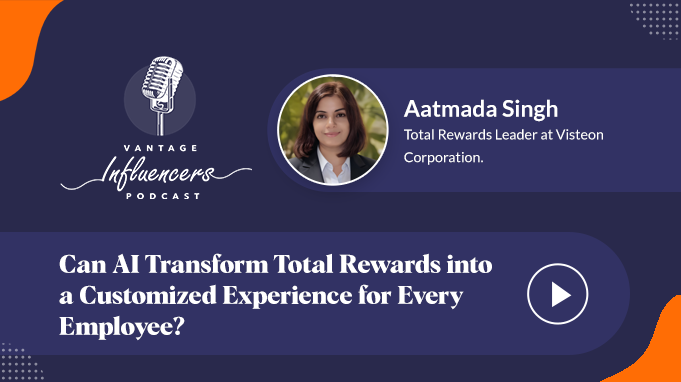
Can AI Transform Total Rewards into a Customized Experience for Every Employee?
Episode Overview
Aatmada Singh argues that most conversations about AI and total rewards focus on the wrong problem. Leaders assume the hard part is generating a personalized offer for each employee, when the real shift is moving HR from a process-driven function to a data science-driven one, which depends on clean, unbiased, well-governed data across HRIS, payroll, and engagement systems. She also flags a subtler risk: organizations get excited about what AI recommends, then discover they lack the budget flexibility, manager training, or infrastructure to actually deliver on it. Underneath both problems sits a change management challenge that technology alone cannot solve, since employees and managers have spent decades assuming that fair means identical.
From there, the conversation turns practical. Singh explains what employees actually expect once rewards become personalized (relevance and respect for their circumstances, not a fully bespoke package), how to introduce customization without creating a perception of inequality, and where legacy total rewards frameworks fail multigenerational, distributed workforces built around a one-size-fits-all assumption. She also proposes a set of ROI metrics that total rewards teams have never had to track before, including relevance scores, choice activation rates, and an equity index, and closes with a look ahead at "liquid benefits" and a points-based rewards portfolio that could eventually replace the static annual package.
Episode Highlights
- The biggest underestimated shift with AI in total rewards is moving from process-driven HR to data science-driven HR, which requires clean, unbiased, and well-governed data across HRIS, payroll, and engagement systems.
- Employees do not expect fully bespoke rewards packages; they expect relevance, respect for their life stage, and rewards platforms that recommend options the way a streaming service recommends content.
- Personalizing rewards without creating a perception of inequality requires a transparent framework, a consistent overall value proposition, and involving employees in co-creating the criteria.
- Traditional one-size-fits-all reward frameworks fail multigenerational, distributed workforces because they assume everyone works the same schedule, lives in the same cost-of-living area, and wants the same things at the same career stage.
- New ROI metrics for personalized rewards include relevance scores, choice activation rates, speed to respond to emerging needs, and an equity index that tracks reward value across demographics and locations.
- As AI matures, total rewards could shift from a static annual package to a "liquid benefits" model, with rigid organizations, small and mid-sized companies, and untrained people managers struggling most to keep up.
About the Guest
Aatmada Singh, Total Rewards Leader at Visteon Corporation
Aatmada Singh is a strategic Total Rewards leader with 18+ years of experience designing and implementing compensation and benefits programs across global organizations in IT, automotive, fintech, and telecommunications. As the Total Rewards Leader at Visteon Corporation, she drives multi-country rewards strategies, overseeing compensation design, job architecture, and incentive frameworks, and has previously held leadership roles at Fujitsu, CITCO, Tata Motors Finance, and TCS, delivering Total Rewards solutions across 40+ global locations. Her expertise spans long-term incentive plans, M&A rewards integration, benefits optimization, and employee engagement initiatives, and she holds certifications as a Long-Term Incentives Expert (Aon) and a Performance & Rewards Professional (Mercer), along with recent training in Generative AI applications for HR.
Connect with Aatmada on LinkedIn
Host
Riha Jaishi, Vantage Influencers Podcast Host
What You Will Learn
- Why the biggest AI risk in total rewards is a data governance problem, not a technology problem
- How to distinguish equity from equality when personalizing rewards for individual employees
- What employees actually expect from a "customized" rewards experience
- Where one-size-fits-all reward frameworks break down for multigenerational and distributed teams
- Which new ROI metrics matter once rewards become personalized
- How AI could reshape total rewards into a dynamic, portfolio-style benefits model
Key Topics & Timestamps
| Timestamp | Topic |
|---|---|
| 00:00 | Cold open and episode introduction |
| 01:11 | Meet Aatmada Singh and her total rewards career journey |
| 04:01 | The most underestimated part of using AI to personalize rewards |
| 07:39 | What employees really expect from customized total rewards |
| 11:31 | Personalizing rewards without creating a perception of inequality |
| 16:14 | Where total rewards frameworks fail multigenerational, distributed workforces |
| 23:17 | New ROI metrics for a personalized total rewards program |
| 29:32 | The future of total rewards, and who will struggle to keep up |
Full Transcript
Click to read the full episode transcript
Welcome to the Vantage Influencers podcast. This podcast is sponsored by Vantage Circle, the simple and effective recognition platform for employee engagement.
Riha Jaishi: Hello, everyone. Welcome back to another episode of the Vantage HR Influencers podcast. I'm your host, Riha, and today we're diving into a topic that is reshaping the future of rewards and recognition: can we really leverage AI to transform total rewards into a more customized experience for every employee? As organizations become more diverse and employee expectations become more personalized, traditional one-size-fits-all rewards no longer deliver the impact they once did. Employees today expect benefits, recognition, and compensation experiences that reflect their individual needs, life stages, and motivations. AI is now stepping in to make this level of personalization not just possible, but scalable. And to help us break this down, I'm joined by Aatmada Singh, Total Rewards Leader at Visteon Corporation. Welcome to the show, Aatmada. It's a pleasure to have you with us today.
Aatmada Singh: Thank you, Riha. It is my pleasure to be here today.
Riha Jaishi: We are equally delighted. Before we kick things off, can you briefly take us through your professional journey so far? We are eager to learn about your journey.
Aatmada Singh: Thank you so much. Hi, everyone. I am Aatmada, and I currently lead total rewards at Visteon, where I'm responsible for designing and implementing compensation and benefits across multiple regions and across the globe where Visteon is present. Over my 18-plus years in total rewards, I've had the opportunity to work with diverse organizations, from TCS, where I started my HR journey, to Reliance Communications and Tata Motors Finance, and now Visteon. This journey has taken me across IT, telecom, financial services, and automotive sectors, giving me a unique perspective on how different industries approach employee rewards. What excites me most about this topic is that I've lived through the evolution of total rewards, from manual compensation planning to today's data-driven, globally integrated programs. In my current role, I lead rewards initiatives across geographies, work on future-state job architecture frameworks, and manage everything from executive compensation programs to designing retention strategies. I'm particularly passionate about the intersection of global consistency and local relevance: how do you create reward programs that feel personalized and meaningful to, say, an engineer in Pune, a manager in Munich, or an executive in Detroit, all while maintaining fairness and alignment with business objectives? That's the challenge AI promises to help us solve, and I'm excited to explore it with you today.
Riha Jaishi: That's such an inspiring journey, Aatmada. Thank you so much for sharing your experience.
Aatmada Singh: Thank you. Now, with your permission, I'd like to delve into our topic further.
Riha Jaishi: Sure. Aatmada, everyone says AI will personalize rewards, but what's the part HR leaders are completely underestimating about this shift?
Aatmada Singh: That's a very interesting question. In my view, the most underestimated part is the shift from process-driven HR to data science-driven HR. The unseen challenge is data governance and integrity. HR leaders focus on the output, the personalized offer, but they underestimate the complexity of the input, which is the data itself. AI is only as good as the data it's fed. This requires robust governance: ensuring data is clean, ethically sourced, unbiased, and integrated across different HRIS, payroll, and engagement systems. That's a massive infrastructure change, not just a software update.
Another thing HR leaders underestimate is the cultural and organizational readiness required to act on AI-generated insights. Many focus on the technology itself: the algorithms, the data collection, the platforms. What they miss is the harder part: are we prepared to actually deliver on the personalized AI recommendation? AI might tell you that one employee values professional development opportunities, another prioritizes flexible work arrangements, and a third wants immediate financial recognition. That's a valuable insight, but can your organization actually deliver 50 different variations of reward packages? Do you have the budget flexibility, the managerial training, and the systems infrastructure to execute on that level of customization? I'd say that's the most important underestimation we're making.
The other underestimated challenge is the human element of change management. Employees and managers have spent decades in a world of standardized benefits. Moving to AI-driven personalization means fundamentally changing how people think about fairness, equity, and what they're entitled to. That's a massive mind shift that requires careful communication, transparency about how decisions are made, and trust building around the AI systems.
Riha Jaishi: Yes, Aatmada, these pointers you talked about, how HR is underestimating the shift from process-driven to data-driven HR, the cultural and organizational readiness, and the human element of change management, are really important for HR leaders to look into, because they're so often overlooked.
Aatmada Singh: Yes, very important.
Riha Jaishi: Moving ahead, when we talk about customization in total rewards, what are employees really expecting?
Aatmada Singh: Employees aren't necessarily expecting 100% bespoke reward packages. What they're expecting is relevance and respect for their individual circumstances. They want to feel seen and understood rather than treated as interchangeable parts of a machine. At the most basic level, employees expect their life stage and personal situation to be acknowledged. A 25-year-old early in their career has fundamentally different needs than someone who's 45 or 50 with aging parents and children possibly headed to college. In both scenarios, employees want rewards that actually solve their problems, whether that's student loan assistance, elder care support, mental health resources, or career advancement opportunities.
They also expect choice. Customization doesn't mean HR decides what's best for each person; it means employees have the tools and options to configure their rewards in ways that make sense for their lives. Think of it like a streaming service such as Netflix, which suggests content based on your preferences or viewing history. Employees expect their benefits platform to work the same way: based on your location, family size, or stress level indicated by the organization's wellness app, here are the top three healthcare plans and a recommendation for a mental wellness subscription. Our total rewards programs should recommend what's good for someone based on their current situation, the way a streaming service does.
Finally, employees expect timeliness. The old annual review cycle doesn't match how people live and work anymore. If someone just had a major life event, completed a significant project, or is going through a difficult period, they expect the organization to be responsive in real time, not six months later at the next review cycle.
Riha Jaishi: Aatmada, that explanation really confirms that personalization isn't about more rewards. Like you said, it's about relevance, respect, and understanding an individual's life stage, and shaping rewards and benefits accordingly.
Aatmada Singh: Yes, that understanding is essential.
Riha Jaishi: How do you personalize rewards for individuals without creating a perception of inequality inside the workforce?
Aatmada Singh: That's perhaps the most delicate challenge in this entire conversation, and it requires absolute transparency and clear principles. The key is to distinguish between equity, giving people what they need to thrive, and equality, giving everyone exactly the same thing.
First, you need a clear framework that everyone understands. Personalization should be based on transparent criteria like role requirements, performance levels, tenure, and life circumstances, not arbitrary decisions made in a black box. When employees understand the "why" behind different reward decisions, they're much more likely to accept variation.
Second, establish a consistent value proposition. Even if the components differ based on an employee's situation or life choices, the total value of the reward package at similar levels should be comparable. One employee might get more professional development budget while another gets enhanced parental leave, but the overall investment should be equitable based on role and contribution.
Third, focus on expanding the pie rather than just redistributing it. When customization is introduced alongside an overall enhancement of the rewards program, it's received much better than when it feels like resources are being shuffled around with some people winning and others losing.
Finally, involve employees in the process. As total rewards or HR professionals, we need to co-create that framework with employee resource groups, run surveys about preferences, and maintain feedback loops. When employees have a voice and input, they're more invested in the outcomes, even when those outcomes vary across individuals.
Riha Jaishi: That was a much-needed explanation. It really shows that fairness is no longer about sameness, but about transparency, intent, and perceived equity: a clear framework and a consistent value proposition, as you mentioned.
Aatmada Singh: Yes. And since you touched on equity, here's a small example to make the point clearer. As HR professionals, we must proactively communicate that equity is not equal to equality. Equality is everyone getting the same shoes, that's uniformity. Equity is everyone getting the shoes that fit best, which we can also call personalization. Personalization is the tool to achieve equity in the organization.
Riha Jaishi: Well said.
Aatmada Singh: Thank you.
Riha Jaishi: Moving ahead: where do current total rewards frameworks fail when applied to a multi-generational, distributed workforce, and how can AI fix those blind spots?
Aatmada Singh: Current reward frameworks are often based on a one-size-fits-all model, and they fail primarily due to a lack of resolution and speed. They're built on an assumption of uniformity: that everyone works in an office, follows the same schedule, has similar family structures, and progresses through their career in a linear path. That simply doesn't reflect reality. Looking at our multi-generational workforce, traditional rewards assume everyone wants the same things at the same career stage. But Gen Z might prioritize purpose and learning over salary in ways baby boomers didn't at that age, while older workers may want to downshift or pursue portfolio careers rather than traditional promotion. Our reward structures have no flexibility for that.
With distributed teams, the challenges multiply. Someone working remotely in a low-cost-of-living area has different financial pressures than someone in an expensive urban headquarters. Time zone differences mean real-time recognition programs might systematically exclude certain team members. Cultural differences also play a major role: what feels like a meaningful reward in one geography may be irrelevant in another.
AI can address these blind spots by processing complexity at scale. It can analyze patterns across demographics, locations, and work styles to identify which rewards actually drive engagement for different segments, and detect whether certain groups aren't benefiting from a program, for example, if remote workers show lower usage of a wellness benefit because they don't have gym access in their location. AI can also enable dynamic adaptation: rather than annual review programs, it can continuously monitor effectiveness and flag when offerings are becoming less relevant or when new needs are emerging, using the behavioral and survey data collected from employees.
Riha Jaishi: I truly agree, Aatmada. This one-size-fits-all assumption is one of the biggest misconceptions organizations have: that it resonates with the entire workforce. In trying to maintain that uniformity, companies fall short, especially when it comes to catering to a multi-generational workforce and Gen Z. AI is becoming less of an option and more of a necessity.
Aatmada Singh: I'd totally agree. We can also discuss a good example around job frameworks. A lot of times we try to treat a job as a person, and that's where the traditional framework fails, because it prices the job. That ignores that the same title means very different things to an employee in a high-cost-of-living area versus a low-cost one, or to a boomer ready to mentor versus a Gen Z employee focused on rapid skill acquisition. AI can fix this by integrating real-time market data, granular location data down to the zip code, and dynamically tracking in-demand skills held by employees, for example, specific coding languages or certifications, then helping calculate a more accurate, dynamic market value for that job rather than relying on a traditional job title and framework.
Riha Jaishi: Absolutely. Moving ahead: when rewards become tailored to each individual, what new ROI metrics should HR start tracking that they've never tracked before?
Aatmada Singh: This is a very good question, and one that often gets missed. We create and operationalize the program, but what our return on investment actually is gets overlooked. With the advent of AI, we need to rethink success metrics beyond traditional utilization rates and cost-per-employee figures.
The first is relevance scores: how well the rewards offered match the actual needs and preferences of each employee segment. This means tracking not just whether benefits are used, but whether the right benefits are being offered to the right people.
Second, choice activation rates: in a personalized system, are employees actually engaging with their options and making active choices, or are they just defaulting to standard packages?
Third, speed: how quickly can you identify an emerging need and activate a relevant reward? If AI detects that an employee is showing signs of burnout, how long does it take to offer mental health support or additional time off? Speed matters in a personalized system.
We should also have an equity index. We need sophisticated metrics to ensure personalization isn't creating unintended disparities: tracking reward value distributed across demographics, locations, and performance levels to ensure fairness in practice, not just in theory.
Finally, predictive impact metrics. Instead of just measuring what happened, we need to measure what AI predicts will happen. If you offer someone a specific development opportunity, what's the predicted impact on their retention, performance, and engagement six months down the line? Then we can track whether those predictions actually materialize.
Riha Jaishi: Thank you for sharing these metrics, Aatmada. These are genuinely unique; we've heard the traditional ones before, but the personalized metrics sound really new. I'm sure HR leaders will find these helpful if they haven't considered them already.
Aatmada Singh: I think this is the need of the hour. We're very much focused on our traditional metrics, but with AI, these new ways of looking at things are very important. We'll definitely have that teething challenge of turning this into reality, because talking about it theoretically is one thing, but a lot depends on how my data looks in the organization and whether my systems are talking to each other and are well integrated. Only then can I properly utilize AI tools and technologies alongside my existing systems and frameworks, and only then will we start making sense of these newer, more advanced metrics for measuring program success.
Riha Jaishi: Well said. Before we wrap up, here's a final question. Looking into the future, how different will total rewards look if AI matures the way we expect, and who do you think will struggle the most to keep up?
Aatmada Singh: That has to be a very interesting one. If AI matures the way we expect, I think total rewards will shift from a static HR function to a real-time, adaptive employee experience platform. Imagine rewards that automatically adjust based on life events, performance patterns, market conditions, and organizational needs, all happening seamlessly in the background. We'll likely see the emergence of "liquid benefits": instead of a fixed annual package, employees have dynamic reward allocations that shift over time based on their circumstances. If an employee needs extra childcare support this quarter, the system automatically reallocates from their professional development budget with their approval. If someone's planning a major home purchase, their financial wellness tool kicks into high gear with personalized guidance and incentives. These are just my views, based on my understanding and reading of what's happening around us, and others may see it differently.
Recognition, one of the key components across all organizations, will become immediate and contextual rather than episodic. AI will help managers and peers recognize contributions in the moment, with rewards that actually matter to the recipient, rather than something that happens quarterly or half-yearly. The annual performance review and compensation cycle might become an artifact of the past, replaced by a continuous feedback and adjustment loop; a lot of organizations are already moving in that direction, and AI will make that trend stronger.
To summarize, total rewards will transform from a structured, static package into a dynamic, continuously optimized portfolio. In this model, rewards can be viewed like a flexible investment portfolio with a baseline of mandatory items like salary and health benefits, and a dynamic point system employees can use to invest in options like additional paid time off, student loan contributions, mentorship hours, or upskilling and reskilling credits. AI can continuously suggest the optimal allocation of these points, adjusting based on market value, personal performance, and personal needs data. For example, if a major life event is approaching for an employee, the AI might automatically shift points toward financial planning services, drawing from benefits that are currently less relevant to that person.
As for who will struggle most to keep up, I see three groups. First, organizations with rigid structures and culture: companies that are heavily hierarchical or resistant to transparency will find it extremely difficult to implement truly personalized rewards. Second, small to mid-sized companies without dedicated resources, since sophisticated AI-driven reward platforms require significant investment in technology, data infrastructure, and expertise, and smaller organizations may also lack the data volume to make AI effective. Third, and most important for all organizations, are people managers. It's imperative that we develop coaching skills for people managers, because as rewards become more personalized and continuous, the manager's role shifts from administrator to coach and advocate. Managers who can't have conversations with their team about individual needs and career aspirations will struggle in this new environment; they need to understand what the AI tool or platform is recommending, explain that to employees effectively, and use it to develop employees further rather than treat it as a transaction.
Riha Jaishi: Aatmada, you've given such a detailed and amazing overview of the future, how total rewards can transform from a static to an adaptive employee experience function if everything goes into place: recognition becoming more immediate and less episodic, and one thing that really caught my eye, how you put it, that annual rewards will become an artifact of the past. That's very catchy, and I really believe something that's annual is going to get replaced with something immediate. I loved how you predicted the future.
Aatmada Singh: Sure. You know, with you saying all of this, I'm starting to feel like I should read tarot cards. I can pull four cards and tell you what's going to happen.
Riha Jaishi: Yes, that's great. Please continue.
Aatmada Singh: No, I just wanted to say one more point. You captured the essence very well. In all of this, in my view, the winners will be the organizations that view this AI shift as an opportunity to genuinely put employees at the center of their reward strategies, not just as a buzzword. Right now, AI is the buzzword, and "total rewards and AI" is the buzzword, but putting employees at the center of the reward strategy has to be a reality, powered by technology and enabled by culture change. So three keywords, in my view: employee at the center, the entire ecosystem powered by technology, and the culture change that brings it all together. That's the big takeaway.
Riha Jaishi: Thank you. Aatmada, we've come to the end of our podcast session. Before we wrap up, I'd like to thank you for joining us today and sharing your incredible insights. It's been more than a pleasure hearing your perspectives on the power of AI to transform total rewards into a customized experience for employees. We truly appreciate your time and expertise, and I'm sure everyone tuning in is walking away with a wealth of information to ponder.
Aatmada Singh: Thank you, Riha, for inviting me onto this podcast. It was a lovely experience talking to you, and I hope listeners find the content meaningful.
Riha Jaishi: Absolutely meaningful and enriching. Thank you once again, Aatmada. And to our listeners, thank you for tuning in. We hope you found today's conversation as enlightening as we did. Until next time, take care, and we'll see you soon.
FAQ
What is the biggest mistake HR leaders make when using AI to personalize total rewards?
Aatmada Singh argues the most underestimated shift is moving from process-driven HR to data science-driven HR. Leaders focus on the personalized output but underestimate the complexity of the input: data governance, integrity, and integration across HRIS, payroll, and engagement systems, plus the organizational readiness to actually act on what AI recommends.
Do employees actually want fully customized rewards packages?
No. According to Singh, employees aren't expecting 100% bespoke packages. What they want is relevance and respect for their individual circumstances, along with the choice to configure benefits that fit their life stage, delivered with the timeliness of a real-time response rather than an annual cycle.
How can HR personalize rewards without creating a perception of unfairness?
Singh's framework rests on distinguishing equity (giving people what they need to thrive) from equality (giving everyone the same thing). She recommends a transparent, criteria-based framework, a consistent overall value proposition across employees at similar levels, and involving employees in co-creating the rules.
What new ROI metrics should HR track for a personalized total rewards program?
Singh names four: relevance scores (are the right benefits reaching the right people), choice activation rates (are employees actively engaging with options or defaulting to standard packages), an equity index (is reward value distributed fairly across demographics and locations), and predictive impact metrics (do AI's predicted outcomes actually materialize).
Related Reading
Also listen on