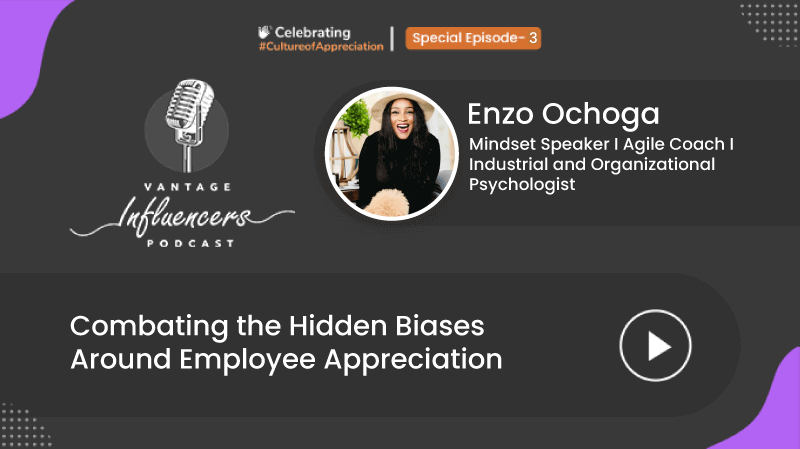
Combating The Hidden Biases Around Employee Appreciation
Episode Overview
Enzo Ochoga joins the show to unpack why so many employee appreciation programs, even the ones companies loudly promote, quietly leave certain groups behind. Her core argument is that appreciation and workplace equality are inseparable: how people feel about their contribution depends heavily on whether their effort is actually seen and valued, and that experience shifts depending on gender, race, tenure, and circumstances like being a single parent. She makes the case that leadership sets the tone for whether recognition gets distributed fairly, because leaders shape the culture, the review processes, and the incentives that decide who gets noticed.
She then walks through what a fairer recognition process actually requires in practice: leaders who extend real compassion and empathy, structured feedback systems including anonymous surveys that catch bias in performance reviews before it hardens into unequal outcomes, and cross-departmental committees that regularly check in on what employees are actually facing. Enzo also pushes back on the idea that employees should quietly absorb a biased manager's behavior, urging them to speak up through HR channels built for confidentiality, and arguing that organizations owe those employees a genuine investigation and real accountability, not just a sympathetic ear.
Episode Highlights
- Appreciation and equality are directly linked. How people feel about their work depends on whether their effort is recognized, and that experience varies by gender, race, tenure, and family circumstances like being a single parent.
- Leadership sets the tone for fair recognition, since leaders shape culture, review processes, and who gets noticed for their work in the first place.
- Anonymous surveys and structured feedback systems remove bias from performance reviews and give a more accurate, non-biased picture of an employee's behavior and contribution.
- Inadequate staffing and chronic overtime drive burnout, and understaffed teams facing heavier workloads see higher rates of depression, cardiovascular disease, and high blood pressure.
- Employees dealing with a biased boss should speak up rather than stay silent, ideally through a confidential HR channel that protects them while the concern is investigated.
- Leaders who deny documented bias after a fair investigation should face real consequences, since accountability, not just awareness, is what actually changes a culture of favoritism.
About the Guest
Enzo Ochoga, Industrial and Organizational Psychologist & Wellness Nerd
With a background in People Development, Organizational Effectiveness Coaching, and Keynote Speaking, Enzo Ochoga is an Industrial and Organizational Psychologist and self-described Wellness Nerd. She has worked across software development and project management roles before moving into research, where she partners with HR teams and organizations to study employee motivation and wellbeing and to help build workplaces that are healthy and safe for everyone. A spiritual purpose guides her work of helping people UNMUTE and TRANSFORM their mindset by harnessing the POWER within them. Enzo found strength in public service and now works with professionals around the world on building healthier, more equitable workplace cultures.
Host
Susmita Sarma, Vantage Influencers Podcast Host
What You Will Learn
- Why appreciation and workplace equality are inseparable, and how bias quietly shapes who feels valued at work
- How leadership behavior and culture determine whether recognition gets distributed fairly across an organization
- Why anonymous feedback systems and structured audits catch bias more reliably than informal reviews
- How inadequate staffing and chronic overtime feed burnout, and why fixing staffing levels is itself a recognition issue
- What employees can do when they're dealing with a biased manager, and why HR needs a genuinely confidential reporting channel
- Why holding biased leaders accountable, even senior ones, is necessary to build a credible culture of appreciation
Key Topics & Timestamps
| Timestamp | Topic |
|---|---|
| 00:48 | Introduction to the Employee Appreciation Series and today's guest |
| 02:05 | Enzo's background and professional journey |
| 03:26 | How to describe employee motivation |
| 04:52 | Which forms of appreciation rapidly enhance employee morale |
| 08:52 | Signs it's time to rethink employee appreciation in the workplace |
| 12:14 | Eliminating hidden biases so leaders can recognize employees fairly |
| 16:25 | How employees can deal with a biased boss |
| 20:29 | Enzo's closing tips for leaders and listeners |
Full Transcript
Click to read the full episode transcript
Everyone wants to be appreciated. It doesn't matter where you sit in the hierarchy, whether you're a man or a woman, a single mother or a family man, from the majority or the minority: how you feel about yourself and your profession depends on how you're recognized. However, most companies that flaunt a widespread employee appreciation culture fail to make it inclusive. Workplace diversity and equality initiatives start with a strong employee appreciation strategy.
Susmita Sarma: Hi everyone, I'm Susmita and you're listening to the Vantage HR Influencers Podcast. This is the third episode of our Employee Appreciation Series, and let me remind you that we at Vantage Circle are celebrating the month of March as Employee Appreciation Month. In this episode, we'll talk about the link between workplace equality and employee appreciation. For that, I have the pleasure of welcoming my guest today, a mindset speaker, coach, and industrial and organizational psychologist, Enzo Ochoga, a leading voice in women's empowerment and innovation. Welcome to the show, Enzo.
Enzo Ochoga: Hello, how are you? Thank you so much for having me. It's such an honor, and I really love what this conversation is going to be about. I appreciate what you all do at Vantage Circle. What you bring to your audiences is profound and impactful, so thank you, I'm glad to be here.
Susmita Sarma: Thank you for mentioning that. Before we get into today's topic, would you like to tell us about your background and your professional journey to date?
Enzo Ochoga: Sure. I don't really talk about myself much, I'm more than my title and my profession. I'm a human being who seeks continuous learning and improvement. I've worked with software development teams, done project management, and now I work as a research scientist, which in this field means an industrial and organizational psychologist. I focus on employee motivation and wellbeing. I partner with HR teams and companies, do the research, and help ensure the organization is healthy and safe for everyone. That's what I do.
Susmita Sarma: Brilliant. Coming to today's topic now, Enzo, how do you like to describe employee motivation, probably from a practitioner's point of view?
Enzo Ochoga: Honestly, there's no need to complicate things. Before I answer, I want to ask: what really is motivation? Motivation is a need or desire that energizes behavior and directs that behavior toward a goal. It's something that energizes our behavior, and I think anyone listening would agree with that. Now, how would I describe employee motivation from my standpoint? I'd say employee motivation is all about support. It's about the environment, what the environment adds. Employee motivation is anything that energizes an employee mentally, and that energy is then projected outward. That's what it is to me.
Susmita Sarma: When we talk about employee motivation, appreciation and recognition are two extremely significant factors in keeping employees moving toward their goals. So what form of appreciation do you think rapidly enhances employee morale?
Enzo Ochoga: Very good question. I think we're all at a point where we're trying to reimagine and redesign the workplace so that it's healthy for the organization, including everyone working in it. As human beings, we seek meaning in life and elevation, we want balance. When it comes to employee recognition, it's vital that organizations show employees that they value and appreciate their invested efforts. No employee should be left behind. I've personally experienced how employees feel when management is part of the team, engages in active listening, and acknowledges hard work. Recognition is really about that human connection. All of us know what it feels like when something motivates us, when we're appreciated by others, it motivates us to want to do more. Small things like saying thank you, giving sincere compliments and encouragement, giving rewards, sponsoring career events, and supporting employee mental health programs are things companies can use to show employees they're respected and valued.
Think about a child learning to walk. The child is crawling, gets up, starts running, and falls. The child looks back, maybe about to cry, and the parent claps and says, "Hey, you can do it." The child gets motivated to get up again. We're still human, we want that same encouragement. Employee recognition is really about showing workers that the company cares about who they are as people. Some companies create team walk activities where employees go for walks together, plan events that bring people together for the purpose of staying active and improving wellbeing. I believe Vantage Circle has devices that support wellness too. Imagine bringing that into the workplace as an incentive, that's motivating. There are studies, even in Harvard Business Review, showing that walking meetings with employees can help boost motivation and improvements. It increases creativity by over five percent. When you walk with other employees and chat with them, it does something to us, because humans are biologically wired for connection.
Susmita Sarma: You've helped so many leaders and employees in your coaching sessions. What are the major signs that tell you it's time to rethink employee appreciation in the workplace?
Enzo Ochoga: I'd focus on one of the issues we formed a workplace committee to address, something I'd advise every company to have: a work-life balance committee where people from different departments, not just management, come together to figure out what employees are facing and what can be done to create a system that works. Based on what I've experienced, one of the biggest issues is organizations that aren't adequately staffed. When you have higher work demands involving longer hours, that pressure pushes employees to work harder and faster, and those situations lead to burnout. It takes a heavy toll on the health and wellbeing of employees. Qualitative and quantitative research has shown that when staffing is inadequate and workload is overwhelming, it can lead to depression, cardiovascular disease, and high blood pressure.
Employees often work overtime because they want more money, so organizations need to ask why that's necessary and what they can do to support employees so they don't have to overstretch. A lot of employees are also caregivers to elderly parents or children, and the people who build organizations are human too. Leadership needs to look at unlearning bad habits, investigating what's going on, and designing strategies that work for that type of organization. Inadequate staffing is one of the biggest issues I've come across, and it leads to burnout and long hours. Even after everything that's happened with the pandemic, you'd think this would look different, but some companies are still facing it right now.
Susmita Sarma: Let's talk about equality in appreciation. When we talk about equality, we have to talk about bias, and bias is present in almost every organization to some extent. How can an organization work on eliminating hidden biases so that people can give and receive recognition fairly?
Enzo Ochoga: First thing first: leadership. You always have to look at leadership, because leadership sets the tone for the culture of an organization. Many employees are caregivers, and one study I know of looked at a nursing home and found that employees whose managers supported them emotionally, extending compassion and empathy, were at lower risk for poor sleep patterns and cardiovascular disease. That tells you leadership has a great role to play in reducing bias, because it starts there. There has to be a system in place, especially during audits or reviews, because the workplace can get political and toxic competition can happen. So the question is what leadership is doing to reform that. It's a review for the leaders too.
And what about when you do audits on employees to find out how they're doing in their position, but the boss reviewing them doesn't like them that much, so the review isn't a kind one? In my opinion, what organizations can do here is create a feedback system. As a research scientist, that's what we do: create a system with anonymous surveys, take feedback that's non-biased, and use it to measure the quality of behavior and performance so you get a more accurate result. That's one way to get a fair review of every employee and what they need to improve, and to encourage employees who fall behind, because we all learn at different paces, and that's okay. Instead of dismissing those employees or treating them as less, create programs that train and develop them into what they're supposed to be, because if you're not helping your employees, your workplace isn't going to go far at all, in profit or in anything else.
Susmita Sarma: Along the same lines, how can employees deal with a biased boss?
Enzo Ochoga: Very good question, because almost everyone has faced some kind of bias situation, in a promotion, or where you did the work, turned it in, and then somebody else, your boss, takes the praise. That's a very common thing. Be bold, let it be known, though not directly to your boss, because there's politics involved. If we create a psychologically safe zone in HR where employees can feel comfortable and protected, confidentially sharing their concerns about their leaders, that information can be taken into account and the leader can be held accountable and investigated.
Do you know what it means for a leader to be investigated after they've been there for many years? It does something to the leader, there's fear involved, especially when you don't know who said what. But when there's a thorough investigation and employees see the company taking it seriously and having their back, that matters. If the boss is still doing it, if he or she denies it after being investigated, in my opinion they need to be put on a timeout, there need to be stronger consequences.
Let me give you an example. There was a leader who was the former CEO of a mining company, the first female CEO of that company, and an outsider to the country she was working in. Every year in that mining industry, dozens of miners used to die. She said, "Not under my watch." When she found out even a handful of miners had died since she took over, she shut the mines down entirely, for the first time in that industry's history, to run an investigation. Leaders with very strong standing in that company, people who had inherited their positions from earlier generations of their own families, got fired as a result. You have to make strong decisions like that. If a leader is bringing toxic behavior and harming the wellbeing of employees, they need to be held accountable. There needs to be some sort of intervention, a penalty, a sanction, whatever you want to call it. I hope that in every organization there's a system where an employee can go to HR and feel comfortable reporting it, without fear that someone will reveal what they said or that it will compromise their position.
Susmita Sarma: We're almost at the end of the show. Before we leave, would you like to give some tips to our listeners on how they can overcome these leadership challenges?
Enzo Ochoga: Something very simple: at the end of the day, we're all human. Somebody is somebody's child, somebody is somebody's parent, you are someone, whoever you are. When we put employees first, put people first, and surround ourselves with the right resources, kindness, empathy, generosity, and recognize that everyone here is part of a team, I think things improve. Leading with the heart before you lead with your head changes everything. We need leaders who are inspired to be leaders, who see employees as people, and we need employees who aren't afraid to create change and take a step. If you're going through burnout or any kind of career change, don't feel like you've been on this earth too long, and it's too late, and don't feel like you're too young either. Anything is possible. No matter the situation, find the organization that aligns with who you are, and if you want to enjoy yourself at work, do something that aligns with your values and your beliefs. Do meaningful work. That's where I'll stop.
Susmita Sarma: Finally, let us know how our listeners can reach out to you.
Enzo Ochoga: I'm on LinkedIn, please send me a message. If I don't reply right away, I promise I'll be back within a couple of weeks. LinkedIn is really my main professional space, I put out a lot of videos and content there, so you can find me and ask me anything. I'm very friendly, and I do respond when I get on. I'm here to support anyone with advice they might need. Keep learning, keep standing, and keep believing. Thank you.
Susmita Sarma: I'd like to sincerely express my gratitude to you for sharing your expertise, ideas, and experience in this special appreciation podcast. Once again, Enzo, thank you for taking the time to join us.
Enzo Ochoga: Thank you so much, I really appreciate you, and I appreciate all the listeners and employees who wake up every single day and do what they do best. That's called hustle. Congrats, and wishing you all the best, thank you for having me.
Thanks for listening to the Vantage HR Influencers Podcast. Please subscribe to the Vantage HR Influencers Podcast on Apple Podcasts, Spotify, and our YouTube channel for new episodes.
FAQ
Why does employee appreciation need to be equitable, not just frequent?
Enzo Ochoga argues that how people feel about their work depends heavily on whether their effort is recognized fairly, and that experience differs by gender, race, tenure, and family circumstance. A widespread appreciation culture that isn't inclusive leaves some employees feeling invisible even while others are celebrated.
What role does leadership play in reducing hidden bias in recognition?
According to Enzo Ochoga, leadership sets the tone for an organization's culture, so reducing bias starts with how leaders behave and how audits and reviews are structured. She recommends anonymous feedback systems and non-biased performance surveys so leaders get an accurate, fair picture of every employee's contribution.
How can employees deal with a biased boss?
Enzo Ochoga encourages employees to speak up rather than stay silent, ideally through a psychologically safe, confidential HR channel rather than confronting the boss directly. She argues organizations owe employees a genuine investigation and real accountability, including consequences for leaders who deny documented bias.
How does inadequate staffing connect to employee appreciation?
Enzo Ochoga points out that understaffed teams facing longer hours and heavier workloads see higher rates of burnout, depression, cardiovascular disease, and high blood pressure. She recommends work-life balance committees that bring different departments together to identify what employees are actually facing and fix staffing gaps before they show up as low morale.
Related Reading
Also listen on






You might also like
 Employee Recognition
 Humanizing the Workplace Through Recognition
 Employee Recognition
 Scaling Culture Without Losing Its Soul as Recognition Drives Growth Inside and Out
 Employee Recognition