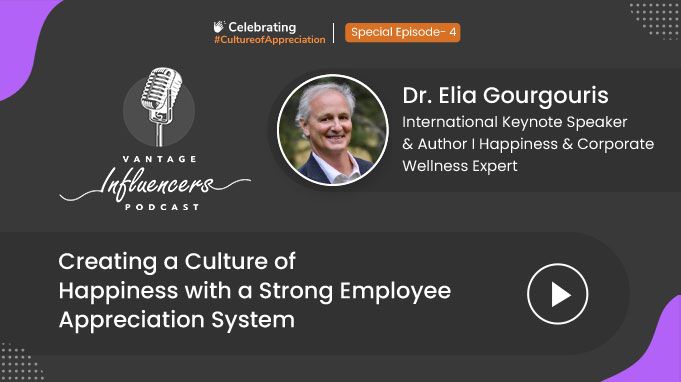
Creating A Culture Of Happiness With A Strong Employee Appreciation System
Episode Overview
Dr. Elia Gourgouris returns for a second conversation, this time framed around Vantage Circle's Employee Appreciation Month. He opens by unpacking a study of 17,000 HR directors across profit, nonprofit, and government organizations, which surfaced five recurring priorities: protecting employees' mental and physical wellbeing, sustaining engagement and productivity, building a workable hybrid work ecosystem, adapting culture to a constantly shifting normal, and protecting people's livelihoods. He argues that appreciation touches nearly every one of these, because happy employees are better teammates, more creative, more productive, and ultimately more profitable for the organizations that employ them.
The conversation gets practical from there. Elia points to research showing that 69% of employees would work harder if they felt genuinely appreciated, then makes the case that appreciation costs almost nothing: a specific, thirty-second comment can do more than an expensive gesture. He connects this to what he calls the Great Resignation, where employees who spent the pandemic reflecting on what matters are leaving jobs where they feel taken for granted, and offers a concrete alternative to the exit interview: a series of "stay interviews" held during onboarding and at set intervals afterward to catch broken promises before an employee walks out the door. He closes by revisiting his "hot communication" framework for leaders checking in on their teams, and by pointing to flexibility, in schedules and hybrid work, as one of the clearest signals of appreciation an organization can offer right now.
Episode Highlights
- A study of 17,000 HR directors found five recurring organizational challenges, with protecting employees' mental and physical wellbeing now ranking first, ahead of productivity and engagement.
- Appreciation is a form of kindness that costs almost nothing. A specific, thirty-second comment naming what someone did well can matter more than a formal reward.
- Research cited in the episode found that 69% of employees would work harder if they felt their efforts were genuinely appreciated.
- The Great Resignation is partly a byproduct of reflection: employees who had time to reconsider what matters during the pandemic are leaving roles where they feel undervalued.
- "Stay interviews," held at onboarding and at set intervals afterward, catch broken promises early instead of waiting for an exit interview that comes too late to fix anything.
- Peer-to-peer appreciation has to start with senior leaders modeling it, paired with "hot communication," honest and transparent check-ins that go beyond a routine "how are you doing."
About the Guest
Dr. Elia Gourgouris, Founder, The Happiness Center
Known as The Happiness Doctor, Dr. Elia Gourgouris is the Founder of The Happiness Center, an organization of world-leading experts in the field of Positive Psychology. He spent the first half of his 35-year career as a clinical psychologist before moving into executive coaching and leadership training and development on the corporate side. He is the number one best-selling author of 7 Paths to Lasting Happiness, translated into five languages, and co-author of Seven Keys to Navigating a Crisis, one of the first books on pandemic resilience to reach the market in May 2020. An international keynote speaker, he has been interviewed on national and international TV and radio and has appeared on over 100 podcasts, and his work with organizations now spans Europe and India as well as the United States.
Host
Susmita Sarma, Vantage Influencers Podcast Host
What You Will Learn
- Why a study of 17,000 HR directors ranks mental and physical wellbeing as organizations' top challenge today
- Why appreciation costs almost nothing, and what a genuine thirty-second comment can accomplish
- What the 69% statistic on effort and appreciation means for how HR should think about recognition
- Why the Great Resignation is pushing companies to rethink what employees actually want from work
- How "stay interviews" work, and why they catch problems that exit interviews always find too late
- How senior leaders can model peer-to-peer appreciation and practice "hot communication" in everyday check-ins
Key Topics & Timestamps
| Timestamp | Topic |
|---|---|
| 00:00 | Cold open: welcoming Dr. Elia back for Vantage Circle's Employee Appreciation Month series |
| 00:58 | Introducing Dr. Elia Gourgouris and The Happiness Center |
| 01:27 | Elia's story: from clinical psychology to corporate wellness, and The Kindest Factor TV show |
| 02:37 | Setting up the topic: creating a culture of happiness through employee appreciation |
| 02:52 | The top 5 HR challenges from a study of 17,000 HR directors |
| 05:14 | Recapping the 5 challenges and how appreciation drives engagement |
| 05:32 | Why happy employees make better teammates, more creative, and more productive |
| 06:36 | The 69% stat: how appreciation links to productivity and satisfaction |
| 07:14 | What appreciation actually costs (almost nothing) and why organizations still skip it |
| 08:23 | Rewards, events, and team building during the Great Resignation |
| 09:58 | Why exit interviews come too late, and what "stay interviews" do instead |
| 14:03 | Encouraging peer-to-peer appreciation, starting from senior leadership |
| 15:05 | Hot communication: checking in on employees the right way |
| 17:07 | Final advice: flexibility, mindfulness, and appreciation in practice |
| 19:29 | Where to find Dr. Elia and closing thoughts |
Full Transcript
Click to read the full episode transcript
Welcome to the Vantage HR Influencers Podcast. This podcast is sponsored by Vantage Circle, the simple and AI-powered rewards and recognition platform for employee engagement.
Hi everyone, and welcome to a brand new episode of the Vantage HR Influencers Podcast. I'm your host, Susmita, and in this episode I'm having a conversation with Dr. Elia Gourgouris, who joined me last year, when we spent a great time discussing the secrets to improve employee happiness and engagement. Today I'm so glad to welcome him back as part of our Employee Appreciation Podcast series, because at Vantage Circle we're celebrating the month of March as Employee Appreciation Month. So if you want to find more appreciation and happiness in your workplace, this episode is for you.
Dr. Elia, known as the Happiness Doctor, is a happiness and corporate wellness expert and the number one best-selling author of 7 Paths to Lasting Happiness, which has been translated into five languages. He is an international keynote speaker and has been interviewed on national and international TV, radio, and over 100 podcasts. Dr. Elia is also the founder of The Happiness Center, an organization of world-leading experts in the field of positive psychology. Let's dig in.
Susmita Sarma: Welcome back, Elia. Great to have you back on the Vantage HR Influencers Podcast.
Elia Gourgouris: Thank you so much.
Susmita Sarma: Okay, so for the audience who are listening to us for the first time today, give us a little story about yourself, and then we'll get started with today's topic.
Elia Gourgouris: My name is Dr. Elia Gourgouris. I'm known as the Happiness Doctor. I spent the first half of my career as a clinical psychologist in private practice, and then switched over to the corporate side, working with senior leaders on leadership training and development and executive coaching. I'm also the number one best-selling author of a book, 7 Paths to Lasting Happiness, which has been translated into five languages. Last year, in the middle of the pandemic, I co-wrote another book called Seven Keys to Navigating a Crisis, a practical guide to emotionally dealing with pandemics and other disasters. I'm an international keynote speaker, so I get to travel the world and speak about corporate wellness, which we'll talk a lot about today, and personal and corporate happiness. And finally, I'm the executive director of a new reality TV show called The Kindest Factor.
Susmita Sarma: Brilliant. So, Elia, coming to the topic, creating a culture of happiness with a strong employee appreciation system: the first and most important question for you, before we get into the happiness piece, what are the top five HR challenges organizations are facing right now?
Elia Gourgouris: It's interesting, and this started at the beginning of the pandemic. This comes from a study of 17,000 HR directors across the globe, spanning profit, nonprofit, governmental agencies, large companies, and small companies. Their consensus has been this. The first challenge is to ensure the mental and physical wellbeing of employees. Mind you, prior to the pandemic this wouldn't even have made the top ten, so it's telling that it's now number one. Number two is maintaining employee engagement, productivity, and effectiveness, which used to be the number one concern for every organization. But you can't get to that until you get the first one right. I feel like organizations, for the most part, have done a decent job ensuring the physical wellbeing of their employees, things like social distancing, working from home, taking the precautions needed to keep their businesses open. But they have really struggled to ensure the mental wellbeing of their employees, which does contribute, especially now, to engagement, productivity, and effectiveness. That's something I talk about across the globe: how do we support mental health in a corporate setting? The third challenge is creating an ecosystem around working from home, this kind of hybrid setup. The workspace has totally changed over the last two years. The fourth is adapting to what people call the new normal, facilitating change, and shaping culture. We'll talk a lot today about shaping a culture of appreciation. I actually don't like the phrase "new normal" because I feel it's overused. When I talk with senior leaders, I talk about the "next normal": what's coming six, twelve, eighteen months down the line, so we can anticipate it and not be surprised. And then the last challenge, especially for employees, is protecting their employment and preserving their livelihood. But anyway, back to appreciation, let's get started.
Susmita Sarma: Right. So you've mentioned the five challenges: ensuring mental health and physical wellbeing for employees, then maintaining employee engagement, creating an ecosystem for the work-from-home setup, adapting to the new normal, and then protecting employment and preserving livelihoods. So the second point, maintaining employee engagement, productivity, and effectiveness: employee appreciation feeds employee engagement, which leads to increased happiness. What are the top benefits of focusing on employee appreciation that you'd like to highlight today?
Elia Gourgouris: Well, first let's talk about employee happiness, because that's a direct result of employee appreciation. What is the benefit of having happy employees in your organization? The benefits are multiple. Number one, they're better teammates, because when people take care of themselves, practice great self-care, and are strong mentally and emotionally, their batteries are full, and they're able to help their teammates because they already have that capacity. So it's sometimes forgotten that happy employees are better teammates. Happy employees are also more creative and more innovative. As a result, they tend to be more productive, and with more productivity and engagement, they're more effective in what they do. In the end that impacts the bottom line and makes the company more profitable. So there's a direct link, step by step, and the outcome is a better-served organization.
Susmita Sarma: Right. So, Elia, I've gone through some research, and there's a statistic that says 69% of employees would work harder if they felt their efforts were appreciated more, and that they'd be even more satisfied if they believed their work was valued. To what extent do you think simple appreciation is linked to workplace productivity and satisfaction?
Elia Gourgouris: I'm glad you asked that question, because it really is that simple. But just because it's simple doesn't mean it's widely practiced throughout organizations. What is appreciation? Appreciation is a form of kindness. What does it cost to appreciate another human being, whether in your personal life or in an organization? Almost nothing, other than the desire to open your mouth and say something nice about somebody else. It doesn't cost any money, and it doesn't really cost a lot of time. What it does mean is that you notice somebody doing good work, and you take that extra thirty seconds or a minute to say, "I really appreciate you working so hard," or "I really appreciate what a good teammate you are," or "I really appreciate that you're always on time," or "when we need something, you show up, and you show up big." I just appreciated somebody in several different ways, and it took less than thirty seconds. That's how easy it is, and yet the benefits are so profound. It baffles me when I go into organizations and see them take shortcuts when it comes to appreciation.
Susmita Sarma: That's really interesting to think about, Elia. So apart from a simple thank you or verbal appreciation, what are your views on events, rewards culture, or team-building activities?
Elia Gourgouris: From what the studies are showing, especially now, as we're living in what isn't quite post-pandemic yet, but we'll get there eventually, the workplace has changed dramatically. Here in the United States, they're calling this the Great Resignation, where people are leaving organizations in droves. Why is that? Because over the last couple of years, having worked from home or in a hybrid setup, people have had time to think about what's truly important in their lives, and what's truly important is relationships. People want to work in an environment where they feel cared for, appreciated, and supported, where there's a sense of belonging, where they matter as an employee regardless of where they sit on the organizational chart. If they feel like they don't matter, or that they're taken for granted, a lot of people are saying they don't need that, and they'll go work somewhere else, or for themselves, or do something different. I see that as a positive thing, actually, because it's grounds-up pressure that's forcing senior leaders to look at their organizational structures and culture, especially once they start losing good talent. And that's unfortunate, because organizations shouldn't have to wait until they lose critically important people before they realize something is wrong and retention has dropped.
So I have a solution to that. Most organizations, when somebody leaves, do an exit interview: HR sits down with them and asks why they're leaving, and so on. But exit interviews are too late, because by the time you get there, your talented employee already has one foot out the door and has found something else. When I work with organizations, I introduce something called stay interviews. A stay interview happens throughout somebody's employment. It starts during onboarding. Within the first week of somebody's new job, you have a stay interview. Another one thirty days in, another at sixty days, and another at ninety days. In those stay interviews, you're having an honest discussion, maybe over lunch, nothing has to be formal, but you're checking the pulse of that new employee: were the things promised to them during onboarding, or when they signed on, actually fulfilled? The worst thing an organization can do is overpromise and underdeliver. We overpromise when we're excited to hire somebody, and then once they're signed and have a desk and a computer, we don't follow up on those promises. When that happens consistently, you eventually end up with an exit interview. So to avoid that, we want stay interviews consistently: one week, thirty days, sixty days, ninety days after hiring somebody. If there's something we missed, or promised and haven't delivered, we should know sooner rather than later and correct it. No organization is perfect, people make mistakes, but we want to be able to address them and listen. Because part of appreciation isn't just verbal, part of appreciating somebody is listening to what's going on in their lives, and then acting on it.
Susmita Sarma: Brilliant. The stay interview you've mentioned, Elia, is something I'm going to bring to my HR team.
Elia Gourgouris: And I'm happy to teach them how to do it. There's a specific way to run stay interviews so they're not intrusive and don't feel like an interrogation. It's more supportive, a form of appreciation, but it's also saying: we made certain promises, and we want to make sure they're being kept, and if they're not, if there's a block somewhere, let us know so we can correct it.
Susmita Sarma: That shows the employee that the company actually walks the talk. Because how often do people get excited to be hired, and then within a week or two think, this isn't what I was promised in the interview, and everyone was smiling and happy to have me then, but now that I'm in the trenches, it feels like they're not walking the talk. People get disillusioned and discouraged, and eventually that ends up as an exit interview, which is too late to fix anything. Organizations rarely act on it once someone has already decided to leave, it just becomes a formality.
Elia Gourgouris: Exactly.
Susmita Sarma: So moving to our next question, Elia. Appreciation is a great method to improve the interaction between employees and managers, and employees also feel that being acknowledged by their managers improves their working relationships, especially peer-to-peer appreciation. It's a genuine way of motivating employees and fosters a culture of support, collaboration, and achievement. How can we encourage employees to acknowledge each other's efforts?
Elia Gourgouris: It has to start from the top. That's why I work with the C-suite, with senior leadership and senior HR directors. We have to show up differently as senior leaders. This is more true now than it's ever been. Over the last couple of years, when the economy shut down and people were working from home instead of coming into the office, HR leaders checked in with their teams over Zoom throughout the week. My message to them is: when you check in with employees to see how they're doing, and you haven't seen them in person for a month or two or three, don't just look at the camera and ask, "how are you doing today?" That's the wrong question, because most people won't be honest, they'll just look at the camera and say "fine," even if that's not true. Instead, lean into the camera, get your face right up to it, and say, "listen, how are you really doing? How's your family? How are your kids? What can I do, what can we do as a company or as HR, to help and support you?" That alone goes a long way. But what goes even further is for senior leaders to show up with vulnerability and authenticity and say, "you know, I've been struggling too." That takes some vulnerability, to be that honest with your employees, to say, "my kids haven't been able to go to school for six months, it's driving my wife and me a little crazy, it's been really hard, I miss being in the office and seeing you all." You can't ask people how they're doing and pretend everything is fine in your own life while asking them to be vulnerable and open with you. That doesn't work anymore. So either we show up as senior leaders with far greater authenticity, vulnerability, honesty, and transparency, what I like to call practicing "hot communication," H-O-T, standing for honest, open, and transparent, or we don't get the results we're looking for. When we practice hot communication, as senior leaders and HR leaders, with all our employees, that's when things really start to change.
Susmita Sarma: Brilliant. That's something very new to me, and I think our listeners will be glad to hear it. So any final suggestions for our listeners, Elia?
Elia Gourgouris: We've been through a lot the last two years as humanity, we've had the pandemic, a mental health crisis, depression, anxiety, and stress at record levels, and a lot of upheaval in the workforce. But one thing I've noticed, even in the midst of it, and I'm an optimist, I believe this too shall pass, even though it's lasted a lot longer than anyone, myself included, thought it would, is that people are living a more mindful life. It's almost as if society paused, which had never happened before, because up until then everyone was working like it was a race. Now people have had time to think, to reflect, and they want to live more mindfully and consciously. That means they want to connect with other people more deeply, not just superficially, and spend more time with the people they love.
A recent study found that one of the greatest signs of appreciation an organization can show its employees is flexibility: flexibility in personal time off, and flexibility in working a hybrid model or from home as much as possible. Companies that allow that tend to have employees who feel genuinely appreciated. Doing business as usual, the way it worked before the pandemic, no longer works. If you're stuck thinking, "I'm not going to change, we were successful before the pandemic, so we'll keep doing it that way," you're sadly mistaken, because organizations stuck in the old ways are falling behind and losing talent left and right. On the other hand, organizations that are flexible and adaptable, that put people first, not just in mission statements but in practice, that show appreciation in a variety of ways and actually listen to what their employees need, are going to be far more successful. They won't just survive this period, they'll thrive in the middle of it.
Susmita Sarma: Thank you for those words, Elia. Finally, how can our listeners reach out to you?
Elia Gourgouris: You can find me through my website, or on LinkedIn, search for Elia Gourgouris, PhD, the Happiness Doctor, and I'd love to connect with you.
Susmita Sarma: It's been a privilege and an honor to have you here, Elia. Thank you so much for being such an amazing guest twice on our platform. I look forward to having you back for many more sessions, and thank you for everything you're doing.
Elia Gourgouris: You're very welcome, my pleasure.
Thanks for listening to the Vantage HR Influencers Podcast. Please subscribe to the Vantage HR Influencers Podcast on Apple Podcasts, Spotify, and our YouTube channel for new episodes.
FAQ
What are the five HR challenges Dr. Elia Gourgouris identifies from his study of 17,000 HR directors?
The five recurring challenges are: ensuring employees' mental and physical wellbeing, maintaining employee engagement and productivity, building a workable hybrid work ecosystem, adapting culture to a constantly shifting normal, and protecting employment and preserving livelihoods. He says the pandemic pushed mental and physical wellbeing to the top of that list for the first time.
Why does Dr. Gourgouris say appreciation costs organizations almost nothing?
He describes appreciation as a form of kindness that requires little more than the willingness to notice good work and say something specific about it. A comment that takes thirty seconds, naming exactly what someone did well, can carry as much weight as a formal reward, yet he says most organizations still take shortcuts on it.
What is a "stay interview," and how is it different from an exit interview?
A stay interview is a recurring check-in held during onboarding and then at set intervals, such as thirty, sixty, and ninety days into a new role, to confirm that promises made during hiring are actually being kept. Dr. Gourgouris argues that exit interviews come too late to fix anything, since by the time an employee is leaving, they have already decided to go.
What does Dr. Gourgouris mean by "hot communication," and why does he say leaders need it?
Hot communication is his term for honest, open, and transparent conversations, where a leader leans in, asks specific and personal questions, and shares their own struggles first rather than settling for a routine "how are you doing." He argues that employees will not be vulnerable with a leader who is not vulnerable with them first.
Related Reading
Also listen on






You might also like
 Employee Recognition
 Humanizing the Workplace Through Recognition
 Employee Recognition
 Scaling Culture Without Losing Its Soul as Recognition Drives Growth Inside and Out
 Employee Recognition