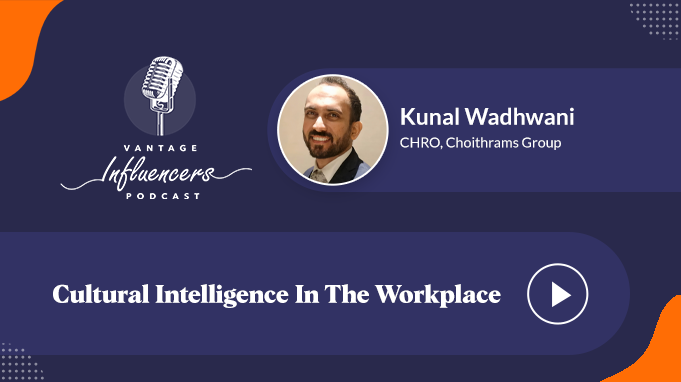
Cultural Intelligence In The Workplace
Episode Overview
Kunal Wadhwani has spent over 13 years at Choithrams Group, a retail and distribution company based in the UAE, where he describes his role as a "cultural transformation specialist" helping the organization move from a family-promoted setup to a modern corporate one. In this episode, he breaks cultural intelligence down into two frameworks: the four foundational principles of human behavior and psychology, and a seven-point personal self-assessment (awareness, knowledge, empathy, adaptability, curiosity, respect, and reflection).
Kunal's core recommendation for HR is deceptively simple: revisit why your organization's corporate values exist in the first place, because most employees, and even leaders, can't answer that question. He backs this with a striking statistic — a World Economic Forum survey of 2,000 global CEOs found 90% believe their organization will cease to exist within 10 years if it doesn't change.
Episode Highlights
- Cultural intelligence rests on four principles of human behavior and psychology: being self-fulfilled, creating harmony in your surroundings, believing in your own ability to do the job, and treating everyone around you as an equal.
- HR professionals can self-assess their cultural intelligence across seven dimensions: awareness of cultural biases, knowledge of others' norms and values, empathy, adaptability in communication style, curiosity, respect for different perspectives, and reflection on cross-cultural experiences.
- Choithrams measures organizational sentiment through a "pulse survey" of roughly 52–55 questions, scored across five factors: respect, trust, fairness, camaraderie, and credibility, then compared department by department.
- Performance appraisal data, including a "Personal Development Areas" (PDA) section signed off jointly by manager and employee, feeds directly into training needs analysis and should be cross-referenced against retention analytics to catch high-engagement, high-attrition mismatches.
- Kunal frames cultural intelligence itself as four components: drive (motivation to engage with different cultures), knowledge (how cultures differ), strategy (making sense of diverse experiences), and action (adapting behavior accordingly).
- A World Economic Forum survey found 90% of 2,000 global CEOs believe their organization will cease to exist within a decade without significant change, which Kunal ties directly to the urgency of generational and cultural inclusivity.
About the Guest
Kunal Wadhwani — CHRO, Choithrams Group
Kunal Wadhwani is CHRO for Choithrams Group, overseeing more than 5,000 employees, with over 20 years of experience linking human capital to business results across aviation, ITES, and BFSI before joining Choithrams. He has led award-winning HR interventions that improved shop floor productivity and brand image, mentored over 6,000 management graduates, and speaks globally at HR forums on leadership, conflict, and stress management.
Connect with Kunal on LinkedIn
Host
Sanjeevani Saikia — Vantage Influencers Podcast Host
What You Will Learn
- Why cultural intelligence is the ability to make sense of unfamiliar cultural contexts and blend in effectively, not expertise in every culture
- The four foundational principles of human behavior and psychology that underlie cultural intelligence
- A seven-point framework for self-assessing your own cultural intelligence: awareness, knowledge, empathy, adaptability, curiosity, respect, and reflection
- How Choithrams uses pulse surveys and performance appraisal data, cross-referenced with retention analytics, to measure organizational sentiment
- Why revisiting the "why" behind your organization's corporate values matters more than reciting what they are
- The four-part model of cultural intelligence in action: drive, knowledge, strategy, and action
Key Topics & Timestamps
| Timestamp | Topic |
|---|---|
| 00:15 | Kunal's corporate journey so far |
| 01:32 | Concise overview of what cultural intelligence entails |
| 03:34 | Role of cultural intelligence in shaping team dynamics |
| 06:11 | Practical recommendations for HR to boost cultural intelligence within teams |
| 10:42 | Metrics and indicators for evaluating cultural intelligence |
| 16:03 | Emerging trends HR should be aware of in the cultural landscape |
| 19:35 | End note |
Full Transcript
Click to read the full episode transcript
Sanjeevani Saikia: Hello everyone, I'm your host Sanjeevani Saikia, and welcome back to another exciting episode of the Vantage Influencers Podcast. In our ever-evolving global landscape, the significance of cultural intelligence in the workplace cannot be overstated. Gone are the days when a narrow understanding of one's own culture sufficed. Today, as organizations expand across borders and cultures, fostering cultural intelligence among employees is paramount for achieving sustained success. It's no longer enough to simply coexist — true organizational excellence hinges on embracing diversity and leveraging cultural insights. To shed light on this vital aspect of modern workplaces, we're honored to have Kunal Wadhwani, CHRO for Choithrams Group. His insights into cultural intelligence promise to provide us with a deeper understanding of this essential topic. So without further ado, let's dive into our conversation with Kunal. Hi Kunal, thank you so much for joining today's conversation.
Kunal Wadhwani: Thank you Sanjeevani, absolutely honored to be a part of this podcast.
Sanjeevani Saikia: Pleasure to have you. Before we dive into today's topic, cultural intelligence in the workplace, I'd love to hear a bit about your professional journey so far — could you walk us through your corporate journey?
Kunal Wadhwani: My name is Kunal Wadhwani and I'm the CHRO of Choithrams Group. I've been associated with Choithrams for over 13 years now — it's been an interesting journey. Overall, I have over two decades of experience, and I've worked across pretty diversified industries. I started in aviation, moved on to ITES, then worked in BFSI, and now I'm with Choithrams, which is primarily a retail and distribution company dealing in consumer goods. It's been an interesting setup because for the last 13 years I've been playing the role of a cultural transformation specialist within Choithrams, where we've been trying to transition from being a very family-promoted organization to becoming the corporate organization we are today. So out and out, it's been an interesting journey, and I look forward to sharing my insights with you as the podcast moves along.
Sanjeevani Saikia: Wonderful, thank you for sharing your journey with us — genuinely appreciated. Kunal, as globalization continues to shape our professional landscapes, understanding and effectively engaging with diverse cultures has become pivotal. With this in mind, I'm eager to explore the significance of cultural intelligence in modern workplaces. Could you offer a concise overview of what cultural intelligence entails, and most importantly, why it's increasingly recognized as a critical skill in today's diverse workplace?
Kunal Wadhwani: This is interesting. Culture is often attributed to a very specific regional location, wherever we generally have a discussion — whether with friends in our personal space or in our organization. When we look at cultural intelligence as a concept, it primarily refers to the skill to relate and work effectively in a culturally diverse situation. It's the capability to cross boundaries and prosper across multiple cultures. It includes the ability to recognize and adapt to cultural differences within your surroundings, and it can give you the confidence to operate successfully across a wide range of settings. Years ago, this would apply mainly to companies with offices in many countries. Today, though — I live in the UAE, in Dubai, and it's so cosmopolitan — it's crucial that we understand our surroundings and stay sensitive to the belief systems around us, because so many nationalities work in one country itself, and more importantly, within your own organization. So when we look at the simple idea of culture, it's primarily the ideas, customs, and social behavior of a particular people or society. From a cultural intelligence perspective, it becomes extremely important to assess and understand the societies around us so that we can belong there.
Sanjeevani Saikia: Of late, we've been noticing how teams nowadays bring together people from diverse cultural backgrounds — multicultural teams have become the norm rather than the exception. Recognizing how cultural intelligence shapes these interactions is crucial for effective team dynamics. Can you share your insights on how cultural intelligence shapes team dynamics and the role it plays in nurturing collaboration and innovation within diverse teams?
Kunal Wadhwani: This is an interesting question because it doesn't have a simple yes-or-no answer, so I may get a bit philosophical here. I believe it's important to understand four primary principles of human beings, across two perspectives — behavior and psychology. Behavior is what people primarily observe as a front-facing concept: anything I do, you observe my behavior. Psychology is very intrinsic — it's what I think. There are two principles for behavior and two for psychology. The two behavioral principles are that I am self-fulfilled, and that I can create harmony in my surroundings. The two psychological principles supporting those are that I have the ability to do the job, and that I will treat everyone around me equally — as a comrade, a team member, a partner. These four simple principles of human behavior and psychology exist alongside the chaos that also exists around us, and one possible reason for that chaos is a lack of sensitivity, or even clarity. I always say half-knowledge is dangerous when it comes to understanding your surroundings, and a lack of know-how about your surroundings can be detrimental to your organization's culture, or even your personal space. That's why the influence of cultural intelligence on team dynamics is so crucial — a lack of sensitivity toward your surroundings, especially in an organizational setup, can take you away from the simple aspects of happiness and harmony among people.
Sanjeevani Saikia: True. As advocates for inclusive workplaces, HR professionals are integral in shaping organizational culture, and enhancing cultural intelligence is one of their priorities. Before we explore strategies, could you share practical recommendations or initiatives HR professionals should focus on to boost cultural intelligence within their teams?
Kunal Wadhwani: It's important that at a self level, we first assess ourselves as individuals. If we aren't confident about a particular topic, we may never be in a position to coach or guide others, or find the right person to assist the organization and its managers. To give you an example, I love traveling, and the last six years have given me a lot of exposure — being in different places, meeting new people, fellow travelers from different countries. I've also tried hypnotherapy as an exercise in the past, and it was an amazing experience. We can't assess our surroundings if we don't have a deeper understanding of self, so it's crucial to first invest time in your own mindset development.
With that said, "how culturally intelligent are you" is the prime question, and to assess it, we need to consider certain aspects. First is awareness — can you recognize differences and similarities across cultures within your setup, and are you aware of your own cultural biases and how they might impact your interactions with people from other cultures? Second is knowledge — do you actively seek to understand the cultural norms, practices, and values of others around you, including both observable aspects like traditions and behaviors, and unobservable ones like belief systems and values? Third is empathy — can you empathize with people from different cultural backgrounds, seeing things from their perspective without judgment? Adaptability is a crucial element too — are you able to adapt your communication style, behaviors, and expectations to different cultural contexts within your organization? I also believe HR people should be curious — having a genuine interest in learning about other cultures, asking questions, and engaging in cross-cultural experiences. It also boils down to respect — whether you show respect for different cultural perspectives and practices even when vastly different from your own, rather than falling into bias. That leads to reflection — do you reflect on your cross-cultural experiences to get deeper insights and improve your interactions with others? And finally, flexibility — are you okay being uncomfortable and not knowing everything? Can you make sense of unfamiliar situations and blend in when you encounter something new?
Net net, I'd recommend HR professionals follow the journey of their own organization's corporate values. This is such a crucial element because many people don't even remember their corporate values. HR people can do so much here — they need to first ask why these corporate values exist in the organization, why these specific values were identified, how people are implementing them, what their thought process is, and most importantly, even though five or six corporate values exist around the organization, we rarely assess what output we expect those values to create. These elements should first be part of your induction training, and then integrated into other training modules as well.
Sanjeevani Saikia: You've touched upon a few really important elements — awareness, knowledge, empathy, adaptability, curiosity, respect, and reflection. In the pursuit of fostering inclusive environments, understanding how to effectively measure and evaluate cultural intelligence becomes pivotal. I understand it's not easy to quantify, but are there any parameters to it? With diversity being a core asset, HR professionals usually strive to gauge impact — could you shed light on how HR professionals can assess the cultural intelligence of individuals or teams, and are there specific metrics or indicators organizations should prioritize?
Kunal Wadhwani: I'll speak about two points regarding what we do specifically at Choithrams, though there could be a much broader perspective in the outside world. First, we run a pulse survey in the organization — globally this could be called an engagement survey or a job satisfaction survey, but we call it a pulse survey, because there are many factors employees give feedback on. When you look at organizations doing really well, they evaluate employee sentiment primarily around five factors: respect, trust, fairness, camaraderie, and credibility. We take these five factors, and within them, a series of around 52 to 55 questions that sum up employee sentiment. We take all the answers and classify them under respect, trust, fairness, camaraderie, and credibility, and analyze how each department performs against the others. It gives a good understanding of how each department rates itself — their relationship with managers, how people feel about the rewards and praise the company gives them, whether they trust what management communicates, whether they respect the organization's ideologies and senior leadership's policies, how they feel among peers (which shows up as camaraderie), and whether they genuinely believe the organization is a great place to work, which establishes credibility. All of this comes out as ratios and percentages, so we can assess which sections of the organization are more or less engaged.
The second aspect is a good performance appraisal system. You can do performance appraisal just to finish it — I could have 10 team members and rate everyone a five out of five, the highest rating — or I can follow proper guidelines, have an appropriate feedback mechanism, and provide unbiased ratings. When you consolidate each department's ratings under those circumstances, you understand what kind of high performers exist in each department, and take action accordingly. So even a performance appraisal system gives you a good benchmark of how people feel in the organization. We also have a section in our performance appraisal called PDA — Personal Development Areas — filled in conjunction with the supervisor. There's a discussion between supervisor and employee about what skills the employee wants to grow in the coming year, and both sign off on it. When HR receives this data across the full bundle of PDAs, it tells us what training needs exist in the organization at that point in time, and programs and benchmarks get incorporated accordingly. I think when you take all of this — the pulse survey data and the performance appraisal data — it should be correlated with retention analytics. It's very crucial to understand how people feel in the organization and whether they want to stay. We associate this data with employee retention analytics because if you have great engagement scores alongside a very high attrition rate, something is wrong in the setup that needs to be evaluated.
Sanjeevani Saikia: Kunal, we're arriving at the end of today's episode. Before we let you go, there's one last thing both our listeners and I would love to know your take on — how do you see the role of cultural intelligence evolving in the future workplace? Are there any emerging trends or considerations HR professionals should be aware of as they navigate the cultural landscape within their organizations?
Kunal Wadhwani: In my humble opinion, I can only state things based on my experience, and it's for people to pick up and see how they can incorporate it in their organization, because every organization's culture is different, or could be different. I believe HR professionals should start treating observation as a daily exercise, beyond routine interventions. As an HR professional, you should ask yourself — am I, at an individual level, culturally intelligent? I was reading a Harvard Business Review piece stating that cultural intelligence is the ability to make sense of unfamiliar contexts and then blend with it — in other words, to function effectively in a culturally diverse situation.
To help HR professionals improve their cultural intelligence journey, they can consider a few components: drive, knowledge, strategy, and action. Drive has a direct correlation with motivation — a person's motivation to learn about and respond to a different culture, and their interest and confidence in functioning effectively in a culturally diverse setting. Knowledge is primarily about cognition — a person's understanding of how cultures are similar and different. The point isn't to be an expert on every culture, but to understand how culture influences behavior, values, and beliefs in your organization. Strategy is about metacognition — how a person makes sense of culturally diverse experiences, and knowledge about cultures enables effective planning and the forming of culturally sensitive strategies as an output. Finally, action is associated with behavior, whether at an individual level as an HR professional, or at the organization's level — a person's capability to adapt their behavior to different cultures, including handling any difficulties that might arise.
Sanjeevani Saikia: True. So we've reached the end of today's podcast. Do you have any message for our listeners? Our listeners would be delighted to hear it, and our audience might want to stay in touch with you beyond this episode — how can they reach out to you?
Kunal Wadhwani: From a message perspective, the global situation is changing right now. HR is no longer the same — it used to be a very transactional domain once upon a time. Global perspectives are evolving, geopolitical aspects are taking charge, the world is becoming a much smaller place, and there are talent shortages that need to be catered to. We bring in people from different regions into our organizations and work with them, so I think the time has come for us to become very inclusive as individuals — once we do that, we'll be in a much better position to understand what our surroundings and our organization really need. I spoke about values — I think we should look at the emphasis on why these values exist in our organization, and organizations that don't emphasize why their values exist will fall back in the race. I've also read a World Economic Forum research piece where 2,000 CEOs globally were interviewed, and 90% of them genuinely believe that if their organization doesn't change, it will cease to exist in the next 10 years. We're working with millennials, we're working with Gen Z, and we need to understand and adapt to all these situations beyond gender, beyond nationality. I think the time has come for HR professionals to look at the concept of generational inclusivity, and that's what will lead us to a better future. So that's my message to HR professionals. Those who wish to stay in touch and reach me, I'm available on LinkedIn — please feel free to connect. I look forward to receiving your questions, or just a hello sometimes, and we can always catch up over a coffee date. Thank you so much.
Sanjeevani Saikia: Wonderful. Thank you so much, Kunal, for joining today's conversation. We truly appreciate it. Thanks a lot.
Kunal Wadhwani: Thank you, Sanjeevani.
FAQ
What is cultural intelligence in the workplace?
Cultural intelligence, according to Kunal Wadhwani, is the ability to make sense of unfamiliar cultural contexts and function effectively within them — the skill to relate and work well in culturally diverse situations, not expertise in every culture.
How can HR professionals assess their own cultural intelligence?
Kunal Wadhwani recommends a seven-point self-assessment: awareness of cultural biases, knowledge of others' norms and values, empathy, adaptability in communication, curiosity about other cultures, respect for different perspectives, and reflection on cross-cultural experiences.
How does Choithrams measure organizational cultural intelligence?
Choithrams runs a "pulse survey" of roughly 52–55 questions scored across five factors — respect, trust, fairness, camaraderie, and credibility — and cross-references this with performance appraisal data and retention analytics to spot mismatches between engagement and attrition.
What is the four-part model of cultural intelligence Kunal Wadhwani describes?
Drive (motivation to engage with different cultures), knowledge (understanding how cultures differ), strategy (making sense of culturally diverse experiences), and action (adapting behavior accordingly).
Related Reading
Also listen on