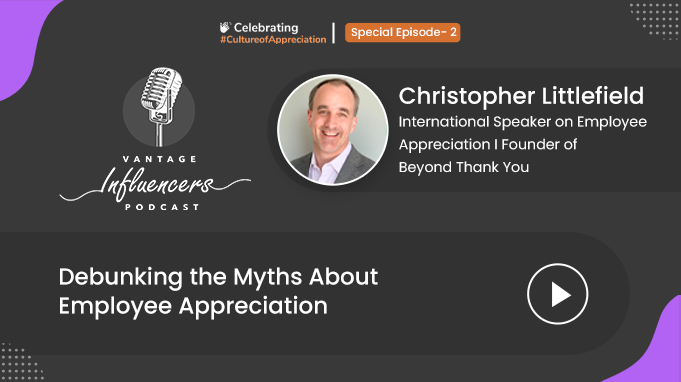
Debunking The Myths About Employee Appreciation
Episode Overview
Christopher Littlefield argues that most employee appreciation programs fail not because organizations do not care, but because they confuse recognition with rewards and awards. He traces the confusion back to a terminology problem in the recognition industry: gift cards, trophies, and other gestures are delivery tools for a message, not the message itself. Drawing on workshops he has run on six continents, he explains that the underlying human need, to be seen for who someone is, what they contribute, and what it takes to do their job each day, stays remarkably consistent across cultures, even as comfort with public recognition varies, from Australia's tall poppy syndrome to the more private preferences he encountered while working in the Middle East and India.
He also draws a line between standard recognition, sharing how someone's actions affected you directly, and what he calls reflective recognition: asking people what they are proud of and then recognizing them for what they share, a practice that works especially well when colleagues cannot see the effort behind each other's day to day work. Littlefield closes with practical guidance for leaders and employees alike, from building what he calls a valued employee mindset to the simple advice that when someone recognizes you, the only response you owe them is a genuine thank you.
Episode Highlights
- Most confusion around employee appreciation comes from a terminology problem: raw rewards and awards are delivery tools for a message, not recognition itself.
- The underlying need for appreciation looks remarkably similar across six continents, even though comfort with public recognition differs, from Australia's tall poppy syndrome to more private preferences in parts of the Middle East and India.
- Appreciation breaks down into three distinct actions: appreciating the person day to day, acknowledging the circumstances they are working under, and recognizing their effort and progress, not just their results.
- The intention behind a gesture matters more than the gesture itself, a generic gift misses the mark while a small, personal one tied to something true about the person can carry real meaning.
- Reflective recognition, asking people what they are proud of and recognizing them for what they share, works especially well when teams cannot see the effort behind each other's work.
- Receiving recognition well is simple: say thank you, and if it meant something, tell the other person so.
About the Guest
Christopher Littlefield, International and TEDx Speaker, Founder of Beyond Thank You
Christopher Littlefield is an International and TEDx Speaker specializing in Employee Appreciation, Recognition, and Workplace Culture, and the founder of Beyond Thank You. Before moving into corporate training and leadership development, he built the first part of his career in international conflict resolution, designing and facilitating dialogues among people affected by protracted conflicts in Israel and Palestine, Northern Ireland, India and Pakistan, and Armenia and Azerbaijan. A falling out with two of his own conflict resolution partners, resolved through a fifteen minute recognition activity, led him to the insight that employee recognition functions as conflict prevention, and he has spent more than a decade since training leaders across six continents in the art of recognition and engagement. He has worked with more than 7,000 managers and employees worldwide, and his clients include Accenture, the Lebanese Postal Service, Boston Medical Center, the Reserve Bank of Australia, Salesforce, the U.S. Army and Air Force, and the United Nations. His work has been featured in New York, Mindful, and British Psychologies magazines, profiled in Harvard Business Review, and he is a regular contributor to Forbes and Harvard Business Review. Christopher is the author of the bestselling book 75+ Team Building Activities for Remote Teams.
Connect with Christopher on LinkedIn
Host
Susmita Sarma, Vantage Influencers Podcast Host
What You Will Learn
- Why raw rewards and awards are not the same thing as recognition, and how to break out of that terminology trap
- How employee appreciation shows up differently across cultures, and what stays constant everywhere Christopher has worked
- How to separate appreciating the person, acknowledging their circumstances, and recognizing their effort and progress into three distinct habits
- Why the intention behind a gesture of appreciation matters more than the gesture's cost or size
- What reflective recognition is, and why it works especially well for remote and hybrid teams
- How the best leaders build a valued employee mindset that treats people's success at work and at home as one job
Key Topics & Timestamps
| Timestamp | Topic |
|---|---|
| 01:24 | Christopher's path from international conflict resolution to founding Beyond Thank You |
| 04:39 | How employee appreciation looks across different countries and cultures |
| 06:17 | The biggest myth: confusing rewards and awards with recognition itself |
| 09:46 | The second myth: checking the box with a gift instead of showing genuine intention |
| 13:01 | Standard recognition versus reflective recognition, and why the latter works well for remote teams |
| 15:16 | Tips for leaders: building a valued employee mindset and a culture of appreciation |
| 17:33 | How to accept appreciation gracefully as an employee |
Full Transcript
Click to read the full episode transcript
Welcome to the Vantage HR Influencers Podcast. This podcast is sponsored by Vantage Circle, the simple and AI-powered rewards and recognition platform for employee engagement. There aren't many companies left that don't believe employee appreciation can help them achieve their goals. However, realizing this fact is only half the battle, because many businesses understand and implement employee appreciation programs in the hopes of achieving the desired results, but only end up failing. What is the possible reason behind that? I personally believe that those companies are still holding on to outdated ideas about the best ways to recognize, engage, and motivate their people. Hi everyone, I'm Sushmita, your host, and in this conversation of the Vantage HR Influencers Podcast, employee appreciation month special series, second episode, we are debunking the myths related to employee appreciation. Please join me in welcoming my guest today, Christopher Littlefield, an international and TEDx speaker specializing in employee appreciation, recognition, and workplace culture, and the founder of Beyond Thank You. Hi, Christopher.
Christopher Littlefield: Hi, Sushmita. How are you today?
Susmita Sarma: I'm fine. How are you, Christopher? Welcome to the show.
Christopher Littlefield: Thanks for having me on today. I'm honored to be here.
Susmita Sarma: Would you like to start by describing your background and your professional journey before we start with the topic today?
Christopher Littlefield: Sure. So right now, what I do is I work with organizations to help them build cultures where people feel valued and appreciated. But before working in corporate training and leadership development, my background was actually in international conflict resolution. I started the first part of my career designing and facilitating dialogues for people around protracted international conflicts: Israel and Palestine, Northern Ireland, a program with folks from India and Pakistan, and a lot of work in Armenia and Azerbaijan. In those programs, we were designing and creating spaces where people could have open dialogue about some of the challenges between their countries, understand the dynamics, and learn to better understand each other.
Then, while running one of those programs, I actually had a huge falling out with my two conflict resolution partners, one from Armenia and one from Azerbaijan. By the end of our program, we could barely be in the room together. It was a real challenge, because here we were, conflict resolution specialists, and we couldn't resolve our own conflict. After a year of tension and frustration, because we had all this funding to keep running these programs together and nothing else worked, it was, funnily enough, a fifteen minute recognition activity that shifted our whole relationship. That one activity, and the power of it, helped us finally see and understand who these co-workers really were, and it shifted my whole relationship to what I was doing. I realized that employee recognition is actually conflict prevention. It's about building and maintaining relationships.
After that, I became obsessed with understanding the role of recognition in the workplace. I went out and interviewed people on the street. I studied why recognition was so important, why we avoid doing it, why we avoid expressing the things that matter to us to others. Out of that came a workshop I developed, and I've now spent over a decade training leaders around the world in the art of recognition and engagement.
Susmita Sarma: So that's how Beyond Thank You came about?
Christopher Littlefield: Yes, exactly.
Susmita Sarma: Would you like to tell us more about it?
Christopher Littlefield: Yeah. So what I do in my organization is first help people update their mindset about what's important and what people really need in the workplace. I then give them new methods they can use to connect with people, and finally leave them with the means, because many times we get these great insights, but then what do we do to follow up? After shifting people's mindset about how they think about connecting with others, I move into giving them new methods they can try and incorporate into their daily work, and then give them the means to do it. I do that through leadership development retreats, keynotes, and virtual workshops. Through the pandemic, I also wrote a book called 75+ Team Building Activities for Remote Teams, to give leaders ways to continue building and maintaining relationships regardless of where people are working and how they're connecting.
Susmita Sarma: Perfect. So Christopher, you've worked with more than 7,000 managers and employees from around the world. How do you see the concept of employee appreciation varying in different countries?
Christopher Littlefield: You know what, it's interesting. I've run my workshops on six different continents, and no matter where I go, it ends up being a very similar conversation. At the heart of the matter, people just want to know that we appreciate who they are, what they contribute, and, most importantly, what it takes to do their job each day and what they're dealing with outside of work. I think that's a commonality. There may be some slight differences in how comfortable people are expressing appreciation. I remember doing a workshop with Salesforce for a team based in India. Beforehand, I interviewed a group of people and asked what recognition looks like there and whether people are comfortable expressing it. They told me people are comfortable expressing appreciation to others, but sometimes less comfortable receiving it in front of others. I heard the same thing working in the Middle East, in Oman, and with teams in Australia. There may be small differences, like in Australia, where they call it tall poppy syndrome. The first time I heard that phrase, I didn't understand it. A tall poppy is a flower: don't grow too high, don't think you're better than others, because if you do, people will tear you down. So people sometimes avoid giving recognition because they don't want that person to stand out and have others make fun of them. There are these little nuances and differences, but at the heart of it, people just want to be appreciated for who they are, what they contribute, and what it takes to do their job.
Susmita Sarma: So organizations have to get creative and redefine their employee appreciation strategies to adapt to constantly evolving situations. Am I right?
Christopher Littlefield: Yes. And I think this is where we need to address the big myth before answering that question. It's a problem that gets perpetuated many times in the employee recognition and reward industry, because we don't have the right terminology to talk about what we're doing. When many people think about appreciation, they collapse it with rewards and awards. But rewards and awards aren't recognition in and of themselves, they're a delivery tool for a message. At the heart of it, people need to know they're appreciated, but how we make people feel appreciated is different. One of the things we need to do to address this myth is recognize that tools and platforms like these play a really critical role and are an important part of employee engagement and our retention strategy. But we need to move away from thinking that's all we need to do. Just like if you've ever bought exercise equipment or a gym membership, owning it doesn't make you fit unless you use it. You've got to get on it and actually do the work.
Over these last two years, with the pandemic and everything going on, we've really seen some organizations trying to organize events, happy hours, and bringing people together, or sending gifts to people, which are nice gestures. But it's just a gesture, it doesn't capture the whole picture. Early in the pandemic, I wrote an article for HBR on how to be an empathetic remote coworker. It was a popular article because it reminded people that what they need right now isn't necessarily the gift. What people need is to know that you understand what they're dealing with each day: what home life is like, whether they're taking care of a sick parent, whether they have kids at home. The best way to appreciate people right now is to show that we understand and value what they're dealing with outside of work, and to do that we need to take the time to ask them. The best managers and leaders right now are constantly staying present to the fact that people have lives outside of work, and that what they're dealing with is always changing, even if my own life and work feels easy that day.
The best managers right now use what I call the one-sixth rule from my book: for every hour of meeting time, one sixth of it, about ten minutes, should go toward relationship building. That can be as simple as starting with a question like, what were you doing five minutes before this meeting? Because when we get on these calls, we have no idea what people are coming from or where they're headed afterward. When you ask that question, people often share that they were just running from another meeting, or taking care of a kid who's also in virtual school, or dropping their kid off somewhere. It triggers the empathy to remember that people have lives going on around the meeting. The best organizations right now hold two things together at the same importance: business results and people results, meaning we're making sure our people have the resources they need to succeed both at work and at home.
Susmita Sarma: So Christopher, apart from the one you mentioned, that employers confuse rewards with appreciation, are there other common misconceptions or myths you want to talk about today?
Christopher Littlefield: Yes. The common mistake I see is that people will give a reward, like a gift card or a gift, and think they've checked the box of expressing their appreciation. The mindset shift people need to make is realizing that rewards and awards are not recognition, they're not. They're a delivery tool for a message and they play an important role, but we need to shift our thinking. When I run my workshops, I explain that we have a terminology problem, and we need to decouple recognition from rewards and awards and break it down into what I see as three things. First, appreciating the person: the day to day actions we do to show people we appreciate them, saying good morning, asking about their family, checking in, seeing if there's anything they need support with, noticing when someone shows up and when they're not there. When somebody sends a report, saying thanks for sending that and giving feedback, checking in, these are the day to day things we do to signal that we appreciate people. Second, acknowledging the circumstances people are working in: thanking someone for coming in when it's extremely hot or cold outside, for doing their work while dealing with everything else going on, for picking up extra work when the team is short staffed. It also means acknowledging it when we're a jerk at work, because if someone yells at another person and nobody says anything about it afterward, it leaves people feeling like nobody really cares. Third, recognizing people's effort and progress, not just the result they produced. People don't want to be recognized only for the result, they want to be recognized for the ups and downs and everything they went through to produce that result, and we often don't see that, so we need to engage with understanding what people are going through and what it takes to do their work. Rewards and awards are a small portion of all this. When it comes to what we can actually do, we need to move away from the myth that a reward or an award is all it takes, that's just the icing on the cake, not the cake itself.
What really matters to people is not necessarily the gift, it's the intention behind the gift. If I just check a box and give someone a generic gift, it can completely miss the mark, like giving someone a nice bottle of alcohol when they don't drink, the gesture means nothing because it shows you didn't know something true about them. But then there can be the smallest thing that means everything: giving someone a little rock or a candle because you know they meditate, and telling them that every time they see it, you want them to remember their contribution to the team, that they're the rock for the team. That can be a free gift and still mean far more.
Susmita Sarma: So clearly, every appreciation has to have some specific value to the person receiving it.
Christopher Littlefield: Yes, exactly. And there are two different types of recognition I train people on. There's specific recognition, where I'm sharing how what you did impacted me directly, like thanking you for preparing and finding the time to understand who I am before we got on this podcast, I really appreciate the preparation because not everybody does that. That's me sharing how what you did impacted me. Then there's what I call reflective recognition, something I created myself, based on the understanding that you and I may work together all the time, but I don't see what you're actually dealing with. You might produce a report or a podcast for me, but I don't see all the work that went into that final product. So I can recognize you for the result you produced, but that doesn't capture everything it took for you to get there. Reflective recognition is asking people, hey, I haven't seen you in a while, what are you proud of, or what do you want to be acknowledged or recognized for, and then asking them to share. As they share, you dig in and ask questions to learn what it took for them to do what they did, and then you recognize them for what they shared. When we practice reflective recognition, we also learn what matters to that other person.
Susmita Sarma: So is reflective recognition, as you mentioned, a better choice in a work from home scenario?
Christopher Littlefield: I mean, honestly, it works everywhere. I've been training people in reflective recognition for about ten years. I've done it with oil workers in Oman, with Reserve Bank of Australia employees in Australia, with social workers in Los Angeles, and with CEOs at a conference in Florida. It doesn't matter who you are, because no matter where we are, whether in person or working remotely, we don't see what people are dealing with. The only way to find out what they're dealing with, and what it took for them to do what they did, is by asking them and listening for what really matters to them.
Susmita Sarma: Great. Would you like to give some tips for the leaders listening to us today?
Christopher Littlefield: I think the biggest tip is to remember what the greatest leaders have in common. I was part of a Best Places to Work stage for several years in the marketing industry, and when I interviewed the CEOs of the top ten companies, there was a commonality among all of them: what I call a valued employee mindset. It's the mindset that my job as a leader is to make sure my employees are successful both at work and at home. By successful at home, I mean creating a work environment that takes into account everything they're dealing with at home and at work, and constantly taking efforts to make sure they have what they need to succeed. That doesn't mean I'm counseling them through a divorce or a relationship issue, but making sure that, for example, if someone has childcare pickups, we account for that, because we want to create a valued employee experience for the people who are doing stellar, extraordinary work and adding real value to the team. We want to move mountains to make sure they have the resources to succeed at work and at home.
So one part is adopting that mindset, that my job is to ensure the success of my people, and to do that I need to understand what they need to succeed. Two is that my job is to constantly be asking people, engaging them, and understanding what they need to succeed, and showing them I value and appreciate who they are by incorporating that into every meeting and every conversation I have, and making sure I take time to get to know my people. And in the end, as senior leaders, the question is what am I doing to nurture a culture of appreciation in my organization, which starts with the conversations we're having with our senior leaders and how much importance we place on nurturing that culture. I'm working with a client right now who keeps asking if we can cut the program from three hours down to one hour, or whether we can just do it in one hour instead of five separate sessions. My answer is: stop cutting things down, and show that you value the importance of this, that it's not a box-checking exercise, but something that's actually built into everything you do.
Susmita Sarma: And for team members, Christopher, most of them get confused after receiving an appreciation. So how should they accept an appreciation, like a compliment from their manager or boss?
Christopher Littlefield: Just say thank you. And if it meant something to you, tell them back. I've done a lot of work on this, and people can check out some of my articles on HBR about giving and receiving compliments at work, it's probably one of my most popular pieces. When it comes down to it, being recognized is very vulnerable, because someone is suddenly showing that they were paying attention and noticed something. Our mind can go to, well, I don't deserve that, or, I don't really do this, why are they recognizing me, there's some hidden intention behind it. There are so many different layers to being recognized, shaped by how we were trained throughout our lives by our parents and everything else, and I can't get into all of that on this podcast. That's why in every program I run, the first part is learning to understand our own hidden relationship to giving and receiving recognition. But at the heart of it, when someone recognizes you, simply say thank you, and if it meant something to you, let them know: say, it was really great to hear that, thank you for noticing. That's all we need to do. It also helps to remember that even if we don't fully agree with the recognition, it's often more about the giver than the receiver. So give them the opportunity to share how they've experienced working with you, because it also gives you insight into how other people see you, which can shift your own perspective about yourself.
Susmita Sarma: Brilliant, I love these insights, Christopher. I hope everything we've discussed today, even though it was a short and crisp conversation, will be of real help to our listeners. So finally, how can listeners reach out to you?
Christopher Littlefield: Wonderful. Feel free to connect with me on LinkedIn, you'll find me as Christopher Littlefield. You can also find me on my website, where there are lots of tools and resources you can download, including a team relationship building assessment and a few other tools. You can also find my book on Amazon, 75+ Team Building Activities for Remote Teams, to build trust and strengthen communication. And the last thing to share is that I have a newsletter called The Nudge that goes out every two weeks with tips, tools, and resources, and you can sign up for that on my site.
Susmita Sarma: Thank you so much for joining me, Christopher, in this special episode of our Employee Appreciation Month series.
Christopher Littlefield: You're welcome. It was great to join you, thanks for having me on.
Thanks for listening to the Vantage HR Influencers Podcast. Please subscribe to our Spotify and YouTube channel for new episodes.
FAQ
What is the biggest myth about employee appreciation?
That rewards and awards are the same thing as recognition. Christopher Littlefield argues that gestures like gift cards and trophies are only a delivery tool for a message, not recognition itself, and organizations that stop at giving a reward have not actually appreciated their people.
Does employee appreciation look different across countries?
The underlying need is the same everywhere, according to Christopher Littlefield, who has run workshops on six continents. People everywhere want to be seen for who they are and what they contribute. What differs is comfort with public recognition, from Australia's tall poppy syndrome to more private preferences he encountered in the Middle East and India.
What is reflective recognition?
Reflective recognition is a practice Christopher Littlefield created that involves asking someone what they are proud of or want to be acknowledged for, then recognizing them for what they share. It works especially well for remote and hybrid teams, since colleagues often cannot see the full effort behind each other's work.
How should someone respond to being recognized at work?
Simply say thank you, according to Christopher Littlefield. If the recognition meant something, tell the other person so. He notes that being recognized can feel vulnerable, but overthinking whether you deserve it defeats the purpose of the gesture.
Related Reading
Also listen on






You might also like
 Employee Recognition
 Humanizing the Workplace Through Recognition
 Employee Recognition
 Scaling Culture Without Losing Its Soul as Recognition Drives Growth Inside and Out
 Employee Recognition