Descriptive HR to Prescriptive HR
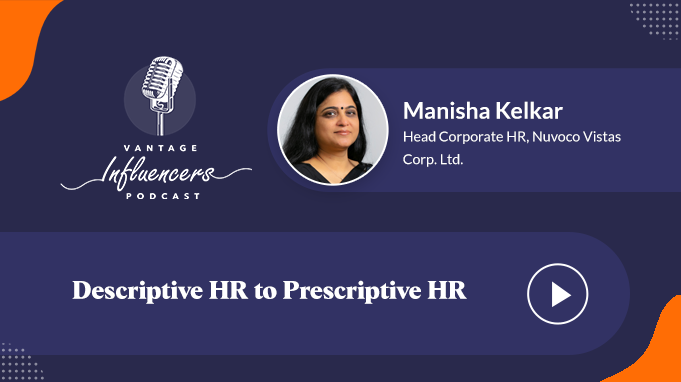
Episode Overview
HR is shifting from looking backward, analyzing what already happened, to looking forward, using data to actively recommend what to do next. In this episode of Vantage Influencers, host Sanjeevani Saikia speaks with Manisha Kelkar, Head of Corporate HR at Nuvoco Vistas Corp. Ltd., about what that shift from descriptive to prescriptive HR actually requires.
Manisha's central argument: prescriptive HR isn't a shortcut around the basics, it's built on top of them. Without disciplined data capture and genuine cross-generational understanding of what people actually want, prescriptive HR has nothing solid to stand on, no matter how advanced the analytics or AI layered over it.
Episode Highlights
- Prescriptive HR requires two things working together: better use of data and technology, and a real understanding of how expectations differ across up to four generations now working side by side.
- Benefit and compensation structures increasingly need to flex by generation, what a Gen Z employee wants from a benefits plan looks nothing like what a Baby Boomer prioritizes.
- Data is the foundation, discipline is the key. Organizations with strong descriptive HR practices (consistent tracking of what's actually happening) are the only ones positioned to move credibly to prescriptive HR.
- A real example: analyzing shifting demographic and benefit-utilization data led Manisha's organization to rebalance its healthcare budget between preventive, physical, and mental well-being investment, and extend vendor contracts based on projected needs two to three years out.
- A costly pitfall: implementing a major HRMS without staying laser-focused on the specific business problem it needs to solve first led to realizing, after major investment, that it couldn't produce the reports actually needed, requiring yet another tool.
- As prescriptive HR and automation take over process-heavy work like hiring, HR's informal roles, coach, mentor, sounding board, are likely to become a more explicit, formalized part of the job, not disappear.
About the Guest
Manisha Kelkar — Head of Corporate HR, Nuvoco Vistas Corp. Ltd.
Manisha Kelkar has over 16 years of experience as an HR generalist across service and manufacturing industries. Over the past seven years, she has held leadership roles as an HR Business Partner and Corporate HR leader, with a track record of building high-performing cultures, developing leadership talent, and implementing employee engagement initiatives that improve morale and productivity. Her core expertise lies in aligning HR strategy tightly with business objectives while continuously improving HR and operational efficiency.
Connect with Manisha on LinkedIn
Host
Sanjeevani Saikia — Vantage Influencers Podcast Host
What You Will Learn
- What actually separates descriptive HR from prescriptive HR beyond the buzzwords
- Why prescriptive HR still depends on disciplined descriptive data practices first
- How to design benefits and career paths that flex across up to four generations in one workforce
- A real example of prescriptive HR reshaping a healthcare and wellness budget
- A costly pitfall to avoid when adopting new HR technology
- How to keep HR human-centered even as data and automation take on more of the work
Key Topics & Timestamps
| Time | Topic |
|---|---|
| 01:52 | Introduction to Manisha and her role at Nuvoco Vistas Corp. Ltd. |
| 02:58 | The difference between descriptive HR and prescriptive HR |
| 07:56 | How prescriptive HR goes beyond identifying trends, with real examples |
| 10:19 | The role data plays in both descriptive and prescriptive HR |
| 12:30 | Common pitfalls HR teams hit moving from descriptive to prescriptive |
| 19:09 | Applying prescriptive HR without losing the human-centered approach |
| 21:36 | Whether prescriptive HR will become the new standard |
Full Transcript
Read the full transcript
Sanjeevani: Welcome to the Vantage HR Influencers Podcast. This podcast is sponsored by Vantage Circle, the simple and AI-powered rewards and recognition platform for employee engagement.
Sanjeevani: HR has always been a vital part of any organization, but the role it plays is evolving. We're witnessing a significant shift from descriptive HR, which focuses on analyzing historical data to understand past performance, to prescriptive HR, which uses advanced analytics to deliver actionable insights and inform future decisions. This transition is more than a trend, I believe it's a strategic move that can revolutionize how organizations manage their people, forecast challenges, and create proactive solutions. To explore this in depth, we're thrilled to have Manisha Kelkar with us today. As Head of Corporate HR at Nuvoco Vistas, Manisha brings extensive experience driving HR strategy, and I'm sure her insights will help us understand how this shift is reshaping talent management and creating more agile, responsive workforces. I'm your host, Sanjeevani Saikia, welcome to yet another episode of the Vantage Influencers Podcast. Let's begin. Hi, Manisha.
Manisha Kelkar: Good morning, Sanjeevani.
Sanjeevani: Good morning, thanks for joining us today. We've got an interesting topic at hand, descriptive HR to prescriptive HR, I'm really looking forward to exploring this with you. Before we dive in, could you walk us through your professional journey so far?
Manisha Kelkar: Sure. I come with almost two decades of experience in human resources across different industries, manufacturing, IT, NBFCs, and now, after a while, back to manufacturing.
Sanjeevani: With your permission, shall we go ahead and dive into today's topic?
Manisha Kelkar: Yes, sure. The distinction between descriptive and prescriptive HR, to me, really comes down to what we do with data and how flexible that makes us in terms of shaping company policy. Descriptive HR focuses on what has already happened, prescriptive HR uses that same data to recommend the best path forward. That's the basic framing, at least.
Sanjeevani: I'd like you to explain in more depth what actually sets the two approaches apart, and why this distinction matters so much right now.
Manisha Kelkar: There are essentially two elements here. One is exactly what you mentioned, how data is used, moving from HR simply looking at past data or doing trend analysis, to actually predicting patterns and helping the organization make proactive decisions and form policy. But there's also a human element tied to how organizations themselves are changing, how entire industries are progressing. We used to talk about a "VUCA world," now it's become even faster and more unpredictable, and that itself creates real challenges for how organizations function. On top of that, HR today has to manage up to four generations in the workplace simultaneously. We talk a lot about Gen Z specifically, but managing all four generations together is the harder, less discussed challenge. So prescriptive HR is really about two things: adapting to technology, and building in far more customization into how we design HR policies and frameworks, especially now that the boundaries between social, personal, and professional life have blurred so much, people even debate whether LinkedIn is a professional network or a social one. People bring all of that complexity into the organization, and a real degree of individual-level customization has become an expectation, not a nice-to-have.
Sanjeevani: You mentioned Gen Z. With so many different generations in the workforce, how can prescriptive HR account for each group's varying needs? Do you think it genuinely has the potential to meet the needs of every generation currently in the workforce?
Manisha Kelkar: It's genuinely difficult. In over two decades in HR, I don't think I've seen any organization fully satisfy every generation's needs, but prescriptive HR is something we'll have to move toward if we want to get closer to that. Take something as basic as compensation and benefits structuring: what a Gen Z employee wants from a benefits plan looks very different from what a Baby Boomer wants. Unless there's real flexibility built in, letting people select what they need at their current life stage and structure their compensation and benefits around that, it won't actually support long-term engagement. Similarly, when we look at how different generations think about career paths and aspirations, Gen Y and Gen Z employees who start in marketing aren't necessarily planning to stay in marketing their whole careers, they're far more open to moving across functions and learning new skills than Baby Boomers or even many Gen X employees tend to be. So career planning and talent management frameworks need built-in flexibility, for people who want to shift and learn continuously, and for people who prefer a more traditional, linear path.
Sanjeevani: As prescriptive HR becomes more integrated into decision-making, how do you see it shaping company policy? Do you have an example of data-driven insight leading to more adaptive or personalized policy, and what impact did you see from it?
Manisha Kelkar: Right now, in the post-pandemic era, a lot of organizations have moved to work-from-home policies, with different rules for different roles, some fully remote, some requiring one, two, or three days in office depending on hierarchy and role. While people work from home or in office, the tools available today to look at how time is actually being spent across different parts of the work throw up a lot of insight, beyond just the software itself, on how to make people more productive, which tasks take the most time, and how roles could be structured differently. There's a real opportunity to build your own data lake across the different tools used across functions, employee engagement data, attendance data, for sales teams their beat-plan and CRM data, and bring all of that together at an organizational level. That kind of combined view gives you genuinely useful insight into what people are struggling with, what skills they need, and importantly, early warning signals.
Sanjeevani: Prescriptive HR gets really interesting once we talk about decision-making specifically, descriptive HR tells you about trends, but prescriptive HR looks ahead and offers real, actionable solutions. Could you shed light on how it goes beyond just identifying trends, with an example of where it's led to actionable insight?
Manisha Kelkar: There are areas like talent management where this shows up clearly, roles that need to change, how to redefine organization or team structure. One concrete example: based on how people were utilizing our current insurance and medical coverage, and looking at how our workforce demographics were shifting over the next two to three years, we, being a manufacturing organization with a strong health and safety focus, ended up changing our entire wellness budget. The balance between preventive healthcare and investment in mental versus physical well-being shifted meaningfully, and we tied up with new vendors on two-to-three-year benefit plan terms as a result. That kind of analysis gives you insight not just for today, but genuinely for planning ahead.
Sanjeevani: I'd like to understand data's role a bit more, how central is it to both descriptive and prescriptive HR, and what's the real difference in how HR teams handle it in each?
Manisha Kelkar: That's a genuinely interesting question, because HR professionals are often criticized for being "too soft," for not bringing concrete value to the table in numbers. I think organizations and teams with a strong foundation in descriptive HR, meaning they've got solid mechanisms in place to track and monitor what's actually happening today, are the only ones who can credibly progress to prescriptive HR. Data is the foundation, discipline is the key. Everyone gets excited about AI, and rightly so, but even people working deeply in AI will tell you data comes first, only once you have real data can you apply different logic, combinations, regression analysis, and project two or three years out. HR teams' own skills and continuous learning matter enormously here too. And it's not just about the HR function itself, since HR ultimately touches every employee's life, not just the people working within the HR department. So when we build any data tool or process, what matters most is awareness and education, especially for people managers, about what we're building, why, what we're tracking, and how it's shared back with them, because it's not only about HR doing its job well, it's about empowering managers to do their jobs well, giving them the right data to understand the specific person in front of them, their background, what they might need, versus someone else on the team with very different tenure or context. That's why data is so central to both descriptive and prescriptive HR, and why making that data genuinely usable and understandable matters just as much as collecting it.
Sanjeevani: Data is the foundation, discipline is the key, that's a real takeaway from that answer. Shifting from descriptive to prescriptive HR sounds like a natural progression, but I doubt it's always smooth. What pitfalls have you seen HR teams run into, whether integrating new technology, aligning teams, or interpreting data, and how should they handle them?
Manisha Kelkar: I can share one example from my own organization. We decided to change how we worked across all functions, including HR, and took on the ambitious task of implementing a single HRMS covering the entire employee lifecycle. One important lesson: when adopting new technology, HR teams need to stay laser-focused on purpose, because everything HR does is ultimately meant to solve a specific problem the business is facing. Whether a given technology will actually solve that problem is the key question, because we invested heavily in that HRMS and eventually realized it couldn't generate the reports we actually needed for our larger purpose, which meant investing in yet another tool and waiting for integration. So staying focused on the actual problem you're solving and the outcome you want, before choosing the technology, matters enormously, alongside skill-building within HR and real awareness for the people outside HR who'll use it. The old PDCA cycle, plan, do, check, act, is genuinely important here too, you can't just implement a piece of technology and forget about it, you need to keep checking whether it's actually meeting the intention or objective you started with, how it's being used, and how satisfied end users actually are.
Sanjeevani: Correct me if I'm wrong, but there's always a risk of losing the human touch when HR relies too heavily on data-driven decisions, we've seen that happen repeatedly elsewhere. How do we use data insight while keeping people genuinely at the center, and how can HR balance the benefits of prescriptive HR with a human-focused approach?
Manisha Kelkar: That's exactly why I opened with those two elements, data and technology adoption on one side, and the human element of shifting expectations on the other. HR is fundamentally a function for people, honestly, even something like engagement work comes down to asking people questions, analyzing their answers, and running activities with them to find real solutions, and that core can't be forgotten. Listening to employees, and not rushing to discard older approaches, matters. We'll have plenty of great platforms that can tell you an employee's mood at the click of a button, but that doesn't mean you stop actually planning or engaging, or that a single day's mood reading tells the whole story, you can't over-rely on it. Don't be in a hurry to discard the old, old isn't automatically bad. Listening remains core to HR, because the people we're trying to solve problems for are the ones who actually give us the real insight into what will help. Some traditional methods that have worked for years will stay relevant even as the nature of work keeps shifting, and I think most of my HR colleagues understand and appreciate that we have to maintain both.
Sanjeevani: Looking ahead, HR analytics is clearly going to grow in importance, and as prescriptive HR gains traction, decision-making itself might change completely, moving toward data-driven decisions as the norm rather than the exception. What's your take on where HR analytics is headed, do you see prescriptive HR becoming the standard, and how might that shape HR's future?
Manisha Kelkar: How far it actually goes in reality depends on how quickly we, as humans, adapt, or honestly, start running alongside the technology, because its pace of change isn't linear anymore. Growing dependence on technology for HR analytics is a given. A lot will depend on how well HR teams themselves learn, since if HR is the custodian of skill-building for the organization, we need to be two steps ahead, understanding what's coming early enough to start building those capabilities in people. A lot of roles that currently take up huge amounts of HR bandwidth, hiring, for instance, will get automated and stop consuming so much time. And other things HR does that we don't traditionally get formally recognized or "paid" for, the informal roles of coach, career mentor, sounding board, will likely start taking up more explicit, formalized time for HR teams as process-driven work gets automated and we focus more on genuinely people-centric work.
Sanjeevani: That's a great takeaway. We've reached the end of today's episode, any final thoughts or a message for our listeners, and how can people stay connected with you afterward?
Manisha Kelkar: I'm on LinkedIn, so reaching out isn't difficult in today's day and age. My final thought, in case anyone assumes only HR people are listening to this: we need to shift gears, genuinely, this is the time to lead from the front, and only when we take that step will organizations be able to pick up the pace. Adopting this used to be optional, today it isn't really a choice anymore. The earlier we adopt, learn, and take steps in this direction, and guide our organizations through it, the better.
Sanjeevani: Thank you so much for being here with us today, Manisha, it was an absolute pleasure having you on the show.
Manisha Kelkar: Thank you so much, Sanjeevani, thanks, bye.
FAQ
What's the actual difference between descriptive and prescriptive HR?
Descriptive HR analyzes historical data to understand what already happened. Prescriptive HR uses that same data to actively recommend the best path forward, moving from monitoring the past to informing future decisions and policy.
Why can't organizations skip straight to prescriptive HR?
Because prescriptive HR depends entirely on a strong descriptive foundation. Without disciplined, consistent data capture about what's actually happening today, there's nothing reliable to build predictive or prescriptive insight on top of.
How should benefits and career paths change across different generations in one workforce?
They need built-in flexibility rather than a single fixed structure. What a Gen Z employee wants from a benefits plan or career path looks very different from a Baby Boomer's priorities, and rigid, one-size-fits-all policies undermine long-term engagement.
How can HR stay human-centered while relying more on data and AI?
By treating data as a tool that supports listening, not a replacement for it. Real-time mood dashboards and analytics are useful, but they shouldn't replace genuine engagement with employees or lead to discarding older, still-effective practices too quickly.
Related Reading
This episode is part of the Vantage Influencers Podcast, where we bring HR thought leaders to discuss engagement, compensation, benefits, and everything related to HR.
Also listen on