Developing A Business-Focused Employee Survey
Episode Overview
Dr. Wayne Brockbank argues that most employee surveys fail before a single question gets written, because HR treats measurement as an off-the-shelf checkbox instead of the same serious discipline finance and marketing bring to their own numbers. In this conversation, he makes the case that measuring human capital is not simpler than measuring finance or customer value, it is often harder, and treating it casually is exactly what makes generic surveys quietly discredit the HR departments that use them.
He lays out a four-step method for building a survey that is genuinely tied to business performance: start with what the company's customers require, translate that into the sources of competitive strategy, translate the strategy into the specific behaviors employees need to show, and only then write survey items around those behaviors. Dr. Brockbank also explains why comparing results to other companies' benchmarks creates no competitive value, why anonymity has to be non-negotiable, and how running behavior questions alongside leadership and HR practice questions in the same survey lets a company see, statistically, which of its own practices are actually driving performance and which ones are quietly working against it.
Episode Highlights
- Off-the-shelf employee surveys use generic language that rarely matches how a specific business actually talks about performance, which quietly undermines HR's credibility.
- A survey built to drive business results starts outside the company, with a clear read on what customers actually require.
- Customer requirements get translated into competitive strategy, then into the specific employee behaviors needed to execute that strategy, and only then into survey questions.
- Comparing survey scores to industry benchmarks feels productive but creates no real competitive advantage, since everyone ends up chasing the same average.
- Running behavior questions alongside questions on leadership and HR practices lets a company statistically link which practices are actually driving, or undermining, the behaviors it wants.
- Anonymity has to be guaranteed and actively protected, since even one perceived breach of trust can quietly shut down honest responses for years.
About the Guest
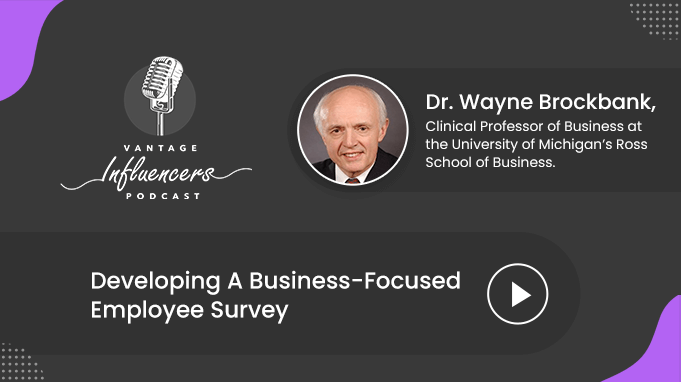
Dr. Wayne Brockbank, Clinical Professor of Business at the University of Michigan's Ross School of Business
Dr. Wayne Brockbank is a Clinical Professor of Business at the University of Michigan's Ross School of Business, where he serves as Co-Director (with Dave Ulrich) and core faculty of the Advanced Human Resource Executive Program. He is also Director of HR Executive programs in Hong Kong, India, Singapore, and the United Arab Emirates, programs that have been rated among the best HR Executive programs in the United States and Europe by the Wall Street Journal, Business Week, and Leadership Excellence for over thirty years. In 2013, he was named one of the top twenty global HR thinkers by HR Most Influential, and he has served on the Board of Directors for the Society of Human Resource Management and the Human Resource Planning Society. His research and consulting focus on the linkages between business strategy and human resource practices, building high-performance corporate cultures, and the key levers that drive business performance, work reflected in seven co-authored books and numerous articles in publications including Harvard Business Review and Human Resource Planning.
Host
Rohit, Vantage Influencers Podcast Host
What You Will Learn
- Why generic, off-the-shelf employee surveys often do more harm than good for HR's credibility
- How to build a survey around what your customers actually require, not industry benchmarks
- The four-step process for turning business strategy into specific, measurable survey questions
- How to decide between frequent spot surveys and a broader, ongoing survey
- Why pairing behavior questions with HR and leadership practice questions reveals which practices are actually working
- Why guaranteeing true anonymity is non-negotiable for getting honest survey responses
Key Topics & Timestamps
| Timestamp | Topic |
|---|---|
| 0:10 | Introduction to Dr. Wayne Brockbank and the episode topic |
| 1:30 | What draws him to human resources as a field |
| 3:07 | What makes a great employee survey for measuring engagement |
| 6:11 | Key considerations before conducting an employee survey |
| 8:23 | The exact parameters to measure in a business-focused survey |
| 16:45 | Frameworks and cadence for running employee surveys |
| 27:08 | Recommended online survey tools and platforms |
| 28:50 | Why employee surveys should be anonymous |
| 31:29 | Favorite business authors |
| 32:58 | HR leaders and organizations worth following |
| 34:36 | Advice for young HR professionals |
Full Transcript
Click to read the full episode transcript
Welcome to the Vantage HR Influencers Podcast. This podcast is sponsored by Vantage Circle, the leading employee benefits and engagement platform.
Rohit: This is Rohit from the Vantage HR Influencers Podcast. We're very excited to have Dr. Wayne Brockbank, who's a Clinical Professor of Business at the University of Michigan's Ross School of Business. Dr. Brockbank is Co-Director and core faculty of the Advanced Human Resource Executive Program, and he'll be sharing his insights today on developing a business-focused employee survey. Over to you, Dr. Brockbank.
Dr. Wayne Brockbank: Thank you very much, I'm honored to be with you. If we were in person, this would be my 128th trip to India, but right now it's only 127 because of COVID-19. I've spent a lot of time in India, and it's been one of the great blessings of my life. So I'm more than happy to be with you, and to speak not only to your Indian colleagues but to your global colleagues who'll be listening to this podcast.
Rohit: It's also interesting that you've made that many trips. How much of that time is related to your teaching versus your consulting work?
Dr. Wayne Brockbank: It's about two-thirds teaching for the university and one-third consulting with some of the leading companies and financial institutions in India.
Rohit: What makes you passionate about human resources, and why?
Dr. Wayne Brockbank: I'm interested in human resource issues for two reasons. One is that we have a huge amount of data through the University of Michigan. We have the largest database in the world on HR professionals, and we haven't just asked what the practices and competencies of HR professionals are. We've asked which of those practices, at the individual and department level, have the greatest impact on business performance, and what that level of impact actually is. So we have data that tell us pretty clearly that HR can have a significant impact on business performance if it's done right. I'm passionate about the potential of collective HR practices to impact business performance, because as business performance improves, employees are better off, leaders are better off, and in my world, even more importantly, customers are better off. My assumption is that organizations don't exist for themselves, they exist to meet the needs of society. We see that in some of India's leading companies. They don't just provide great products and services, they do it with the intent of making the people of India better off.
Rohit: Organizations are exploring new ways, like pulse surveys and people analytics, to measure employee engagement. What do you think makes a great employee survey for a company that wants to understand engagement inside its organization?
Dr. Wayne Brockbank: Let me start with an assumption. Measurement, in many departments, is one of the most sophisticated and intellectually intense activities in that department. We see that clearly in finance, it's heavily a measurement activity, and some of the brightest people in a company focus on how to measure money. The same thing happens in marketing. Some of the brightest people focus on how to measure customer value, and their statistical background and analytics capability are extremely high. Those departments don't rely on off-the-shelf surveys from consultants. They focus their intellectual effort on measuring marketing and financial activities in a way that will impact business performance. So rule number one is that human issues are at least as important, and often more difficult, to measure. This isn't a simple off-the-shelf activity. It's complicated, it's important, and it requires substantial intellectual effort to create and implement surveys that differentiate you from your competitors. If you're using the same surveys everyone else is using, there's no competitive advantage in it. In order for HR to add competitive value, the survey needs to focus on your business, not on comparing your results to other companies. That's fine to do, but it isn't what creates competitive advantage. If your survey results are similar to your competitors', you've created no competitive value.
Rohit: Are there any key considerations HR leaders need to have before conducting an employee survey?
Dr. Wayne Brockbank: Absolutely. The first consideration is deciding what the purpose of the survey is. Is the purpose simply to track people's attitudes toward tactical practices? Do they like their pay? Do they receive the communication and training they need? Do they work in a safe environment? Those are okay questions to ask. You can also ask about employees' mental state, what we'd call satisfaction or engagement surveys. Do they have good experiences at work? Do they have a best friend at work? Would they refer this company to a friend looking for work? That's a second purpose, assessing the mental state of your employees. The third purpose, which is the premise of today's topic, is to assess the extent to which your employees, including leaders, are thinking and behaving in ways that are directly aligned with business performance. You can do tactical questions and mental-state questions and still not focus specifically on the behaviors and thought patterns required for a high-performing organization. My assumption today is that we're focusing on how to develop a survey that results in outcomes directly aligned with business results.
Rohit: What are the exact parameters we should look at when measuring a business-focused survey? Should it all be about numbers, profits, and revenue? I want to understand what exact measurements each company should look at.
Dr. Wayne Brockbank: That's a great question, and it takes us to a fundamental one: what's the purpose of HR? The purpose of HR is to think about, frame, and develop people who are able to beat the competition, because it's only by beating the competition that the workforce secures its own employability. So the purpose of HR is to create a highly productive human side of the business. What do we mean by that? It has two components. We need individual people who can perform, but we also need to make the whole greater than the sum of the parts. That means asking whether HR professionals focus on individual talent or on organizational capability. There's a lot of research showing that most competitive advantage comes from making the whole greater than the sum of the parts, that is, building organizational capability on top of having good people. So part of the measurement challenge is figuring out what organizational capabilities, alongside individual capabilities, are required for a high-performing organization. Now, how do you do that? If the purpose of the survey is to help business leaders understand how people are thinking and behaving in order to perform well, then as you design the survey, you have to start with what defines performance for your company. You can't go to an off-the-shelf survey for that, those are designed to be generic by definition. Let me walk through the four steps required to develop a business-focused survey. The first step is having a clear understanding of what's happening in your external environment. You need to understand what high performance means, and that's dictated by what your customers require. Are they after new products and services? Low cost? On-time delivery? Convenience? High quality? Service? You need a clear understanding of what matters most to them, because you then have to translate that into what behaviors you need from your people to meet those requirements. Those requirements vary company to company, which is why off-the-shelf surveys are questionable. I spoke with a colleague at an Indian company, I won't name it, who told me a few years back that there's probably nothing that discredits an HR department faster than using an off-the-shelf survey. The reason is that off-the-shelf surveys use a vocabulary and logic structure that may not align with the language and logic of your business, including your customer requirements. So the starting point is understanding what your customers require. Then you ask how your people need to think and behave to meet those requirements. The second step, once you understand what customers require, is understanding the firm's strategy: what sources of competitive advantage is your company building to meet those requirements? Innovation? Being first to market? Whatever the customer requires needs to translate into specific strategies and activities for your company, and those need specific metrics attached to them. Say fast innovation is something your company needs to focus on. You'd translate that mandate into metrics like what percentage of revenue comes from products launched in the last year, or how many new products you're putting on the market annually. You need to translate customer requirements into specific business strategies that have metrics attached. That brings us to the third step: how do our people need to think and behave to meet the requirements of a strategy that reflects our customers' requirements? If you're building a business-focused or performance-focused survey, you have to start with the customer, translate that into strategy, and only then ask how people need to think and behave to execute that strategy and win in the marketplace. Finally, once you understand how people need to behave differently in the future than they have in the past, in order to get better results, you can translate those behaviors into specific survey items. Now you've developed a survey that's exactly customized to your strategy and market environment. That's how you build a business and results-focused survey.
Rohit: That's a very well-defined answer on what an HR leader should look at when creating a business-focused employee survey. Once we have the end goal in mind, it becomes easier to know what needs to be measured and how to improve it. But should an HR leader stick to a single framework? Should surveys be weekly, quarterly, or annual? Should they be run function-wise or team-wise? What frameworks should we look at when designing a survey like this?
Dr. Wayne Brockbank: That's a great question. There are two philosophies, and I agree with both, ironically. One is that it's appropriate to run spot surveys, maybe half a dozen questions that get at specific tactical issues arising in the course of business. Those can be run on an as-needed basis, whenever the need arises. When COVID-19 hit, several companies I worked with ran surveys almost immediately, they didn't wait for the end of the year or a monthly cadence. When the need arose, they implemented survey questions that helped them understand how things were progressing from a performance standpoint during the crisis. As a rough guide, I'd think about spot surveys occurring at least once a month, but only when there's a need, not as part of an ongoing, scheduled tracking exercise. Now, having said that, I criticized surveys earlier for sometimes using language that isn't consistent with business logic, but I'm also a firm believer that surveys are one of the most important tools HR departments have to influence culture and behavior. Years ago, a professor at Stanford, one of the brightest people the HR field has produced, pointed out in his research that the greatest impact of a survey isn't acting on the results, though you should act on them. The biggest impact is the questions you ask in the first place. When you send a survey to your entire employee population, it communicates to employees what issues senior leadership cares about, and that shapes how employees think about where the company is headed. So the questions you ask communicate the priorities of your leadership just as much as the results themselves. Once you have a survey like that in place, there are a couple of powerful things you can do. First, assuming you've designed the survey to capture the behaviors your people need to exhibit to achieve company goals, you also want to ask traditional questions about organizational and leadership practices, things like: I understand the mission of my company, I understand my department's objectives, my goals are aligned with my department's goals, I'm rewarded for accomplishing my objectives, my job provides the opportunity to do challenging work, my company's processes enable me to achieve my objectives, I hold myself accountable to people in other departments, I share information with people across departments. There's a whole set of tactical questions like that worth asking. Here's the real value I've seen in a small number of companies where a survey like this becomes the foundation of their HR strategy. Once you have a set of behavior questions and a set of leadership and HR practice questions in the same survey, you can show the statistical relationship between the two. In one recent client I worked with, we found that performance management was being done really well and was positively influencing all the behaviors they wanted. That's terrific news, it's working well, so don't spend resources trying to fix something that isn't broken. The same survey showed that communication from senior leaders was happening at an okay level, but wasn't having much impact, not negative, just mediocre and having mediocre impact. That's something worth paying attention to and improving. And in this company, the reward system wasn't being done well at all, and in some cases, the more attention people paid to it, the more it worked against behaviors the company wanted. This company wanted greater cooperation across departments, but there was a negative correlation between the reward system and how much people shared information across departments. Why? Because people were being rewarded for staying in their silos. The survey surfaced that the reward system wasn't being managed well, and as a result, it was reinforcing exactly the lack of cross-department sharing the company needed to fix to meet its strategy and customer requirements. So the last step in a survey like this is showing, statistically, the relationship between your leadership and HR practices and the behaviors you want, so you know which practices to reinforce and which ones need to change to create and sustain a high-performing organization. That's the comprehensive approach I'd recommend: a survey that drives business performance directly, links employee behavior to business performance, and shows the relationship between HR and leadership practices and those behaviors, so you know whether to reinforce them or change them. I've seen some very good companies in India take this approach, and it's had a great impact on their performance.
Rohit: That's a very insightful breakdown. I also want to understand your thoughts on well known online employee survey tools and platforms. What would you suggest to HR leaders who are looking at using such tools?
Dr. Wayne Brockbank: I think online survey tools are a great idea, there are some great platforms out there that get the work done at low cost. But the content of the survey needs to be customized to the context of your business. Once you get the survey results, someone inside the company usually needs to do the analysis to show the statistical relationship between the desired behaviors the survey captures and the leadership and HR practice areas it also captures. That analysis usually isn't the responsibility of the survey platform itself. Just as finance doesn't rely on a generic tool to interpret its numbers, and marketing doesn't either, HR can rely on these platforms to collect the data, but analyzing it is an intellectual and analytical activity that needs to happen inside the firm, the same way it does in marketing and finance.
Rohit: Employee feedback has to be genuine, not manufactured. Do you think employee surveys should always be truly anonymous, so there's no fear of managers or backlash, especially during a time like COVID when employee morale may already be low?
Dr. Wayne Brockbank: I think that's a really important issue. Yes, they should definitely be anonymous. I touched on consulting a minute ago, but there's an advantage to using external consultants who are flexible enough to design the survey with you based on the principles we discussed earlier. The advantage of using an external survey firm is that it reinforces the perception of anonymity. That said, it's an ongoing issue. A quick, funny story: we ran a survey with a company, and one person was absolutely convinced we knew her individual results. She said she didn't trust us, that we had the ability to know exactly who was responding to what and how. I told her, no, we're using an external firm, the company itself doesn't have access to the raw data, we can't connect responses to individuals, and honestly, we don't care what her specific responses were, what we care about are the responses across the whole organization. She settled down. Later, we wanted to run a focus group with the company to help clarify some of the results in greater depth, so we randomly selected people to be involved. As it turned out, this same woman was randomly selected, and she came to us and said, see, I told you so. So the punchline is that anonymity has to be guaranteed and strongly protected.
Rohit: Do you have any favorite business books?
Dr. Wayne Brockbank: Let me reframe that slightly. It's not so much the books, I look at who's writing them, so I go after authors, not titles. I read my own work sometimes, though that's a bit self-serving, but there are three people I read regularly to stay intellectually informed. One is Dave Ulrich, everyone will know his work. The other two are also well-regarded thinkers whose clarity I value, one in strategy and one in HR. There's also someone in India, a former head of HR at a large Indian bank, who recently wrote a book I found very insightful. There are some very smart people writing today. My approach is to follow authors, not titles.
Rohit: Do you follow any HR leaders or CEOs that you'd recommend our listeners follow?
Dr. Wayne Brockbank: That's a difficult question, because there are many good HR leaders, both globally and in India. But I'd say it's less about individual HR leaders and more about the organizations doing interesting things. Disney continually reinvents itself, so I track Disney closely, and notice I'm not tracking its HR function, I'm tracking the HR practices and the leaders driving them. Other companies I watch include Amazon, TCS in India, Infosys, and several other major Indian companies working hard to stay at the state of the art. Reliance does great work too. Outside India, I think about Amazon, Google, and Microsoft. Microsoft is especially interesting because it continually reinvents itself, it was on the ropes for a while, and now it's reinvented itself. A lot of the executives at these companies come from India, as you well know. There are some really good companies doing great work out there.
Rohit: What's one piece of advice you'd give to young HR leaders trying to build a career in HR, especially those entering this tough environment?
Dr. Wayne Brockbank: That's a great question. I have a couple of pieces of advice. The first is that the core intellectual activity for HR is to continually ask: how do our people, collectively, as an organization, need to think and behave differently in the future than they have in the past, so we get better results going forward? Once you understand that, the next question is what levers you're going to put in place to make sure your people develop those ways of thinking and behaving, ahead of your competitors. That's the fundamental exercise. The second piece of advice, and a really important choice for young HR professionals, is deciding your unit of analysis. Are you focusing on individual people or on the organization? That's a big distinction. If you focus on individual talent, which is kind of the flavor of the month in HR right now, you'll end up majoring in psychology, because you're defining people as individuals, and by definition, you'll make the whole equal to the sum of the parts. But if you focus on organizational capability, and there's significant research showing organizations outperform individuals substantially on this, you'll end up majoring in economics or organizational sociology, studying how organizations function rather than just how individuals function. That decision, individual versus organizational capability, is one of the most fundamental choices a young HR professional will make, and the research suggests the organizational perspective outperforms the individual perspective by a wide margin. That research is laid out in the most recent book Dave Ulrich and I wrote. I originally called it by its former title, but the current title is Victory Through Organization, and the thesis is that HR professionals need to focus on organizational capability in addition to the foundation of individual talent. So those are my two recommendations.
Rohit: Dr. Brockbank, where can people reach out to learn more about your work?
Dr. Wayne Brockbank: I'm at the University of Michigan, and I respond quickly to emails. I'd be delighted to hear from any of your colleagues, to clarify anything I've said or to share additional insights and perspectives.
Rohit: Dr. Brockbank, thank you so much for your time. I know it's very early for you, and I'm really glad we got the chance to speak with you today.
Dr. Wayne Brockbank: Thank you, I really enjoyed the conversation. It's an honor to be with you today, and good luck and godspeed with your important work.
Thanks for listening to the Vantage HR Influencers Podcast. Please subscribe to the Vantage HR Influencers Podcast on Apple Podcasts and Spotify for new episodes.
FAQ
What makes an employee survey "business-focused" instead of just an engagement survey?
A business-focused survey goes beyond tracking attitudes or engagement scores. It is built from the outside in, starting with what your customers require, translating that into competitive strategy, and only then into the specific employee behaviors and survey questions that show whether your people are thinking and acting in ways that drive business performance.
Why does Dr. Wayne Brockbank say off-the-shelf employee surveys can hurt HR's credibility?
Because generic surveys use vocabulary and logic that may not match how a specific business actually talks about its customers and its performance. If your results simply track industry benchmarks, the survey has created no competitive advantage, and Dr. Brockbank notes it can actively discredit the HR department that runs it.
Should employee surveys be anonymous?
Yes. Dr. Brockbank says anonymity should be guaranteed and strongly protected, and that using an external survey firm can help reinforce that perception of anonymity so employees answer honestly.
How often should companies run employee surveys?
Dr. Brockbank recommends a combination: a broader survey tracking behaviors and HR practices on a regular cadence, plus short "spot surveys" of a handful of questions run as needed, whenever a specific issue, like a crisis, calls for fast feedback.
Related Reading
Also listen on