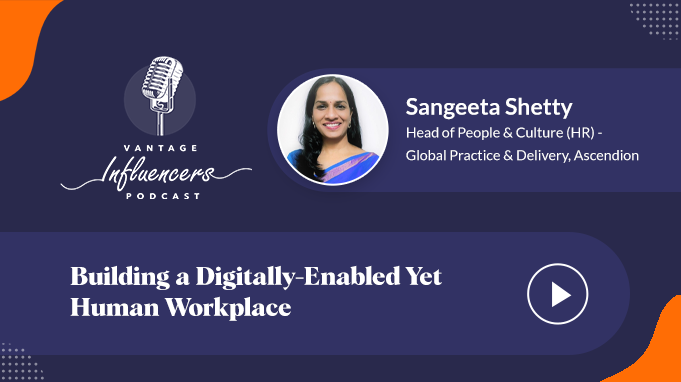
Building a Digitally-Enabled Yet Human Workplace
Episode Overview
Sangeeta Shetty argues that technology works best as a background enabler at work, not the headline act. Comparing the modern workplace to Tony Stark and his AI assistant Jarvis from Iron Man, she describes how tools can handle the noise, the data, and the repetitive tasks, while judgment, empathy, and connection stay firmly in human hands. She carries the same principle into onboarding, where her team automates repetitive steps but keeps fixed leadership touchpoints in place, including a conversation she personally holds with every new hire in their second week, built around their personal passions rather than their job description.
The conversation also digs into why organizations chase trending tools, from AI to VR, without first asking whether the tool solves a real problem for their people, and why Sangeeta prioritizes the need on the ground over copying what a competitor or a "best practice" playbook says to do. She shares how an internal engagement platform helped her team build genuine connection across a globally distributed, largely remote workforce, and closes with a framework for responsible AI: three pillars, transparency, context, and care, because trust with employees is earned by people, not installed by software.
Episode Highlights
- Technology works best as a silent enabler in the background of work, not the face of the employee experience, freeing people to focus on purpose and human connection.
- Even as onboarding becomes faster through automation, leadership keeps fixed touchpoints in place, including a second-week check-in built around a new hire's personal passions rather than their tasks.
- Comparing the modern workplace to Tony Stark and his AI assistant Jarvis, technology can bring speed and precision, but judgment, empathy, and unpredictability stay distinctly human.
- Instead of chasing every trending tool, from AI to VR, leaders should ask what problem their people are actually struggling with before adopting anything new.
- Digital engagement platforms only build real connection when leaders use them to spotlight employees' personal passions and stories, not just push corporate updates.
- Responsible use of workplace data rests on transparency, context, and care, because trust is earned by people checking in with employees, not by software checking on them.
About the Guest
Sangeeta Shetty, Head of People & Culture (HR) – Global Practice & Delivery at Ascendion
Sangeeta brings more than two decades of HR experience across recruitment, HR business partnering, and change management, built at large Indian and global IT services companies as well as early-stage startups. She has spent close to five years at Ascendion, where she leads people and culture for the company's engineering unit, working alongside CEOs and leadership teams to shape culture, co-create values, and drive change that lasts. For Sangeeta, HR is not about policies and processes, it is about building workplaces where people feel valued, connected, and inspired to bring their best selves to work every day.
Connect with Sangeeta on LinkedIn
Host
Sanjeevani Saikia, Vantage Influencers Podcast Host
What You Will Learn
- How to keep technology in a supporting role so it does not crowd out empathy, judgment, and human connection at work
- Practical ways to preserve high-touch moments, like leadership check-ins, even as onboarding and other HR processes become more automated
- How to evaluate whether a new tool like AI or VR is genuinely solving a problem for your people or just following a trend
- Ideas for using digital engagement platforms to surface employees' personal passions and build real belonging, not just broadcast updates
- A framework for using workplace data responsibly, built on transparency, context, and care, so employees feel supported rather than surveilled
- Why lasting workplace culture depends on people and intent, not on any single piece of technology
Key Topics & Timestamps
| Timestamp | Topic |
|---|---|
| 01:19 | Sangeeta's career path across recruitment, HR, and change management on her way to Ascendion |
| 04:14 | Embracing digital tools without losing the human touch at work |
| 10:20 | What a "digitally enabled yet human" workplace looks like in practice, illustrated through Iron Man's Jarvis |
| 15:30 | Why digital transformation should follow real employee needs, not the latest trend |
| 21:10 | Creative ways to build empathy and connection in hybrid and remote teams |
| 27:52 | Using AI and data responsibly while protecting employee trust |
Full Transcript
Click to read the full episode transcript
Welcome to the Vantage HR Influencers Podcast. This podcast is sponsored by Vantage Circle.
Sanjeevani Saikia: Whenever we talk about the future of work, technology almost always takes center stage. AI, data, automation, all of it. But I keep coming back to this one question: if everything becomes digital, then where does the human side of work really fit in? Because at the end of the day, what makes work meaningful is not just the tools that we're using, it's how we feel, how we connect, and most importantly, how we grow as individuals. That's exactly what we're exploring today: how do we build a workplace that's digitally enabled, but still deeply human? I'm Sanjeevani Saikia, and welcome back to another episode of the Vantage Influencers Podcast. Joining me for this conversation is someone who knows this balance inside out: Sangeeta Shetty, Head of People and Culture, Global Practice and Delivery at Ascendion. Hi, Sangeeta, it's a pleasure to have you on the show. Thank you so much for taking the time. Before we dive into the main conversation, I'd love to get to know the person behind the insights. Could you share a bit about your journey and what led you to where you are now?
Sangeeta Shetty: Thank you, Sanjeevani. Thank you so much for having me here on this platform, and for the opportunity to express myself. By now, I'm close to 22-plus years of experience in the domain of HR. I've navigated my path through different portfolios, starting with recruitment, touching different business models, change management, and moving from regional to global portfolios, along with several smaller projects during the course of my career. It has largely been in IT services: large Indian MNCs, global MNCs, small startups, core HR services, which has helped me deal with various facets of people across different dynamics. Of all the experiences I've had, what stays common is the IT and engineering domain, and operating from the grassroots level while growing up the ladder along with the people alongside me. With all of this, what's constant is the urge to make a difference, and that's what has led me to where I am today. I lead people and culture for Ascendion, the engineering unit of Ascendion, and I've been with Ascendion for more than four years now. I'll be completing five years this coming February 2026. It's been a journey of its own kind. I've leveraged and brushed up on all my entrepreneurial skills while putting this together, and I take great pride in being part of Ascendion because of what it is.
Sanjeevani Saikia: Wonderful. Thank you, Sangeeta, for sharing your journey with us. I'm sure it has been incredible for you, and I'm sure our listeners have had a great time getting to know you as well. So, with your permission, I'd like to begin today's conversation on the topic.
Sangeeta Shetty: Sure, please do.
Sanjeevani Saikia: Great. You know, it feels like every part of our workday is touched by digital tools now, whether it's how we collaborate, how we measure performance, or even how we recognize people. And while it's great for efficiency, I think a lot of us quietly wonder at what cost. If everything gets automated or digitized, do we risk losing the warmth and meaning that come from human connection at work? So I'd love to begin by understanding from you, Sangeeta, how can organizations embrace technology without losing that very human touch that makes work meaningful?
Sangeeta Shetty: Yeah, thank you, and well said. That's something we're constantly grappling with, through conversations with peers and colleagues. Whenever you try to get a sense of what's happening around us, all you hear about is AI and technology. In HR, we're constantly navigating between how to balance ourselves with automation and, at the same time, hold on to the authenticity that we as HR representatives bring to the table.
A lot of these digital tools have transformed the way we work, the latest buzz being AI, and everywhere we try to see how AI can make a difference, it often does, sometimes in magical ways. We've seen AI take away a lot of our transactional work. In the Indian context too, we use AI to screen resumes, and there's constant effort across different HR functions to eliminate repetitive tasks and bring AI into performance management, learning and development, and other HR activities. They're genuinely incredible: they bring efficiency, scalability, and data-driven insights that are often more precise than vague perceptions. All in all, it's been a blessing, letting us do more of what we'd like to do instead of getting sucked into repetitive tasks.
But here's where it gets tricky: when we lean too heavily on technology, we risk stripping out the very things that make work feel meaningful. The essence of the work goes away if you lean in completely on technology. For example, in onboarding, we've adapted some digital techniques that are faster and more scalable. But under my leadership, we're very mindful about not missing the touchpoints. There are a lot of repetitive onboarding tasks that AI tools and agents can manage, whether in communication or mapping processes in an automated fashion. But we haven't done away with the human touchpoints: we have 30- and 45-day connects with leadership, which help new hires get a sense of belonging and understand what it has taken for us to build the company. There are floor connects, the manager's mandatory step of connecting with each team member, and HR catching up with the employee. Most important of all, I personally connect with new hires in their second week, and what we discuss there is less about the job and more about the passion they hold, because that's what helps them connect with our culture.
So while we adapt a lot of these automations and technologies, I believe the secret is intent: the intent of people like us, holding these portfolios, to make sure that while we bring in tech to handle repetitive and operational tasks, we don't do away with the things that bring our emotion and keep us relatable to the people on the ground. At the end of the day, people stay for the culture, the people, and the purpose, and that cannot be brought in by technology. That will always require the human touch.
Sanjeevani Saikia: Yes, absolutely. I think, Sangeeta, you've highlighted a very important point, that there has to be intent behind the use of technology, but it shouldn't take away the human side of it. And at the end of it, you've again mentioned the significance of culture. These are some really incredible points. Building on that, when people talk about a digitally enabled workplace, it sometimes feels like a vague vision statement, an overused, mostly abused word. But in reality, what does that balance look like day to day? How do the tools, the workflows, and people actually interact in a way that feels smart, digitally driven, and human centered? So how does it look in practice?
Sangeeta Shetty: For me, when we talk about culture, when we talk about people, it reflects in the smell of the place: what we're putting in, what ingredients we're putting together. And when I say smell of the place, it sounds human, doesn't it? So we wouldn't want to take away that part of our existence.
How I look at it is, we can't undermine the importance of technology. We're all experiencing its blessings in some way, personally and professionally, in every facet of life. You don't need to be tech-savvy to be experiencing all of that; it's building on all of us. However, the way I see it, a workplace where technology acts as a silent enabler, always present, but not the face of it, working in the background and helping us focus on people and purpose.
This reminds me of Iron Man, where Tony Stark uses his AI assistant, Jarvis, which manages the armor, performs checks, provides real-time battlefield support, and even guides him on business ventures and scientific experiments. Jarvis serves as a voice interface for Tony's advanced suits. But at the heart of every decision Tony makes is Tony himself: an individual who is flawed, emotional, unpredictable, deeply human, prone to arrogance, vulnerable, and full of intense emotional experiences.
That's exactly how I see workplaces. We're building our own versions of Jarvis: technologies that sort resumes, tools that give us speed, precision, and scale we couldn't have imagined before. They amaze each of us. But we cannot remove the human from the equation. If we hand over too much, we lose the essence of what the HR portfolio is really about. So let AI and automation handle the noise so we can focus on purpose. Let digital tools process the data so we can hold real conversations with people. Let technology handle the complexity so we can be a little more compassionate, and lead with that. In a nutshell, we'll have these high-tech suits, just like Jarvis, but it's still the human side that saves the day. The relationship between Tony and Jarvis underscores the distinction I look at when I think about the workplace: technology will still be an enabler, but it shouldn't eat up a complete part of us.
Sanjeevani Saikia: I think you've explained this part with a very good example, something we can all understand and relate to. So Sangeeta, something else I've noticed is that companies often chase whatever is trending in tech, whether that's AI, VR, or the next big platform. And sometimes it feels like these changes are more about keeping up appearances than genuinely helping employees. So how do leaders slow down and ask, is this tool really serving our people, or is it just adding to the noise?
Sangeeta Shetty: My approach, while building pieces together at Ascendion, has been to look at what the objective is that we're trying to meet. When we started, having come from a large IT setup and seen what was available there, it would have been easy to get carried away chasing best practices and just copying them. Instead, the approach I've always taken, and which I feel works well, is to ask what the need is on the ground, and to prioritize action toward that need rather than follow the trend or join the bandwagon. That's been the secret sauce for so many things we've built at Ascendion, and it's exactly my approach to digital transformation.
We're a company powered by AI; that's our offering to clients. So it's natural for us to fall into the trap of adopting everything just to appear to be part of a category. What I'd suggest companies look at instead is that there will always be several new things coming, and there's no shortage of what can come in, but what's required is to focus on the priority: what are your people actually struggling with? Is it onboarding inconsistency? Is feedback delayed? Is learning hard to access? What stage of growth is your company in, and what's your business model?
I recall a time when we tried to follow a VR approach to give people a glimpse of our organization. It takes a while to build, and eventually we stepped back and asked whether that was worth the investment of time and effort for a growing setup like ours. We chose instead to focus on the experience. The key is, in the process of meeting the business case, not to ignore the human case. A chatbot may save hours in service, but it may not reflect our culture in the way it speaks. So we don't hand things over completely to the chatbot; we keep a flavor of what it means to be part of Ascendion in it. In my view, numbers alone, how many technologies or AI interventions you've adopted, can't be the measure. The real question is whether it's meeting the purpose and elevating the experience. Experience matters, not digitizing for the sake of appearing modern, but digitizing to be more human at scale, for a company our size. As we grow, the constant effort is to automate while strengthening relationships, empowering people, and simplifying work, so the people who came together to make a difference can do more of that, instead of getting stuck in processes.
Sanjeevani Saikia: Agreed. So I'd like to talk about connection here, since we've discussed digital enablement and also the human side of it. In a hybrid or remote setup, most of our interactions happen through screens. And honestly, while tools like Slack or Zoom keep us connected, somewhere I feel they don't really make us feel connected. But I've also seen organizations experiment with creative ways to use these platforms to build empathy and a sense of belonging. So what are some creative ways organizations can use digital platforms to build that real human connection and empathy?
Sangeeta Shetty: We'll do that, thanks for asking this question. It reminds me of an interesting part of my early days building at Ascendion. I came from a large setup that was equipped with all the tools needed to create engagement and connection. But interestingly, when I joined Ascendion, we were at the peak of Covid, five years back, and the rules of the game were the same for everybody. Irrespective of the fancy offices companies had, everyone had to rely on Zoom or Teams to feel connected, just as your question suggests.
Technology helps with how we connect, the channel, but the real magic is the intent behind it. A lot of these pieces come together: we talked about different technology tools for automation, but it's the small connects from leadership, HR emphasizing individuals' passions, that make the difference. After joining Ascendion, we've been leveraging an internal engagement platform to build that connection, and honestly, compared to nearly 20 years of experience in physical workplace settings, I don't think I would have built as many connections as I did through that platform in such a short time, especially spread globally the way we are.
The reason this works is that, as a company, we believe in the concept of "complete you": we don't limit ourselves to seeing an individual only from a work standpoint. That shows up in how our leaders speak, taking a keen interest in an individual, emphasizing their passions rather than discarding them from the conversation. As we walked that path, we brought a lot of people's personal stories to life on that platform: what they do on their own time, their travel stories, their hobbies. These topics require no knowledge of technology; they instantly create connection.
That internal platform is just one example. Across the other tools we've brought in, we've made sure people understand the intent behind them, and when they understand the intent, they feel more connected. There are other interventions too, like a feedback tool that helps people share their "inner voice" with managers. We've blended the technology, giving us a dashboard view we'd otherwise have built through manual work, but the guiding principle behind it is what we've made the real effort to emphasize. Technology will stay, but the values and thinking you bring along matter far more. With the time we've saved from manual, one-on-one check-ins through automation and dashboards, we've used that same time to focus more on culture and on strengthening the relationship between manager and team member. So it's about how wisely we play and leverage technology so we can do more of what we're actually meant to do.
Sanjeevani Saikia: That did help. I think you've lucidly explained this once again. We're reaching the end of today's episode, Sangeeta. So, to round this all off, there's one area I cannot not bring up, and that's data and AI. They give leaders so much power to understand their people, spotting early signs of burnout or identifying where teams need support. But at the same time, if employees feel like the technology is crossing into surveillance, trust can disappear, and it can disappear fast. And once that trust is gone, no shiny tool can really bring it back. So Sangeeta, help me understand how companies can leverage these tools responsibly while still keeping employee trust intact.
Sangeeta Shetty: Thank you, Sanjeevani. That quickly gave me a flashback to a workshop we've been running to build an agentic mindset among our delivery leaders, because there's a symbiosis between AI and the human workforce that we all have to operate within. There's an effort where I, along with business leaders, work to help people adapt to this mindset in a structured way. The term that comes up repeatedly through all of it is ethical responsibility.
As a service provider to clients, using different agents or AI tools, we've made it a careful, common effort to establish that while the possibility is immense, some of these guardrails are an important part of the offering. Likewise, as people and culture for us, the guardrail is this: our data can help us uncover trends, identify risk, and improve experiences, but the moment we, as custodians of trust, use those insights without empathy or context, we risk shifting the perception people have of us, from being seen as support to being seen as checking on them.
I remember one of our leaders saying, since he'd had experience at other companies that installed tools to check on people's break timings and productivity, very consciously: "I don't check on people, I check in with people on how they're doing." That stays true for everything we do with automation, technology, or AI tools we adopt. Responsible AI, I feel, is built on three pillars: transparency, context, and care. So especially in the HR fraternity, we shouldn't get buried in policy, but stay open and keep the conversation ongoing, so people don't feel like data is being used on them, but that it's being used for them. That's a critical reminder for all of us, because trust can't be built by software. It has to be earned, over time, by people, and HR happens to be at the forefront of that job.
Sanjeevani Saikia: Well said, again. And your colleague also said something very good, that he doesn't like to check on people, but check in with them. That's again a great takeaway. Also, you've mentioned the three pillars: transparency, context, and care. Thank you so much, I had a wonderful time in this podcast with you. We've discussed something that is very crucial in today's time. We've reached the end of today's episode, so Sangeeta, do you have any final message for our listeners? I'm sure our listeners would be delighted to hear it from you. Also, kindly let them know the best way to reach out to you, because I'm sure post this podcast, they'd love to stay connected with you.
Sangeeta Shetty: So, one message for all of us, as a reminder: AI must certainly help us build smarter systems, but we have a very important job to build stronger relationships. That's the summary of everything I've spoken about. Stay connected with me, look for Sangeeta Shetty, you'll find me there.
Sanjeevani Saikia: Great, thank you, Sangeeta. Thank you once again for joining in, and thanks for giving us your time. Do stay connected.
Sangeeta Shetty: Thank you. I enjoyed the conversation too. I hope my perspectives do add value to the overall objective. Thank you.
Thanks for listening to the Vantage HR Influencers podcast. Please do subscribe to the Vantage HR Influencers podcast YouTube channel for new episodes.
FAQ
What does a "digitally enabled yet human" workplace actually look like?
Sangeeta Shetty describes technology as a silent enabler that handles noise, data, and repetitive tasks in the background, while people keep ownership of empathy, judgment, and relationships in the foreground. She uses Tony Stark and his AI assistant Jarvis from Iron Man as an illustration: the technology is powerful, but it's the flawed, emotional, deeply human person at the center who makes the decisions that actually matter.
How can HR teams adopt AI without losing the human side of their work?
Sangeeta's answer centers on intent rather than the tool itself. Her team lets automation handle repetitive onboarding tasks, but keeps fixed human touchpoints in place, including 30- and 45-day leadership connects and a personal second-week conversation she holds with every new hire about their passions rather than their job. The goal is to bring in tech for operational work without losing what keeps HR relatable to people on the ground.
How should leaders decide whether a new HR technology trend is worth adopting?
Rather than chasing whatever is trending, whether AI, VR, or the next platform, Sangeeta asks what the actual need on the ground is and prioritizes that over copying a competitor's playbook. She gives a concrete example of stepping back from a VR initiative once her team realized it wasn't the best use of time and effort for their stage of growth, choosing to focus on employee experience instead.
What are the three pillars of responsible AI use in HR, according to Sangeeta Shetty?
Sangeeta names transparency, context, and care as the three pillars of responsible AI. She illustrates the point with a colleague's line about checking in with people rather than checking on them, and argues that trust cannot be built by software. It has to be earned over time by people, with HR at the forefront of that work.
Related Reading
Also listen on