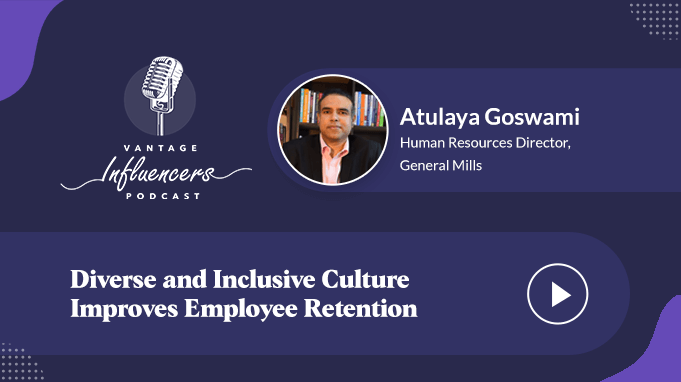
Diverse And Inclusive Culture Improves Employee Retention
Episode Overview
Atulaya Goswami argues that employee retention has been misunderstood for years. Companies chase tenure numbers, celebrating employees who stay five, ten, or fifteen years, without asking whether those years were actually productive. In this conversation, he reframes retention around a simpler question: is the person still delivering value, or just occupying a seat? That distinction, he says, is what separates organizations that build real engagement from those that merely manage their attrition numbers on paper.
He also pushes back on the phrase "the great resignation," calling it instead the great reshuffle, a pandemic-triggered reset in how employees weigh flexibility, purpose, and belonging at work. From there, the conversation moves into why diversity and inclusion sit at the center of that reset. He explains that a genuinely inclusive culture does more than satisfy a compliance checklist. It signals to employees, especially those who bring different perspectives to the table, that they are wanted for that difference, not merely tolerated. That signal, more than any single policy, is what keeps people choosing to stay.
Episode Highlights
- Atulaya reframes retention as continuity tied to productivity, not just tenure: staying ten years means little without real engagement and results.
- He calls the mass exodus of talent "the great reshuffle" rather than "the great resignation," tracing it to pandemic-driven shifts in priorities around flexibility and work-life balance.
- Culture, in his view, is the single biggest lever for retention because it defines an organization's purpose and values, and no two company cultures are ever identical.
- Diversity and inclusion improve retention by bringing in employees who genuinely represent an organization's consumers, countering the instinct to hire people who think alike.
- He cites data linking stronger diversity and inclusion to higher profitability, stronger engagement, and status as an employer of choice.
- Across generations, from Gen Z to baby boomers, he sees the same core expectations: respect, meaningful work, good managers, and increasingly, flexibility.
About the Guest
Atulaya Goswami, Human Resources Director, General Mills (Global India Center)
Atulaya Goswami has spent close to 17 years in HR, currently serving as Human Resources Director at General Mills, where he sets and delivers local talent, organization, and culture priorities across the Global India Center, along with strategy, harmonization, governance, and execution of operational site HR plans across the broader General Mills India business. Before joining General Mills, he built a track record of high-impact HR work across startups, and in sales and marketing, commercial, and supply chain business-partnering roles. Outside of his day job, he is an active LinkedIn voice with close to 29,000 followers, mentors young HR professionals and B-school students, and runs a YouTube channel called HR Shorts with Atulaya. He is also a fitness enthusiast.
Connect with Atulaya on LinkedIn
Host
Gautam, Vantage Influencers Podcast Host
What You Will Learn
- How to define employee retention using continuity and productivity rather than raw tenure.
- Why Atulaya prefers the term "the great reshuffle" over "the great resignation."
- How company culture and flexibility work together to influence whether employees stay.
- Why diversity and inclusion strengthen retention beyond compliance or headline diversity numbers.
- What the data suggests about the link between diversity, profitability, and employer brand.
- How expectations around respect, meaningful work, and flexibility compare across generations.
Key Topics & Timestamps
| Timestamp | Topic |
|---|---|
| 02:55 | Atulaya's HR journey and background |
| 05:00 | Defining employee retention: continuity vs. productivity |
| 10:46 | The "great resignation" vs. the "great reshuffle" |
| 15:00 | How company culture and employee retention are connected |
| 18:27 | Why a diverse and inclusive workplace culture improves retention |
| 21:50 | The business benefits of diversity and inclusion |
| 28:05 | Atulaya's closing thoughts on retention and inclusive culture |
| 31:55 | How to connect with Atulaya Goswami |
Full Transcript
Click to read the full episode transcript
Welcome to the Vantage HR Influencers Podcast. This podcast is sponsored by Vantage Circle, the simple and AI-powered rewards and recognition platform for employee engagement.
Hiring the right talent is difficult enough, but retaining them is a whole new challenge. One of the first signs of an employee on the verge of leaving a job is disengagement. Creating a highly productive and engaged workplace begins with competent employee retention strategies. Companies with a diverse and inclusive outlook have a reduced employee turnover rate and a relatively higher employee retention rate. Naturally, job seekers and employees are more likely to stay in an organization with a history of practicing diversity and inclusion. When your employees feel included, they tend to last longer and give their best. In today's episode, we will learn everything about enhancing employee retention with a diverse and inclusive outlook.
Gautam: Hello listeners. Welcome back to Vantage HR Influencers Podcast. I am your host, Gautam. As you all know, I mostly focus on company culture and diversity and inclusion in the workplace. Today, we will discuss an important aspect of organizational growth which is employee retention, and how we can improve it by nurturing diverse and inclusive company culture. To give us more insights on this topic, we have with us Atulaya. The Human Resources Director at General Mills, Atulaya Goswami is accountable for setting and delivering local talent, organization, and cultural priorities across Global India Center. He also has accountability for the strategy, harmonization, ongoing governance, and execution of operational site HR plans across broader General Mills India. With over a decade of experience, Atulaya has a proven track record of high impact results in various HR assignments, across startups, sales and marketing, commercial, and supply chain business partnering roles. A fitness enthusiast and YouTuber, Atulaya is joining us in this episode to talk about how a diverse and inclusive company culture enhances employee retention. Hello, Atulaya. Welcome to the show.
Atulaya Goswami: Hi, Gautam. It's a pleasure to be a part of this podcast, and that too on a Saturday morning, so it's a fresh start and I'm a very passionate HR professional, so I look forward to the discussion.
Gautam: Yeah, I think beginning this session on a Saturday, I think is quite refreshing for the weekend to start.
Atulaya Goswami: Absolutely.
Gautam: I'm definitely delighted to have you with us today, and we shall begin the podcast with a brief introduction about yourself. Maybe something that I might have missed mentioning about you is what our listeners might want to know about yourself.
Atulaya Goswami: Sure. I actually come with almost like 17 years of experience in HR, and what the listeners would know is that when I started my career in HR, primarily it started off as a job, because typically when you start your career, you don't really know so much about the subject back in those days. It was more about the management degree, and as I got into this specialization, I actually started learning it and started enjoying it a lot. Over the years, when you live in a city, it grows on you, so HR grew on me, and today what I can say is that if you wake me up at 3 AM in the morning and talk to me about the subject, this is something which I sleep, eat, drink. I just love my subject, and that is what also got me into being pretty active on LinkedIn. I follow a lot of people. I have almost like about 29,000 followers who are connected with me, so I find that platform very relevant for sharing material on HR, sharing about the key contemporary topics in HR, and also learning a lot about human resources. So that's another platform where I'm very active, and I love to interact with young students. I've been mentoring a lot of students in the HR domain who've just joined the B-schools, or young HR professionals who've just passed out from college. So I play that role as well, formally and informally, working with some institutes and also at a personal level. So it's been a very exciting journey, and I just love what I do.
Gautam: Thank you, thank you, Atulaya, so much for letting our listeners know about your achievements and what you are all about. I think we are extremely delighted to have such a dignitary with us today who can enlighten us about employee retention. I think you said before the conversation that employee retention and diversity and inclusion is quite close to your heart. So, how would you define employee retention as per your knowledge, or as per your segregation? So how would you define it?
Atulaya Goswami: So employee retention, as the word goes, is more about finding probably the right people who fit, and I use the word cultural fit here. So people who actually associate with the values of your company, and these are like core ingredients, right? So people who probably think the way your values are formulated doesn't necessarily mean that people who think like you, because there's a difference, right? So values are core to the company. So people who are pretty similar in terms of thinking from a value-based perspective, but who bring different perspectives. You don't want people who are your clones. You want people who bring different ideas to the table. So a combination of these two things is what you get into the organization. And then how do you work around the entire employee life cycle? So think about a person from a pre-onboarding stage or selection stage to the entire cycle of whatever life they spend in the organization, for the next five years, two years, ten years, fifteen years, depending on the degree or the length of the life cycle, the employee experience that you provide to these employees is something which becomes very prominent. So that employee experience is actually the key determinant of whether a person is actually going to have a continuity with a lot of productivity. So I think these are the two words which we need to remember. It's not about retention for the sake of retention, right? It's continuity for the sake of productivity. If I work for three years and I deliver 6x, that's highly productive and that's valuable retention. But if I work for ten years and I deliver 5x, that doesn't help, right? Or I just spend my time, but I'm not really having that psychological contract with the company or not really driving productivity, that retention is not worth it, right? So it's more about getting the people who fit the purpose and the values, who think differently, and who are given a wonderful employee experience which actually drives that psychological contract and makes them stay in the organization. So that would be my definition of retention.
Gautam: Thank you, thank you. So when you say that culture fit, I think, and you say that there needs to be a mix of perspective as well. So I think what we need to accept is with culture fit, we need to add culture add as well. The term culture, that yes, you do fit with our organizational values and you're allying yourself with it, but at the same time, never lose out on your individuality. That is your own identity. And that is what we must focus on in promoting a good company culture. Do you agree on that?
Atulaya Goswami: Oh, absolutely, absolutely. And today, the word is flexibility. Let's face it. So in today's era, if you talk about the post-pandemic world, future of work, reimagining work, reimagining HR, every organization has at least one employee, or probably most of the employees, who want flexibility. And flexibility is a very broad term, and HR and the leadership really have to crack the word flexibility and understand what it means for each individual. And that is going to be your driving force for retention. Now, coming back to your question, individual thoughts, individual ability to express themselves, and that expression is also expressing different ideas, right? It's also expressing my individual strengths on the table. So while I align with the values and the culture, do I get the space to speak my mind? Do I get the space to feel empowered? Do I have the ability to do something which I'm great at? And companies are trying to do it in different ways, right? So you have examples of companies who today, and these are slightly controversial topics, but you have examples, so you have companies who actually allow moonlighting, where you can take on gig assignments or work in different areas. So today, in the morning, you might be an HR manager. By noon, you are operating as a coach. By evening, you are a content creator. And by night, while you sleep, you may be doing something else, right? So this is a simple example of some companies dabbling around with moonlighting. There could be, but this is slightly controversial because a lot of times companies have a contract where you don't get to do these assignments, but then think about the gig economy. Today, a lot of employees are moving out of the job market because they want to dabble around, they want to work around different things. That's a classic example of expressing themselves in a different way. But in a usual employee experience, or in a usual corporate atmosphere, it's more about whether they get the opportunities to express their ideas on the table. Do they feel empowered? And to your point, this is exactly what flexibility is, which also has a lot to do with work-life balance today. So can I work from home? Do I work in a hybrid model? Can I get remote? So flexibility for everybody is different, but then there are certain core components which are very similar, or very core, to flexibility. So as long as those points are getting met and the HR leaders and the line managers and the leadership are able to crack that code and work around it, I think retention is something that can be manageable here.
Gautam: Okay, thank you so much for that knowledge sharing, that information. So whenever we say that companies are taking their efforts, companies are doing this and that to retain their employees, yet we see a lot of employees resigning. So what is your opinion about the great resignation, and how companies must improve their employee retention strategies?
Atulaya Goswami: Yeah, so I don't call it the great resignation, I call it the great reshuffle, Gautam. Because what we need to understand is that in the last couple of years, people have started thinking differently. So there is a reshuffle around because of the pandemic, you could not step out of your house for two years. So if you were a father of children who could not spend time with kids, you had no choice but to do that, right? You were sitting at home along with kids, along with family, you got more me-time, whether we like it or not, and it was a good thing, right? So a lot of people actually reimagined or reshuffled the way they used to think in the daily rut of life, right? So you were in a nine-to-six job or a nine-to-eight job, and you were not doing a lot of things, or finding that time for self-reflection. And while this pandemic happened, over the last two years, people reimagined careers also. So people thought, and people also got that flexibility over the last two years, because we all understood the power of working from home. And there were so many organizations, I was also part of organizations where, I moved into General Mills almost six months back, but I have worked in organizations where we never piloted work from home, and the pandemic forced us to do that. And guess what? We realized that it is workable. People are more productive, though of course it comes with its own set of work-life balance challenges, because the lines get blurred between your work and your personal life, but the reality is work did happen, and companies were able to manage around it. And what it also did is it forced companies to look at a very different business model, to come out with something which helps them survive in the current market. So that's the great reshuffle, right? People started feeling that there is much more to life than work. And because of this whole flexibility element, people probably started believing that priorities can be managed in a different way. And today, that is translating into this word called flexibility, which I just mentioned. So that's what people are looking for, that's what employees are looking for. And because of that great reshuffle, what we have is the great resignation. And especially in the tech sector, if you talk about digital and technology space, and again, it depends on the role. So while companies are opening up their operations as the pandemic goes away, companies are planning the return-to-work setups, companies who have great culture, companies, and I repeat this, companies who will have great culture will have a better possibility of managing the great resignation. Companies who were managing employees as employees will tend to struggle with retention. And that's exactly what we are seeing here. So though we understand it's a problem, it's a challenge around all sectors, but the intensity of the challenge varies with the culture of the company. So that's an important thing to watch out for. So we always say that culture eats strategy for breakfast every day, but today it's also about flexibility. So companies who were able to do it, who were able to crack the code, who were able to customize their employee value proposition or get the policies right to support flexibility, to have the right culture, where people actually want to come back and spend some time to feel the culture, feel the connect with the people in the organization, feel the connect with the leadership, they are the ones who will get it right and probably have better retention.
Gautam: Well, I think I would totally agree with you on this, because as a part of Vantage Circle as well, here we give so much importance to company culture that we also believe that if the culture is good, I think our employees would be more productive, more engaged, and in that way, I think we can have a great team to work with. And on that note itself, when you say that retention and company culture are interconnected, I would like you to tell me, what is the relationship between company culture and employee retention for you?
Atulaya Goswami: For me personally, I think it's a big correlation, and I would say it's the only correlation, because culture is, what is culture here, right? So culture is how the company defines its purpose, how people live their values every day, in and day out. So purpose is the what, right? What I stand for today. And values is how I achieve that, what are the things that I'm going to do to get there? And it could be thinking ethically, it could be thinking strategically, it could be doing the right things principally. And so there are multiple factors, and every organization has a very different purpose, depending on the industry that they are in, and values which actually, how the leadership in the organization feels, or how the people in the organization feel is part of the values, and how do you get there to deliver that purpose? So these two things are very important, and at the end of the day, culture is also, in layman's terms, how the people think in the company. How much do you feel aligned to the way things operate in a company? And no two companies can ever be clones, right? So it's impossible to find a company X to be a clone of company Y, or Y to be a clone of Z. Every company would have something unique about its culture, which makes it very unique. So think about Google. Google's culture is very different. But if you compare Google with, let's say, Tesla, Elon Musk will have a very different purpose and a very different value to deliver that purpose, and Google would be very different from that. So culture is something which differentiates its stance. Personally, for me, it's a make or break, because if you don't get that right, it eats strategy for breakfast every day, as I said, right? So you may have wonderful strategies, you may have great plans, you may have great execution ideas, even a great team, but what is going to get you there to deliver that is great culture. Otherwise, you can't retain even the high-potential or high-performance talent. And we've seen so many examples, personally, in my life, I've seen so many examples of companies who've hired top talent, high-potential talent, because they were able to pay better, but eventually people stay back for culture. And there are organizations who have Gen X or Gen Y employees who've hung around for ten years, fifteen years. Why did they do that? Because they had wonderful culture there. And it was a culture of continuity with productivity, with a great culture. And that's the differentiating factor there. So culture is the core. And if you don't have it right, probably that doesn't make you stay.
Gautam: Yeah, I think this is a very good point, that culture is the core. But when you say that every company has a different culture and it cannot be cloned, I think one thing that companies are slowly approaching towards, or giving more importance to, is diversity and inclusion. Because that is a very important aspect of building a good, equal, and equitable company culture for employees to get attracted to work with you, or to retain them as well. So, do you believe that a diverse and inclusive workplace culture helps improve employee retention?
Atulaya Goswami: Oh yes, absolutely. And going back to the point that you mentioned, right? So the point we talked about towards the beginning of the discussion, around diverse thoughts, right? So around people who come to the table and bring different ideas. How does that happen? That only happens when you don't hire what you like, right? You should never, this is a trap that we have as recruiters, we like to hire what we like, and this is what leads us to hire people who are like us. So that's the watch-out when you think about diversity and inclusion, because if you are hiring everybody similar, you're getting similar ideas, right? So values and ideas, everything being 100% match doesn't serve the purpose. So diversity is about celebrating the difference. It's about bringing different ideas to the table. And why do we do that as something which is very important, right? This is where we tend to miss the whole game plan. And sometimes we start thinking that diversity and inclusion is a numbers game, so if we incentivize the right people, if we incentivize the right leadership, if we pay a higher commission to a headhunter to get more women or a more diverse workforce, that's not the game, right? The game plan is having people who represent your consumers. So having diversity means getting people who are actually your consumers, who consume your products, who can bring in different ideas. Think about an FMCG company, right? A consumer of a food product could be anybody. And getting the people who actually consume your products, it could be a woman, it could be someone from the LGBTQ community, it could be somebody else, right? It could be a person with disability, it could be anybody. And those are your opportunities where you actually get people who bring in those diverse thoughts. And when you get that right, the company understands, or people in the organization celebrate it over a period of time. And once again, I say that companies who have actually focused on diversity and inclusion with true intent, there are metrics to prove that companies with higher diversity and inclusion have delivered better profitability over a period of time. There are numbers to prove that. So there's analytics around it. And from a culture perspective, it's a big, big enabler, because you become an employer of choice over a period of time, because you attract the right people at the end of the day. What you want is people with diverse thoughts. And when you're doing it deliberately, that's what you're doing. So it has a very strong correlation.
Gautam: Wow, that's great to hear from you, because when we say that we want different perspectives from various cultures, backgrounds, identities, gender, but at the same time, I think we, as companies or leaders, also need to understand that it is very important to recognize them equally. And at the same time, we must focus on their existence in the office, that the environment is discrimination-free, harassment-free, and there is equitable ground at the office for everyone to play and work equally. So although I like to believe that implementing diversity and inclusion has many benefits, but according to you, what are the benefits of implementing diversity and inclusion, especially in enhancing employee retention rates?
Atulaya Goswami: So the first thing, like I said in my previous message, is about getting diverse ideas. So the first thing is you get people who actually bring in a different perspective, and they represent your consumers. And by the way, if you see examples of various organizations today, there are certain spaces where you have advantages if you have a diverse workforce, right? I'll give you a very simple example without mentioning specific organizations. So think about working in a high-noise area in a plant, right? You can have people who are disabled there, right? People with disability, somebody, there is a possibility of having a certain set of workforce who could actually add value in that space. Not necessarily saying that that's the best solution, but it could potentially be a great solution. And I've seen examples of people who have been part of such organizations who've delivered exceptional results. Having said that, companies are more flexible in terms of giving opportunities now, and that's the right thing to do, because it brings that element of connectedness in the organization. So the first value addition is you get diverse thoughts and processes which help you deliver better profitability, and it's a proven fact in terms of the analytics and the numbers, and that's a real, real benefit. The second benefit is that good organizations, or culturally evolved organizations, as we call them, best employer of choice organizations, tend to attract better people over a period of time. So it's a chain reaction, right? So companies who are more diverse create a culture of care, that's the core message when you have that, and you'll have a very strong correlation. And I'm saying this without looking at data, but I'm pretty sure if you look at the data of companies who are culturally diverse, they will have a very high possibility, or very high engagement levels, in their organizations, if you do any sort of engagement survey. And what does that mean essentially, is that they also have higher levels of productivity over a period of time, because engaged people are going to deliver higher results for you. A person who wakes up in the morning and says, hey, this is my day today, and I want to seize it, versus a person who says, why do I have to go to office on a Monday morning, thinking about it on a Sunday evening, there's a very big difference in terms of productivity. And diversity and inclusion helps you build that, because you see the culture of care. And there are examples of so many organizations who have done so much in this space. And eventually everything boils down to the bottom line and the results. So engagement, productivity, what does it result in? Better business results, higher engaged employees, and everything from a numbers perspective also gets impacted, right? So that's a chain reaction which you tend to create if you focus on DNI.
Gautam: Completely agreed, because when we say that diversity and inclusion are important, merely saying it is not the thing, it is a constant effort. And when it comes from the leader, employees themselves gain trust towards the company, because they think that yes, everyone is welcomed here, and we are not getting charged on the basis of who we are, or what we are, or where we are coming from. The only thing that matters is our skills, our education, our performance, and nothing else. So I think that is a great factor in enhancing employee retention, especially with millennials and the new generation of employees, as they are way more forward and way more accepting of differences compared to the other generations. Would you like to agree on that?
Atulaya Goswami: So the core remains the same, right? So whether you are Gen X, Gen Y, or Gen Z, point one or point two, the expectations in terms of the basics are very similar, right? Everybody wants respect at the workplace. Everybody wants to work on meaningful work. Everybody wants to work with a great manager, or if not a great manager, at least a good manager, right? Everybody wants to work for an organization which gives flexibility. And today, I think what has changed is the flexibility element. So probably, whether you talk about the young generation, or whether you talk about Gen X, or Gen Y, or anybody else who's participating in the workforce, flexibility is something which is becoming important. And it's always a combination of all these four points, which anybody would look at, maybe the young generation, the Gen Z, thinks a bit differently in terms of continuity and careers. And that's true for any generation, right? So any generation would have thought about it very differently. So those are the elements which organizations need to understand and customize their strategy around retention in that space. But I do believe that, from an engagement perspective, the core still remains the same. So whether I'm a Gen Z or a baby boomer, I don't want to work for an organization where I have poor leaders, right? So people management, or developing strong people leaders, is something which I have to do lifelong. It's not a one-time effort, and everybody wants it. If I'm not going to work on meaningful work, whether I'm a Gen Z or a baby boomer, it doesn't really make a difference, I'm not going to feel engaged. If I don't get the flexibility, the same principle applies. So I think the basics are out there. It's about organizations who get it right and organizations who don't get it right. So that's where the differentiation is.
Gautam: Thank you. Thanks so much, Atulaya, for that enchanting and enlightening message that you give, that the core remains the same. And as much as I would like to keep listening to you, the time would not give us that chance. So now that we are slowly approaching the end of this conversation, how would you like to summarize your thoughts on employee retention, and how a diverse and inclusive culture helps elevate the same?
Atulaya Goswami: So my summary would be that retention is important, but we should also remember that retention and continuity of engagement, along with that retention, is equally important. So retention without engagement holds no value, right? So it's not about saying, hey, work with me for ten years, I'll do everything to make you stay for ten years, but what are we going to do to engage somebody culturally, to get the job done, even in the three years that they stay, versus ten years, is more relevant. So think about the great reshuffle. I don't like the word great resignation, because it's very negative. I think it's more about the great reshuffle here, because even people like you and me on this call, we are also thinking differently, right? So if we introspect and ask this question of ourselves, we also want flexibility today. And it's very normal, and organizations who understand and get the whole game around flexibility, right, but be it in terms of their approach, the culture, the policies, the systems, and training the managers, most importantly, their people leaders, and working around the mindset of leadership over a period of time, are the ones who will get it right. So people who get the elements right, on the core basics of what we just talked about, engagement, meaningful work, people, managers, leaders, all those elements are basic, but the bigger piece now is flexibility. So if you are able to crack that code over a period of time, and again, it's not about flexibility meaning that you have to do everything to please the employee, it doesn't work that way, right? It's like saying that if I give a hike every second day, you will be more engaged. It doesn't work that way. You have to look for people who fit into the values of the organization. And it's very easy in this world to find people, at least in our normal personal lives, where we relate to, right? We find people who share a certain chemistry with us. So the same thing applies to the organization. Get people who think similar to you in terms of the values, in terms of the purpose, but who think differently, right? Who think differently in terms of ideas. So those are the pieces which organizations should spend time on, and then, within the limitations of your cultural flexibility, of what you can do and cannot do, get the game right there. I don't think it's about replicating everything that, let's say, an organization which is providing a vacation in Shimla or in Manali is doing. You should not be replicating everything, right? So you have to do what works for your organization. If you have a very powerful culture, you have to continuously work towards evolving your culture, and that's where the elements around the key drivers of engagement, having a diverse workforce which brings those diverse ideas, and really creating a high-performance organization over a period of time, is something which organizations need to work on. So the solution lies in the question itself, right? So as you talk about the great reshuffle, what are you going to do to reshuffle your own strategies, your own models, your own mindsets, your own capabilities, to drive those pieces of engagement? And flexibility is something that you need to get right. And as long as we are able to do that, we'll get the solution.
Gautam: Well, I think that was a really, really enlightening session with you, and I personally enjoyed listening to you, because company culture, diversity and inclusion, employee retention, these are topics that are quite close to my heart as well. And I mostly write on these topics, and I'm grateful to you for having joined me today and helping our listeners know more about these topics. But just in case our listeners would want to contact you personally, how can our listeners reach out to you?
Atulaya Goswami: So I'm somebody, there's a joke around this, right? If you don't find me anywhere, you'll find me on LinkedIn. So that's a platform which I'm pretty active on. So people can follow me on LinkedIn, and I would love to connect with them if they have any questions, or if they need any ideas around any element, or maybe if they want to talk about a certain topic, I would love to do that. So I'm pretty much there on LinkedIn. And like you pointed out during the introduction, I'm also a YouTuber, and I have a channel called HR Shorts with Atulaya. So that's basically the audience that I cater to, primarily students who are in the B-schools pursuing HR, students who want to pursue HR as a career and don't have much knowledge about the subject, and young HR professionals who are like three, four years into the organization. And I keep posting about different roles in HR, different perspectives on HR. So that's another platform where you can reach out to me. And obviously, these are the two easiest ways to talk, and from there, we can actually get a more personalized connection if required.
Gautam: Okay, thank you so much, Atulaya. And with this, we have come to the end of another enlightening episode of the Vantage Influencers Podcast. Thank you so much, Atulaya, for joining us today and making our listeners know more about the importance of diverse and inclusive company culture in enhancing employee retention. Thank you so much, Atulaya.
Atulaya Goswami: Thanks, Gautam. And thanks for bringing up this wonderful topic. It's a very contemporary topic and comes in at the right time. And most organizations are thinking about what we can do differently. And I'm also a constant learner here, so while we are doing this, we are also learning every day. And my last message would be that learning is a constant journey here. So, the future of work, the great reshuffle, or the great resignation, this is going to teach us a lot of things. It has taught us a lot of things in the last two years, and we'll continue to learn. And again, the learning has to be agile here, right? So we should be ready to change certain things over a period of time, if we learn things differently, and if we see things coming out differently. So that would be my parting words, that we should continue to be agile in terms of learning as well, and be flexible to turn around things, as we work towards the next steps from here on, on retention, right? So thanks so much for having me. It was a pleasure to talk to you.
Gautam: Thanks, Atulaya. I think it was a great closing message, and keep listening to Vantage Influencers Podcast until we come back with another knowledge-sharing and engaging episode.
Thanks for listening to the Vantage HR Influencers podcast. Please do subscribe to Vantage HR Influencers podcast on Apple Podcasts, Spotify, and our YouTube channel for new episodes.
FAQ
What does Atulaya Goswami mean by "the great reshuffle"?
He uses the term instead of "the great resignation" to describe how the pandemic pushed employees to reprioritize flexibility, family time, and meaningful work. Many left jobs that could not accommodate those new priorities, which he frames as a reshuffle of values rather than a wave of quitting for its own sake.
How does company culture affect employee retention, according to Atulaya?
He calls culture the biggest single lever for retention. Culture defines an organization's purpose and how its people live out its values day to day, and no two company cultures can ever be identical. Get that right, he says, and even wonderful strategy and a great team can't compensate for a culture that fails to hold on to high performers.
Why does diversity and inclusion improve employee retention?
Atulaya argues that diverse hiring counters the natural instinct of recruiters to hire people who think and look like them. A workforce that genuinely represents an organization's consumers brings different ideas to the table, and he points to data linking higher diversity and inclusion with stronger profitability and higher engagement, both of which feed retention.
What is Atulaya Goswami's advice for retaining employees across generations?
He believes the basics stay constant across Gen Z, Gen Y, Gen X, and baby boomers: respect at the workplace, meaningful work, good managers, and flexibility. What has changed, in his view, is how much weight employees now place on flexibility specifically, making it the differentiator organizations most need to get right.
Related Reading
Also listen on