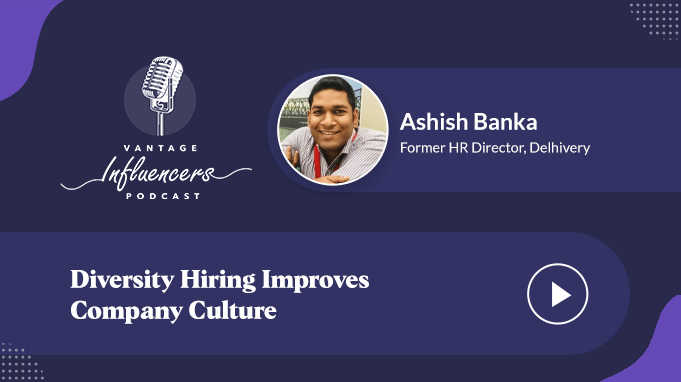
Diversity Hiring Improves Company Culture
Episode Overview
Ashish Banka opens with a blunt reframe: diversity hiring is not about ticking a gender quota box, it is about acceptance. In this conversation, he argues that most organizations have built a culture that works for a narrow definition of "normal," and that diversity hiring only succeeds once leaders confront the discomfort that comes with disrupting that comfort zone. He walks through what actually counts as diversity, including acid attack survivors, persons with disabilities, the LGBTQ+ community, trauma survivors, and the third gender, and explains why treating diversity hiring as a gender only initiative misses the point entirely.
The discussion then moves from mindset to method. Banka shares concrete practices he has seen work across the organizations he has worked with and studied, from all women facility teams and Pride Month observances to sensitization partnerships, accessible workstations, and even a reservation style approach for historically excluded groups. He closes with a challenge to HR leaders: diversity efforts fail when they are treated as a one off initiative rather than a leadership commitment that starts at the top and flows down through the whole organization.
Episode Highlights
- Diversity hiring means creating acceptance for people from every caste, religion, sexual orientation, and background, not just meeting a gender quota.
- Bringing diverse hires into an existing culture can feel disruptive, and most organizations resist that disruption instead of embracing it.
- True diversity includes acid attack survivors, persons with disabilities, the LGBTQ+ community, trauma survivors, and the third gender.
- Practical steps to build diversity include all women facility teams, Pride Month observances, sensitization partnerships, accessible workstations, and pilot programs before scaling.
- Employee engagement and diversity acceptance are separate issues, and new hires should be evaluated on their openness to diversity from the interview stage itself.
- Lasting change requires commitment from the top down, treated as an ongoing organizational value rather than a one time initiative.
About the Guest
Ashish Banka, Former HR Director at Delhivery, Founder and National President of HR SAMPARK
Ashish was last employed as HR Director with Delhivery, leading HR for the company's First and Second Mile segment. He is a passionate HR leader with 14 years of experience across talent acquisition, performance management, and employee engagement, having led a team of 100 HR professionals overseeing a workforce of roughly 20,000 employees. Ashish is the Founder and current National President of HR SAMPARK, a non-profit trust focused on HR conclaves, knowledge sharing, industry academia events, and CSR initiatives, with active chapters in Kolkata, Mumbai, and the National Capital Region.
Connect with Ashish on LinkedIn
Host
Gautam, Vantage Influencers Podcast Host
What You Will Learn
- Why diversity hiring goes far beyond gender ratios and what "diversity" actually means in an HR context.
- How to recognize and work through the discomfort that diverse hiring brings to an established workplace culture.
- Concrete initiatives that make diversity hiring effective, from all women facilities to accessibility programs and community partnerships.
- Where to start building diversity into your hiring process, including sensitization training and pilot projects before a full rollout.
- Why sustainable diversity and inclusion requires leadership buy-in from the top rather than a standalone HR initiative.
Key Topics & Timestamps
| Timestamp | Topic |
|---|---|
| 00:00 | Cold open: what diversity hiring means and why it matters |
| 01:04 | Host introduction and guest background |
| 02:35 | Ashish's personal introduction and life philosophy |
| 04:05 | Defining diversity hiring as an acceptance mindset |
| 04:56 | The key to nurturing a good workplace culture |
| 10:24 | How diversity hiring improves company culture, with real examples |
| 15:22 | The best ways to hire diverse talent |
| 19:04 | Diversity hiring's connection to employee engagement |
| 21:10 | Closing thoughts on embedding diversity into company culture |
| 22:33 | How to connect with Ashish |
Full Transcript
Click to read the full episode transcript
Welcome to the Vantage HR Influencers Podcast. This podcast is sponsored by Vantage Circle, the simple and AI powered rewards and recognition platform for employee engagement. Diversity hiring is the first step towards building a more inclusive and diverse workplace culture. Anyone not living under a rock knows the importance of diversity and inclusion in every aspect of our lives. The same extends to our workplaces too. To simply define, diversity hiring is when companies design a hiring process that provides an equal opportunity for candidates of diverse sexual orientation, gender, race, and other minority groups to take part in the interview process and get recruited. Overall, diversity hiring improves company culture.
Gautam: Hello listeners. Welcome back to Vantage Influencers Podcast. I am your host, Gautam. I guess you already know the topic of discussion today from the introduction. Yes, it is diversity hiring improves company culture. And to give us more enlightening insights on this topic, we have a very special guest with us. He is Mr. Ashish Banka. Ashish was last employed as HR Director with Delhivery for their First and Second Mile segment. He is a passionate HR leader with 14 years of experience in the HR domain, specialising in talent acquisition, performance management, and employee engagement. He led a team of 100 HR professionals and managed a headcount of nearly 20,000. Ashish is the Founder and currently the National President for HR SAMPARK, a non-profit trust focusing on HR conclaves, knowledge sharing, industry-academia events, and CSR actions. Ashish has a remarkable chapter presence in Kolkata, Mumbai, and NCR. Hello Ashish. Good morning and welcome to the show.
Ashish Banka: Thank you, Gautam, for the invitation. Greetings to all my viewers who are there on this podcast and are listening to this small rendition of my thoughts.
Gautam: We are truly delighted to have you with us today. And our listeners would be truly enlightened by listening to your thoughts on the topic that we are going to discuss today. But before we could move to the topic of discussion, would you please brief us about yourself? Like in very short, something that I might have missed mentioning about you.
Ashish Banka: Thank you for giving me this opportunity. Namaste to all the viewers. I am glad that we are connecting over this platform. I happened to be a core HR professional by design. I love interacting with people. I have come from a very low economic background, and achieving some success gives me a feeling that we need to hold onto two things very closely in our lives. One is respect and one is recognition. For me, I treat life very simply. I don't complicate it, and I look at it from an observation that each person is, for us, a role model to learn from. It is up to us how we look at our lives, how we simplify them, and live with peace and satisfaction in ourselves. So this is something which was not mentioned by Gautam in my professional introduction. But as a person, I believe that continuous learning is very important for all of us.
Gautam: Thank you, Ashish. And I think nobody else but you could have described this about yourself, because, of course, we do not know each other personally, but what you told us about yourself is about respect. And I think that truly defines our topic of discussion today as well, which is about diversity hiring, and considering you're closely related to HR, what is diversity hiring in your knowledge?
Ashish Banka: In my opinion, diversity is all about acceptance. Acceptance of something which is diverse. When we get anybody at a workplace, be it from any caste, creed, religion, or sexual preference, are we giving him or her an opportunity to thrive and be comfortable? Diversity hiring is having an inclusive mindset to have people from all across zones, all across genres, come and thrive at a common workplace and feel comfortable. That is the diversity hiring point.
Gautam: Thank you so much, Ashish, for that amazing response. But when it comes to HR's hiring, they always think about making a good workplace culture or a company culture. So what is the key to nurturing a good workplace culture, and how does diversity hiring come into play in this context?
Ashish Banka: I'll extend and elaborate on this question in terms of my thoughts and experience for our viewers. Let us understand step by step what culture is, first of all. The question says good workplace culture, and that differs from person to person. All of us, when we go to a workplace, generally thrive on five elements, which are individual requirements that keep changing based on every parameter. These are your salary, your authority, your designation, company growth, company culture, and how much you are learning under a good boss. All of us make decisions about our employment based on these parameters, and the priority keeps changing for everybody. We said one of the parameters is culture. So everybody asks what culture is, and that definition differs from person to person. You walk into an office and you feel comfortable. You are greeted well, you are not put under pressure, there is a work life balance. You are paid your salary on time, you are appreciated for your performance, and you are rewarded. There is an annual appraisal and increment cycle, and there is a learning opportunity. We say that is a good culture.
In that good culture, when we bring in people from diverse backgrounds, it gets disrupted. Most of the organizations I have come across, worked with, and spoken to feel scared of that diversity, because they feel they have thrived in a particular way, and if they bring a change into that way, they will get disrupted. Diversity brings disruption. First of all, viewers need to understand that it is not something we immediately accept. When we say diversity, normal people with two eyes, legs, and ears intact, a head, a brain, shoulders, everything, that is not diversity. Diversity is something which is not common, which is special. What are the parameters of diversity? There are different parameters. Acid attack survivors, specially abled individuals, the LGBTQ community, trauma survivors, women who have been molested, they all deserve a chance, and the third gender as well. They all deserve a chance to be associated with us and thrive in that opportunity and environment. But we as normal people go back and adopt a mindset that says, no, you are not one of us, we will not give you that opportunity, we will try to create obstacles in your journey. That is what hindrance to diversity looks like. So when these people come into our system and want to be a part of it, and we don't allow them, that is hindrance. A good company work culture is one where we accept them. The acceptance happens from top to bottom. It gets inculcated into everybody's mind. And when we all thrive together at a workplace, that is called a good workplace culture.
The next question is how diversity comes into play in this context. What does diversity actually do here? One, it makes our organization very inclusive. It makes us a model employer, giving everybody an opportunity to thrive at one workplace. We are not a stereotyped organization. Second, we learn to be tolerant. We learn to be patient. We learn to respect everybody. Our orthodox mindset is something everybody carries, and you are not entirely responsible for that, it comes from the background you have come from and your upbringing. All of this shapes our mindset, but when we come to a workplace, we are assumed to be among people with a similar mindset. We are expected to be open to change and adaptability, and if you come back and do not embrace this change, then the responsibility falls on you. So when people say your upbringing is bad and that is why you cannot adapt, I don't agree with that. It is only because you are not open to change, and you, not your upbringing, are responsible. So diversity gives us an opportunity to become global and develop the right mindset. This is the culmination of improving an organization's culture toward openness and acceptance of every kind of person, through different models and different approaches to hiring. That is how I would answer your question.
Gautam: I think that was brilliantly answered, Ashish, because in a lot of instances, what we see is that when people say they are equal opportunity employers, we don't actually see the change. I think it's also because of the privilege people come from, from different backgrounds. There are people with a lot of privilege who do not wish to accept change. But I think with sensitization programs, we can develop that curiosity in people's minds, and this is where company culture also comes into play. I know both questions might sound similar, but I believe they are different, because workplace culture and company culture are two different terms. So when it comes to diversity hiring, in what ways does it help improve company culture?
Ashish Banka: Great, there are a number of ways. I'll build on where I left off and give the viewers a lot of examples of how we can do that. First of all, we need to have an open mindset. How do we build an open mindset? In most organizations, there is a target of around 10 percent gender diversity, where they go back and hire a lot of women into the workplace. Some organizations keep it at 20 percent, which is also a global agenda. But ideally, that is only one piece of diversity, not diversity as a whole. So the question is about diversity, not just gender diversity, viewers. Let me give some examples of how to build diversity.
I have worked with organizations like Tata and Reliance, and I have come across a lot of folks from other organizations such as Accenture and Wipro. I'll give a combination of the best practices that everyone follows. Based on your suitability, you can pick and choose whatever works for you.
First, when I was with Jio in Kolkata, we created a Jio center called Angel JC, where the entire facility was staffed by women. This helped create a gender diversity balance and also set an example, because other organizations have since replicated a similar model staffed entirely by women. This is one way you can decide to hire and run a facility with an all women team, and it works.
Second, you build up a Pride march. Last month was Pride Month. How many of us as organizations actually celebrate Pride Month? It is not necessary that everyone in the LGBTQ community is open about it. As an organization, we embrace and celebrate Pride Month even though some people remain discreet and are not open about their orientation.
Third, we need to partner with institutions that come in and sensitize our employees on how they need to behave with these communities. That is very important, because awareness has to be created first, regardless of whether or not you plan to bring diversity into your workplace right away. You cannot bring diverse hires in and tell them to adapt on their own, you have to sensitize your existing employees first, because these are highly sensitive matters, and you cannot let new hires be hurt through the actions of other employees during that process.
Fourth, are you giving specially abled employees a proper workstation? Are the toilets located close to their workspace? Are they looked upon as one of the team? Acceptability is very important. You do this through a pilot project: you pick a unit, run the pilot, and then scale up after running a campaign around what you have done as an organization. These become your benchmark practices.
Fifth, you bring the family members of these employees to the workplace and ask them to talk about their experience. You give them the respect and recognition of being present. This is another way you bring about a mindset shift in hiring.
These are the different ways you can use to help company culture. Culture is nothing more than this: when you walk into the office, do you feel comfortable? That is the only culture. Do you feel respected? Do you feel recognized? Is your self respect intact? I think that is the only definition of work culture, and these are the ways diversity can open all of us up. You cannot live in a cocoon and say that whatever you have always done is the only right way. Embracing change is what company culture is all about.
Gautam: Wow. Thank you so much, Ashish. I think our listeners and I myself are truly delighted with your talk today, because your experience completely speaks to what you deliver. And I think your responses are a reality check for a lot of leaders as to what they can do to improve their company culture and the diversity and inclusion in their offices. So considering that, what are the best ways? You have been in the HR industry for so long, and I think you'll be the best person to answer this. What are the best ways to hire diversely?
Ashish Banka: Since most organizations have become sensitized nowadays, there are a lot of ways this is possible. Again, for my viewers, I am not focusing on gender diversity, I am referring to diversity more broadly. There are specially abled institutions you can partner with, interview candidates, and find the best talent available. You can also partner with LGBTQ communities. Pride Circle is one such organization I know of that does a lot of work supporting organizations in this area. You can also organize a job fair where you invite diverse candidates from different backgrounds after doing outreach and marketing. When you invite them, you are giving them a platform and telling them they are wanted in society. Otherwise, they will stay where they are and wait in isolation for an opportunity to come to them before starting their career. You give everyone an all round opportunity. That is the third way. Fourth, you can tie up with employment exchanges. There are special government wings that can help with this. You can also run a referral program in your organization, where you give these opportunities to these people and reward the employee who referred them if the new hire stays for six months.
The last thing, which I feel is the best part of hiring diverse talent, is that these people tend to be very loyal and very dedicated. If you give them an opportunity, they will not let you down. So build a loyalty program for them within the organization, because the opportunity you give them as an employer is one others are not giving. So these people can be the best fit for an HR fraternity across various roles, not all roles, but roles where attrition levels can be minimized. Other people might go out and look for jobs elsewhere for more money, but the inclusivity your organization offers is something others will not be able to match, so they will be less likely to leave. You are on safe ground, you have their loyalty secured, so give more employment opportunities to them.
The last point is a more hypothetical one: create a reservation system for them within the organization. Because if you leave it purely as an opportunity, in my experience, employers will hire one person against a hundred openings and say they have done their job. So a meaningful count should be given to the kind of people we hire. Some people might counter that this creates separation, since these are people in the world just like everyone else, so why create a separate channel for them? The reason, to answer that, is because they have been deprived for a long time. When a group has been deprived for such a long time, you need a dedicated reservation to bring them to the level they should be at. If they should represent 30 to 40 percent of the workforce, and employers are only managing to deploy around 1 percent, if we do not create a reservation, how do we bring that up to a meaningful level, say 10 percent, if we leave it purely as a choice for most people? So that is my final answer on the best ways to hire diverse people.
Gautam: Thank you so much, Ashish, and I think that was brilliantly answered. But in a true sense, do you feel promoting diversity and inclusion right from the hiring stage helps enhance employee engagement?
Ashish Banka: Employee engagement and acceptance are very different things. I do not agree that they are directly correlated. When you interview people, do you interview specially abled candidates in a different time slot from other candidates? That is the first thing to think about when it comes to promoting diversity and inclusion right from the hiring stage. How are you treating them? Are you treating them with a sympathetic view, or with the understanding that the best candidate will get the job? I think that is what promoting diversity right from the hiring stage really means.
I don't see the hiring stage itself as leading to diversity. Hiring, and diversity and inclusion, are separate things. Most organizations keep the two departments separate, they run sensitization on a different channel and keep their existing employees evolved on the topic. The question is about new employees coming into the system who have not gone through that evolution yet. So what do you do for them? You treat them equally. During the interview itself, you can ask candidates what they think about diversity and inclusion. That is a second way to test how open they are, and you hire based on that openness, without compromising on their talent, but also weighing their thought process and behavior.
Employee engagement is a very individual topic. How engaged you are with an employer is not necessarily impacted by diversity and inclusion specifically. You can include a question about diversity and inclusion in an employee engagement survey, where employees give feedback on how open the company is to it, but it is not necessarily tied to an individual's engagement in that direct sense. It starts from hiring: new candidates need to be judged on their thought process.
Gautam: Thanks, Ashish. And we are now slowly approaching the end of this conversation, and we don't have much time left. So I will just quickly ask you to give a conclusion. How would you like to wrap up your thoughts on this topic for today?
Ashish Banka: Thanks, Gautam. I enjoyed this discussion, sharing my thoughts on whatever I have experienced and implemented. I am not a scholar, but I have worked on this subject for quite a while, so I could share that. My only request, to sum it up, is for HR people not to treat this as a one off initiative. If you treat it as an optional or alternative initiative, it becomes very difficult to get it embedded. I think we should all join hands, and it should flow from the CEO or the board down to everyone else, so that we as a company embrace everybody. When we internalize this thinking, then everything I mentioned, the initiatives, the opportunities, the options, will all follow one by one, because none of this is rocket science, everybody can figure it out. But accepting this first is the most important part. I think HR people can play a great role in steering the organization toward this. So I believe everybody can do it, it's just that we need to embrace it and make sure the company embraces it as well.
Gautam: Thank you so much, Ashish. It was great having you with us today. And finally, how can our listeners reach out to you if they need to contact you for any reason?
Ashish Banka: Thank you, Gautam. I enjoyed this discussion. Listeners, I am available on social media, I'm a social media enthusiast. Please reach out to me, Ashish Banka, on LinkedIn. I give a lot of weight to people who reach out and specifically share their views, thoughts, and real life experiences there. So I'm happy to be on this professional platform and share my thoughts, and take this connection forward with all of you.
Gautam: Thank you, Ashish. It was a great conversation with you, and I did not want to stop you because you were so enlightening. But time does not permit us to keep going on, so I have to say goodbye for today. It was a great conversation, and I hope we get the opportunity to speak with you again sometime soon. Thank you so much for joining us today, Ashish.
Ashish Banka: Thank you so much. Thank you for having me here. I wish all the viewers a safe and happy mind, and a good week ahead. Thank you.
Gautam: Happy weekend to you too. And listeners, please keep listening to the Vantage Influencers Podcast, and we'll be back with more such enlightening topics and conversations in our future episodes. Thank you so much.
Thanks for listening to the Vantage HR Influencers podcast. Please do subscribe to Vantage HR Influencers podcast on Apple Podcast, Spotify, and our YouTube channel for new episodes.
FAQ
What is diversity hiring?
Diversity hiring is the practice of building an inclusive recruitment process that gives equal opportunity to candidates across gender, sexual orientation, race, ability, and other underrepresented groups, so they can thrive once hired rather than simply be counted toward a quota.
How does diversity hiring improve company culture?
It pushes organizations to become more inclusive and tolerant, moving them away from a stereotyped, one type of employee mindset. Ashish Banka explains that when leaders embrace acceptance from the top down, diversity hiring builds a culture where employees at every level feel respected and comfortable.
What are practical ways to start hiring more diversely?
Ashish Banka recommends steps like partnering with specially abled institutions and LGBTQ+ community organizations, running diversity focused job fairs, tying up with employment exchanges, offering referral incentives, and piloting new initiatives in one unit before scaling company wide.
Does diversity hiring directly improve employee engagement?
According to Ashish Banka, engagement and diversity acceptance are related but not the same thing. He argues diversity and inclusion should be built into the hiring process itself by evaluating candidates' openness and thought process, while ongoing engagement is best tracked separately through employee feedback and surveys.
Related Reading
Also listen on