Employee Branding Helps Improve Company Culture
Episode Overview
Sarang Brahme opens with a reframe that upends how most companies think about employer branding: it doesn't fix a broken culture, it amplifies whatever culture already exists, tenfold. Ask him whether employee branding improves company culture, and he flips the causality around. Culture builds the brand, not the other way around. A glass door, not a marketing campaign, is how he describes what employer branding actually captures, since it merely reflects the truth of what happens inside an organization. If leaders assume that investing in employer branding will paper over a toxic culture, disengaged managers, or broken trust, he warns that the campaign will only broadcast that dysfunction louder and faster.
He walks through what actually builds a culture worth amplifying: real listening instead of assumption, analytics that connect employee sentiment to business results, identifying and empowering internal advocates instead of mandating participation, and leadership visibly living the values it asks employees to repeat externally. He returns repeatedly to the idea of the employee value proposition, arguing that vague promises collapse the moment a new hire discovers the gap between what recruiting said and what the job actually is. Feedback, he insists, only works if it's genuinely anonymous, since employees self-censor the moment they suspect a manager or HR could trace an opinion back to them. By the end of the conversation, he ties employer branding, employee experience, and engagement into a single loop: engaged employees advocate for a company without being asked, and that word of mouth becomes the real brand, whether or not marketing signs off on it.
Episode Highlights
- Sarang Brahme argues employer branding does not fix a bad culture, it only amplifies whatever culture already exists, for better or worse.
- He describes employer brand as a glass door: a reflection of the real employee experience inside a company, not something a campaign can manufacture.
- Building an authentic brand starts with continuous listening, using anonymous surveys and social media monitoring instead of assuming what employees and candidates want.
- Identifying internal brand ambassadors and giving them a genuine reason to participate matters more than mandating advocacy as a job requirement.
- Leadership visibility and consistency are non-negotiable, since employees will not repeat a story externally that leadership does not live internally.
- A strong employee value proposition has to be a specific, provable promise backed by real stories, not a vague slogan on a careers page.
About the Guest
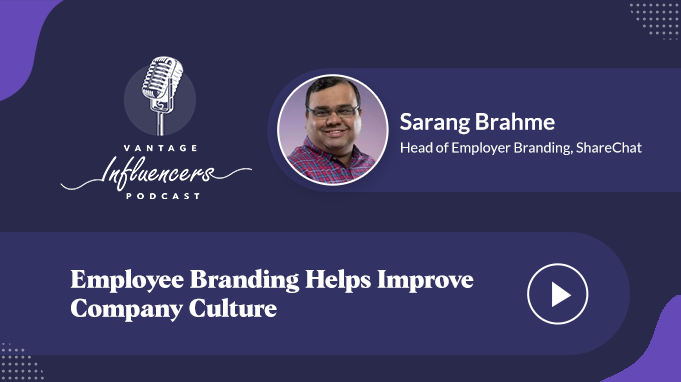
Sarang Brahme, Head of Employer Branding, ShareChat
Sarang Brahme is the Head of Employer Branding at ShareChat, with over 19 years of experience across talent acquisition and employer branding. Before joining ShareChat, he was Programme Manager, Candidate Experience & Employer Branding, where he globally led efforts to attract and hire top talent, engage target talent pools through talent branding, and deliver a strong first experience for candidates. He also led the digital transformation of a global recruiting system spanning talent attraction, the careers site, and analytics. Beyond his corporate role, he writes about talent and employer branding on his own blog and is active on LinkedIn and Twitter, where he shares his perspective with a wider HR and talent community.
Connect with Sarang on LinkedIn
Host
Gautam, Vantage Influencers Podcast Host
What You Will Learn
- Why Sarang Brahme believes employer branding can only amplify a company's existing culture, never fix a broken one
- How to identify and empower internal brand ambassadors without turning advocacy into a mandated task
- Why continuous, anonymous listening matters more than assuming what employees and candidates want
- How to build an employee value proposition specific enough to survive a new hire's first month
- Why leadership visibility and consistency determine whether an employer brand feels authentic or hollow
- How employee engagement and employer branding reinforce each other in a continuous loop
Key Topics & Timestamps
| Timestamp | Topic |
|---|---|
| 00:14 | Cold open: what employee branding is and why it matters |
| 02:19 | Sarang's path into talent acquisition and employer branding |
| 03:07 | Defining employee branding versus employer branding |
| 04:17 | How employee branding drives business success |
| 08:31 | The ingredients of an authentic employer branding strategy |
| 14:02 | Why culture builds the brand, not the other way around |
| 19:05 | How employee branding strengthens employee engagement |
| 24:08 | Closing thoughts and how to connect with Sarang |
Full Transcript
Click to read the full episode transcript
Welcome to the Vantage HR Influencers Podcast. This podcast is sponsored by Vantage Circle, the simple and AI-powered rewards and recognition platform for employee engagement.
Employee branding is a new twist in employee engagement and identity. It shapes the behavior of the employees so that they project the brand identity in their daily activities. The core idea is to transform your employees into brand ambassadors to present your brand in the best possible light. It depends greatly on the reach of your employees on social media. Suppose they have great reach, then brand engagement becomes that much easier. They can share your notifications which ends up getting more engagement. And sometimes new customers. As a whole, it positively impacts your company culture and attracts top talent.
Hello everyone, welcome to the Vantage Influencers Podcast. I am your host, Gautam. In today's episode, we will enlighten you on how employee branding helps improve company culture. To shed light on this significant topic, we have with us Mr. Sarang Brahme. Sarang is the Head of Employer Branding for ShareChat. He brings in over 19 years of experience across various sectors. Before ShareChat, he was Programme Manager, Candidate Experience and Employer Branding. For someone with such immense experience, he is the best person to enlighten us on employee branding and how it helps improve company culture. In the past, Sarang has also globally led an agenda to attract and hire top talent, engage the target talent pool through talent branding, and provide a great first experience for talent to work with. He also led the digital transformation agenda for a new global recruiting system on talent attraction, careers site, and analytics.
Gautam: Hello, Sarang. Welcome to the show.
Sarang Brahme: Hi, Gautam. Thank you so much for having me.
Gautam: So, we are surely delighted to have you with us today. And thank you so much for agreeing to lend your voice to our listeners. I'm looking forward to a great conversation. So, to begin with, please tell us something about yourself, something that I might have not mentioned.
Sarang Brahme: Well, no, I think you kind of covered it in your introduction. I'm someone who joined recruitment and employee branding accidentally. That's not my educational background, but I'm really passionate about attracting talent and positioning the brand of a company as an employer brand, and letting that be a shining voice for why someone should join the company. So yeah, I think you covered it.
Gautam: Thank you. Thank you so much. And since you are the Head of Employer Branding for ShareChat, and our topic today is also centered on employee branding and company culture, I would like to ask you: in your words, what exactly is employee branding?
Sarang Brahme: Correct. So I think sometimes we say employer branding and employee branding. Obviously, employer branding is about the employer, and employee branding, or what's popularly known as talent branding, is about the employee or the talent. More and more, I think the world has shifted to talent branding, because whether a company is good or not is really based on the image and perception of employees and candidates. That's why, more than what the employer is saying, it's also becoming more important what employees and candidates are experiencing. And that's why I think employee or talent branding is becoming important, because it's really the authentic voice, more than just advertisement.
Gautam: Wow. Thank you so much, Sarang, for letting our listeners know what employee branding means to you. But when we talk about company success or business success, how does employee branding help businesses succeed?
Sarang Brahme: So I think the context of how businesses are becoming successful has changed over the past few years. It's not just about machines, processes, and efficiencies. I think it's also becoming more important to look at innovation, the kind of value that companies bring to customers. So it's a paradigm shift from efficiency to experience, right? And today, people play an important role in that whole paradigm. I mean, yes, you have the greatest tools and machines and engagement and all of that, but it's really important to see how your employees are adding value, how their experience is building the customer experience at the end of the day. So if you are looking for a great customer experience, you have to provide an amazing experience to employees as well, because they are on the front line delivering to your customers. And if they are taken care of, if they are being heard, if they are having a great experience, if they are growing and becoming advocates of the brand to their network, then it also has a positive impact on recruitment, attraction, retention, and internal growth. You end up hiring people who aren't just left out in the market, you're really able to hire top talent. You're able to retain talent, because if employees start to connect with your brand and company and build that sense of belonging, it passes on as a viral effect to others. And that's how great cultures are built, right? So if a company has a great culture, a great experience, that reflects in the voices people are sharing externally. Then that also becomes the brand. Nowadays, the health of a company isn't just about the financial results, but also the health of employee happiness or employee experience.
Gautam: Definitely.
Sarang Brahme: If your culture is toxic, if your employees aren't having a great time, then however much profit, P&L, top-line or bottom-line growth you're driving, if that's not reflected from an employee's standpoint, it's not sustainable growth. At some point, it will break down, because today it's an employee-driven market, and employees will find another place where they can be heard and taken care of. So I think people, we always say, are our biggest asset. If you know that, then they need to be taken care of, and their views today become more influential than what the employer itself might say through its own advertising campaigns. That's how authenticity is also built: what the employer is saying and what employees are saying should match, meaning it's one voice and not different voices, which people won't believe externally. So yeah, I think they have an enormous role to play in the success of a business in the long term as well.
Gautam: Thank you so much, Sarang, for that response. I think when you say employees must be valued, and we have to take care of everything that builds a company culture that's equitable and not toxic, there are so many things that come into employee branding. When we say we want employees who speak well about our company, who speak the best, we also need to give them the best. So in that scenario, what are the best ingredients to create the best employee branding recipe?
Sarang Brahme: So I honestly feel that you can't create a good employer brand. Employer brand, or employee brand, is merely a reflection of what the truth is inside. It's like a glass door. If, as an organization, you are providing amazing experiences, that's how it will reflect externally. If you're not providing them, it won't reflect. So number one is to really be, and I'll keep going back to this, authentic: provide really good value from a growth and career perspective. Now, with the pandemic and the future of work, there's a whole different paradigm shift in terms of what we call a good work experience, or the kind of new work models coming in. What are the real expectations of employees? I think that's important: first understand what those expectations are. Are you listening to them, or are you just assuming what they want and deciding what you should do? So continuous listening is important. Secondly, use analytics to really understand the correlation between what employees are saying and the results that are coming in. Are you having attrition in some part because of certain challenges? People might not have good views about the company because of some underlying challenges, so solve that. Third, look at amplifying that effect through the power of people's voices: identify your internal brand ambassadors. You might already have some influencers or people who are well connected. See if you can work with them. There's always a question of what's in it for them, so create that, so they don't feel it's just another corporate duty as part of a job description. They won't do it just because someone told them to. Create that environment, simple guidelines like social media guidelines on what they should and shouldn't talk about regarding the company. And reward the right behavior. Identify who's doing the right things, make them famous, turn them into role models, and look for others. And more importantly, even before that, get your leadership on this bus. They are the front face of the business in the market. They need to be vocal, they need to share stories of how they are improving the company's culture, what their contribution is. What does your employer brand stand for? Are you clear on your positioning, your employee value proposition, why people should join and stay? Do you have good enough storytelling, a good enough narrative? Do that. Also use internal communication, because employer branding starts internally. Externally, people see the tip of the iceberg, but it really starts internally: with leadership, with your own employees, with internal engagement and internal communications. Then slowly it starts to show externally, organically, because people say the same thing internally that they say externally. There aren't two different faces of the business. If you're experiencing the company really well internally, you'll talk about it the same way externally. So look at what you're doing with pulse surveys, what your scores are, and then what people say on external review platforms, what people say on external forums: does that match? If it doesn't, you need to do course correction. If you know your internal engagement is amazing and people are happy, but that's not the picture going out externally, you need to make sure those stories start going out externally, with HR, business leadership, and marketing coming together, ensuring the right channels, the right content, and the right engagement. So these are a few steps I would definitely recommend.
Gautam: I think those were amazing, because when you say it has to start internally and assumptions shouldn't be made, I think most leaders sometimes assume that employee needs are basic, that what employees want is basically rewards and recognition, but they fail to understand that every employee has different needs. And when it's communicated well, when there's no discrimination, when there's an equitable culture in the company, I think that builds good employee branding. Do you agree with that?
Sarang Brahme: Yeah, absolutely.
Gautam: Okay, sure. That's great then. When we speak about assumptions, about effective communication, about good listening, I think all of this helps build a good company, and it also helps build a good company culture that attracts top talent and enhances retention. But do you think employee branding also helps improve company culture?
Sarang Brahme: So I think it's a bit of a chicken-and-egg question. I don't think employer branding improves the culture, I think it's the other way around: it's culture which improves the brand. What is brand? It's the perception of what a company is in the minds of employees and candidates. So I would say it gives a magnifying effect to a good culture, and it will never fix a bad culture. If people think that investing in employer branding will fix the bad culture they have, that's not the case. It will, in fact, amplify that bad culture tenfold. So there's a risk to it as well. Once that starts to happen, it becomes a snowball effect. If you have a good culture and that's communicated internally, it spreads like a snowball into different departments. A lot of times there are amazing stories about employees, what they've achieved, the impact they've made, whether it's about diversity and inclusion, business stories, or the change and transformation they've built. That needs to be told internally to all employees as well. And suddenly you start to find a change in perception: "Oh, I never knew we do this. I never knew we venture into these kinds of activities." And slowly that starts to shape what my company brand is, and what my view of the company is. That will have a snowball effect externally too, because employees will start to talk about it externally, and that will further shape perception. And this is where I'll go back to my initial point about the employee value proposition. It needs to be very clearly defined, articulated, and communicated from leadership: this is what we have on offer in terms of why you should join and stay, this is a differentiating factor working with us versus our competition. Then it becomes a promise, and you have to deliver on it, so build proof points. If you're saying you'll give a diverse and inclusive culture, just saying it through employer branding doesn't make sense. You have to find what has actually happened, what the proof points are, the stories that back that promise, and communicate that internally and externally. And it's not a two-minute fix. You have to do it consistently, passionately, and persistently, all the time, whether you're hiring or not. And a lot of the time the market is volatile, it goes up and down, but that shouldn't impact your employer brand, because employer brand is a long-term investment into retention and attraction. It shouldn't stop just because you don't have hiring needs right now, otherwise your employer branding becomes a very tactical exercise, not a strategic position. So that's how I see culture and branding: like a duo that works together. And this is a big responsibility for leadership, to maintain that culture, commit to it, and deliver it, so that the perception and image of what people think about your company builds up.
Gautam: True, true, I completely agree, because I think company culture can frame a lot of what you want to implement in your company, whether it's enhancing engagement or retention. I think culture is something that's at the forefront for every new joiner, and for people already working in the company, to tell others: this is what our culture is, and this is why you should join us. And I think that's where employee branding is already done. I mean, the initial stage of it, the word-of-mouth process, is already done. But when you said in the previous question that employee feedback is important, I think feedback also enhances employee engagement, to the extent that employees have a space to voice their needs and their discomforts. And if they see the company working to address them, I think that also helps build a culture that's suitable for people to want to work in. But when it comes to employee branding, does it also help enhance employee engagement?
Sarang Brahme: Yeah, yeah, absolutely. So as I said, the first step of building an employee brand, talent brand, or employer brand is to listen to what your employees and candidates are saying, in their interview experience, whether they're successful or not. Across the entire life cycle of the employee journey, right from the time someone becomes aware of your company till the time they exit and become an alumnus, that entire life cycle needs to be covered, and you need to be able to plug in nudges where you can listen to them. So you do a candidate survey when they're in the recruitment process, an employee survey when they're already in the company, and an alumni survey once they've moved on. It's really important to understand what they like, what they don't, and to make it anonymous. That's my humble request, because if you ask them to put their name to it, it becomes difficult: there's a perception that HR or a manager could trace it back to them. So make it anonymous. There are enough listening tools out there. Social media monitoring is also a good technique: while you're not proactively asking for feedback, you can monitor social media for what people are saying about your company, and gauge whether that chatter is positive or negative, what perception they have. Then find the areas for improvement, and once that happens, it will obviously help improve employee engagement as well. Because if your employees are engaged, if they find a sense of belonging and connection, the employee brand will automatically improve, because they're happy and able to connect with your brand. I mean, a lot of people love certain consumer brands so much that, without even being asked, they'll talk about the ecosystem, because that brand has built that connection with users by giving them an amazing experience. Likewise, that can happen in the employee brand space too, because employees are already sharing photos and experiences externally on LinkedIn, Twitter, and Instagram, even without being asked. And when that happens, it means you don't need to nudge them proactively, they're already doing it because they feel that sense of connection and belonging. And that happens because they feel engagement with the company, and with management too. Engagement with "the organization" is, I'd say, a bit of a lazy concept; it's also with the manager, with peers, with the people around them, because at the end of the day, they're spending more time with their managers and their people. And we all know the saying: people leave managers, not companies. So it's important that leaders and people feel it needs to be part of their intrinsic behavior, the way we work with people, we take care of them, they come first, and then everything else follows.
Gautam: Yeah, I mean, absolutely, that needs to run right from candidates, to internal employees, to alumni. A lot of the time, you'll get similar feedback and similar reasons why people love working with companies. And that's great. I think when you spoke about keeping it anonymous, I think that also helps achieve a more honest response, and I can say this from personal experience, because Vantage Circle has its own pulse feedback and pulse surveys as a product. We use it amongst ourselves as well. I mean, our clients use it, but we also use it ourselves, and it's completely anonymous, so it doesn't create that hesitation of what would my manager think, or what would HR think if they find out this is me, will they really judge me. That sort of mentality goes away when it's anonymous, and I completely agree with you on that. And on that note, I think you've been a great speaker for us on this topic of employee branding, because I don't think anyone else could have been this detailed, and we're surely delighted to have had you with us today. But before we let you go, what are your concluding thoughts on employee branding improving overall company culture and helping businesses succeed?
Sarang Brahme: Yeah, so let me go back to some very simple things. One: don't think that employee or talent branding is going to fix your bad, toxic culture. That has to come from the inside, not the outside. Just because you show happy, smiling faces on career pages doesn't mean you actually have happy, smiling employees. So that needs to be looked at first. Secondly, leadership plays such an important role: if they're not the torchbearers of this, it becomes very difficult to make it authentic and turn it into a strategic need and strategic position. It's also a bottom-up approach, fueled by employees, but leaders provide the fuel, the inspiration, and the encouragement. Third, please make this a data-driven activity: measure the impact of employer or employee branding on things like your reputation, your engagement, and awareness of your brand. How does it impact retention and attraction, so you know what's working and what isn't. And lastly, I'd say, passionately work on employee experience. Employee experience and employer brand, to me, are two sides of the same coin. If you have a great employee experience, the employee brand will fall into place. It doesn't happen the other way around. So if you're providing amazing experiences, great career growth, direction, those stories will automatically come out, even if you're not doing any marketing. And lastly, tactically, it's a team game. It's not just an HR or recruitment thing, it has to be a team game between leadership, business, HR or recruitment, and marketing, to amplify and find your voice, with employees and leadership helping to implement it. So it's an inside-out thing: culture and employee experience are the enablers of that. If you get that right, it becomes much easier to get employee branding right.
Gautam: Thank you so much, Sarang. I think you've given our listeners a lot to learn from, and even I wasn't very sure about employee branding, because this was a bit of a new topic for me. Not that I didn't know about it, but I hadn't gone in depth. And I think for listeners who want to know more about employee branding, this is where they can listen to you. And approaching the end of the show, if our listeners want to contact you, how can they reach out?
Sarang Brahme: So yeah, I'm on most of the platforms, you can search for Sarang Brahme on LinkedIn and Twitter, I'm there. I have my own blog as well on talent branding, and I have a YouTube channel where I'm trying to become a content creator. I'm not so good at it, but I'm trying. But yeah, you can always reach out to me through these platforms, and I'll be happy to answer or guide if anyone has questions.
Gautam: Sure. I think our listeners would surely love to join you for more insights and content, and we hope to see more content on YouTube as well. And thank you so much, Sarang, for joining us today. It was indeed a pleasure to have you with us, and we hope to stay in touch in the future as well. We hope to have you back on our show someday.
Sarang Brahme: Yeah, thank you so much, Gautam. It was nice speaking with you, and let's catch up in the future.
Gautam: Thank you. And with this, we've come to the end of this episode. You just heard Sarang Brahme speak about employee branding improving company culture. Stay tuned for more engaging podcasts, only on the Vantage Influencers Podcast. Thank you.
Thanks for listening to the Vantage HR Influencers Podcast. Please do subscribe to the Vantage HR Influencers Podcast on Apple Podcasts, Spotify, and our YouTube channel for new episodes.
FAQ
Does employer branding improve company culture, or is it the other way around?
Sarang Brahme calls it a chicken-and-egg question, but sides firmly with culture coming first. Employer branding doesn't create culture, it reflects and magnifies whatever culture already exists. A strong culture gets amplified into a strong brand; a toxic culture gets amplified into a toxic brand, roughly tenfold, in his words. Employer branding can never fix bad culture from the outside in.
What are the ingredients of an authentic employer branding strategy, according to Sarang Brahme?
He lists continuous listening to employee and candidate expectations, using analytics to connect sentiment with business results, identifying and empowering internal brand ambassadors rather than mandating advocacy, securing visible leadership involvement, and defining a specific, provable employee value proposition backed by real proof points and consistent internal and external storytelling.
Why does Sarang Brahme insist that employee feedback has to be anonymous?
He argues that once employees have to put their name to feedback, they self-censor, worried a manager or HR could trace an opinion back to them and judge them for it. Anonymous surveys, pulse tools, and social media monitoring surface more honest signals about what's actually happening inside a company, which is the raw material for any employer branding effort.
How does employee branding connect to employee engagement?
Sarang Brahme frames it as a loop: engaged employees who feel a sense of belonging and connection naturally share their experience externally on platforms like LinkedIn, Twitter, and Instagram without being asked, and that unprompted advocacy becomes the employer brand. Listening across the entire employee lifecycle, from candidate to alumni, is what sustains that engagement in the first place.
Related Reading
Also listen on