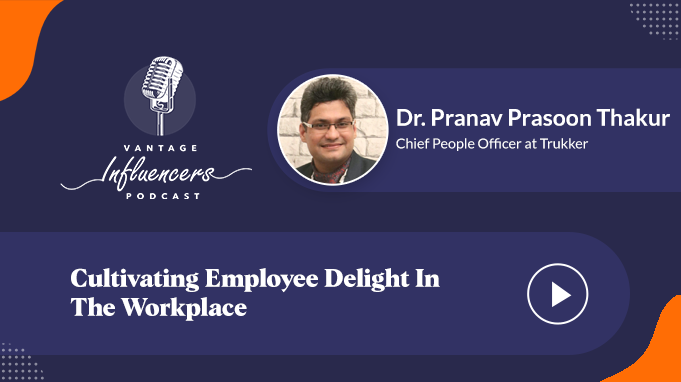
Cultivating Employee Delight In The Workplace
Episode Overview
Dr. Pranav Prasoon Thakur brings an unusual path to HR — nearly 20 years in the people function after starting his career as an Army officer, followed by roles at Renault Nissan, Coca-Cola, and now as Chief People Officer at TruKKer, where he leads the people function across 11 countries. Employee delight was also the subject of his PhD, and he defines it precisely: not employee satisfaction, but "level 10" of it — the point beyond a number-driven definition of engagement.
Dr. Thakur's central argument is that COVID reset what employees actually want. Pre-pandemic motivators were role, salary, promotions, and foreign assignments; post-pandemic, safety and well-being, organizational agility, psychological safety, and purpose became the real drivers — which is why he insists genuine employee delight "cannot be faked around." He shares a first-hand story from his time at Renault Nissan India, airlifting oxygen concentrators from Russia ahead of COVID's second wave, as an example of what delight actually looks like in practice.
Episode Highlights
- Employee delight is "level 10" of employee satisfaction, not a synonym for it — a distinction that became the subject of Dr. Thakur's PhD research.
- COVID reset employee priorities: pre-pandemic motivators were role, salary, and promotions; post-pandemic drivers are safety and well-being, organizational agility, psychological safety, and purpose.
- At Renault Nissan India, Dr. Thakur's team airlifted around 20 oxygen concentrators from Russia and converted vehicles into makeshift ambulances ahead of COVID's second wave — a concrete example of delight in action, not policy.
- Genuine employee delight can't be manufactured through one-off gestures like parties or flash mobs; it has to be rooted in psychological safety, appreciation, and purpose.
- The two clearest metrics for employee delight are talent attraction (time-to-close on open roles, organic employer-brand pull from current employees) and attrition analysis (exit interviews, feedback, and which departments show the most turnover).
- Listening is the hardest HR skill to build but the most important one — most employee conversations fall into four buckets: policy questions, career/aspiration mismatches, work-dynamics friction, or dissatisfaction with ratings, salary, or incentives.
About the Guest
Dr. Pranav Prasoon Thakur — Chief People Officer, TruKKer
Dr. Pranav Prasoon Thakur is an ex-Army officer with 19+ years of experience in the people domain across the Indian Army, Renault Nissan Technical Centre, Renault India, and Coca-Cola, and is now Chief People Officer at TruKKer. He is an alumnus of IIM Lucknow and has published two novels, "Those Unknown" and "Fallen Few." He has worked extensively in counterinsurgency and counter-terrorism environments in J&K and trains officers and employees on leadership and resilience.
Connect with Dr. Pranav Prasoon Thakur on LinkedIn
Host
Sanjeevani Saikia — Vantage Influencers Podcast Host
What You Will Learn
- Why employee delight is "level 10" of satisfaction, not just another word for it
- How COVID reset employee priorities from role/salary/promotion toward safety, agility, psychological safety, and purpose
- A real example of employee delight in action from Dr. Thakur's time managing HR during COVID at Renault Nissan India
- Why genuine delight can't be manufactured through one-off gestures, and what it actually requires instead
- The two practical metrics for measuring employee delight: talent attraction and attrition analysis
- Why listening — and the four recurring topics employees bring to HR — is the most important and hardest HR skill to build
Key Topics & Timestamps
| Timestamp | Topic |
|---|---|
| 01:26 | Dr. Thakur's corporate journey so far |
| 02:25 | Significance of employee delight for organizational success |
| 10:27 | Real-life examples of how employee happiness drives organizational outcomes |
| 13:15 | Practical approaches for fostering a culture of delight and engagement |
| 18:48 | Going beyond traditional employee engagement tactics to forge emotional connections |
| 24:14 | The role of continuous learning in fostering delight and growth |
| 28:38 | Common themes and insights emerging from employee conversations |
| 31:42 | Key metrics and indicators organizations should focus on |
| 34:17 | End note |
Full Transcript
Click to read the full episode transcript
Sanjeevani Saikia: Hi everyone, I'm your host Sanjeevani Saikia, and it's great to have you tuning in for another episode of the Vantage Influencers Podcast. Today we're shifting gears to focus on a topic that's essential for any organization striving for success, and that's employee delight. Trust me when I say you cannot impress your employees only with bonuses anymore — your employees must feel delighted working in your organization, they must be genuinely happy. You'll be interested to know that companies with happy employees outperform the competition by 20%, and happy, delighted employees are 12% more productive. These figures tell us a story of how delighted employees can effectively contribute to the success of an organization. So to talk more about employee delight and give us a better understanding of this topic, we have with us Dr. Pranav Prasoon Thakur, currently the Chief People Officer at TruKKer. Let's begin our conversation with him. Hi Dr. Pranav, thank you so much for joining us for this conversation.
Dr. Pranav Prasoon Thakur: Thank you Sanjeevani, the pleasure is all mine.
Sanjeevani Saikia: Before we dive into today's topic, employee delight, I'd love to hear a bit about your professional journey so far.
Dr. Pranav Prasoon Thakur: The journey has been quite long now, I can say — 20 years. I started with the Indian Army, then joined the field of HR almost 15 years back. I worked with automotive companies like Renault Nissan, and then FMCG, like Coca-Cola. Now I'm working for a startup called TruKKer, and I lead their people function across 11 countries.
Sanjeevani Saikia: Great, thank you so much for sharing your journey with us. With your permission, I'd like to now begin today's conversation. As a layperson, when I use the word employee delight, I mean employee satisfaction or happiness, but I'm sure this term implies more than just that. I think it's essential to establish a clear understanding of what this term encompasses in today's workplace context. Could you share your perspective on how you define employee delight, and most importantly, why it's considered a linchpin for organizational triumph?
Dr. Pranav Prasoon Thakur: Yes, I try to make it simple. Employee delight is the level 10 of employee satisfaction, or the happiness quotient of an employee. This was also the topic of my PhD — employee delight in the future of work. In very layman language, it's that wall of trust which we create for our employees, in whichever organization we work with. Employee satisfaction would be a label of yesterday, but delight is something we carry very close to our heart when we talk about people functions today.
Now, why is it important for the organization? I define the current era in two specific phases — pre-COVID and post-COVID. Pre-COVID, the parameters of satisfaction, or the way we engaged with employees, were different — role, offices, salary, promotion, foreign assignments — these were the motivators once upon a time, and money, in terms of appraisal numbers, was one of the top factors defining quick motivation. During COVID, a lot happened — there was a disease, and many of us lost someone from our family or close circle, and there was something like post-traumatic stress that no one really addressed. Somewhere deep down, everyone was scared; they came close to the actual life-and-death part of things, and found out that the sort of satisfaction they were living with maybe wasn't real satisfaction at all. And all of us started searching for a word called purpose.
After that, we came through another term — the Great Resignation — and studies say this happened because of a lot of anxiety, a reaction to something uncontrollable and unfathomable, called uncertainty. When we were all working very close to our families, trapped in that situation for two or three years, we came very close to family, found out parents were sick a thousand-plus kilometers away, or lost someone, and emotional dependency changed. When husband and wife were both working, they both knew exactly what the other's job content was — these things became transparent to families, and priorities changed. Then everyone came back to offices and was told to work from office, no more work from home. A lot of shifts happened in the last two to three years.
So now, what future employees or new-age companies' employees want is no longer limited to satisfaction expressed as some number — it's a higher word: delight. Delight encompasses, as I mentioned, a level 10 of satisfaction, which includes safety and well-being as the primary thing, salary competitiveness across the startup ecosystem and MNCs, agility in organizational policies, psychological safety, a sense of purpose connected to the organization's purpose, and overall a career of their choosing — a sort of gentleman's agreement between employer and employee. When all these things come together, it's no longer limited to the word "satisfaction" — it goes further, and that's where I coined the term employee delight as one of the primary things organizations are striving for.
Sanjeevani Saikia: You've made it very simple for us. I'd like to understand one more thing — terms like "great resignation" or "quiet quitting" have gained traction post-pandemic. Do you think employee delight, or satisfaction, has declined post-pandemic?
Dr. Pranav Prasoon Thakur: I wouldn't say it's declined — rather, all of humankind came together and understood that the things we were chasing pre-COVID were only a portion of our entire existence. What we call satisfaction, those parameters changed post-COVID. One word that came very strongly was "revenge travel" — we wanted to contain the entire life we'd missed into a few months, spending on travel, internal or international, in a way no one used to before. Second, I was surprised to see the purchase of luxury cars increased by almost 50%, because we wanted to live our lives to the fullest. Human aspirations changed — buying a Mercedes became less about the car and more about gifting yourself a sense of elite status that had, until then, felt out of reach or distant. And the family became the priority. I wouldn't say things changed entirely — they were always there, but our priorities were lost somewhere, and we became a bit clearer about them.
Sanjeevani Saikia: Interesting. It's one thing to discuss the theory of employee delight, but another to see it in action, and our listeners really like to hear real-life instances. Can you take us through a memorable experience where you witnessed firsthand the positive impact of employee delight initiatives?
Dr. Pranav Prasoon Thakur: There are many, but one that's very close to my heart was during phase two of COVID. I have high regard for my HR colleagues across the ecosystem during that time — HR was running the business then, because people were at the center. I was working with Renault, heading HR for Renault Nissan India. Before phase two could hit, my CEO at the time, who'd worked in Russia, and I anticipated that breathing difficulties would become a major problem, so we managed to airlift almost 20 oxygen concentrators from Russia, which were in extremely high demand in India at the time and hard to source locally. Because we were an automotive company, we were also able to convert a few of our vehicles into running ambulances. It was meant as a precaution, but when the real second wave hit and we saw the misery on the ground, I could only thank God and our CEO that we took the right steps at the right time. I don't have a lot of formal testimonials on it, but the messages, the smiles of employees when sudden COVID outbreaks happened in the office and we managed to deploy oxygen concentrators, not just for employees but for their families and friends too — that's when I could feel employee delight happening, going well beyond what people could typically seek from a company.
Sanjeevani Saikia: I'm sure organizations have strategies that work best for fostering a culture of delight and engagement. Could you share some of those with our listeners — what strategies can organizations deploy to foster this culture?
Dr. Pranav Prasoon Thakur: Being in the people function, I actually distance myself from the word "strategy," because when you have people, people have feelings, and feelings change every day — if you try to build a hard, two-by-two matrix out of it, I don't think it works. A few things I've used in my life that do work, drawing from my time in the Indian Army — there's nothing that can be hidden from your men, or, as I say now, your employees. There has to be a strong bond, a connection between top management and the last employee, and vice versa, without too many layers or jargon around it. That connection — approachability — is the first piece. It can take many forms: a town hall, a bottom-up survey, leadership connects, morning meetings, or even something as simple as a birthday or work-anniversary connect, which creates real motivation.
So, first is people connect. The second piece is around growth and expansion — whatever the organization achieves, if it's not shared with employees with transparency and fairness, it won't work. When it comes to performance management and appraisals, if employees push themselves and the organization performs substantially because of it, that substantial outcome has to be shared — not necessarily in full ratio, or the CFO will have a heart attack, but shared. Employees are not "resources" or "capital," pre- or post-COVID — they're partners in the organization. It's high time people-function leaders start playing their role and putting people at the center of the organization. If we build our policies, strategies, and initiatives with that as the foundation, we get very close to employee delight.
Today's employee knows everything the organization did last summer — you can't hide anything from them, and they're smart and demanding enough to know exactly what they want from the organization. A quick boost, a party, a get-together, a flash mob — the motivation from those can change by the very next day. Things are denser now; it's more about purpose and overall well-being than a fragment of it.
Sanjeevani Saikia: That's a great point — humans have emotions, so no single set of strategies will always work, and I really appreciate the approaches you've shared. I think the biggest takeaway is keeping employees at the heart of the organization, a people-first culture. Moving on — traditional engagement strategies can only take us so far when it comes to truly connecting with employees on an emotional level; those tactics only scratch the surface. How can organizations transcend the norm to forge authentic emotional bonds with their workforce, and foster genuine delight?
Dr. Pranav Prasoon Thakur: That's a tough question — let me put on my psychological hat here; I got certified in human psychology during COVID. Every human being, whether an employee or an entrepreneur, has a few basic needs we're born with, and the way we conduct ourselves, appreciation always goes side by side. From the day we open our eyes and our parents clap and cheer for our first steps or first words, celebration is deeply rooted in the psychology of a human being. So when you ask how to foster genuine delight, it's not really me explaining it to you — we all already know. The genesis comes from psychological safety, from appreciation and respect, from love.
Sometimes I see execution happen at a very transactional level — you have a CV, a JD, a match, an interview, you're selected, there's onboarding, you start doing the job, you have KPIs, review mechanisms, salary cycles, a value system you're developed against, talent assessments, and a yearly appraisal that determines your hike. That's the life cycle of an employee. But beyond that, a human is not a machine — every day is different, every day's mood is different, and it's all played around emotion. If you have emotion, those emotions have to be addressed.
I've seen a lot of push post-COVID around employer branding — I was in touch with organizations, including a Russian one and a Japanese one, that brought a lot of insight into how employer branding, paired with money and a great structure, can end up looking like employee delight, but may or may not actually be it. Humans are trained to find something fake and something real, and that's why I use the word genuine employee delight. Every organization will create the gigs — birthday celebrations, appraisal parties, promotions — but at the end of the day, more focus and energy should go into well-being and purpose-finding. If your soul is connected to the soul of your employer — the company's soul — that's when you have organizations where people work for passion. That was the first thing that happened during COVID, because DNA cost, meaning payroll, is roughly 80 to 90% of most organizations' cost. When shops closed and demand fell, the first ask from a CFO would be to reduce payroll cost, meaning letting people go. But organizations connected with employees at the purpose level made adjustments — salary cuts, some restructuring — but ensured employees weren't let go; they were protected. Those are the organizations doing well yesterday and doing well today. This word — genuine employee delight — has to be felt, understood, and then executed. It cannot be faked.
Sanjeevani Saikia: I came across a LinkedIn Global Talent Trends report which found that employees believe professional development is the number one way to improve company culture, and it's a known fact that investing in employee development is key to keeping employees engaged. Could you share your insights on how offering personalized development opportunities contributes to employee satisfaction, and at the same time, highlight the role of leaders in driving employee delight, since leaders are the key change-makers?
Dr. Pranav Prasoon Thakur: Two difficult questions — I'll take them one by one. Employee development is one of the most important elements driving employee delight. As humans, we can't be the same every day, and what we like today, we might not like tomorrow. But the way we were trained in school and college — a syllabus, learning something new every day, an organized life — as we enter the corporate sector, organizations with strong learning cultures, academies or universities inside the company, develop employees in a very solid manner. But expectations around this differ from what they used to be, because our focus is shifting — I attended a session in Dubai where I learned our attention span is now lower than a goldfish's, around 9 seconds, compared to a goldfish's 12.
In that kind of environment, a long, detailed development plan isn't the "in" thing anymore — bite-size learning, gig-style working, generative approaches. People are hungrier to learn things quickly. E-learning and certifications are everywhere now. That learning is a very natural, internal need for us, and a very methodical way to feel engaged and delighted — that's always at the core.
On the second part — senior leadership buy-in is very important. Any employee initiative, historically driven by HR, needs the leadership team to actually be successful — otherwise you get a very unfulfilling ROI or delivery on any such initiative. If HR creates something and hands it to the organization, how it's deployed and how successful it is depends entirely on whether the leadership team focuses on it, partners with it, and executes it together.
Sanjeevani Saikia: In my experience, one of the most valuable aspects of fostering a positive work environment is listening to the people at the heart of it all — our employees, who bring energy and passion to the workplace every day. Have you had the chance to talk with your team about what brings them joy at work, and if so, what are some common themes or insights that emerge from those discussions?
Dr. Pranav Prasoon Thakur: The first skill any HR person should have is listening — trying to understand, with empathy and compassion, the other person's standpoint. That's our prime job. When an employee comes to us, or even to their team members, the first thing is how welcoming you are — that comfort level matters, because the person might be frustrated, and in global organizations, people are spread across geographies and functions. When someone blocks time with HR or their team, there are generally four recurring topics: first, questions around policies or process; second, career decisions or aspirations — a mismatch between expectations and reality, or wanting to steer their career in a different direction; third, work dynamics — issues executing their work for various reasons; and fourth, operational things — dissatisfaction with ratings, performance reviews, salary, salary hikes, or incentives. The success of any HR leader comes down to that compassion and empathy, and to being a genuine link between management and employees — information has to flow both ways, top-down and bottom-up, and the person has to take ownership and execute without personal bias. Listening is, I'd say, the most difficult skill to build, but it's the most important one if you're working in HR or trying to drive change in an organization.
Sanjeevani Saikia: As we near the conclusion of today's episode, one final thing I'm eager to hear from you — the topic of metrics. I'm not sure how much you like that word in the context of employee delight, but I think it's essential to have mechanisms to measure the effectiveness of delight initiatives. How do we quantify the success of employee delight efforts, and what key metrics should organizations focus on?
Dr. Pranav Prasoon Thakur: Thank you, Sanjeevani — this is one of the toughest questions asked of any HR person, measuring matrices and overall impact. But as we work in organizations, these studies are important as long as we're careful about what they're actually directing us toward. If you're running an organization the right way and doing a lot of employee-delight initiatives, you'll see that trickle down into two specific parameters. First, talent attraction — you'll see a lot of positive buzz floating around in the market about your organization, which today's millennials check across different platforms before they join, and it comes from your own employees acting as brand ambassadors; the brand makes the culture, and this can be measured through ease of filling open positions, or turnaround time to close them. Second, of course, is attrition — if you have clear exit analysis, feedback from departing employees, and a clear indication of how people felt, how many left, why they left, and which department has the most issues, you can find out a lot. These are the two metrics that most categorically define the success of any employee-delight initiative.
Sanjeevani Saikia: You've answered all my questions lucidly. Dr. Pranav, as we wrap up today's episode, is there a final thought you'd like to leave our listeners with? And for those keen on staying connected with you beyond this episode, could you share how they can reach out?
Dr. Pranav Prasoon Thakur: For reaching out, LinkedIn is the easiest way to connect. The last thing I want to leave listeners with is that HR isn't about "human resource" — it's more about putting the right people in the right place, engaging them, and pushing them toward the maximum level of delight, or what I'd call partnership. The best organizations don't employ people — they partner with employees. And employees don't just work for a company; they work for a company they love. If HR, organization heads, and leaders want to build an organization employees love working with, things become easy and simple, and HR has a good time after that.
Sanjeevani Saikia: Dr. Pranav, thank you so much for joining today's episode and sharing your knowledge with our listeners. We truly appreciate it.
Dr. Pranav Prasoon Thakur: Thank you so much. Have a nice one.
Thanks for listening to the Vantage Influencers Podcast. Please subscribe to the Vantage Influencers Podcast on Apple Podcasts, Spotify, and our YouTube channel for new episodes.
FAQ
What is employee delight?
Dr. Pranav Prasoon Thakur defines employee delight as "level 10" of employee satisfaction, not simply a synonym for it — a state built on safety and well-being, organizational agility, psychological safety, and a sense of purpose, rather than role, salary, or promotions alone.
How did COVID change what employees want from work?
Pre-pandemic motivators were role, salary, and promotions. Post-pandemic, employees prioritize safety and well-being, psychological safety, organizational agility, and purpose — a shift Dr. Thakur ties directly to the Great Resignation and quiet quitting.
How can organizations measure employee delight?
Dr. Pranav Prasoon Thakur points to two metrics: talent attraction (how easily and quickly an organization fills open roles, driven by organic employer-brand buzz from current employees) and attrition analysis (exit interviews, feedback, and which departments see the most turnover).
Why is listening considered the most important HR skill?
Because most employee conversations fall into four recurring categories — policy questions, career or aspiration mismatches, work-dynamics friction, and dissatisfaction with ratings or compensation — and addressing them well requires empathy and unbiased follow-through, not just process.
Related Reading
Also listen on






You might also like
 Employee Recognition
 Humanizing the Workplace Through Recognition
 Employee Recognition
 Scaling Culture Without Losing Its Soul as Recognition Drives Growth Inside and Out
 Employee Recognition