Empowering Black Americans: Workplace Challenges & Potential
Episode Overview
Cora Black opens by connecting her HR career to a reality many Black professionals recognize: sitting inside compensation systems that reveal exactly how unequal pay can be along both race and gender lines. She describes the particular weight of being the only Black person in a workplace, especially during moments like 2020, when conversations about police brutality and racial justice spilled into offices that were not equipped to have them. From there she turns practical, arguing that diversity, equity and inclusion has to start with honest numbers: teams should reflect the community around them, and companies cannot claim progress by counting only entry level or janitorial roles as proof of representation. She also makes the case for belonging as the missing piece of DEI, tying it to visible steps like HBCU recruiting pipelines and intentional recognition of heritage months that let employees see people who look like them thriving inside the company.
The conversation then moves to what happens once people are already inside the building. Cora explains why diverse leadership and board representation matter beyond optics: seeing someone who looks like you in a senior role changes what feels achievable, and that exposure does more to close systemic opportunity gaps than any single policy on its own. She is candid about imposter syndrome, including how it shows up in her own inbox through over apologizing, and she credits specific, detailed performance feedback from managers with helping employees trust that their success is earned rather than lucky. She closes with direct advice for Black professionals: stay unapologetically yourself at work, seek out the tuition and development benefits companies rarely publicize, and find a mentor at least two levels above you who can see more of the map than you can see on your own.
Episode Highlights
- Being both Black and a woman means facing pay inequity from two directions at once, on top of the isolation of often being the only Black employee in the room.
- DEI has to start with representation numbers that genuinely reflect the surrounding community, not headcounts padded by counting only entry level or janitorial staff.
- Belongingness, the "B" in DEIB, matters because people need to see others who look like them before they can believe a role or level is achievable for them too.
- HBCU recruiting pipelines and intentional recognition of heritage months are concrete ways organizations can build both talent pipelines and a genuine sense of belonging.
- Diverse leadership and boards create an exposure effect: seeing someone in a position makes that position feel attainable, addressing systemic opportunity gaps rather than just the numbers.
- Imposter syndrome often shows up in small habits like over apologizing in emails, and specific, detailed performance feedback from managers is one of the most effective ways to counter it.
About the Guest
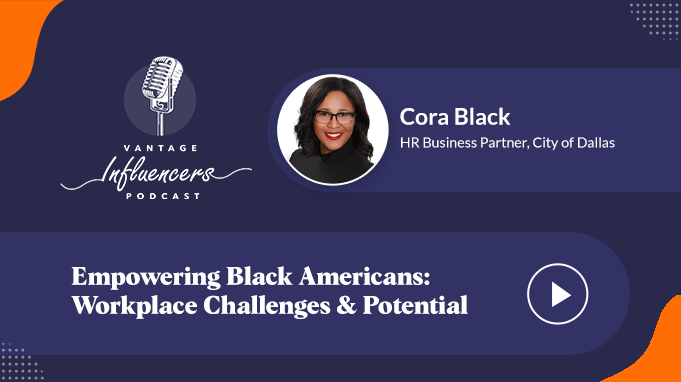
Cora Black, HR Business Partner, City of Dallas
Cora Black has spent a decade building her career across the HR technology, generalist, and consulting sides of human resources before moving into her current role in city government. She started out inside an HRIS platform, which gave her a close up view of how HR systems and processes work, before moving into broader generalist and consulting work. Outside her day to day HR Business Partner role for the City of Dallas, she works as a coach and consultant helping organizations identify blind spots in how they support their Black employees, and she is active in community advocacy and political engagement across Texas.
Host
Susmita Sarma, Vantage Influencers Podcast Host
What You Will Learn
- Why compensation visibility inside HR roles can surface pay inequities tied to both race and gender at once.
- How to evaluate whether your organization's DEI numbers reflect genuine representation, not just headcount padded by lower paid roles.
- Why belonging, the "B" in DEIB, depends on employees being able to see people like themselves succeeding inside the company.
- Practical ways to build a talent pipeline and a culture of inclusion, from HBCU recruiting partnerships to leaning into heritage month programming.
- How specific, detailed performance feedback helps counter imposter syndrome for employees navigating both race and gender bias.
- What Black professionals can do for their own career growth, including seeking out a mentor at least two levels above them.
Key Topics & Timestamps
| Timestamp | Topic |
|---|---|
| 00:00 | Cold open: the origins and purpose of Black History Month |
| 00:42 | Introducing guest Cora Black, HR Business Partner, City of Dallas |
| 01:20 | Cora's ten year journey through HR tech, generalist work, consulting, and government HR |
| 02:50 | Facing pay equity challenges as a Black professional, and the intersectionality of race and gender |
| 06:14 | The dynamics of diversity, equity and inclusion, and why DEI numbers need to reflect real community representation |
| 08:50 | Building inclusive environments through HBCU recruiting pipelines and heritage month programming |
| 11:58 | How diverse leadership and boards create an exposure effect for employees |
| 14:50 | Corporate DEI training programs versus culture, and getting comfortable with hard conversations |
| 16:38 | Using DEI policy to open up honest conversations on racial justice in the workplace |
| 17:51 | Imposter syndrome, Michelle Obama's example, and how specific feedback helps combat it |
| 22:03 | Advice for Black professionals: authenticity, company resources, and finding the right mentor |
Full Transcript
Click to read the full episode transcript
Welcome to the Vantage HR Influencers Podcast. This podcast is sponsored by Vantage Circle, the simple and AI-powered rewards and recognition platform for employee engagement. In February, we celebrate Black History Month, which is also known as African American History Month, a time dedicated to recognizing the rich heritage, achievements and resilience of Black Americans. Black History Month owes its beginnings to Dr. Carter G. Woodson, a scholar passionate about honoring the remarkable contributions of Black people throughout US history.
Susmita Sarma: Hi everyone, I'm your host, and in today's episode of the Vantage Influencers Podcast, we have the privilege of hosting Cora Black, HR Business Partner, City of Dallas, to explore the theme of empowering Black Americans, navigating workplace challenges, and unleashing potential. Stay tuned as we dive into Cora's remarkable journey and tackle crucial discussions surrounding diversity, equity, inclusion and so much more. Let's begin.
Susmita Sarma: Hi Cora, welcome to the Vantage Influencers Podcast. It's truly a pleasure to have you with us today.
Cora Black: Hello, it's a pleasure to be here. I'm so excited to delve into the topic for today.
Susmita Sarma: Yeah, so before we dive into our discussion on the topic, it would be great if you can share with our listeners a bit about your background and the experiences that have shaped your journey in the professional world.
Cora Black: Absolutely. So I actually joined human resources. I started with an HR tech company, in the HRIS platform space, and that really was a moment for me to get a grasp on the HR world and everything that it takes, just by knowing the systems. And from there, I went on to do more HR generalist work. I also do consulting. And now I'm actually working more on the government side, at a municipality. So it's been a wild ride for me. But it's been 10 years now with me being in the HR world, and I couldn't imagine being in another profession at this point.
Susmita Sarma: Brilliant. Thank you, Cora, for sharing your journey with us. It's truly inspiring to hear how your experiences have shaped your path in the professional world and now into the government sector. Your insights will undoubtedly provide valuable perspectives as we explore empowering Black Americans in the workplace today. So Cora, I'm really curious to hear more about your experiences in the profession. It makes my heart a little heavy to ask this even in this 21st century, but can you tell us if you have faced any challenges as a Black professional, and most importantly, how did you keep moving forward?
Cora Black: Sure, absolutely. So just like everyone else in the profession of HR, we have this unique positioning in companies to know what others are paid, and that can really bring on some challenges at times. Because when you have that visibility to know how much people are paid, you get to see those inequities, not just for Black professionals, but for women. So for me, the intersectionality between being Black and also being a woman, women face that from time to time too, and it can feel like challenges from both sides. Women are traditionally underpaid, and then being Black, you're traditionally underpaid. So having both, sitting in both of those seats, wearing both of those hats, is a very interesting situation.
I also have dealt with having to navigate being sort of a token Black American, being the only Black person in an office, and having those struggles of a lack of understanding from a cultural perspective. That definitely had its challenges. And I faced a lot of challenges, especially with everything that's gone on politically here in the US. So during 2020, when George Floyd was happening, and those hot topics of police brutality and gun violence were brought to people's attention, it was an odd time to be the only Black person in a workplace, or one of very few.
And that's why I made the change that I have made today. Number one, continuing to coach and provide my consulting, because it really is a privilege to be able to help influence other cultures and show them some things that might just be blind spots, right. There might be some blind spots for companies that they're just not aware of. So I take the times that I counsel and consult very seriously, because having that influence and having someone's undivided attention on what they should be doing and what they should be looking at when it comes to the African Americans that work for them matters.
Susmita Sarma: It's truly eye-opening to hear about the challenges, Cora, especially as a woman, the things you have faced and the way you have navigated through them with so much resilience. You really deserve a lot of credit for your strength and persistence. Moving forward, Cora, we will be talking about the dynamics of diversity, equity and inclusion, the call for which is louder than ever now. From your perspective, how critical is it for organizations to actively address these principles, and in your experience, what change can fostering DEI have on unleashing the full potential of Black employees?
Cora Black: Absolutely. So I think one thing, and forgive me because it's going to sound extremely basic, but you do need to focus on your numbers first and foremost. There should never be a situation where you have a team, no matter what the department is, that does not have good representation reflective of the community in which we live. And the reality is African Americans are all over the US, so no company in the US should have teams that don't reflect the population. So I always say, get those numbers up first and foremost. It's okay to look at how many people from diverse backgrounds you have on each team, or to represent the company as a whole, and make sure they're not the lowest paid on the team. Some companies say, well, we have a 30 percent African American population, but it's all janitorial, blue collar staff level. That's not what we're talking about when we're talking about DEI.
Also, another thing I like to bring up on the topic of DEI is belongingness. I love that a lot of people are starting to say DEIB, with that B standing for belongingness. In order to feel like you belong somewhere, you have to see other people who look like you.
Susmita Sarma: And for someone who has undoubtedly contributed to creating an inclusive environment, Cora, can you share some specific strategies you have found effective in fostering an atmosphere that not only embraces diversity but also propels the professional growth of Black Americans? And how do these strategies resonate with the broader goals of an organization?
Cora Black: Yeah, absolutely. I think some very tangible steps are things like creating pipelines from HBCUs, historically Black colleges and universities. Many companies have recruiting strategies that source employees from all over, different university pipelines, local universities, local colleges, even community colleges. And if you have a pipeline set with HBCUs, that's a great way to make sure you're bringing in top talent that you're able to help cultivate and mold. That's a beautiful tradeoff, because the more you put into employees and the more you care, the longer they're going to stay and the harder they're going to work.
So I think having pipelines, intentional recruiting efforts, is extremely helpful, but also having programs already set up and going within the organization matters. For instance, I take the observance months very seriously. So right now, it's Black History Month. Elevate some Black voices during Black History Month, and sooner or later you're going to find that when you elevate these voices, even if it's during that month, you find out things you didn't know before, and you also find new places and spaces for those employees to grow into.
It's simply about getting to know your employees. I'm also very adamant about celebrating Hispanic Heritage Month, celebrating Pride in June, months like that, that carry national recognition. I say lean into those things. It doesn't have to be ignored. A lot of people think that's something for your personal life, not your work life, and I beg to differ.
Susmita Sarma: Brilliant answers, Cora. Your insights are incredibly valuable and shed light on important issues we really need to address today. If we talk about leadership representation, Cora, it has been a topic of increasing importance, and definitely for a reason. In your view, how does the representation of diverse voices in leadership impact overall dynamics in the workplace?
Cora Black: What I absolutely love are companies that think about this from the board all the way down. I love seeing companies that have diverse boards. I think it's something a lot of people can almost get fooled by, by looking at the company roster, scrolling through and seeing who is a VP or director. I'm now starting to look at boards. Of course, I've told you about this intersectionality I'm living in as a Black woman, so I look for not just Black people, not just women, but specifically Black women.
I think how that impacts the environment altogether is that when you see someone in a position, you see something that exists, and that makes it more likely for someone else to have that as their goal. It's really an exposure concept: when you see something, you know it's achievable, and that becomes your goal. So the way I'd love to see companies foster their employees, pour into them, and see them grow from one level to the next, going from individual contributor to manager to VP to SVP, you have to see it. That's just human nature. What that ends up doing is cultivating an environment where you're naturally going to be diverse, because you're addressing the systemic issue instead of just looking at the numbers at that point. That's the thing that isn't the band aid. You're actually addressing the systemic issue of opportunity, and people having the exposure of knowing what's possible.
Susmita Sarma: But this is itself a challenge, isn't it, Cora? Do you think corporate training programs, more specifically DEI training programs, can bring any change?
Cora Black: That's an interesting question. So I think there are trainings that can be done, but I really believe that culture, where you live, where your kids go to school, what you're exposing your kids to, just thinking about a complete community, is going to do more for people than a training class. But I do think there are very effective bias trainings that reveal someone's biases or blind spots that they might have. And it's really about getting comfortable having those tough conversations. So many people still feel that talking about race in the workplace is awkward and uncomfortable, and nobody wants to be uncomfortable. But it really doesn't have to be that way. There's a stigma around it that is only holding everyone back, because diversity is helpful to any space. I'm a huge believer that having diversity in any space makes it better, because with diversity comes diversity in thought.
Susmita Sarma: And with DEI as a policy in the workplace, don't you think HRs can navigate discussions on racial justice, casual conversations even, and we can see positive outcomes from that?
Cora Black: Yes, absolutely. That's a really good example of what I mean when I say lean into the months. So if it's Black History Month, if it's the month of February, have some of those more racially based, constructive conversations. Have those curated spaces, those curated discussions. I know the term safe space has been overused and abused, but when you do create a safe space in the sense that there are no repercussions, bring out what you're feeling, what you're thinking around a said topic, because if you don't talk about it, if you don't bring that out, then you can't properly address it.
Susmita Sarma: So I was going through this research paper, and I found that in 2018, Michelle Obama wrote a book called Becoming, which became very popular, selling over two million copies in the US and Canada within just 15 days. It was a huge success all around the world. But even with all this success, when Michelle was talking to students in London and they asked her about being a symbol of hope, she admitted something surprising. She said she still feels like she is not entirely deserving of all her attention and success. That feeling is called imposter syndrome. And while it's often thought to mainly affect women, research shows that imposter syndrome can impact anyone, especially when combined with experiences of racial discrimination. So Cora, how do you think organizations are doing when it comes to supporting employees who grapple with these feelings of inadequacy and self doubt?
Cora Black: Sure, and that's a tough one in general. It's a very interesting thing where sometimes you see those very bold personalities in high positions who feel like they're lacking in talent, and yet they sleep like a baby every night, never questioning what they have and what they've earned. And honestly, from time to time, it affects me too, in a very daily way. There are times I'm crafting an email and I say to myself, why am I apologizing? I've tried to be more mindful of not saying "I'm sorry" when I didn't do anything wrong. That's one of the little ways imposter syndrome can come out, using very apologetic language, "so sorry about this, let me get right on it," when really you didn't make a mistake.
So it's a thing that can really give you quite a bit of anxiety. But honestly, I think when you have an organization that is supportive of an employee's success, in the sense of saying you did a great job on this specific project when that project happened, and not speaking about an employee in a general way, that really helps combat it. When I've been at companies that had very thorough and thoughtful performance management systems in place, and had those performance evaluations, the times I felt my managers cared about me the most were when they spoke on specifics. It wasn't just a vague "she's doing a good job." It was specifics: she went above and beyond on this project, she helped train her new colleagues even though that wasn't in her job description. Having those specific things tied to performance evaluations, when managers actually put the time in to give that true feedback, honestly helps so much in not feeling that imposter syndrome in the workplace.
Susmita Sarma: Brilliant, Cora. Your words resonate deeply, and your experiences highlight the ongoing struggle for equality in our society and the importance of amplifying voices like yours. Cora, as we move on to close our discussion today, what advice do you have for Black Americans seeking to excel in their careers, and finally, how can organizations actively support and amplify their aspirations?
Cora Black: Yeah, so my main advice for any Black professional navigating their workplace is to unapologetically be yourself. Of course, be professional, but don't dim your light, because then you're often overlooked, and that can cause more frustration, more heartache, and a lack of success. So I strongly suggest that Black professionals also lean into not only their organization, but seek out on their own what resources the company provides. I've seen so many times where it's an "if you know, you know" type of situation, and if you don't go out there and seek what a company might provide, even tuition reimbursement, continuing education opportunities, or stipends, actual dollars going toward getting higher certifications, that's something a lot of companies offer but don't widely publicize. So if you don't ask about them, you won't know.
I also strongly suggest finding someone who can be your mentor, at least two levels above you, because that's someone who has a much bigger view of the map than you do. Having a guide in a professional environment helps tremendously, and it can feel intimidating to go to someone and ask if they'd be your mentor, but at the end of the day, most success stories start with a strong, positive mentor. And I also have to say, coupled with that, never ask to be someone's mentee without knowing exactly what you want out of it.
This is something I've discussed even with my dad. My parents started a supply chain and logistics company years ago, and it's been a 40 year success story. I've talked about this with my dad, and he has specifically said he loves when someone comes to him in the organization and says, one day I want to have this title, I want to be doing something close to X, Y and Z, whether that's wanting to be a director one day or wanting to venture into another career path entirely. When you're asking for something specific from a mentor, you're going to get so much more out of it. You don't have to have every step figured out, but definitely have some goals in mind. And those goals might change, and that's okay. That's just part of growth.
Susmita Sarma: Thank you, Cora, for generously sharing your insights today. Our hope is that this conversation not only inspires but also serves as a catalyst for meaningful change within organizations.
Cora Black: Well, thank you so much. It was honestly really nice to talk about these things, and I just love that this was a topic of yours in the first place.
Susmita Sarma: I seriously look forward to you joining us next time on the Vantage Influencers Podcast as we continue to explore such important HR topics. Cora, until then, stay inspired and keep striving for positive changes.
Cora Black: Thank you so much. I'll keep doing the work.
Thanks for listening to the Vantage HR Influencers podcast. Please do subscribe to the Vantage HR Influencers podcast on Apple Podcasts, Spotify and our YouTube channel for new episodes.
FAQ
What did Cora Black say about the intersectionality of race and gender in the workplace?
Cora Black explained that being Black and a woman means facing pay inequity from two directions at once. Women are traditionally underpaid, and Black professionals are traditionally underpaid, so sitting at that intersection compounds the challenge. She also described the added strain of often being the only Black person in an office, particularly during periods like 2020 when national conversations about racial justice were unfolding while workplaces were not equipped to have them.
Why does Cora Black believe DEI initiatives need to start with the numbers?
Cora argued that representation has to be measured honestly before anything else. Teams should reflect the makeup of the community they operate in, and a company should not claim progress by pointing to a diverse percentage that is concentrated in the lowest paid or entry level roles. Getting the numbers right first, she said, is the basic starting point every other DEI effort builds on.
What is DEIB, and why does Cora Black see belonging as central to inclusion?
DEIB adds "belongingness" to diversity, equity and inclusion. Cora said she likes the shift because belonging depends on employees being able to see people who look like them succeeding inside the organization. She pointed to HBCU recruiting pipelines and genuinely leaning into heritage month programming as concrete ways companies build that sense of belonging rather than just checking a representation box.
What advice does Cora Black give Black professionals looking to grow in their careers?
Cora's core advice is to stay unapologetically yourself at work without dimming your presence, and to proactively seek out benefits like tuition reimbursement or certification stipends that companies rarely publicize on their own. She also recommends finding a mentor at least two levels above you, and going into that mentorship with specific goals in mind rather than a vague request for guidance.
Related Reading
Also listen on