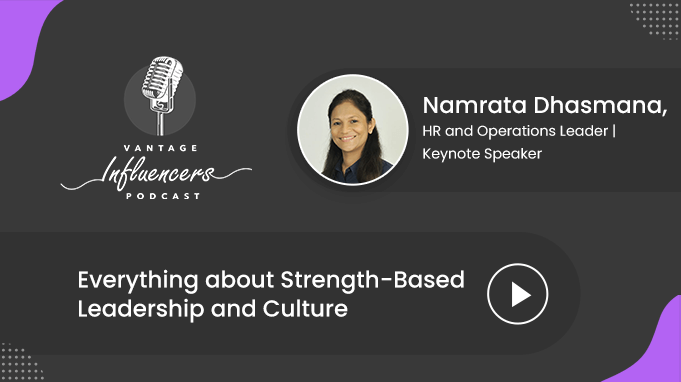
Everything About Strength-Based Leadership And Culture
Episode Overview
In this episode of the Vantage HR Influencers Podcast, host Susmita Sarma speaks with Namrata Dhasmana, an HR and operations leader whose 18 year career took her from a strategist role in the Indian Army into corporate strategy, CSR, and human capital work, about why most organizations still lead by hunting for what is wrong in people. Namrata traces her path from the Army into a CSR leadership role at Vedanta and then into a business unit within the US mortgage industry, and she draws on that varied background to argue that leaders default to fixing weaknesses because it feels productive, when the real lever for performance is identifying each person's natural talents and investing in them until they mature into strengths. She frames strength-based culture as a full mindset shift across an organization: purpose over paycheck, conversation over review, coaching over bossing, and development over satisfaction, with the shift needing to start at the executive level before it can cascade down.
The sharpest, most concrete point in the conversation is Namrata's distinction between feedback and feed-forward. She argues that traditional performance feedback only relitigates the past (what an employee failed to do), while a strength-based approach uses feed-forward conversations that pair an employee's known strengths with a concrete path to future goals. She is equally specific about weaknesses: they can be managed or compensated for, but they never convert into strengths, so leaders should name a person's blind spots to prevent failure while spending most of their coaching energy nourishing what someone is already naturally good at. She backs this with data, noting that employees who know their strengths report being roughly six times more engaged, are far less likely to leave, and interact better with both coworkers and customers.
Episode Highlights
- Strength-based culture means identifying each person's natural talents and deliberately investing in them until they mature into strengths, instead of trying to fix weaknesses.
- A strength-based mindset removes bias and favoritism, since leaders learn to recognize and use each person's distinct natural abilities rather than repeatedly leaning on the same few people.
- Strength-based organizations run on purpose over paycheck, conversation over review, coaching over bossing, and development over satisfaction, and the shift has to start at the executive level.
- Weaknesses can be managed or compensated for through training, but they never develop into strengths; only strengths can be nourished into consistent high performance.
- Feed-forward conversations, which pair an employee's known strengths with a path toward future goals, work better than feedback that only recaps past shortcomings.
- Employees who know their strengths are measurably more engaged, less likely to quit, and treat coworkers and customers better, making strength-based culture a business strategy, not just a feel-good idea.
About the Guest
Namrata Dhasmana, HR and Operations Leader, US Mortgage Industry
Namrata Dhasmana is an HR and operations leader with 18 years of experience spanning strategy and leadership roles, including a background as an officer in the Indian Army before she moved into corporate strategy, CSR leadership, and human capital work. She currently works within a business unit of the US mortgage industry, and her exposure across the armed forces and corporate settings shapes her core belief that every person carries innate talents a leader should uncover and invest in rather than judge. An IIM L alumni, strategic leader, and certified global coach, she works to find the sweet spot between business, technology, and people, and she is also a sought-after keynote speaker who advocates for diversity, inclusion, and leadership.
Connect with Namrata on LinkedIn
Host
Susmita Sarma, Vantage Influencers Podcast Host
What You Will Learn
- How to define strength-based leadership and what separates it from a traditional, deficit-focused management style.
- Why organizations should build strength-based culture into their core values, starting with executives before it cascades to managers and teams.
- How to tell the difference between managing a weakness and developing a strength, and why only one of the two can be nourished into consistent high performance.
- How to replace backward-looking performance feedback with future-focused feed-forward conversations that route employees toward their goals through their own strengths.
- How to recognize the strengths of individual team members during recruitment, one-on-ones, and everyday delegation.
- Why organizations that build a strength-based culture see measurable gains in engagement, retention, and customer experience.
Key Topics & Timestamps
| Timestamp | Topic |
|---|---|
| 02:03 | Namrata's journey from Indian Army strategist to her current role |
| 04:27 | Defining strength-based leadership and strength-based culture |
| 10:20 | How organizations and managers can prioritize and build employee strengths |
| 14:09 | How knowing strengths improves employee job performance |
| 14:26 | Why feed-forward outperforms feedback in a strength-based approach |
| 18:23 | Whether weaknesses and performance risks can be ignored |
| 22:50 | Recognizing each team member's strengths beyond the resume |
| 24:22 | Using strengths to increase employee engagement |
| 25:30 | Applying a strengths lens to conflict resolution |
| 26:59 | How the future of work is reshaping HR's role |
| 29:42 | Advocating for a strength-based workplace: final advice for leaders |
Full Transcript
Click to read the full episode transcript
Welcome to the Vantage HR Influencers Podcast. This podcast is sponsored by Vantage Circle, the leading employee benefits and engagement platform.
It is in human nature to first look for negatives in everything. Most reports on the news are negative, and in our conversations there are more negative words than optimistic and happy ones. Our mind automatically jumps to pessimistic thoughts and grim conclusions when something doesn't go the way we think it should. It is in human nature to repair problems as well: we love finding problems so that we can solve them. We not only use this approach in our own work, but we also use it to assess our workers, and it's very natural. But this is where we go wrong. This is the reason why we are not using our human potential to the fullest, and it's the explanation for why we have more average managers than we have genuine leaders. The basic truth is that we should stop attempting to fix our employees and instead center around their strengths and their interests. That's how we can enable them to take our products, image, and culture to a whole new level.
Susmita Sarma: Hello everyone, this is Susmita from the Vantage HR Influencers Podcast. To talk about strength-based leadership and strength-based culture, I'm so excited to welcome our guest speaker today, Namrata Dhasmana. Namrata has rich, diversified experience across the industry in strategy and leadership roles. She works in a US mortgage industry business unit. An HR by heart, she believes every person has innate talents, and as a leader, it's essential to find the sweet spot between business, technology, and people. She is an IIM L alumni, a strategic leader, and a certified global coach. Her immense exposure to varied experiences in the Army as an officer makes her a unique differentiator in her career ladder. Welcome to the show, Namrata.
Namrata Dhasmana: Thanks, Susmita, for having me.
Susmita Sarma: So first, please let us know about your journey from being a strategist in the Indian Army to your current position.
Namrata Dhasmana: It's been a journey of 18 years now. I worked with Vedanta and created teams to carry out CSR activities, leading a CSR project worth 100 crore and setting the short-term strategy. Then I joined a US mortgage lending bank, driving a lot of million-dollar initiatives as a strategist, and I'm based in Hyderabad. As you mentioned, being in the forces as an Army officer and then moving into strategist roles across the country negotiating strategic responsibilities, I moved into learning and development roles as well. I'm a passionate design thinker and a certified global coach, and now I'm in a consolidation phase of my career. So if you ask about my journey, it has been full of learning, unlearning, and applying everything I've learned in my 18 years, and I'm still learning. One thing I've learned while dealing with human capital, whether in the forces or in the corporate world, is that everyone is unique. I can't put people into any kind of model or framework; I have to deal with them according to their innate, inborn attributes. As a leader, I remind myself of that instead of labeling people or making judgments about them, and sometimes I do handholding for people going through any kind of transition, be it a mid-life transition or any other kind, so that they achieve success in their life. That's how I'd sum up my answer to your first question. I hope that helps.
Susmita Sarma: So coming to the topic, strength-based leadership or strength-based culture: according to you, Namrata, how would you define what strength-based means exactly? What is a strength-based company culture?
Namrata Dhasmana: Sure, Susmita. Strength-based simply means identifying and knowing your employees and your teams with their strengths. As a leader, you know their talents, invest in those talents, and turn them into strengths so that their energy levels are always elevated, increasing their motivation and subsequent productivity. It's about how you make an employee feel when they're meeting you as a leader. You feel bad if I list your ten negatives when you come to the office and tell you to start your day with everything you haven't done, or how your team is lacking. Instead, I could say, "Susmita, why don't you use your analytical mind to get the team started," or "why don't you lead with your ideation and creativity to bring some great business ideas," speaking to your natural strengths. Strength-based culture also removes bias and favoritism, because when a manager knows that a certain person always delivers when given a task, but only because that person keeps getting the opportunity, it gives birth to favoritism. A culture of strengths gives everyone the understanding that each person has unique, inborn, natural talents, and as a leader, it's my responsibility to unleash the true potential my people have in my team and my organization. So strength-based culture makes you think rather than just being judgmental about people. As a leader, I should know what my team's individual strengths are and empower each person with their own inborn natural strengths. It's easy to make others count their shortcomings, what they're not good at, but when I tell someone these are your strengths, I first have to think rather than simply make a decision or a judgment.
So when you ask what strength-based culture is, it's a culture of purpose versus paycheck. When my team comes to work, they come with a purpose, not just thinking about the paycheck they'll get at the end of the month; they know their purpose and they know their strengths, and that's how they apply themselves to meet the targets of the day. It's also a culture of conversation versus review. In a review-only culture, I just give an MOM style review: this is what you're not able to do. Whereas in a strength-based culture, there is conversation: when I know your strengths, we talk about giving you a path and alternatives, that your strength is your creativity, your strength is maximizing, your strength is empathy, so why not use these strengths to collaborate, build relationships, or partner with other teams. Then it's a culture of development versus satisfaction: when you're satisfied, you stop evolving, there's a full stop. Development, on the other hand, is a continuous process, so once you know your strengths, you stay curious about how to apply them, and that's how development keeps happening at the individual level too. It's also a culture of strengths versus weakness, and a culture of coach versus boss, instead of just bossing people around. When you know the strengths of your people and your team, you start coaching them, helping them realize how they can move forward in life or handle their personal and professional relationships. And on the whole, it's a culture of life versus job: a job and an organization are just part of life, and life has to be broad-minded. It gives people a reason to live for, a sense of what they want their life or ambition to look like five years down the line. That's how I'd sum up strength-based culture in any organization.
Susmita Sarma: So basically, a leader has to see what's good in each employee and say, "I see this in you, so you can really prosper in this area."
Namrata Dhasmana: Yes, that's how it can be seen. And if a leader knows their own strengths first and has gone through their own process of self-development, they'll understand this more easily in others. Otherwise, there are assessments and other tools available to help with that.
Susmita Sarma: As you already mentioned, we tend to want to fix our employees and look for what's wrong in them rather than seeing their strengths and utilizing them. So how can an organization or its leaders prioritize and build strengths? What should managers or HR leaders actually look for?
Namrata Dhasmana: Great question, thanks for asking that. Organizations can make strength-based culture one of their core values, and everything flows top to bottom to make sure it's executed in the true spirit. There are many organizations that have even had assessments done, and employees know their top five talents or strengths, but they're still not using them. Once it's part of the core values of the organization, execution will happen in the true spirit. It can be one of the pointers for organizations to know the strengths of the team; let managers know how those strengths can be unleashed and put to use. To know a strength, one has to think, because the easiest thing to do is to label people. That positivity in thought process creates the right mindset for managers. Let there be meetings and one-on-ones built around talents, because talents are naturally there in people. When I say talent, I mean raw talent: you need to invest in it, and that investment happens through a coach or an expert who understands those talents, and then that talent gets developed into a strength. This should start at the executive level first: leaders need to know their own talents and strengths, because research shows only about 15% of employees strongly agree that the leadership of their organization makes them feel enthusiastic about the future. That shows how much employees look to their leaders. So leaders first need to know their own strengths, and that happens once strength-based culture becomes one of the organization's core values. Then there can be an internal pool of experts developed in alignment with a center of excellence team, and there are many other ways to do this too. It also creates an understanding that everyone will approach a task differently: if I give the same task to four people, their execution will vary. One will be creative, one will be good at relationship building, and others will approach it in their own ways. I'm only interested in the end result, so let the "how" vary from person to person, because that "how" depends on each person's inborn talents, and that can only be understood once leaders themselves know the importance of talent, which happens once they know their own strengths.
Susmita Sarma: So employee job performance improves after they know their strengths. Is that what you're saying?
Namrata Dhasmana: Yes, exactly.
Susmita Sarma: So Namrata, coming to performance feedback: this strength-based approach to performance feedback is considered superior to the weakness-centered approach. What would be your recommendations for delivering effective performance feedback using a strength-based method?
Namrata Dhasmana: Great question. First, feedback by definition speaks about the past. In a strength-based culture, we have to work for the future, because every organization works toward its vision, and goals are always future oriented. So strength-based culture creates a mindset shift in the words we use: a feed-forward approach is future focused, and I always use feed-forward with my team, because organizations, by nature, have a futuristic approach. Feed-forward is superior because when you give someone a conversation full of alternatives to meet their goals, that's more effective than an MOM style feedback session where you're only told what you haven't done. When, as a leader, I tell someone which initiatives they need to take and that these can be met through one of their strengths, whether that's collaboration or creativity, the employee feels empowered that they can do this using their innate strengths, and they get a path to navigate toward the future. When they accomplish this through their mature talents, their strengths outweigh their weaknesses. A strength-based feed-forward approach works better than a feedback session that only recaps the past, things like not meeting an SLA or not delivering expected savings. That's the past, and both the employee and I already know it; what matters is how to achieve the goal next with a positive mindset, which is only possible by putting the strengths that already exist naturally in that employee into practice and working toward the target. Then the chances of success go up significantly. So my recommendation for leaders and managers is to understand that everyone has natural strengths that make them think, feel, and behave very differently, and a strength is the ability to consistently deliver near-perfect performance. So while giving feed-forward, note the gaps as well as the strengths, and favor conversation over review to help people become aware of and appreciate their own talents and share them with their peers. Managers, acting as coaches, can ask exploratory questions during feed-forward, like asking whether the person was able to align their strengths with the target they were given.
Susmita Sarma: So can we totally ignore people's weaknesses and other performance risks in the strength-based approach?
Namrata Dhasmana: No, not at all. Susmita, weakness is a blind spot, and managing weaknesses is another way to demonstrate the power of strengths. Weaknesses are an integral part of strength-based development, but a weakness will never develop into a strength; it can only be compensated for and managed. How? When you start knowing your strengths and keep practicing them, your strengths outweigh your weaknesses. Strengths can develop infinitely and provide an unlimited, evergreen source for increasing performance, and once they become mature talents and strengths, you know where to draw the line when you're dealing with a weakness or a blind spot.
Susmita Sarma: So you mean weakness can never become a strength; is that right?
Namrata Dhasmana: Weakness can be managed, but not developed into a strength. We always talk about employee training, but when we train an employee, we rarely first check what that person's actual strength is; we just continue with the training regardless. So even if someone is trained in an area where they're weak, will they become an expert in it? What I always tell my team is that a weakness can only be faced to prevent failure, whereas strengths can be nourished to create success. I leave it to each person to decide whether they want to keep working on their weakness just to prevent failure, or dive deeper into their natural talents, invest in them, mature them, and create success.
Susmita Sarma: So basically, before training someone, it's important to see what that person is good at.
Namrata Dhasmana: Yes, precisely. There are a lot of assessments through which those natural talents come to light, and when we dive deep into those talents, we often realize that these have been our natural talents right from childhood; it's just that we now consciously recognize them, maybe through an assessment. How that natural talent can help someone become successful is something they need to dive deeper into, along with their leader or coach helping them understand more about their strengths. A weakness, in this framework, is also something you need to dive deeper into: you'll understand it when you notice, for instance, that you're learning too much but not applying what you've learned. That gap, where you should draw the line and start executing, is where a blind spot appears in strength-based culture: you keep learning but don't apply it. That weakness of not applying or executing becomes a blind spot, and it can only be managed once you consciously recognize that you've learned enough and now need to start applying it.
Susmita Sarma: So then there's a challenge: how do we recognize the strengths of each person we manage? Is it enough to simply look at the strengths listed on their CV, or is there another way to recognize strengths in each person?
Namrata Dhasmana: When you're recruiting and a candidate mentions things they've achieved, you can always ask how they achieved it. If the candidate can't quite articulate it, but the interviewer understands what strength-based culture and leadership are about, they'll be able to gradually recognize that this person is good at certain things and likely has certain strengths. Once recruitment is done, if the organization has a strength-based culture, employees can go through a strength assessment or similar tests, and their natural talents come into clearer focus. These days, people often go into these assessments already wanting to know their strengths so they can do better in interviews, unleash their true potential, and understand what they're naturally suited for.
Susmita Sarma: So how can we increase engagement by focusing on strengths?
Namrata Dhasmana: According to statistics and reports, when employees know their strengths, they're more motivated and engaged, nearly six times more so. They have higher performance and are much less likely to leave their company, because they feel engaged and empowered in their own development, and they look forward to coming to work. They have more positive conversations with coworkers and even treat their customers better. When this kind of culture exists, there's a clear, elevated level of engagement among the team and across the organization.
Susmita Sarma: My next question is about conflict resolution, which is a very important topic. Can we use a strength-focused approach for that as well?
Namrata Dhasmana: I love this question, thanks for asking. Natural strengths also govern emotions; there are characteristics and words describing each strength, and each strength is associated with certain needs. For example, someone whose strength is achieving will need the freedom to work at their own pace and in their own space, and they may need to stay busy all the time. If you have four people reporting to you and one of them is an achiever who isn't given that kind of space, their emotions will show it. We're all diverse, and if those needs aren't fulfilled, something is lost, and conflicts come up. In a strength-based organization, an internal pool of people can also act as negotiators, because they're well versed in the reasons behind varied employee behavior, and they can create a win-win situation as collaborators while negotiating a conflict.
Susmita Sarma: How do you see the future of work? What changes does HR as a function need to make?
Namrata Dhasmana: I love that question. Coming from the forces and having seen VUCA in the external environment of an organization, I consider myself lucky to have witnessed real VUCA in the corporate world, where it's genuinely difficult to predict what comes next. But one thing I can say is that it's going to look very different, and to keep pace with that, people need to upskill themselves at a personal level. Mental resilience, discipline, and adaptability need to be primed to take on the challenges of future work. Focusing on innate talents as a foundation has become increasingly important, and that's what's required to keep pace with the technological changes ahead, because in many industries, specific skills and knowledge have a much shorter lifespan than they used to. That's why continuous improvement in personal development is so important for keeping pace with what's coming. As for changes in HR as a function: HR is an integral part of an organization and primarily deals with its human capital. Traditionally, HR has only operated at a transactional level: recruitment, employee engagement, hiring, and so on. Now, HR needs to align itself not only with corporate strategy but with business strategy as well, finding the sweet spot between three elements: technology (feasibility), business (viability), and people (desirability). With human capital, HR needs skill sets in EQ, emotional intelligence, and empathy, and needs to understand the emotions, actions, and reactions of people, which can only happen when HR knows the strengths of its human capital.
Susmita Sarma: My last question: how do you advocate for a strength-based workplace, and what would your suggestions be for the managers, leaders, and executives listening to us?
Namrata Dhasmana: A strength-based workplace is a place where people are uniquely identified by their talents. When you invest in talents through a coach or an expert, they become strengths, so in such a workplace, there are no labels for people; what someone does differently is because of their talents, and another person will do things differently because of their own talents and strengths. Employees can even have their top five strengths written on their desks, something for them to enjoy while working with their talents. As for advocating this culture, I strongly feel that strength-based culture is a business strategy for delivering exceptional performance and organic business growth. Studies from StrengthsFinder research, covering 1.2 million individuals and roughly 49,495 work units across 45 countries, show how strengths affect outcomes; those statistics speak for themselves. Strength-based culture creates a happiness quotient, reduces attrition, and also improves the brand image of the organization. That's why I really advocate for this kind of culture.
Susmita Sarma: Lastly, Namrata, please tell our listeners how they can reach out to you.
Namrata Dhasmana: Sure, they can reach out to me through LinkedIn, and otherwise they can also reach me by email.
Susmita Sarma: That was a great conversation with Namrata. Thanks a lot for your insights, and thanks for joining me.
Namrata Dhasmana: Thanks so much, Susmita, it was absolutely a pleasure for me. Thank you.
Thanks for listening to the Vantage HR Influencers podcast. Please do subscribe to the Vantage HR Influencers podcast on Apple Podcast and Spotify for new episodes.
FAQ
What does strength-based leadership actually mean?
Namrata Dhasmana defines it as identifying and knowing each employee's natural talents, then investing in those talents as a leader so they mature into strengths. It's a culture built on purpose over paycheck, conversation over review, coaching over bossing, and development over satisfaction, and it removes the bias that comes from repeatedly leaning on the same few people.
Why does Namrata recommend feed-forward over traditional performance feedback?
She explains that feedback, by definition, only speaks to the past, while a strength-based culture works toward the organization's future vision. A feed-forward conversation pairs an employee's known strengths with concrete alternatives for meeting future goals, which she argues is more effective and more empowering than an MOM-style review that only lists what wasn't done.
Can weaknesses be ignored in a strength-based approach?
No. Namrata is explicit that weaknesses are an integral part of strength-based development and must still be managed, not ignored. Her distinction is that a weakness can only be compensated for or faced to prevent failure; it can never mature into a strength the way a natural talent can be nourished into one.
How does focusing on strengths affect employee engagement?
Namrata cites research showing that employees who know their strengths are nearly six times more engaged, less likely to leave their company, and more positive with coworkers and customers alike. She frames this as evidence that strength-based culture is a measurable business strategy that also reduces attrition and improves brand image, not just a feel-good philosophy.
Related Reading
Also listen on