Navigating The Evolving Landscape Of Fresher Hiring
Episode Overview
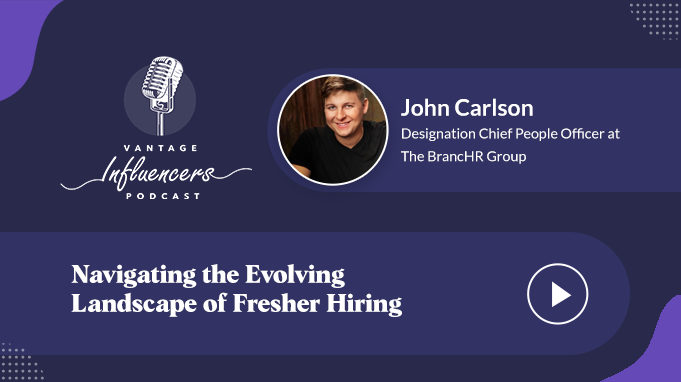
John Carlson argues that the old rulebook for hiring freshers is falling apart, and most organizations have not caught up. He makes the case that degrees and GPAs are losing ground to practical, on-the-job experience and soft skills like communication and teamwork, and he pushes back hard on diversity efforts that chase headcount numbers instead of rethinking the hiring funnel itself. Tokenism, he warns, is what happens when a DEI program becomes a target number rather than a genuine change in who gets access to opportunity.
The conversation also digs into where technology is helping and where it is quietly working against fair hiring. John talks through how AI tools can speed up resume screening while still carrying forward the same unconscious biases that exist in the humans who built them, and why first-round video interviews, for all their efficiency, can strip away the human connection a candidate needs. He closes by making the point that diversity initiatives only work if they are paired with belonging, and that leaders who actually listen to culture survey data will outperform those who simply chase metrics.
Episode Highlights
- Employers are shifting away from strict degree requirements and instead prioritizing internships, hands-on experience, and soft skills such as communication and teamwork.
- Genuine DEI work means widening the candidate funnel and auditing job descriptions for bias, not chasing headcount targets that slide into tokenism.
- Removing names from resumes and reviewing job postings for biased language or unnecessary experience requirements helps reduce bias earlier in the hiring process.
- AI can speed up resume screening, but unchecked algorithms can quietly carry forward the same human biases they are meant to remove.
- First round video interviews save recruiting teams time but often strip away the human connection candidates need before accepting an offer.
- Diversity hiring initiatives only work long term when paired with a genuine sense of belonging, tracked through annual culture surveys rather than assumed.
About the Guest
John Carlson, CEO of The BrancHR Group
John Carlson has spent nearly 14 years in the HR and people space, a journey that took him from an early start in telecommunications through independent consulting, several Fortune 100 companies, and up to the Chief People Officer role before he founded The BrancHR Group. His firm provides consulting across three areas: tactical HR, strategic HR, and culture and DEI work, and his approach centers on helping organizations build cultures where employees feel respected, accepted, and set up to perform at their best.
Host
Susmita Sarma, Vantage Influencers Podcast Host
What You Will Learn
- Why organizations are placing less weight on formal degrees and more on internships, on-the-job experience, and soft skills.
- How to widen a hiring funnel for genuine diversity instead of chasing target numbers that slip into tokenism.
- Practical bias-reduction steps such as removing names from resumes and auditing job descriptions for exclusionary language.
- The risks AI and video interviewing introduce into fresher hiring, and how to guard against them.
- Why belonging, not just diversity metrics, determines whether new hires stay and thrive.
- Which HR metrics, from time to hire to annual culture surveys, actually reflect whether a hiring program is working.
Key Topics & Timestamps
| Timestamp | Topic |
|---|---|
| 00:45 | Introducing John Carlson and his corporate journey to CEO of The BrancHR Group |
| 02:18 | How skill requirements have shifted from degrees to practical experience and soft skills |
| 05:31 | Incorporating DEI into fresher hiring and avoiding tokenism |
| 08:26 | The role of AI and machine learning in fresher hiring, and where bias creeps in |
| 10:14 | The human cost of video-first interviewing |
| 10:59 | The Walmart gender diversity hackathon example and why belonging matters |
| 12:53 | Other hiring trends: scarcity mindset, hybrid work, and generational shifts |
| 16:02 | Metrics for tracking the effectiveness of fresher hiring programs |
| 18:34 | John's closing advice to HR leaders |
Full Transcript
Click to read the full episode transcript
Welcome to the Vantage HR Influencers Podcast. This podcast is sponsored by Vantage Circle, the simple and AI-powered rewards and recognition platform for employee engagement. Do you want to know about the latest trends in fresher hiring? As the job market continues to evolve, organizations are adopting new strategies to attract and hire the best and the brightest new graduates. From virtual recruitment processes to a focus on soft skills and cultural fit, there are some exciting developments in fresher hiring that both employers and job seekers should be aware of. Let's dive in and explore some of these trends in more detail.
Susmita Sarma: Hello listeners, I'm your host, and to talk about the fresher hiring trends in this episode, please join me in welcoming our guest speaker, John Carlson. Welcome to the show, John.
John Carlson: Thank you so much for having me on the program. It's been an absolute pleasure to speak with you, and I'm looking forward to hearing any feedback.
Susmita Sarma: Thank you so much for being here in this podcast conversation today, and thank you for the time you're giving us. First of all, we'd like to know a bit more about you and your corporate journey.
John Carlson: Absolutely. So my name is John Carlson, and I am the CEO of The BrancHR Group. We provide consulting in three specific areas: tactical HR, strategic HR, and culture slash DEI work. I've been in the HR and people space for, goodness, about 14 years now, including up to the Chief People Officer role, and it has definitely been a journey. I got my start in telecommunications, did some consulting on my own for a while, and I've worked for some really great Fortune 100 companies. And now I'm the head of my own firm, where I get to make an impact on businesses. So it's been an exciting journey.
Susmita Sarma: Great. So as you know, John, in this episode we've welcomed you to talk about fresher hiring trends. Let's begin, and to start, let's talk a bit about the skills that are in demand now. Undoubtedly, the skills organizations look for in candidates change over time, isn't it? But it's always a good idea to keep ourselves updated on this. There are so many new skills that organizations are looking for in fresh graduates. So how have skill requirements changed over the past few years, and what skills are in high demand currently?
John Carlson: Yeah, absolutely. I think one of the number one things that has changed, or that we've seen a shift toward more recently, is the idea that practical knowledge, being able to have on-the-job experience, and your soft skills has become so much more prevalent and so much more important. There are many companies out there, you look at your Fortune 500 companies, and they're not necessarily all looking for that hard-copy degree anymore. They're looking for, can you do the job, and what kind of skills are you bringing into it? So one of the things I suggest to people who are in college programs, and I know it's a lot, is to try to gain some knowledge outside of just the classroom. Look for internship opportunities, look for the ability to really get your feet wet. It will certainly give you a leg up. And then I think the other piece of it is the personal soft skills: being able to communicate effectively, being...
Susmita Sarma: Communication skills?
John Carlson: Yes, it's so important, and you're talking about verbal and nonverbal communication. That's something that in today's society, there's been a shift in how people communicate, certainly with social media and the communication tools we have as a world. You have to be able to step away from the phone sometimes and learn how to just have a conversation with someone and how to navigate that. It's important, because we're seeing less and less of that.
Susmita Sarma: Yeah, so when you talk about communication, I think overall soft skills, such as teamwork and leadership, are always in high demand too, and they're very essential for success in any workplace.
John Carlson: And one of the things I do with a lot of the people who come through my door is have them take one of the many personality assessments out there. One that I find really successful is the Gallup StrengthsFinder. I love it because it identifies where your strengths are and also where your opportunities are, and it teaches you how to lean into those, because so many people don't feel comfortable communicating, since they feel like communication isn't necessarily their strong suit. But everybody has a different language of communication. Mine may be through commonalities, whereas someone else may communicate through data. So figure out what you're passionate about, and people will see that.
Susmita Sarma: Right. And let's talk about hiring from diverse backgrounds. We always talk about diversity and inclusion nowadays, given that hiring from diverse backgrounds can lead to a more well-rounded and successful company culture, as well as overall improved productivity. So I'd like to ask you, John, how are organizations incorporating DEI into their fresher hiring processes, and what steps are they taking to eliminate bias and promote equal opportunities?
John Carlson: Well, I think some companies are certainly doing it right, but one of the best ways to promote and expand your DEI hiring is by widening your funnel: looking outside the box for candidates, creating college programs, creating veteran programs that will ultimately increase your pool of candidates. The worst thing I see when I go in and consult for companies is companies who are just trying to hit a target number, who say, "we need thirteen Black and Brown individuals in order to hit this quota." Because you're not doing it the right way. All you're doing at that point is being performative, and it's tokenism. So the number one thing you can do is take a look at what your hiring process looks like. What levels of accessibility are there into your company? The second thing, take a look at your job descriptions. Are your job descriptions written for individuals who graduated from an Ivy League program, who have twelve years of work experience, when that doesn't necessarily translate into soft skills? Those can be built up. And the third piece, which you spoke to, is reduction of bias. There are so many pieces of bias within the hiring process. One of the things I've implemented with different companies is the removal of names from resumes, because that can be a huge source of bias. The other thing is, when you're looking at your job descriptions, are there pronoun usages? Are there micro-biases and micro-aggressions written into your job descriptions? What does your interview process look like? Is it consistent? Are the questions consistent?
Susmita Sarma: The practice of blind hiring, isn't it?
John Carlson: Yes, yes, absolutely.
Susmita Sarma: Also, I think, John, providing DEI training is a very important practice to increase awareness and understanding of different backgrounds, experiences, and perspectives.
John Carlson: It is, absolutely, DEI training as well as general interview training. There are so many interviewers or managers who do interviewing that have never been trained on how to interview.
Susmita Sarma: Yeah, and in the same line, I think we should talk about AI in the hiring process, since many companies have gone on to use it now. Our listeners would be interested to know how emerging technologies like AI and machine learning are impacting fresher hiring trends, and what new opportunities they present for both companies and job seekers.
John Carlson: I think we're on the cusp of a lot of change in the way that we hire, in the way that we view candidates, and even in the way we sort through resumes. AI is showing us there's capability out there. I think the one thing that makes me a little nervous about AI is the information that's fed into it, because unconscious bias lies within all of us, and that bias can end up within it. So who's checking the AI? Until we perfect that, if it can be perfected, there always needs to be a system of checks and balances, because there will always be bias in the world. Being able to recognize that, and being able to audit that within our own technologies, is critically important, or else we're just perpetuating the same issue.
Susmita Sarma: So, John, in any kind of AI-based hiring, there's a lack of human connection, a lack of human interaction and human touch, which definitely affects candidate experience negatively. What do you have to say about that?
John Carlson: I agree. One of the trends I've seen over the last year to year and a half is first rounds being done by video interviewing. It removes the human interaction, and I understand why companies try to do it, they're trying to ease the process up a bit, they probably have a bottleneck in their HR department reviewing a thousand resumes, so it's time-consuming. But the candidate experience is the most important setup you're going to have with that potential employee, to set them up for success with your company. So it does a disservice to the candidate, and it does a disservice to your company, when you try to skip steps.
Susmita Sarma: Yeah, also while researching for this conversation, I came across research from Walmart Global Tech India, which addressed a global gender mandate by tailoring hiring hackathons exclusively for females. Through this campaign, Walmart exceeded its gender diversity mandate by hiring 300-plus female recruits across engineering colleges. Do you think initiatives like this can have a significant impact on hiring a diverse workforce?
John Carlson: I think so, absolutely. The more programs you can put out there that allow accessibility into areas that may not have been as accessible to those individuals in the past, specifically when you look at women in tech, yes, I think that's great. But my next question is, okay, once we have those individuals on board, how are we treating them? Historically, Walmart has not been known to treat its employees very well. So it's all good and well to create those programs, but once you have those diverse employees, what are you doing to show them there's a career, that there's development, and that you're nurturing them and that they truly belong there?
Susmita Sarma: Yeah, so employee experience is an important factor while hiring, as well as while retaining employees in your organization.
John Carlson: Well, the one thing that people miss the most when talking about diversity, equity, and inclusion is the "B," which is belonging. Once you have diversity and equity and inclusion, can they feel like they belong? Do they feel like they belong? Most companies that get it wrong have a massive turnover of their minority employees, simply because they don't feel like they belong once they join the organization.
Susmita Sarma: Yeah, so this was about DEI in fresher hiring trends. It varies from year to year, but based on current industry trends and predictions, would you like to walk us through some other trends organizations are currently working on, apart from DEI?
John Carlson: Well, I think right now there's a scarcity mindset within organizations, and a lot of organizations are trying to do more with less. We find ourselves in a predicament right now because of the global economy, and I think we're still trying to weather through a lot of the after-effects of COVID. So you see a lot of companies trying to work through hybrid policies, bringing employees back to the workplace who have been out for a while. There are trends where the college-degree requirements we spoke about earlier aren't looked for as much anymore. So I think the number one thing I can suggest to the workforce in general is to understand what you desire and what you're looking for in an organization, because one thing I've seen happen a lot recently is that people have so much choice when it comes to their employers, and they're choosing the culture of an organization based on their own personal morals and cultural beliefs. And if companies aren't willing to adapt, to evolve, to change themselves, to really adopt a growth mindset, they're going to continue to lose employees, and they're going to continue to have a hard time hiring employees. I think it comes down to the fact that failure to adapt and evolve leads to extinction, and we've seen that with so many large companies that simply didn't think they needed to evolve or adapt for the workforce. I talk to CEOs and executives that I consult for, and they say, "oh, the millennials, what are we going to do about the millennials coming in," and I tell them, you're about fifteen years behind, the millennials are already here, what are you doing for the next generation? We're in a really interesting time, because we've never had this many generations in the workforce at once, so what is your company doing to help adapt to and nurture different generations with different generational needs and unique personality traits?
Susmita Sarma: Definitely, you have upskilling and reskilling. It's high time that companies invest more in upskilling and reskilling programs to help not just freshers, but everyone from every generation, develop the skills they need to succeed in the job market and stay competitive in their careers, isn't it?
John Carlson: Absolutely, yes.
Susmita Sarma: So now, John, let's talk about assessing and evaluating the effectiveness of fresher hiring programs, which is equally important, I believe.
John Carlson: Indeed, because without evaluation we can't really know if we're meeting our objectives and our goals.
Susmita Sarma: To be more specific, it would be great if you could talk about the metrics we can use to track and evaluate that.
John Carlson: Yeah, absolutely. I mean, you have your traditional HR metrics, right, where you look at retention, you look at number of positions, you look at gender equality, you look at pay and compensation analysis, comparing across all of your employees to make sure the numbers are aligned. We look at time to hire, we look at cost per hire, there are a lot of numbers in HR. But I think where people fail is understanding what the employee is feeling. If there's one thing you take from this conversation, I hope it's that I'm very much a culture-driven person. I think the culture of an organization is the number one thing you can have an effect on as a leader in your business. So as HR, it's my job to have a pulse on the organization. I think the number one way you can measure the effectiveness of your hiring programs is to maintain culture surveys, make sure you're doing culture surveys annually, and that you're looking at the heat maps those surveys provide. People will tell you what they want to see and what their issues are, as a leader in your organization. It's your job to listen. It doesn't take that much, but so many leaders fail to just sit back, ask their employees questions, and listen to their answers.
Susmita Sarma: Yeah, so John, how frequently should these surveys be organized?
John Carlson: I suggest doing at least an annual survey, that way you're able to compare year-over-year results.
Susmita Sarma: Okay, please continue, John.
John Carlson: Sure, I was just saying that as a leader, it's your responsibility to listen to your employees and take action on that. And then there's measurement through performance reviews and things like that, but I think the number one thing you can do is maintain a pulse on the culture of your organization.
Susmita Sarma: John, thank you for pointing this out to our audience today. Is there anything at the end that you'd like to add?
John Carlson: I guess I would summarize by saying that with everything that's gone on over the past two and a half years, with the murder of George Floyd, with COVID, with the change in the workforce, with the focus on diversity, equity, and inclusion, we've come to a point where it's time for leaders to step up, it's time for them to put their money where their mouth is. Those who make a commitment to change, specifically in the diversity, equity, and inclusion space, people are watching, and people are still demanding change, and employees, or future employees, are still choosing not to work at companies who don't get it right. And that would be my word of advice to employers and companies out there: focus on your culture, focus on your people, and the rest will come.
Susmita Sarma: Our audience might have questions for you, they might want to provide feedback, or they might want to work with you, or simply want to be in touch with you. It would be great if you could tell us how they can reach out to you.
John Carlson: Absolutely. You can find me on our website, as well as on LinkedIn, my handle is John D. Carlson, and I'd love to stay in contact.
Susmita Sarma: Great, so before wrapping up, I'd like to take a moment to express my sincere gratitude to you for accepting our invitation and being a part of this conversation today. It's been an absolute pleasure to have you share your insights and experiences on this important topic. John, once again, a big thank you for your time and dedication in making this podcast a success. I'd also like to thank our listeners for taking the time to tune into this conversation. Until next time.
Thanks for listening to the Vantage HR Influencers Podcast. Please do subscribe to the Vantage HR Influencers Podcast on Apple Podcasts, Spotify, and our YouTube channel for new episodes.
FAQ
What skills are employers looking for in fresher candidates today?
Employers are placing less weight on formal degrees and more on practical, on-the-job experience, internships, and soft skills such as communication, teamwork, and leadership. John Carlson recommends that college students seek internships and personality assessments, like the Gallup StrengthsFinder, to understand and communicate their strengths early.
How can organizations avoid tokenism in DEI hiring?
Tokenism happens when a company chases a target headcount rather than changing how it hires. John Carlson suggests widening the candidate funnel through college and veteran programs, auditing job descriptions for exclusionary language and unnecessary experience requirements, and reducing bias through steps like removing names from resumes and standardizing interview questions.
Does using AI in hiring introduce new risks?
Yes. AI can speed up resume screening, but the data it is trained on can carry forward the same unconscious biases present in the people who built it. John Carlson argues that AI-based hiring tools need ongoing human checks and balances, and that first-round video interviews, while efficient, can remove the human connection that shapes a candidate's experience.
What metrics actually show whether a fresher hiring program is working?
Beyond traditional metrics like retention, time to hire, and cost per hire, John Carlson points to annual culture surveys as the clearest signal. Reviewing the heat maps from those surveys shows leaders what employees are actually feeling, which matters most for spotting whether new hires feel a genuine sense of belonging.
Related Reading
Also listen on