From Fear to Empowerment: Overcoming AI Resistance to AI Adoption in Teams
Episode Overview
Amy Bouque argues that AI resistance in the workplace usually comes down to language and framing, not the technology itself. She lays out a three part manifesto for how employees should approach AI: treat it as a collaborative partner rather than a replacement, stay adaptable through continuous learning, and use it to unlock creativity and human value instead of fearing it. She brings the idea to life with a story about feeding an old African proverb into an AI image generator ahead of a leadership presentation, and how the unexpected image it produced became a rallying theme for an entire education team.
The conversation also confronts the fear that AI will leave employees with nothing but "leftover" busywork once automation absorbs the interesting tasks. Amy rejects that framing outright, arguing that AI taking on mundane work is exactly what creates room for coaching, connection, and strategic thinking, the parts of a job only people can do. She also points to the language leaders use around digital transformation and upskilling as the real source of fear, and sketches out what an ideal AI powered employee experience could look like, from automation that anticipates what a worker needs to AI functioning as a mentor for skill building.
Read our blog on: AI In Employee Engagement: Transforming Workplace Dynamics
Episode Highlights
- Amy's AI transformation manifesto rests on three shifts: seeing AI as a collaborative partner instead of a replacement, staying adaptable through continuous learning, and using it to unlock creativity and human value.
- An African proverb she fed into an AI image generator produced a result so powerful that an education leadership team adopted it as their theme for the year, showing how AI can spark ideas a person might never reach alone.
- She rejects the fear of being left with "leftover work" once AI takes over routine tasks, arguing that automation frees people for the coaching and strategic thinking only humans can do.
- Weaponized language around digital transformation and upskilling can alienate employees; Amy argues IT and HR need to partner closely so change feels done with people, not to them.
- Her vision of an ideal AI powered workplace includes automation that anticipates what an employee needs, curates relevant learning, and matches people to projects based on real time capacity.
- Asked what AI might ask HR leaders, Amy turns the question into a commitment: to keep learning from human values and empathy so AI can help build more inclusive, purpose driven workplaces.
About the Guest
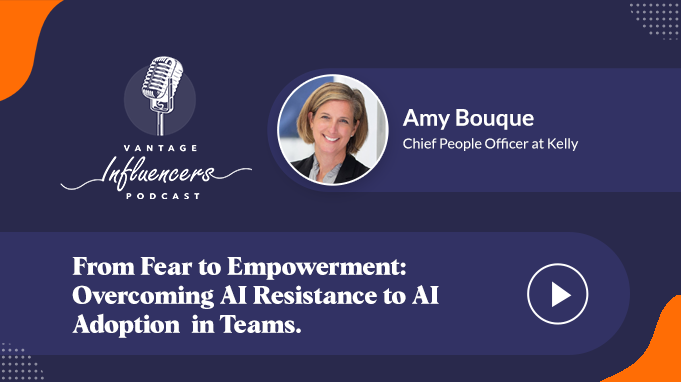
Amy Bouque, Chief People Officer at Kelly, a global leader in specialty talent solutions
Amy Bouque has spent more than 30 years in human resources roles across manufacturing, utilities, and financial services, including work inside power plants and distribution systems, and she trained in lean manufacturing principles and Six Sigma Black Belt methods rooted in Toyota's production philosophy. As Chief People Officer at Kelly, based in Detroit, Michigan, she oversees human resources for more than 5,000 full time employees worldwide and champions initiatives that build purpose, potential, and belonging for job seekers from all backgrounds. She is committed to empowerment, inclusion, and compassion, and views her role at Kelly as a privilege to lead in a talent focused organization that embraces the full humanity of all workers and supports diverse workstyles.
Host
Susmita Sarma, Vantage Influencers Podcast Host
What You Will Learn
- Why treating AI as a collaborative partner rather than a replacement changes how teams adopt new technology.
- How continuous learning and adaptability help employees stay ahead as AI reshapes daily work.
- Why AI freeing people from mundane tasks should be read as an opportunity, not a threat to meaningful work.
- How leaders can spot and remove weaponized language that turns digital transformation into a source of fear.
- What an AI powered employee experience could look like when automation anticipates needs and curates learning in real time.
- How HR and IT can partner more closely to make technology adoption feel like something done with employees, not to them.
Key Topics & Timestamps
| Timestamp | Topic |
|---|---|
| 00:13 | Cold open: reframing AI adoption from fear to empowerment |
| 00:51 | Introducing the episode and guest Amy Bouque |
| 01:21 | Amy's 30-year HR journey across manufacturing, utilities, and financial services |
| 03:02 | Building an AI transformation manifesto: collaboration, adaptability, and creativity |
| 05:46 | An African proverb, an AI generated image, and an education team's rallying theme |
| 08:28 | Unexpected ways AI has boosted team dynamics and creativity |
| 10:38 | Avoiding the "leftover work" trap as AI takes over mundane tasks |
| 12:20 | The biggest misconception about AI in the workplace, and fixing the language around it |
| 13:44 | Designing the ideal AI powered employee experience |
| 15:55 | What AI might ask HR leaders, and how HR should respond |
Full Transcript
Click to read the full episode transcript
Welcome to the Vantage HR Influencers podcast. This podcast is sponsored by Vantage Circle, the simple and AI-powered rewards and recognition platform for employee engagement. AI adoption in teams can often feel like a leap into the unknown, mixing excitement with fear and resistance. Yet, the key to success lies in transforming that fear into empowerment. By shifting mindsets and embracing AI as a tool for collaboration, creativity, and growth, teams can overcome initial hesitations. The future of work is here, and those who view AI as a partner, not a threat, will lead the way in innovation and productivity.
Susmita Sarma: Hi everyone, welcome to another exciting episode of the Vantage Influencers podcast. In this episode, Amy Bouque, the Chief People Officer at Kelly, will share her insights on overcoming AI resistance in teams and embracing AI as a partner in the workplace. We'll explore how AI can boost creativity, reshape team dynamics, and transform the future of work, all while empowering employees to thrive in an AI-powered world. Hi Amy, it's great to have you on the podcast today. How are you?
Amy Bouque: I'm well. Thank you so much for including me. It's great to be here.
Susmita Sarma: Wonderful. So, Amy, you have quite an impressive background in corporate leadership, and so would you like to share a bit about your experiences and how they have shaped your views on workplaces, especially technology in the workplace?
Amy Bouque: Absolutely. I'd be honored to. So I am sort of at that point in my career where I've been at this for over 30 years, always in a human resources role, across a variety of work types and locations and different industries. I've worked in manufacturing and been in the manufacturing facilities. I've worked in utilities and done work in power plants and in distribution systems. I've also worked in financial services. And most recently, in my current role, I have the privilege of serving as Kelly's Chief People Officer. I'm located here in Detroit, Michigan. So when you ask me how it all comes together: back in those manufacturing days, I did a lot of work in lean manufacturing principles and Six Sigma, Black Belt. We were trained under some of the Toyota principles. And when I think about today, and how it influences my way of leading and my vision of the future of work, it's really those principles inside of me that are helping propel my function and the company forward on digital transformation and other key components.
Susmita Sarma: Yeah, rightly said, Amy. And today we have a very interesting topic about AI, the different resistance and the adoption in teams. So to start with, Amy, AI can definitely stir mixed feelings. Speaking of which, if you had to create an AI transformation manifesto for employees, what would be the three most radical shifts that you'd encourage them to embrace about working alongside AI?
Amy Bouque: That's a great question. I love this idea of a manifesto. For me, this really breaks down into three key principles: adaptability, collaboration, and innovation. To break those down, I would start with this idea of seeing AI, and honestly all technology, as a collaborative partner, not a replacement. It reminds us that AI and all AI automation is not here to replace the human worker, but to augment our abilities and enhance our creativity. We should see AI as a colleague, and my team has been doing that for many years with automation. Our bots have names, and we refer to them in a naming convention so they're seen as a vital part of our work. From an encouragement perspective, that collaboration allows us to, instead of fearing obsolescence, treat it as an opportunity to enhance our skills, promote problem solving, and allow us to work at our full potential. That's my collaborative partner and collaboration focus.
The second one I think about is adaptability, which is really a mindset of continuous learning, recognizing that the workplace is changing and we must evolve right alongside it. As an organization, we have a focus on profitable growth, this idea of making sure what we do delivers value and allows our clients and Kelly to succeed. I would encourage each of us to see ourselves as always growing and learning, and being willing to take the time to invest in new technologies. For me, that means staying open and curious.
And finally, I think about this redefinition of using technology to deliver creativity and human value. I very recently had to do a presentation in front of Kelly Education. In the United States, Kelly is the number one provider of substitute teachers in the classroom across the country. Our business leader brought her leadership team together and asked me to present on leadership capabilities, empowering and engaging and unleashing the potential of our teams. I have a proverb, an African proverb, that I carry in my heart as a kind of manifesto: if you want to go fast, go alone. If you want to go far, go together. As I was putting my presentation together, I put that African proverb into AI and asked it for an image. The image it came back with was the most beautiful image of a tiger running fast, and on one half of the image its paw goes to the other half, which shows a long line of humans moving together up a mountain. You can see the energy and power of that long line of people, hands on each other's backs, moving together. That's a creativity I would never have come to on my own, but the imagery was so powerful to the education leadership team that they adopted it as their priority for the year, grow together, and they really embraced it. I offer that it's an old ancient African proverb, a leadership principle I believe in, and AI helped me bring it to life in a really beautiful way. So I think this idea of seeing the creativity and human value, and recognizing that our emotional intelligence, our judgment, our ability to connect with others, will always be our competitive advantage, but AI allows us to free up time and mental energy so we can focus on problem solving, creating meaningful experiences, and leading with vision and empathy. So those would be my three.
Susmita Sarma: Right. So, like you said, you want employees to focus on embracing continuous learning, fostering collaboration with AI, and shifting the mindset from unnecessary competition to a creative kind of partnership with AI. So these shifts are really going to empower employees to see AI as a tool for growth rather than a threat, for sure.
Amy Bouque: Yes, that's right. That's right.
Susmita Sarma: Those are some powerful shifts that you mentioned, Amy. Let's talk about the human side of AI. Can you share the most unexpected way you have seen AI positively impact team dynamics or creativity, something that completely defied initial expectations?
Amy Bouque: Sure. Well, let me start with a fun one. I once asked AI to give me a response to a chat in a certain voice, like a famous actor's voice, and the word choices were hilarious. Sometimes those little spontaneous moments of creativity and fun allow us to just laugh a little bit and connect, and I think that warmth and familiarity is good. But from a creative problem solving perspective, not too long ago my team was stuck, and we used AI as a bit of a silent brainstormer. We have a proprietary product within our Kelly system, and we asked it to create outlandish ideas that no human would ever suggest. At first the list that came out, we were just laughing about it. But within it, something cracked open for us: we looked at these ideas and thought, oh, we could do that. It wasn't any of the ideas the machine had given us, but it was this idea of unlocking our thinking because of those outlandish ideas. So AI isn't just a tool, it's like a wildcard team member, unpredictable and fun and a little weird. But at the heart of it, I worry that we weaponize technology in a way that makes people feel uncomfortable, and I'm trying to encourage my team to use it every day and get more comfortable with it, both in their personal lives and in their professional lives, as we look to improve our employee experience and our talent experience through augmented technology.
Susmita Sarma: Yeah, fantastic example, Amy. And for sure, AI can definitely enhance human connections in the workplace. But there are still fears that AI has already overtaken mundane tasks, and employees might be left with the most boring work to do in the workplace. So how do you think we can ensure that people don't feel like they are just getting the leftovers when AI steps in?
Amy Bouque: That's an interesting question, because I actually don't see it that way. I'm certainly telling my team it's not about being left with the most boring work. In fact, I believe what we're asking of technology, automation, and AI to do is the boring, mundane work. The flip in the narrative isn't taking away the fun work, it's creating the mind space and the time space to really focus on what truly matters. While AI handles the mundane, it's our job to imagine the roles focused on creativity, strategy, and connection. It's the work that only humans can do: the coaching, the connection, the creativity, the consulting. I've been asking my team for years to try to automate, standardize, and simplify work through technology and AI in such a way that they can work at their fullest potential.
Susmita Sarma: Rightly said. Communicating clearly about how AI is going to free them up for more meaningful projects is key, I suppose. Providing opportunities for skill development can also empower them to take on more responsibilities and more engaging work. So it's a crucial process to involve employees in the whole journey of bringing AI into the workplace.
Amy Bouque: Agreed.
Susmita Sarma: So now, if you could wave a magic wand and eliminate one major misconception about AI in the workplace, what would it be?
Amy Bouque: I would go back to my earlier comment and ask leaders to be really clear about the language they're using and the way they're engaging with all workers. Because I worry, as I mentioned, that we weaponize language, not intentionally, but we use terms like digital transformation and upskilling and the revolution of AI, and it potentially leaves people behind. Instead, I believe IT and HR need to be best friends and work much more closely together. When I look at some of the transformative work I see on our client side with our outsourcing consulting group, it's because of digital enablement, our great technology teams helping us. It's called Helix, which aggregates all of this disparate information and really improves our client experience, but we're doing it together. We're doing it with and for our people, not to them.
Susmita Sarma: And if I ask you to envision a workplace where AI seamlessly integrates into daily tasks, providing real time support and personalized learning, what do you think the ideal employee experience would look like in an AI powered corporate world?
Amy Bouque: I was just at a very large technology company earlier this week, and they were talking about how even in their environment they have challenges with employees being able to discover and find everything that they need. There's so much innovation and opportunity and insight, but making it available so the employee knows where it is really matters. So when I think about that question, I think about automation in an AI powered world that anticipates the need and curates learning opportunities. So if you're downloading new software, it automatically says to you, okay Amy, three other people on your team use this software, and in fact Sally's an expert if you need help, and here are three learning resources available in the system for you, and here are the five best use cases this technology has been used for. I would also say employees and leaders would have an AI mentor for skill building, and real time wellness insights that pay attention to the full employee's needs beyond just the work. It's dynamic team matching to tackle projects: it would be able to say you need somebody with this technology capability, or you need a project manager, and it would serve up three project managers who have capacity to help you. Imagine walking into a workspace that adapts to your mood and energy and goals for the day, and serves up what you need, when you need it, where you need it.
Susmita Sarma: And to complement that tool of collaboration and mutual success, workshops and open discussions can probably help bridge the gap between human and AI collaboration.
Amy Bouque: Agreed. I very much agree.
Susmita Sarma: So almost towards the end of our podcast, Amy, ending with a fun thought: if AI could ask HR leaders one question, what do you think the question would be, and how should HR respond to that?
Amy Bouque: By being our partner in unlocking human potential, I'd love to ask AI to keep learning from us, to keep looking at our values, our empathy, and the nuances of human connection, so that as a tool, as a partner, it could help us build inclusive dynamics in purpose driven workplaces, to help us find and solve solutions around breaking down barriers of work. Kelly is known for its barrier breaking work and equity at work initiatives, and to have a tool that makes work accessible, productive, but also deeply meaningful for all people would be my ask.
Susmita Sarma: Okay, my question was a little different. What I asked was: if AI could ask HR leaders one question, what would that be?
Amy Bouque: I guess I would say, within my response, the idea that: how can I, AI, bring the best insights and solutions that allow you to ensure that human potential is being reached, that we're always keeping humanity at the center. How best can I do that for you?
Susmita Sarma: Brilliant, brilliant, Amy. Thank you for sharing your thoughts on overcoming AI resistance and empowering teams to embrace this technology. It's clear that with the right approach, you can turn fear into empowerment, for sure.
Amy Bouque: Thank you very much. It's been a pleasure speaking with you.
Susmita Sarma: Thank you for your time and energy today, Amy. Hope to meet you for another episode very soon.
Amy Bouque: Likewise. Thank you.
Watch the podcast, Spotify, and our YouTube channel for new episodes.
FAQ
What are Amy Bouque's three shifts for an AI transformation manifesto?
Amy Bouque breaks her manifesto down into adaptability, collaboration, and innovation. Adaptability means treating the workplace as constantly evolving and staying open to continuous learning. Collaboration means seeing AI as a colleague and partner rather than a replacement, which she illustrates with how her team names and refers to its automation bots. Innovation means using AI to unlock creativity and human value, something she demonstrates with a story about turning an African proverb into an AI generated image that became a rallying theme for an entire leadership team.
How does Amy Bouque suggest employees avoid feeling like they are left with "leftover work" when AI takes over mundane tasks?
She argues the framing itself is the problem. Rather than seeing AI as taking the fun work and leaving people with scraps, she positions automation as creating mind space and time space for the work only humans can do: coaching, connection, creativity, and consulting. She has spent years encouraging her team to automate, standardize, and simplify routine work through technology so people can operate at their fullest potential instead of being consumed by it.
What does Amy Bouque see as the biggest misconception about AI in the workplace?
She points to language, not the technology itself, as the real problem. Terms like digital transformation, upskilling, and the revolution of AI can unintentionally weaponize how change is communicated and leave people feeling behind. Her fix is closer partnership between IT and HR, so that technology adoption, like her company's Helix platform, is something done with employees rather than to them.
What would Amy Bouque want AI to ask HR leaders?
She would want AI to commit to learning from human values, empathy, and the nuances of human connection, so that as a tool and a partner it can help HR build inclusive, purpose driven workplaces and break down barriers to work. When pushed to frame it as a literal question AI might pose, she reframes it as: how can AI bring HR leaders the best insights and solutions to ensure human potential is being reached, keeping humanity at the center throughout.
Related Reading
Also listen on