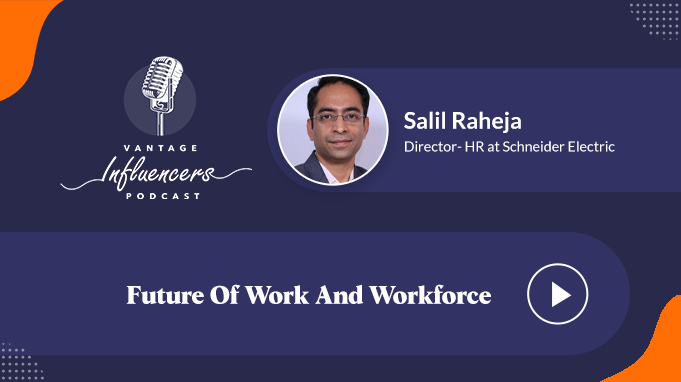
Future Of Work And Workforce
Episode Overview
Salil Raheja has spent close to 15 years in HR, the last six at Schneider Electric, where he leads the HR business partner portfolio for a set of Indian businesses and works on skills transformation and employer brand strategy for the broader organization. In this conversation, he covers five distinct forces reshaping work: remote collaboration, the freelance/gig economy, DEI, AI and automation, lifelong learning, and workplace sustainability.
Salil's central idea is what he calls "meta skills" — an iceberg metaphor where visible technical skills are only the tip, and the 90% below the waterline is learning agility, an entrepreneurial mindset, and soft skills like communication and empathy. He backs this with a specific data point from Google's Project Oxygen study: when Google analyzed what made its most effective managers, technical skills like STEM ranked last, while communication, inclusion, empathy, and coaching ranked at the top.
Episode Highlights
- The work-from-home versus work-from-office debate won't sustain much longer, as organizations converge on a middle ground built on intentional one-on-ones, cross-functional collaboration, and psychological safety.
- The freelance economy is following the iPhone's adoption curve: the underlying capability existed for years before mindsets caught up, and Schneider now treats skills, not fixed jobs, as the basic unit of work.
- DEI is a business imperative, not a compliance exercise, built on leadership commitment, bias-reduction in hiring like blind resumes and diverse panels, inclusive policies, and employee resource groups — and blind-resume hiring should become the norm, not the exception.
- AI will not replace you as an individual, but a person using AI well may replace one who doesn't — Schneider's response is an internal "AI and Data School" running cross-functional awareness sessions.
- "Meta skills" — learning agility, an entrepreneurial mindset, and soft skills — sit below visible technical skills like an iceberg; Google's Project Oxygen study found STEM skills ranked last among traits of its most effective managers.
- Green skills are rising fast: India ranks fifth globally in green-skill workforce intensity, with green talent growing roughly 12% between 2023 and 2024, driving Schneider's internal "Sustainability School" initiative.
About the Guest
Salil Raheja — Director-HR, Schneider Electric
Salil Raheja has 15+ years of experience across HR business partnering, talent management, organization design and simplification, and employer brand amplification, currently serving as HR Business Partner for multiple business units in India. He is a Hogan Certified Coach, honored by Business World among the HR 40 Under 40 HR Leaders in 2023, by TA Pai Management Institute & People Consulting as Young HR Leader 2023, and by People Matters and DDI as an Emerging Future HR Leader in 2016.
Connect with Salil on LinkedIn
Host
Sanjeevani Saikia — Vantage Influencers Podcast Host
What You Will Learn
- Why the work-from-home versus work-from-office debate is giving way to a middle ground, and what actually builds camaraderie in remote teams
- How the freelance and gig economy is following the same adoption curve as the iPhone, and why treating skills — not fixed jobs — as the basic unit of work is gaining ground
- Practical, structural strategies for DEI: leadership commitment, bias reduction in hiring, inclusive policies, and employee resource groups
- Why AI is unlikely to replace individuals outright, but why people who use AI well will outcompete those who don't
- The concept of "meta skills" — learning agility, an entrepreneurial mindset, and soft skills — and why Google's Project Oxygen study found technical skills mattered least for effective managers
- How sustainability is reshaping both workplaces (green infrastructure, ethical supply chains) and the workforce (rising demand for green skills)
Key Topics & Timestamps
| Timestamp | Topic |
|---|---|
| 01:02 | Salil's corporate journey so far |
| 03:00 | Enhancing virtual collaboration in remote work |
| 08:32 | Impact of flexible working hours or arrangements |
| 13:32 | Ways to promote inclusion in the workplace |
| 17:40 | AI, automation, and the future of jobs |
| 22:12 | Embracing lifelong learning |
| 28:06 | Promoting eco-friendly practices in the workplace |
| 34:33 | End note |
Full Transcript
Click to read the full episode transcript
Sanjeevani Saikia: Hi everyone, I'm Sanjeevani Saikia, your host, and I'm thrilled to welcome you to another exciting episode of the Vantage Influencers Podcast. The conversation around the future of work and workforce is at the forefront of our minds like never before, with remote work becoming the new norm and automation reshaping industries — the very fabric of how we work is undergoing a massive shift. We're not just discussing the future of work here, we're actively shaping it. Today, I'm thrilled to welcome Salil Raheja, Director-HR at Schneider Electric, a distinguished authority in leadership and organizational development, to explore this vital topic with us. Hi, Salil, thank you so much for joining today's conversation.
Salil Raheja: Hi, Sanjeevani. Thank you for inviting me. My pleasure to be part of this podcast today.
Sanjeevani Saikia: Great to have you today with us. Before we dive into today's topic, I'd love to hear about your professional journey so far.
Salil Raheja: Sure. So just to give a very brief introduction about my professional journey — I've been an HR practitioner for close to 15 years now. I'm basically an engineer, but I always wanted a management degree, so that's where I went into HR 15 years back, post my MBA from MDI Gurgaon. My first stint was at a company called SRF Group, where I worked for nine years across two different domains of HR — I had a stint in factories, a stint in the corporate office, managed the HR BP portfolio for the sales teams, and certain CoE roles in talent and performance management. That was the journey of nine years. After that, I moved to Schneider Electric, a global MNC in industrial automation and energy management, where I've now been for close to six years. In my current capacity, I manage the HR BP portfolio for a set of businesses here in India, and along with that, I work with the business leaders for those businesses on the next stage of our people strategy and priorities. I also work with my colleagues on the India HR leadership team on strategic projects around the workforce of the future, org design, and building a strong employer brand for ourselves in the market. That's been the journey for the last six years, and I've really loved my time with the company.
Sanjeevani Saikia: Wonderful, thank you so much for sharing your journey with us — truly appreciated. Today, we're diving into the vast topic of emerging trends in the future of work and workforce, and while we won't be able to cover everything in this episode, there are a few crucial areas I'm very excited to explore. First up, let's talk about the recent surge in remote work. Given the significant shift towards remote work, what innovative methods do you see emerging to enhance virtual collaboration and recreate a sense of companionship of the traditional office environment? At the same time, Salil, could you highlight how alternative work models like gig economy platforms impact traditional employment structures?
Salil Raheja: Sure, thank you for that question. Let me address the first piece around remote work. A lot has changed after the pandemic — the entire concept of remote work has gained more and more prominence. But I don't think the debate on work-from-home versus work-from-office will sustain for much longer, because there's always a middle ground that companies are arriving at. Having said that, the future of work has undergone a significant transformation, especially with the widespread adoption of remote work. Some innovative methods organizations are embracing to enhance virtual collaboration and foster camaraderie among remote teams: one is creating space for collaboration through one-on-one connections — in remote settings, leaders must intentionally connect with team members on a personal level, doing regular one-to-ones, building relationships, encouraging idea sharing, and providing support wherever required. Second is cross-functional collaboration — bringing people spread across the country or the globe together in virtual brainstorming sessions or cross-functional project groups, allowing exchange of ideas and perspectives, because that helps foster innovation.
There's also a lot we can leverage through technology. Video conferencing is used beyond regular meetings — for team-building activities, workshops, social events. Collaborative tools like Microsoft Teams, Slack, and Google Docs facilitate real-time collaboration and seamless communication and document sharing. And lastly, a piece that's not spoken about as much is building an environment of trust and psychological safety with your team, especially in remote setups. Transparent communication helps here — leaders should be open to sharing information transparently, addressing concerns, and creating a psychologically safe environment where employees feel safe expressing their opinions, even if they differ from the majority view. Those are some real examples organizations are using to build camaraderie and collaboration in remote setups.
Now, on the freelance and gig economy — this is a topic I've personally invested a lot of time in, because I've been working on it at Schneider under our approach of putting skills, not jobs, as the denominator of work. The skills-first approach is part of our people strategy — increasing skill diversity by accessing a broad, on-demand talent pool, which is exactly what freelancers provide. Let me bring in an analogy: in the 90s, when we were all using landline handsets, they worked reliably for multiple decades — much like jobs today, which have lasted for decades and offered reliable rewards. But what we don't realize is that in the late 90s, the research behind the iPhone was already happening in terms of the computing power required — yet people rejected it, assuming it would need a massive amount of computing power and storage they didn't think was feasible. That's exactly what's happening in the space of future of work — network providers and freelance platforms already exist to give you access to a wide pool of freelancers, but there's still a mindset of being fixed into a full-time role, which organizations are trying to move past. Just as small incremental upgrades made us the iPhone users of today, I think these small incremental upgrades happening now will shape the future of work.
There are multiple forces pushing organizations toward this. External forces: the need for agility to foster innovation quickly, and a strong, growing talent pool available especially post-pandemic. Internal forces: a strong skill demand-versus-supply gap that freelancers help bridge, and employee demand elasticity — you don't always need full-time employees for every role. On the toolset side, talent marketplaces that were once mostly internal have now expanded into external freelance marketplaces giving companies access to these pools. And finally, there's a mindset shift — organizations are rethinking how jobs have been structured, moving from organizing and filling jobs to deconstructing jobs, automating parts of them, and reconstructing what's left as freelance-compatible work. This is where job architecture is moving toward skill architecture — matching skills to tasks rather than people to roles. At Schneider, we've taken on a skills-transformation project specifically to build a skill architecture for the future, and traditional career ladders are shifting toward reskilling pathways that reflect individual motivations.
In summary — the freelance economy can't be ignored; it'll continue to be a trajectory of significance over the next three to five years. It's not separate from the existing workforce model, more like augmentation or a complementary setup that gives faster access to hyper-relevant, quality skills that might not be easy to find otherwise. At Schneider, we use this for new revenue generation, sustainability audit consulting, and specific expertise like content creation. It's a long game — start small, iterate fast, and there are enough external partners now to help access that pool of freelancers.
Sanjeevani Saikia: Interesting — you've loosely explained both remote working and the gig economy. I think there's one other thing that's equally important, and that's DEI. The fundamental pillars of diversity, equity, and inclusion have assumed a pivotal role in shaping the narrative of the future of work, with organizations recognizing the significance of fostering environments that champion equal opportunities for every individual. What practical strategies can organizations implement to create environments that prioritize DEI and ensure equal opportunities for all employees?
Salil Raheja: Sure. DEI as a topic is now core to any people strategy, and not just people strategy — the overall business ambition of any organization, because of the benefits it brings. It increases innovation and creativity, enhances decision-making across a larger team, leads to more inclusive problem-solving, increases employee engagement and retention, and creates a strong employer brand. At Schneider, we believe DEI is a business imperative because it creates a culture of innovation and performance generated through diversity of people and a strong environment of inclusion. Our ambition is to offer equal opportunities to everyone, everywhere — DEI for us isn't only about the right gender mix, but ensuring fair representation of diverse groups and that every individual has the opportunity to be the best version of themselves.
On strategies organizations can implement: first and most important is a clear commitment at the leadership level — communicated through mission statements, policies, and public statements, with leaders modeling that dedication by example. Second is eliminating conscious or unconscious bias in processes like hiring and promotion — training recruiters and hiring managers on bias, using diverse interview panels, and concepts like blind resumes to minimize bias. Third is building holistic, inclusive work policies that support employees at every life stage — flexible work arrangements, accommodating diverse needs, promoting work-life balance, and providing career development resources regardless of background or gender. We also have employee resource groups at Schneider, which encourage diverse representation in leadership positions, provide a sense of belonging, and foster networking, mentorship, and insight for participants. Last but not least is creating a culture of continuous dialogue — this isn't a topic with a short-term end state, so it's important to keep the conversation going with leadership, employees, and managers, continuously building awareness.
Sanjeevani Saikia: You've touched on something crucial — fair and unbiased hiring practices like blind resume policies. Do you think this will become a norm rather than an exception in the future?
Salil Raheja: It should. If we want to move into a culture where we truly eliminate bias, that's where the challenge lies — coaching hiring managers and people leaders to embrace this mechanism rather than seeing it as "yet another HR initiative." It ideally should become a norm, because that's where the real change happens.
Sanjeevani Saikia: True, perfect. Now, with the increasing prevalence of artificial intelligence and automation, the nature of employment is undergoing a profound transformation. While these shifts bring new opportunities, they may also bring challenges for workers. Could you help us understand the nuances and implications of these changes, and how individuals can proactively prepare for the jobs of tomorrow?
Salil Raheja: Any discussion today can't ignore AI. I'm reminded of a quote by William Gibson: "The future is already here, it's just unevenly distributed" — and that's exactly what's happening with AI. It's not that AI suddenly sprung up; it's been in the works for years, it just became far more visible after ChatGPT. This convergence of AI and automation is reshaping the world of work, bringing both opportunities and challenges.
On opportunities: first, AI enhances efficiency by automating repetitive tasks, freeing up human capacity for more complex, creative work. Second is personalized learning — AI-driven platforms can tailor learning experiences and enable continuous skill development. Third is improved decision-making — AI analyzing vast data sets to help organizations make better decisions across domains.
On challenges: there's a lot of research around job displacement. I'm not an expert in this specific field, but what I can share is that I don't think jobs will go away entirely — but reskilling will be required for a lot of what we do today, as some tasks currently done by humans get taken over by machines, leading to workforce shifts we need to be ready for. Second is the ethical considerations of AI — as AI systems make more decisions, questions arise around bias, transparency, and accountability. Third is privacy — as more data gets collected through AI-driven systems, privacy concerns follow. But I strongly believe AI may not replace you as an individual, but a person using AI may surely replace you — so you need to be ready for that future, and it starts with upskilling yourself and learning more about AI. At Schneider, we took an early lead here with a team called the "AI and Data School," which runs regular sessions with employees across different domains on how AI touches different functions, including HR. The first step to prepare for the jobs of tomorrow is to embrace this and get more aware of what this technology brings to your own domain.
Sanjeevani Saikia: Really interesting — my biggest takeaway is that AI will not replace us, but a person who uses AI will. Now shifting gears — earlier, once you got a degree, you were considered set for life, but that's not true in today's scenario. We've got to keep learning and upgrading ourselves at every step. How can individuals navigate the demands of lifelong learning to proactively reskill and remain well-positioned in a rapidly changing job market?
Salil Raheja: Sure. Let me bring in a well-known quote I read a few days back: "The illiterate of the 21st century will not be those who cannot read and write, but those who cannot learn, unlearn, and relearn" — that's from Alvin Toffler's book, Future Shock, written many years back. As I was thinking about this quote, I actually searched Google for what skills you'd need for the future — and Google gives you close to one and a half billion search results on this topic. I tried a similar search on LinkedIn, and it gives an equally diverse range of advice. But in a world where automation is like a rising tide that can do more and more of what humans currently do, we need to look for skills relevant not just today, but for multiple decades to come — and that's where I want to bring in the concept of "meta skills."
Meta skills are the higher-order, general skills that enable you to develop the core of what you do in your domain. Think of an iceberg — the visible skills are the tip above the water, but meta skills are the 90% below the waterline. Let me share three. First, learning agility — the ability to quickly size up a new situation or problem and decide what to do; it's about knowing what to do when you don't actually know what to do. I think this may become one of the strongest predictors of a person's ability to flourish in a fast-changing world. There are different dimensions to it — mental agility, people agility, change agility (how comfortable you are with new experiences), results agility (staying positive and still delivering results in a fast-changing environment), and self-awareness. But learning agility isn't something you learn online or in a classroom — the only reliable way is through experience, taking on new challenges, and seeing them through to success.
Second is what I call the entrepreneurial mindset — not about becoming an entrepreneur, but having the mindset of one to flourish in a fast-changing world: dreaming big, recognizing opportunities, picking up problems and making an impact around solving them, being resourceful and persuasive, being action-oriented, and having the tenacity to solve situations. Third is soft skills — often underrated. Let me bring in a Google example: Google ran a project called Project Oxygen years back, trying to understand what makes the most effective managers on high-performing teams stick. When the results came out, technical skills — STEM specifically — actually ranked last, which was a genuine surprise. The top seven skills that came out instead were: communication and listening, including others with different viewpoints in discussions, having empathy and being supportive of colleagues, being a good critical thinker and problem solver, making connections across complex ideas, and being a good coach. Interestingly, this was validated by a World Economic Forum poll years later listing the top skills required for the future — many of the same dimensions came up: complex problem solving, critical thinking, creativity, people management, and emotional intelligence. I think these three meta skills — learning agility, entrepreneurial mindset, and soft skills — have stood the test of time for many years, and will remain important for the next two to three decades.
Sanjeevani Saikia: True. Beyond the individual level, the broader context of sustainability and environmental impact is increasingly shaping the narrative around the future of work — it prompts us to envision how workplaces can align with efforts to promote eco-friendly practices and reduce carbon footprints. What do you have to say about that?
Salil Raheja: The entire topic of climate change and sustainability is very close to what we do at Schneider — I'm proud to work for an organization where this is core to our purpose, which is to empower all to make the most of energy and resources, in the process bridging progress and sustainability for all. Let me break this into two parts — workplaces, and the workforce itself. On workplaces, organizations are increasingly embracing remote work, which reduces the need for daily commuting and lowers carbon emissions from transportation. It's also about integrating green technology into infrastructure — energy-efficient lighting, smart building management, renewable energy — which are becoming more prevalent. It's also about sustainable supply chains — prioritizing sustainable and ethical sourcing, adopting eco-friendly materials, and responsible supply chain management. And it's about advocacy and education — companies investing in building awareness among employees and encouraging sustainable practices both at work and in personal life.
On the workforce side, as the world transitions toward environmentally friendly practices, demand for skills related to renewable energy, energy efficiency, and sustainable design will only increase — this is the concept of "green skills" getting integrated into the workforce. This trend has already started reshaping the job market, leading to new roles like sustainability specialist, renewable energy engineer, carbon footprint analyst, and green technology consultant. A study last year ranked India fifth among the top 25 countries with relatively high green-skill intensity in its workforce, and reported that green talent in the workforce rose by close to 12% between 2023 and 2024. This trend will only increase, and it places an onus on organizations to invest in future skills — and not just organizations, but educational institutions and training providers too, some of which are already catering to this growing demand for sustainability expertise.
As for organizations, we can also look at launching awareness programs. At Schneider, we have an initiative called "Sustainability School," where we encourage and expect all employees across the company to upskill on sustainability, starting at a beginner level and moving into advanced stages, regardless of function, because this topic touches all of us in some way. One of our newer brand campaigns, called "Impact Makers," looks for exceptional people and organizations turning sustainability ambitions into action at the intersection of automation, electrification, and digitization. As an organization, our growth ambition is to become an industrial technology leader, working with and for our customers, partners, employees, and communities to enable a sustainable future through electrification, automation, and digitization. With that ambition, just a few months back, we repositioned our culture and people values, launching a strong employee value proposition called "IMPACT" — inclusion, mastery, purpose, action, curiosity, and teamwork. There's a lot happening in this space, and it's a trend that will only get more attention.
Sanjeevani Saikia: True, correct. We've tried to touch on aspects I think are very crucial for the future of work and workforce, and I'd like to thank you for helping us understand all of this better. We've reached the end of today's episode — Salil, is there a final thought you'd like to leave our listeners with? And for those staying connected with you beyond this episode, could you share how they can reach out to you?
Salil Raheja: Sure. The one thing I'd leave your listeners with is to have a very curious mindset — that's something that really helps me grow, both personally and professionally. Having that curiosity, the ability to connect dots across different streams and ideas, and bringing that to what you do as an individual, is something I think is very important. As for reaching me — I'm available on LinkedIn, where I try to post regularly under my blog, "Curiosity Stream," and I'm also on Twitter/X under the handle Salil Raheja. I'm happy to get inputs and feedback on this conversation. Thank you so much for inviting me, and I really look forward to more such enriching conversations.
Sanjeevani Saikia: Great — Salil Raheja, thank you so much for joining today's conversation. Your insights and expertise have added immense value, and we appreciate the time you've dedicated to sharing your knowledge with our listeners. So, a big thank you.
Salil Raheja: Thanks a lot. Thank you, Sanjeevani.
FAQ
What are the biggest shifts shaping the future of work?
Salil Raheja points to five converging forces: remote and hybrid collaboration, the rise of the freelance and gig economy, DEI as a business imperative, AI and automation reshaping jobs, and sustainability driving demand for green skills.
Will AI replace jobs?
Salil Raheja argues AI is unlikely to replace individuals outright, but a person who knows how to use AI effectively will outcompete one who doesn't. He frames the real risk as a reskilling need, not blanket job loss.
What are "meta skills"?
Meta skills are the higher-order, general capabilities beneath visible technical skills — Salil Raheja names three: learning agility (knowing what to do when you don't know what to do), an entrepreneurial mindset, and soft skills like communication, empathy, and coaching.
What did Google's Project Oxygen study find about manager effectiveness?
The study found that technical skills, including STEM expertise, ranked last among traits of Google's most effective managers. Communication, inclusion of differing viewpoints, empathy, critical thinking, and coaching ranked highest.
Related Reading
Also listen on