Are Gamification and Micro-learning the Perfect Match for L&D Success?
Episode Overview
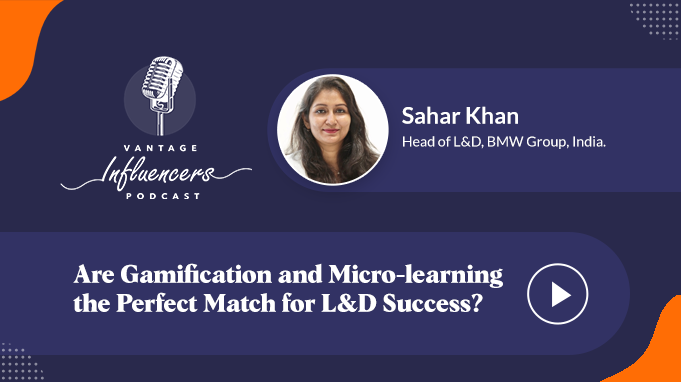
L&D teams keep trying to make training stick, and too often it still feels like throwing information at a wall. In this episode of Vantage Influencers, host Sanjeevani Saikia speaks with Sahar Khan, Head of Learning & Development at BMW Group India, about whether gamification and micro-learning genuinely solve that problem, and when combining the two is actually the wrong move.
Sahar grounds the conversation in the psychology of forgetting, walks through real examples from ICICI, Urban Company, and Duolingo, and makes a clear case for when gamification helps and when it's just unnecessary noise layered onto something that already works on its own.
Episode Highlights
- The Ebbinghaus forgetting curve is the real reason micro-learning works: research shows up to 90% of learning is forgotten within two months without reinforcement at intervals.
- Gamification and micro-learning solve different problems. Micro-learning delivers information in the moment; gamification motivates people to engage with content they might otherwise avoid.
- ICICI runs a six-month onboarding program called "Code of IT" where most modules are gamified micro-learning, and employees can't complete probation without finishing them.
- Urban Company technicians use in-the-moment micro-learning modules on their devices to look up exactly the part they need mid-repair.
- Gamification is the wrong tool for intrinsically motivated learners. Layering game mechanics onto something a learner already wants to do creates "overkill" and becomes an interruption, not a help.
- Gamified formats change the feedback loop and its perceived stakes. A static bulletin board announcing a sales contest lands very differently than a live leaderboard, because the leaderboard amplifies visibility and reframes competition as something positive rather than punitive.
About the Guest
Sahar Khan — Head of Learning & Development, BMW Group India
Sahar Khan is a Human Resources professional with 14 years of experience delivering HR practices across pharmaceutical, FMCG, apparel retail, automobile, and NBFC sectors. Based in Delhi, she currently leads Learning & Development at BMW Group India, with previous roles at Aditya Birla Fashion and Retail (Pantaloons), McCain Foods, and Glenmark Pharmaceuticals. She holds an MBA in Human Resources from the Symbiosis Centre for Management and Human Resource Development.
Connect with Sahar on LinkedIn
Host
Sanjeevani Saikia — Vantage Influencers Podcast Host
What You Will Learn
- Why the Ebbinghaus forgetting curve makes micro-learning necessary, not just nice-to-have
- What gamification actually adds on top of micro-learning, and where the two work independently
- Real examples of gamified L&D from ICICI, HDFC, Urban Company, and Duolingo
- How to avoid tool overload when choosing L&D platforms
- When gamification becomes overkill for intrinsically motivated learners
- How to actually measure whether gamified micro-learning is working
Key Topics & Timestamps
| Time | Topic |
|---|---|
| 02:00 | Sahar's corporate journey so far |
| 03:11 | Why gamification and micro-learning make such a strong combination |
| 06:18 | How gamification makes learning more engaging when paired with bite-sized lessons |
| 12:02 | Real examples where the combination transformed an organization's L&D |
| 15:28 | Choosing the right tools without getting lost in the noise |
| 21:23 | How to measure the success of combining gamification with micro-learning |
Full Transcript
Read the full transcript
Sanjeevani: Welcome to the Vantage HR Influencers Podcast. This podcast is sponsored by Vantage Circle, the simple and AI-powered rewards and recognition platform for employee engagement.
Sanjeevani: Hey everyone, and welcome to another episode of the Vantage Influencers Podcast. I'm your host, Sanjeevani Saikia, and I'm really excited about today's conversation. The world of L&D, learning and development, is evolving very fast, bringing both new opportunities and challenges. We all want training programs that truly engage learners and leave a lasting impact. But let me be honest, sometimes it feels like we're just throwing information at the wall, hoping something sticks. That's why I find the idea of gamification and micro-learning so fascinating. But I have some basic questions: could they be the game-changers we've been looking for? Do they actually work together to create better learning experiences? That's exactly what we're diving into today. To help us with this, I'm thrilled to welcome Sahar Khan, Head of Learning & Development at BMW Group. Sahar brings a wealth of experience, and today she'll help us explore the real impact of gamification and micro-learning. Let's begin our conversation. Hi, Sahar, how are you doing?
Sahar Khan: Good evening, thank you so much for inviting me, it's an honor.
Sanjeevani: It's our pleasure. Before we start our conversation on the topic, would you like to walk us through your corporate journey so far? I'm sure all our listeners would love to know how your journey has been.
Sahar Khan: Thank you so much, Sanjeevani. I started my journey in 2011 when I graduated from business school, and started my career at a pharmaceutical company based out of Bombay. After that, I had the privilege of working across four companies in four different sectors, pharma, FMCG, retail, and right now I'm in the automobile and NBFC space. I've been very privileged to work across all of these sectors, and along the way I got exposure to a range of HR practices, from talent acquisition to talent management, development, and HR business partnering. The interesting part I've really enjoyed has been learning how to craft HR delivery to suit the specific needs of each business, since these businesses have all been very different from one another. Through that journey, I also realized how pivotal learning and talent development are to a business's success.
Sanjeevani: Wonderful, Sahar, thank you for sharing your journey. With your permission, I'd like to move into the topic.
Sahar Khan: Yes, let's go ahead.
Sanjeevani: Moving to our topic: gamification and micro-learning, the perfect match for L&D success. Gamification and micro-learning are often seen as dream elements in the L&D space. In your opinion, what makes these two such a powerful combination, and to what extent do they actually enhance learning and development outcomes?
Sahar Khan: Before I answer why it's such a perfect combination, let me go back to basics, since I'm sure a lot of younger listeners will be consuming this too. Micro-learning is something that teaches in the moment. It's effective because it delivers short chunks of information reinforced at regular intervals, which maximizes retention. There's a concept called the curve of forgetting: in the 1880s, a German psychologist named Hermann Ebbinghaus formulated what's now called the Ebbinghaus forgetting curve, which shows that the more time passes between learning a concept and putting it into use, the more likely that material is to be forgotten. Research actually shows up to 90% of learning is forgotten within two months. So it's important to combat this problem of forgetting, which all of us deal with, and if anything, as we get older, forgetfulness only increases in my experience. The antidote is spaced learning, presenting concepts at regular intervals to reinforce retention, and that's exactly where micro-learning comes in.
Now combine that with gamification, and you get an extremely powerful combination, because gamification helps motivate people to do things they might not otherwise want to do. It borrows elements from video games, self-paced learning, and introduces rewards that encourage learners to complete, and sometimes even enjoy, their training. Together: micro-learning provides in-the-moment training, so if I want to learn something right now, I don't want a three-hour or full-day classroom module, micro-learning gives me a 15-minute, or even 5-minute, nugget of information. With gamification, learner engagement goes up because everyone loves to play games, and you also get faster measurement of effectiveness. Put together, it's a genuine match made in heaven: it boosts engagement, improves knowledge retention, gives instant feedback, and ultimately improves workforce productivity.
Sanjeevani: Gamification is clearly gaining popularity, and it has this quality of making learning engaging and enjoyable, which pairs well with the bite-sized nature of micro-learning to create real synergy. What makes gamification specifically so engaging, and why are people looking for it across every platform they use?
Sahar Khan: Learning has traditionally been a push, the organization pushes employees to learn. Gamification has become a genuinely enabling tool for L&D practitioners because it's fundamentally about fun, about adding competition or reward to increase engagement with content or tasks that otherwise wouldn't be very engaging. Compliance training, process improvement training, these tend to be quite boring, that's feedback I've heard consistently across my career, but they still need to be done, often year on year, because they reduce operational risk for the company. So it's important to get people to do these tasks willingly. Gamification borrows from video and online games and introduces concepts like badges, storytelling, and progress dashboards. It creates individual and team leaderboards, encouraging healthy competition among teams and individuals, which creates the fun element. Gamified micro-learning is also usually available on the go, people can access it from home or while commuting. It gives immediate feedback too, say I fail a level and I'm told I got seven out of ten but needed nine to make the leaderboard, I can immediately try again. And if something's wrong, like a glitch or unclear explanation, that feedback comes back immediately too. One of the best things is that it allows social features, commenting, asking questions, cheering each other on, which builds a real sense of community, especially powerful for large distributed teams like banks, retail organizations, or FMCG companies where people aren't all working out of the same physical space.
Sanjeevani: On the business side, take something like a sales contest. If you just post results on a bulletin board, the reaction is very different than if you put it on a gamified leaderboard. Does gamifying it actually amplify how seriously people take the contest?
Sahar Khan: You're right that a bulletin board has a different impact, it's from a previous era, very formal, static, tied to one physical location. It has its impact, it shows results. But a gamified format amplifies things in a real way, almost everyone in the company will be logged into that portal, and whether or not they're participating, a notification will reach them. Nobody has to physically go anywhere to see the results. Since it's gamified, people also tend to take it in a more positive spirit, because a game gives you room to fail and try again. During something like a sales contest, there are rewards at every level, the idea is to reward the learner and create a pull that brings them back. You give people leaderboards, extra lives, extra coins throughout the journey to stay engaged, so that even if one team wins, everyone still sees their own individual score, as a team and as an individual. That creates ongoing positive benchmarking among teams that a static leaderboard, in my experience, just isn't able to deliver.
Sanjeevani: Traditional training programs can feel like a mundane task that leaves employees disengaged, but there are real stories of gamification and micro-learning transforming the learning experience. Do you have any real-life examples where this combination completely changed the game for an organization's L&D?
Sahar Khan: One of the best examples I came across while preparing for this podcast, which I actually keep on my phone, is Duolingo. It's not a corporate application, but it offers plenty of ideas companies can adapt, and I've borrowed from it myself several times. It provides language learning to anyone who wants it, and its usage has doubled since the pandemic and keeps growing. It gives you micro-learning, puts you into contests, gives you a leaderboard, and lets you benchmark yourself against others, though the learner still has to choose to show up. In actual corporate settings, one of the best stories is from Urban Company. Anyone living in a metro who's interacted with their technicians will have seen this: the company gives them strong micro-learning modules, because micro-learning happens in the moment. I've personally seen an Urban Company technician come to service my AC, not know exactly which part was needed, go straight to the relevant micro-learning module on his device, learn what he needed, and resolve the issue immediately.
Another example from large industry: HDFC and ICICI use gamification and micro-learning extensively, not just to drive sales but for HR processes too. ICICI, for instance, has a program called "Code of IT" that runs for the first six months after an employee joins. There are around ten modules, most completed through micro-learning and contests, with scores accumulating along the way, and the last two done face to face. Employees can't complete their probation until they finish these modules. This turns what would otherwise be a stretched-out, easy-to-lose-track-of onboarding journey into something gamified, where learners can go back and check what they've learned, with leaderboards published throughout. Companies like HDFC and ICICI, with large numbers of people joining constantly, really lean into this. Beyond banking, companies like Nestle, Philips, Coca-Cola, and Wipro use gamified and micro-learning extensively for sales teams and other departments too.
Sanjeevani: With so many tools out there claiming to make learning more fun and effective, having lots of options is a good problem to have, but it can also lead to decision fatigue. How can L&D teams pick the right tools without getting overwhelmed?
Sahar Khan: Great question. As HR professionals, we need to be careful about which content gets delivered through which platform or medium, because every few months there's a new trend or fad flooding the market. We need to be discerning about what should be driven to whom, and what outcome we actually expect. Micro-learning as a concept is very widely applicable and doesn't need gamification to be worthwhile, it can work perfectly well on its own, as long as the learner is motivated, like the Urban Company technician example, someone who needs to know something in the moment, without requiring complicated effort to access the material. Game mechanics, on the other hand, are best applied in scenarios where learners aren't intrinsically motivated to access the content, essentially, you're creating a pull factor. That's why gamification works well for things like compliance or process-improvement training, necessary, ongoing, but not naturally engaging.
But if you already have an intrinsically motivated learner who genuinely wants to access the content, adding gamification at that point is unnecessary overkill, it becomes an interruption rather than a help. As HR professionals, we need to be clear about which medium suits which situation. Micro-learning and gamification both help drive behavior when you need change quickly, but long-term behavioral shifts, like leadership development, can't be achieved through gamification and micro-learning alone. That requires different platforms entirely, reflection, self-assessment, peer learning, coaching, mentoring. One size doesn't fit all, and discernment is genuinely important for L&D professionals as new trends and technologies keep emerging.
Sanjeevani: With Gen Z entering the workforce, do you think gamification content needs to change for them specifically, something different for Gen Z versus millennials?
Sahar Khan: That's a great point. Gamification works really well with Gen Z because this generation is very tech-savvy, everything needs to be at their fingertips, and gamified learning makes it easy to learn on the go, while commuting or heading into a meeting, getting results and feedback fast. It's also adapting content on a gamified, micro-learning platform is much faster and more cost-efficient long-term, if one part of a business process changes, or a new product feature launches, you only need to update that specific piece of micro-learning or that specific gamified question, and you're back up and running. That's genuinely cost-effective at scale. And while Gen Z really enjoys learning fast and on the go, non-Gen-Z employees are enjoying gamification too, because at its core it's about positive competition and getting a score immediately, so adoption is strong across both groups.
Sanjeevani: As we near the end of the episode, we've covered how gamification and micro-learning are transforming L&D. But as with any strategy, the real measure of success is in the results. What's the best way for organizations to measure whether combining gamification with micro-learning is actually working?
Sahar Khan: As we discussed, combining the two has to be done thoughtfully, with a firm eye on business outcomes, the goal isn't just to get people to play and feel good without delivering real results. You measure it through engagement levels, course completion rates, and impact on actual job performance, faster resolution of customer complaints, higher sales of a focus product if you're in retail and training your sales staff on new features, higher completion rates for compliance-style training, reduced operational risk. All of that helps determine whether the training has actually been effective. And with gamified learning, feedback comes back continuously, you know almost immediately how many people are engaging with the program, whether it's easy enough for learners, how much time they're spending on the platform, giving you a range of data points to analyze the kind of engagement the L&D team or gamified platform is actually creating.
Sanjeevani: Thank you so much for sharing your valuable insights today, I thoroughly enjoyed this conversation. Before we wrap up, any final thoughts or advice for HR professionals striving to earn a seat at the table, and how can people reach out to you?
Sahar Khan: For anyone in HR trying to earn a seat at the table, or starting out, or venturing into something new, HR is a beautiful profession that teaches you empathy and problem-solving. My advice: be a lifelong learner. New things come up every day, and there are multiple ways of doing the same thing, don't get stuck thinking the way you learned something is the only way. Stay humble, stay open to learning from others, and build a network of peers you can exchange honest feedback with, feedback is a gift, and honest colleagues and friends are the ones who can give you genuinely useful, critical feedback that helps you improve. Enjoy HR, it's a beautiful profession, we're there to enable other people's careers, but in that rush, never forget to enable your own, HR often comes last in its own career development conversations, so you have to be emotionally strong about that. In your effort to help others grow, never put yourself last, seek out opportunities to learn, to gain mentorship, and to offer help wherever you can. The best way to reach me is via LinkedIn, feel free to drop me a message and I'll get back to you.
Sanjeevani: Wonderful, thank you so much, Sahar, once again for being here with us, it's been a pleasure.
Sahar Khan: Thank you so much, it's been a pleasure on my side too.
FAQ
Why does micro-learning work better than traditional training for retention?
Micro-learning directly combats the Ebbinghaus forgetting curve, research shows up to 90% of learning is forgotten within two months without reinforcement. Delivering information in short, spaced-out chunks maximizes retention far better than one-off, longer training sessions.
What does gamification add on top of micro-learning?
Gamification motivates people to engage with content they might not otherwise want to complete, using elements like badges, leaderboards, and rewards borrowed from video games. Micro-learning delivers the "in the moment" information; gamification makes people want to show up for it.
When is combining gamification with micro-learning the wrong choice?
When the learner is already intrinsically motivated to learn something. Adding gamification on top of content someone already wants to access becomes unnecessary overkill and turns into an interruption rather than a help, gamification works best for tasks people wouldn't otherwise willingly engage with, like compliance training.
How can organizations measure whether gamified micro-learning is actually working?
Through engagement levels, course completion rates, and downstream business impact, faster complaint resolution, higher sales of a trained-on product, reduced operational risk, and real-time platform data on how much time learners spend engaging with the content.
Related Reading
- A Brief Guide On Experiential Learning In The Workplace
- Continuous Learning in the Workplace: Definition, Benefits, and How to Build a Culture
This episode is part of the Vantage Influencers Podcast, where we bring HR thought leaders to discuss engagement, compensation, benefits, and everything related to HR.
Also listen on