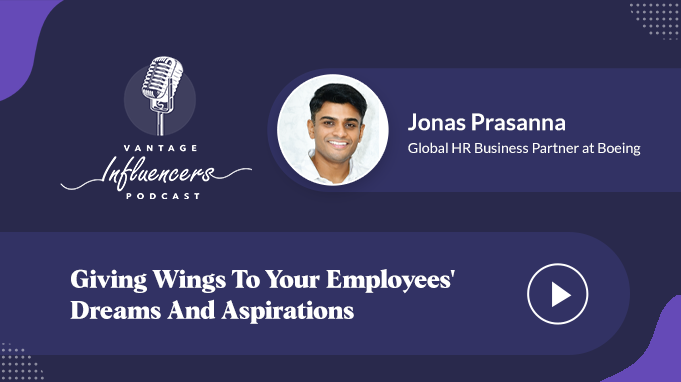
Giving Wings To Your Employees' Dreams And Aspirations
Episode Overview
Jonas Prasanna knew early on he wanted a career in HR (rare among peers who "fell into" it after trying other paths) and built his way through Philips, Capgemini (where he ran employer branding and social recruitment, including launching IPL content on what became Disney+ Hotstar), and now Boeing as Global HR Business Partner. His definition of employee engagement is deliberately simple: four verbs (being seen, being heard, being valued, being respected), each translated into concrete manager behaviors, like being reachable across whatever channel an employee actually uses, or deliberately going around the room in meetings so quieter voices get space to speak.
His most structurally interesting idea is Reid Hoffman's "tour of duty" model from The Alliance, applied concretely to HR career paths: instead of vague loyalty expectations, a manager and employee agree on a defined multi-year mission (Jonas uses recruiter-to-HRBP as his example), checked in on at the halfway point, which shifts the relationship from "lifetime employment" to "lifetime employability." He's also unusually direct on moonlighting. He avoids the word itself for its negative connotation, but argues employees pursuing personal passions on their own time is "perfectly viable," with one clear caveat: never using company resources to do it.
Episode Highlights
- Employee engagement, in Jonas Prasanna's framework, comes down to four verbs: being seen, heard, valued, and respected, each mapped to concrete manager behaviors rather than abstract sentiment.
- Reid Hoffman's "tour of duty" model applied to HR careers: manager and employee agree on a defined multi-year mission with a mid-point check-in, shifting the relationship from lifetime employment to lifetime employability.
- Jonas Prasanna avoids the word "moonlighting" for its negative connotation, but argues pursuing personal passions on personal time is viable, with one caveat: never using company resources to do it.
- Corporate volunteering matters because knowledge-work employees are often disconnected from the physical world they live in, a reminder that their work, and they themselves, matter beyond the office.
- Enterprise mentoring programs mostly fail, and the fix rests on four pillars: open enrollment, letting mentees choose from multiple mentor options, making it easy to actually meet, and giving the relationship real time to develop.
- His leadership philosophy for managing while giving employees freedom: seek information (don't assume everyone's life circumstances match yours), give voice, and listen more than you respond.
About the Guest
Jonas Prasanna, Global HR Business Partner, Boeing
Jonas Prasanna was named to SHRM India's Top 20 HR Influencers on Social Media across consecutive years. He has over a decade of experience in HR, having held roles as HR Business Partner, Employer Brand Manager, and Learning and Talent Advisor across multinational organizations including Philips, Capgemini, and Disney.
Connect with Jonas on LinkedIn
Host
Susmita Sarma, Vantage Influencers Podcast Host
What You Will Learn
- A simple, four-verb framework for employee engagement: being seen, heard, valued, and respected
- How Reid Hoffman's "tour of duty" model can structure real HR career paths, shifting from lifetime employment to lifetime employability
- Jonas Prasanna's take on moonlighting: viable, as long as employees never use company resources for personal pursuits
- Why corporate volunteering matters for employees disconnected from the physical world around their day-to-day work
- The four pillars of a mentoring program that actually works: open enrollment, mentor choice, ease of meeting, and enough time to build trust
- A simple three-part leadership philosophy for balancing employee freedom with accountability: seek, voice, and listen
Key Topics & Timestamps
| Timestamp | Topic |
|---|---|
| 01:15 | Introduction to Jonas and his current role |
| 02:40 | Jonas's definition of employee engagement |
| 05:50 | Supporting employees in pursuing personal and professional dreams and aspirations |
| 11:20 | Volunteering activities corporates can take up |
| 14:29 | Key components of a robust, world-class mentorship program |
| 18:54 | Tips for leaders to manage employees while giving them workplace freedom |
Full Transcript
Click to read the full episode transcript
The best employees work hard because their work aligns with their personal goals, not because they love their company or their boss. By assisting them in achieving their personal dreams and aspirations, you can create those employees who go the extra mile to help your company flourish.
Susmita Sarma: Hi everyone, this is Susmita, welcome to another episode of the Vantage HR Influencers Podcast. Today we'll talk about giving flight to our employees' dreams and aspirations, and for that, I'm so excited to welcome my guest, Jonas Prasanna, the Global HR Business Partner at Boeing. Hi Jonas, welcome to the show.
Jonas Prasanna: Hi, thank you Susmita for the opportunity to be part of Vantage's podcast.
Susmita Sarma: Thank you for joining me today. Would you like to introduce yourself to our audience? I see you've been part of some of the top, exciting corporations leading up to your current position, how would you describe your corporate background and current role?
Jonas Prasanna: My career path was basically carved by what I didn't want to do, I didn't want to do engineering or medicine, the traditional career paths. Unlike a lot of folks who kind of fell into HR after trying different paths, I was pretty clear that HR was where I wanted to go, and my journey started at Philips, where I joined as a management trainee. I did a variety of roles there, HR business partner, learning advisor, talent acquisition, and employer branding. I got the chance to move to Mumbai with Capgemini, and interestingly, Capgemini paid me to be on social media, I was doing employer branding and social recruitment for them, which was pretty exciting, and I got to be part of launching IPL content when it first came to Hotstar, now Disney+, building that whole thing from scratch, a real once-in-a-lifetime opportunity. Currently, I'm with one of the most wonderful companies in the world, which is Boeing.
Susmita Sarma: Undoubtedly, Jonas. I also see, from your LinkedIn profile, that you're very passionate about human-friendly workplaces, hiring the best talent globally, and most importantly, employee engagement, everyone's talking about engagement these days. What's your definition of employee engagement, and what makes an employee engaged in your view?
Jonas Prasanna: There are a lot of charts and frameworks used to describe how employees feel engaged and tied to a company. I like to simplify it into four verbs: being seen, being heard, being valued, and being respected. Breaking that into tangible actions for managers, being seen isn't just about coming into the office, being noticed, and clocking in and out on time. It's about the one-on-one cadence that builds real connection between employee and manager, which is what actually makes someone feel seen, and that becomes even more challenging in a hybrid environment. My suggestion for managers to increase engagement here would be simply being available when a team member reaches out, whether that's Slack, a quick message, a text, a phone call, or a formal meeting. If a manager is available when the employee actually needs them, that builds a higher level of trust, and ultimately, that sense of being seen.
Being heard is about whether everyone in a meeting has a voice, and the manager can facilitate that beautifully, going around the room, pausing at the right moment, asking if anyone has something they'd like to raise before the meeting ends. That gives people with different personalities time to reflect and contribute, which matters a lot for engagement. The third is being valued, which comes down to access to leadership, not something employees often ask for outright, but having those skip-level conversations with team members genuinely makes them feel part of a larger mission, and leaders get valuable input from it too.
Susmita Sarma: Out of these, I think the factor around being heard connects to employees needing to balance their personal and professional dreams and aspirations, right? That falls under one of the factors you mentioned, and employers really need to take care of that too.
Jonas Prasanna: Absolutely, and just to connect to the last point before I get into this, being respected. That dignity in the workplace, having that respect, is extremely critical. Now, on pursuing personal and professional dreams and aspirations, this isn't an original idea of mine, I borrowed it from Reid Hoffman, one of the co-founders of LinkedIn. He writes about it in his book, The Alliance, where he talks about "tours of duty." What exactly is a tour of duty, and how does it connect to personal and professional dreams and aspirations? It starts from the notion that lifetime loyalty and lifetime employment aren't really true anymore in today's environment, that was true for previous generations, but not now.
So essentially, he proposes a kind of contract, or compact, for a defined tour of duty, he uses four years as an example, because major transitions, elections, the World Cup, the Olympics, tend to happen on roughly a four-year cycle, and that's also typically how long it takes someone to really master a role. Within that four years, he has a check-in conversation at around the two-year mark to assess how the individual is actually contributing. Let's take an HR example, say I join as a recruiter, but ultimately want to become an HR business partner. That transition is difficult, and you need certain experiences to make it. Now imagine giving that recruiter a defined tour of duty: "if you make a tangible impact over four years, hire this many people, hire this quality of people, I'll give you the projects, assignments, and special initiatives along the way that build the skills you need to become an HR business partner." That's a genuinely compelling proposition for an employee, because they can see a real path to their professional aspiration without needing to look outside the company.
Once they deliver, and the employer fulfills their side of that promise, the next tour of duty begins, maybe now they want to move into a center of excellence, say total rewards, because ultimately they want to become an HR head. That's how you shift from lifetime employment to lifetime employability, and in that small way, you address real professional aspirations. Someone might also have a personal dream of being an entrepreneur, and there are ways to support that within an established company too, through internal startups or intrapreneurship opportunities, guiding that person down that path if that's what they want.
Susmita Sarma: When it comes to personal aspirations, say someone doesn't want to be an entrepreneur within the company, but wants to paint, or sing, or pursue something else entirely, that's where the trending topic of moonlighting comes up. Do you support moonlighting, or are you against it?
Jonas Prasanna: You're putting me on the spot! What I feel is that a company doesn't own more of an individual than the individual has agreed to, a company avails the services of an individual for a fixed period of time, and during that time, the individual needs to be dedicated to delivering what they've contracted themselves into. I think moonlighting is a very real reality, though I won't use that word specifically because it carries a negative connotation. I'd say individuals are free to pursue their passions in their own time, and should be encouraged to. It's the eight or nine hours a day, depending on the contract, that belong to the company, and the rest of the time is genuinely the individual's, with one caveat: as long as they don't use company property or company resources to fulfill those personal ambitions, I think it's perfectly viable, and in fact, it leads to higher engagement when someone can balance both their personal and professional needs. That's my take, and I'm on the side that's in favor of it.
Susmita Sarma: Understood, pursuing passion, thanks for clearing that up. Moving forward, you're also dedicated to developing and funding initiatives that benefit the communities employees work and live in, whether through mentoring, volunteering, or nonprofit work. Could you tell us about volunteering activities corporates can take up that draw genuine attention and goodwill from society?
Jonas Prasanna: At the core of volunteering is an individual's need to feel like a valuable member of society. In the best jobs we do, working on a laptop, in an air-conditioned environment, we can feel disconnected from the world we actually live in. Volunteering is a powerful reminder that we matter, that our work matters, and it gives us a real opportunity to give back. For me, volunteering has always felt natural, because my dad has done it my whole life, I've seen him provide access to shelter and education for waste-picker communities, build toilets, and now he's growing healthy vegetables with them.
Many corporates partner with organizations like "Let's Be The Change" or "The Ugly Indian." I remember a really interesting example, a prominent location in Bangalore had a garbage dump directly opposite a major national company, and I used to wonder why nobody addressed it. One day, passing by, the entire area had been transformed, repainted, benches put in, turned into a proper sitting area, and the garbage problem had simply vanished, because a few people from that company decided to take the initiative and change the place. Many people also do cleanup drives, my current organization, during COVID, went out of its way, and I'm very proud to have been part of that, contributing medical assistance, vaccinations, and even distributing oxygen concentrators in Bangalore, in partnership with the government, who were extremely supportive of us doing that. It's one of the proudest moments of my life, my son once said, "we don't just build aircraft, we also build oxygen concentrators." It's genuinely powerful.
Susmita Sarma: That's a really great initiative by your organization, Jonas. We also want to talk about mentoring, which matters a lot in businesses today, especially for retaining and developing talent in a competitive, dynamic labor market. What are the key components of a robust, world-class mentoring program?
Jonas Prasanna: Honestly, enterprise mentoring programs mostly miss, with a few exceptions where they hit. At the core of a good enterprise mentoring program are four pillars: how you enroll people, how you match mentor and mentee, how you ensure ongoing engagement, and last but not least, the duration of mentorship. On enrollment, if you force people into a mentoring program when they're not ready or willing, it just becomes a checkbox activity, so I believe open enrollment is far more viable: inviting people to opt in as a mentor or mentee, which means there's genuine motivation behind it.
Second is matching, which is a nuanced process, admins can match based on skills and preferences, but mentees need a few options, at least two or three, and space to actually interact with potential mentors and see if there's a fit in terms of vibe, thought process, and approach, before the mentee makes the final selection. Most organizations just assign "here's your mentor," and if the fit isn't right, it becomes pressure, "HR is following up, I need to complete this", rather than genuine engagement. During the mentoring period itself, make it as easy as possible to actually meet, even virtual is perfectly fine, as long as the connection happens. I have a couple of mentees, one based in Japan, one in India, and interestingly I find it harder to meet the one in India because we keep trying to meet in person, so instead, we just put a recurring calendar invite, agree on a set frequency, and keep the channel open, which has worked really well. And last, mentoring genuinely takes time, it won't happen in one or two conversations in a single month, because building enough trust to open up and seek real advice takes time, so both mentor and mentee need that space. Some mentors end up staying with you for years, even decades, once that relationship really develops.
Susmita Sarma: That's a genuinely interesting topic, enterprise mentoring programs deserve a whole episode of their own, maybe we can have you back specifically for that. As we head into 2023, what would be your tips for other leaders on balancing and managing employees while giving them the freedom they need?
Jonas Prasanna: I like to keep this simple too, this is something many organizations practice, and it comes down to seek, voice, and listen. Seek information, don't assume everyone is in the same life stage or life condition you are, and the more you understand about an individual, especially in an environment where face-to-face meetings aren't always possible, the more grace you can bring to those interactions. Voice, your own perspective matters, and it's important to share it with others rather than keep it to yourself. And last, listening, we're often in the habit of responding rather than truly listening when someone says something, so just pause and listen. If leaders do these three things, they can manage employees while giving them the freedom and flexibility to contribute to the organization, and to their own lives.
Susmita Sarma: Brilliant, Jonas. We'll have to end our conversation here, but it would be great if you could share your contact details for our show notes, for anyone who wants to connect with you.
Jonas Prasanna: You can reach out to me on LinkedIn, I'm pretty active there, my name is Jonas Prasanna. I'm also on Twitter/X, handle Jonas1. Those are the two best places to reach me, and I'm happy to offer advice and support.
Susmita Sarma: I truly appreciate your wisdom and insight on everything we discussed today, Jonas, this will definitely help teams and leaders navigate the challenges they're facing. Thank you again for your time, and we hope to have you back soon.
Jonas Prasanna: Thank you, and thanks again for the opportunity.
Thanks for listening to the Vantage HR Influencers Podcast. Please subscribe to the Vantage HR Influencers Podcast on Apple Podcasts, Spotify, and our YouTube channel for new episodes.
FAQ
What is Jonas Prasanna's definition of employee engagement?
He simplifies it into four verbs (being seen, being heard, being valued, and being respected), each mapped to concrete manager behaviors, like being reachable when an employee reaches out, or actively creating space for quieter voices in meetings.
What is the "tour of duty" model for HR careers?
Borrowed from Reid Hoffman's book The Alliance, it's a defined, multi-year mission agreed on between manager and employee (with a mid-point check-in) that maps a concrete path toward a career goal, shifting the relationship from vague lifetime loyalty to "lifetime employability."
Does Jonas Prasanna support moonlighting?
He avoids the term itself due to its negative connotation, but argues employees pursuing personal passions on their own time is perfectly viable and can boost engagement, with one condition: never using company property or resources to do it.
What makes an enterprise mentoring program actually work?
Jonas Prasanna names four pillars: open enrollment rather than forced participation, giving mentees a choice of mentors rather than an assignment, making it easy to actually meet regularly (virtual is fine), and giving the relationship enough time to build real trust.
Related Reading
Also listen on