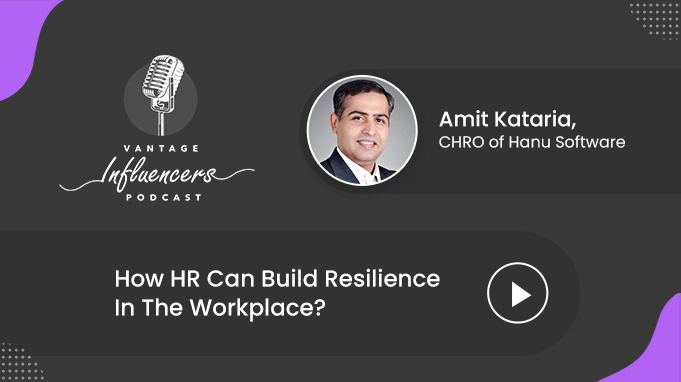
How Can HR Build Resilience In The Workplace?
Episode Overview
Amit Kataria, Chief Human Resource Officer at Hanu Software, joins the podcast to unpack what resilience actually looks like inside a company, not as an abstract buzzword but as a skill people can deliberately build. He defines it simply: the capacity to bounce back from the adversities you face in life and to re-establish yourself afterward. Coming to HR through an unconventional path himself (a computer applications graduate who was drawn to the function after watching HR teams run his own onboarding), Amit argues that resilience is the one variable in a person's professional life that they have almost complete control over, unlike external circumstances such as market conditions or a manager's mood on a given day.
His clearest, most concrete example comes from what Hanu Software did when it moved to full remote work. Instead of scaling engagement back, the HR team doubled the frequency of personal check-ins with employees, replaced in-office events with virtual contests and games, and paired each employee with a peer responsible for staying aware of their wellbeing. Amit credits this approach with a measured 123 percent increase in the company's internal productivity metric during the lockdown period, evidence, in his view, that trust and flexibility build resilience far more effectively than monitoring and control.
Episode Highlights
- Resilience is the ability to bounce back from adversity and re-establish yourself, and unlike most workplace pressures, it's something a person can fully control.
- Amit's top HR priority is mental agility: the shift from instinctively reacting to a setback toward calmly responding to it.
- A strong work-life balance policy, a focus on employee health, and a culture of compassion combine to build genuinely resilient teams.
- When Hanu Software went fully remote, HR doubled the frequency of employee check-ins and replaced in-office events with virtual contests and games.
- Hanu pairs every employee with one peer responsible for staying aware of their wellbeing, a practice Amit credits with building a compassionate workforce over time.
- Giving employees full autonomy over how they get work done, rather than monitoring hours at a desk, coincided with a 123 percent rise in Hanu's internal productivity metric during the pandemic.
About the Guest
Amit Kataria, Chief Human Resource Officer, Hanu Software
Amit Kataria is the Chief Human Resource Officer at Hanu Software, where he leads talent acquisition and management, rewards and recognition, capability development, employer branding, and employee engagement. With more than 17 years of global HR experience across information technology and ITES, he has driven HR strategy, employee engagement, global mobility, talent management, and compensation and benefits at scale, while championing Hanu's recognition as a great place to work.
Connect with Amit Kataria on LinkedIn
Host
Rohit, Vantage Influencers Podcast Host
What You Will Learn
- How to define resilience in practical terms and why it's the most controllable factor in your professional life.
- Why mental agility, the shift from reacting to responding, matters more than avoiding difficult feedback.
- How work-life balance, employee health, and workplace compassion combine to build resilient teams.
- Practical ways to keep remote teams engaged, from more frequent check-ins to virtual contests and games.
- How pairing employees with a dedicated peer can build a genuinely compassionate workplace culture.
- Why giving employees autonomy over their work, rather than monitoring their hours, can increase productivity.
Key Topics & Timestamps
| Timestamp | Topic |
|---|---|
| 0:10 | Introduction to Amit Kataria and Hanu Software |
| 0:50 | Amit's path into HR |
| 2:09 | Defining resilience in the workplace |
| 2:54 | Building resilient teams as HR |
| 7:25 | Nurturing relationships inside and outside work |
| 9:50 | Building a compassionate workforce |
| 11:58 | The importance of breaks for re-energizing |
| 14:20 | Measuring and building employee productivity |
| 16:47 | Metrics Hanu Software uses for employee engagement |
| 19:50 | HR leaders and CEOs Amit admires |
| 21:11 | Advice for young HR leaders |
Full Transcript
Click to read the full episode transcript
Welcome to the Vantage HR Influencers Podcast. This podcast is sponsored by Vantage Circle, the leading employee benefits and engagement platform.
Rohit: Hello, this is Rohit from the Vantage HR Influencers Podcast, and today I'm really excited to have Amit Kataria, who is CHRO at Hanu Software. Amit is responsible for rewards and recognition, talent acquisition, and employee engagement, among other roles. In this session, we're talking about how HR can build resilience in the workplace. Let's get into it.
Amit Kataria: Thank you, Rohit, especially for having me here. It's been fantastic, and I've been following Vantage Circle's work for a while now.
Rohit: Thank you for the kind words. I'd love to understand, how did you get into HR, and what interested you in getting into HR?
Amit Kataria: Very interesting. So what happened, Rohit, is that I did not deliberately decide to become an HR professional. It happened in the course of my education, or I'd say during my master's. My background is actually a Master's in Computer Applications. So when I completed my MCA, I got placed in a top-tier software services company, and we went through an onboarding session. All week, I kept seeing HR people having that kind of power center around them, everyone waiting all week for their turn in the boardrooms. That's what made me decide that being in a function called HR would let me do something I was aspiring to. So that's how the whole idea started. I took a break and started preparing for human resource management, and then switched to pursuing my MBA and Master's in Human Resource. And that's how it's been ever since, there was no looking back.
Rohit: Interesting. In this part, I want to talk about what resilience is and how you build resilience in the workplace.
Amit Kataria: Yeah, so resilience for me, if you go by the dictionary and literal meaning, in simple terms is about how you bounce back from the adversities you face in life. Whether you're talking about general life or professional life, whatever the scenario, it's about how you cope with the difficulties you go through and how you re-establish yourself. So I think of it simply as bouncing back to a favorable part of life where you're happy, that's how I perceive it in a general sense.
Rohit: Right, and how do you look at building such resilient teams in companies, especially during times like these, when we're working remotely and facing stressful situations because we're not meeting our teammates in person and things like Zoom fatigue set in? How do you look at building that kind of resilience?
Amit Kataria: Yeah, it's very relevant to the topic, but before that, I want to touch on a few things that give context. The human race in general is very resilient. When you compare all of human evolution to where we are today, it's because of resilience that we're here. We're the smartest species on Earth, and we've developed the most. But when you ask how we became more resilient, when you discuss this within the HR fraternity, two things become apparent: there are controllable and uncontrollable factors. Resilience is what you can control, and that's the whole idea behind wanting to build more resilience within a workspace. It's one factor you have complete control over: how you want to bounce back. The other factors you may or may not have control over, you can influence them or not, but resilience is the most controllable factor among all of them.
So how do we build it? There are a few things you can slowly work on to achieve that. For HR, I give the most priority to one factor: mental agility. What I mean by that is, it's not every time that you have favorable conditions at your workplace. It's not that your boss will always come and say, "You did great work." There are good chances that sometimes you get adverse feedback, sometimes even a bit of a dressing down. You don't feel happy about it. Since we're emotional people, there will be a feeling of sadness, a feeling of anger, maybe confusion. But what I'm saying is your mental agility is the most important factor here. You don't need to stay in that headspace; you need to come out of those emotions like sadness, anger, or confusion as soon as possible. Once you come out of it, you build agility around yourself.
So how does it work? There are two things I want to touch on. When you talk about mental agility, there are two factors that matter: reacting and responding. As people in the workplace, when something happens, our instinctive nature is to react. But resilience tells us to respond, not react. What I mean by responding is, if you take the emotion and the instinct to react out of the equation, you become more objective. So it's a journey from reacting to responding, from being instinctive and saying whatever comes to mind, to being more focused and objective-driven. That's how I think mental agility comes into play.
Second, on how we can be more resilient and how HR can help, there are a few important things. We can build a robust work-life balance environment within the company. We can also focus on employee health. And we can build compassion within the work culture. These factors combined create a better, more resilient team, and I think that works in a great way to push people forward.
Rohit: Right, and since we're in the middle of the COVID crisis, I want to understand how we nurture relationships outside and inside the workplace, because I think it's important to build relationships outside of work culture too, since people are working non-stop and there isn't a clear line between work and life when you're working from home.
Amit Kataria: Right, as I just said, work-life balance is a very important part of building a resilient team. How do we do that? I'll take a practical example from within Hanu itself. Being an IT company, we already had a good, automated system of support, HR, finance, and so on, so we didn't face much of a hurdle when we went to 100% work from home.
That said, when people are working from home, it does become monotonous over time, and it becomes difficult to maintain the balance between work and life. Earlier, as a typical week, we used to have Fun Fridays and engagement activities. Once we went into lockdown and moved to complete work from home, we didn't stop the engagement, we actually augmented it. We doubled the frequency. We started reaching out to all our Rockstars, that's what we call our employees, twice a week by phone and email, to make sure we heard their voice at least once a week. Instead of the earlier in-person engagement activities, we started running virtual games, fun contests like decorating your workspace, small dance competitions, kids' activities, anything that could be done virtually.
That brought engagement back to its earlier level. I think it worked in our favor: instead of work from home becoming a reason for a less productive workforce, we actually saw better productivity ratings during the lockdown and after. So that's how I think work-life balance works. As HR, you can't just stop engaging when something like this happens; you have to work to augment it and keep adding to the morale and happiness of your people.
Rohit: Right, and I've also felt it's very important to build a sense of trust and compassion among your people. I want to understand how you build compassion so that employees can work together and take on the organizational role.
Amit Kataria: So when you think about a compassionate workforce, it's about building it over time. You can't do it overnight and say, okay, now we have a compassionate workforce. You have to take a systematic, step-by-step approach. So to make our workforce compassionate, we started with a few things. First, you need to make mandatory time off part of the company culture, so people get time to think and aren't always in a mindset of just getting things done.
When it comes to building compassion between teams, we pair every employee with one other person in the team whose responsibility is to know everything about them. Everyone at Hanu, as a Rockstar, knows that they're paired with one person they need to know everything about. We have a phrase we use, customer obsession in a positive sense, and we've replicated that internally as Rockstar obsession, which means that as a team member, I have to be compassionate enough toward the one person I'm paired with and know everything about, in a general sense. So if anything happens in their life, at least one person is aware.
That's how compassion gets built: because you feel someone is caring about you, and that means the organization as a whole cares about you. We start these steps from the moment someone comes on board, and keep building on those exercises so this culture of compassion develops over time.
Rohit: And Amit, I was wondering, do you also believe employees should be given breaks when they're working from home? How important are breaks, vacations, and family time for employees to re-energize themselves?
Amit Kataria: Absolutely, Rohit. If you think about breaks, I think it depends on the work style of companies that want employees to be at their desks for extra time. We lean the other way. For us, it's a very flexible environment. What's important to us is that you do your task on your own terms, but complete it as your KRA suggests. We're not about monitoring anyone or checking whether they've spent eight or nine hours at their desk. We never do that.
So for Hanu, we say, here's the assignment, here's what you're supposed to do, do it at your own discretion. But while doing that, we encourage all our Rockstars to take small breaks and participate in our engagement activities. As I mentioned, we organize activities so that when things get monotonous, there are avenues and programs that keep you engaged. We do encourage mandatory time off, but overall, we don't focus on how many hours someone sits at their desk. The focus is on accomplishing your tasks and goals in whatever way makes you feel good about it.
Rohit: And is it possible for companies to track productivity and monitor performance, especially for people working remotely during COVID?
Amit Kataria: Okay, I want to understand more about what you mean by tracking productivity, then I can answer better.
Rohit: By tracking productivity, I mean, since it's not really possible to know exactly how much time employees are spending on their work, I mean being productive during the work environment and being able to accomplish the goals and targets assigned to them.
Amit Kataria: Yes, Rohit. For us as a company, what we believe is that as long as you give freedom, as long as you give your Rockstars a free hand with whatever goals and milestones are assigned to them, you'll see an uptick in productivity. Because when a person feels free to experiment and innovate, they do wonders with their work.
Let me give you an example. If you're asked to do a task in a particular manner, you'll reach point A to point B exactly as defined and directed by your manager. Whereas if you're simply told, "I want this accomplished, get to point B however possible," you'll at least think about alternate methods of doing it. You'll expand your thinking and start innovating ways to accomplish the same task, saving time and resources in the process. That's what happened with us.
So when we talk about productivity being measured or increased, Hanu observed that after moving to 100% work from home since the end of March, our internal productivity metric, what we call the scale of productivity, saw an uptick of 123%. That's phenomenal, because we didn't do anything extraordinary to achieve those results. We didn't question anyone, we didn't keep an eye on whether people were pleased or not. Because when all the Rockstars at Hanu felt free, they focused entirely on achieving results and were respected for how they did it. I think that's what works in favor of companies like us: it enables higher productivity for the same results.
Rohit: Right, and are there other metrics that managers can use to measure engagement, whether through surveys or something else? Does Hanu also look at specific metrics to measure engagement?
Amit Kataria: Yes, we're a very innovative company when it comes to Rockstar engagement and happiness, which is why we have a role called Rockstar Happiness Officer. Surveys are a fairly old methodology, from around a decade back. I remember almost ten years ago, Hanu had mood indicators at our front exit and entry gates, where if anyone coming into Hanu wasn't feeling good, or whatever the emotion was, all they had to do was press a mood-indicator button on the device installed there. That gave us real-time information about the general mood of the workforce on any given day. We did that almost a decade back.
Now, beyond gauging workforce mood, we implemented OKRs, a milestone-based approach where your ongoing achievements are tracked. We also use Yammer extensively as a social platform. Our core emphasis is also on rewards and recognition: we have a system of badges and peer-to-peer rewards across the company. There are many methods we use. Overall, we're very engaged in this approach, and whatever avenues are available, we're never hesitant to experiment or innovate.
Rohit: Interesting. I wanted to ask, what's your favorite business book?
Amit Kataria: I have to admit, and I'm a bit embarrassed to admit, that I'm not much of a book reader. I'd probably be the laziest person when it comes to picking up a book and reading it. But to answer that, I'd say I'm passionate about documentaries and series, anything that's informative, that's more my thing. I'm sorry, Rohit, I'm not a big reader, but I think the last book I read outside of what my job requires was back in my college days.
Rohit: Got it. And which HR leader or CEO do you admire, someone the listeners might also want to follow?
Amit Kataria: Yes, there are many personalities, not necessarily from HR, that I'm genuinely impressed by. I keep following the wisdom of leaders I find truly influential, not necessarily from this era. I think Tesla was one personality who I feel was very underestimated in his own time, and his work contributed enormously to the development of humankind. Coming to more recent figures, there's a prominent technology industry CEO I admire, and naturally, Mukesh Ambani is also on my list, I've seen him transform the business environment within his group. Above all, as a group, I admire the Tata Group the most, and within Tata, there's a senior figure known for his philanthropy and wisdom who inspires me most, and I keep following what he says.
Rohit: Absolutely, that's a great list. And what's one piece of advice you'd give to young HR leaders, whether they're just graduating, going through tough times, or looking to build a career in HR and become HR leaders themselves?
Amit Kataria: Very relevant question, Rohit. Since it's closely tied to this topic itself, I'd say you have to be resilient. What that means is, for young HR professionals coming into the industry, there's no quick path to success. It all comes from hard work, it all comes with time. At times you'll feel it's not worth it, and I've seen that happen to me and to my friends. Even a small hurdle, a small speed bump, and people surrender. That's the biggest mistake we make in our professional lives.
So my advice, the one thing I'd say, is: don't lose your compassion, be resilient, and be confident. Whatever comes your way, whatever doesn't go as you expected, it's just one small step taking you toward your goal, not a step taking you away from it. If you keep that in mind, nobody can stop you. You just need to keep working in the one direction you're passionate about, in this case, HR, and be resilient about it.
Rohit: And what's the best way people can reach out to you and know more about you?
Amit Kataria: Sorry, Rohit, I think I have a bad connection, I keep losing you. Can you repeat that?
Rohit: What's the best way people can reach out to you and know more about you?
Amit Kataria: Oh, sorry about that. I'm on a few platforms, but I'd prefer LinkedIn, that's where I'm most active. I keep engaged in a lot of activities on that platform, so if anyone wants to reach out, just find me on LinkedIn, I'd be very happy to reply.
Rohit: Thank you so much for taking the time to speak with us. I really enjoyed our conversation.
Amit Kataria: Thanks, Rohit, pleasure to all of you. Have a wonderful day.
Thanks for listening to the Vantage HR Influencers Podcast. Please subscribe to the Vantage HR Influencers Podcast on Apple Podcasts and Spotify for new episodes.
FAQ
What is resilience in the workplace, according to Amit Kataria?
Amit defines resilience simply as the ability to bounce back from the adversities you face, whether in your personal or professional life, and to re-establish yourself afterward. He sees it as the one factor in a person's professional life that is almost entirely within their own control, unlike external circumstances such as market conditions or a colleague's mood. For him, building resilience is less about avoiding hardship and more about how quickly you recover from it.
How can HR help employees build resilience?
Amit points to mental agility, the ability to move from instinctively reacting to a situation toward calmly responding to it, as the single most important skill HR can help develop. Alongside that, he says a robust work-life balance policy, a focus on employee health, and a culture of compassion combine to create genuinely resilient teams.
How did Hanu Software keep employees engaged during remote work?
When Hanu Software moved to full remote work, the HR team doubled the frequency of one-on-one check-ins with employees and replaced in-office events like Fun Fridays with virtual contests, games, and small competitions. Amit also describes pairing every employee with one peer responsible for staying aware of their wellbeing, an internal practice the company calls "Rockstar obsession." He credits this combination with a 123 percent increase in Hanu's internal productivity metric during the lockdown.
What advice does Amit Kataria give to young HR professionals?
Amit's core advice is to stay resilient and not give up after small setbacks, since there is no shortcut to success in HR and progress comes from sustained hard work over time. He tells young professionals to treat every setback as one small step toward their goal rather than a step away from it, and to hold on to their compassion and confidence as they build their careers.
Related Reading
Also listen on