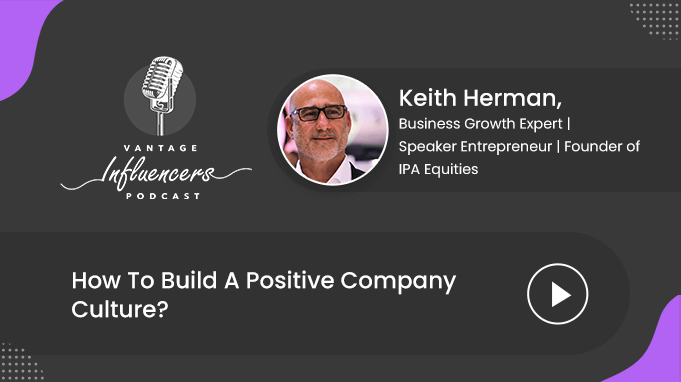
How To Build A Positive Company Culture?
Episode Overview
In this episode of the Vantage HR Influencers Podcast, host Susmita Sarma speaks with Keith Herman, founder of IPA Equities and Oura Collective, about what actually holds a company together when times get hard. Keith frames company culture not as a perk or an atmosphere but as the single biggest factor in whether a business survives, calling it one of the most powerful competitive weapons available to any organization. He traces the foundation of a strong culture back to respect, then builds outward from there with open mindedness, tolerance, diversity, and inclusion, while noting that hiring for culture fit works differently once a team becomes decentralized or remote.
The sharpest point in the conversation is Keith's distinction between motivating people and empowering them. He argues that external motivation has a short shelf life and loses value quickly, while employees who are given the right tools and clear direction become internally driven and produce better work because they are succeeding on a personal level. He extends that same idea to crisis leadership and employee feedback, insisting that what people want most from their employer is time, not just resources, and that giving people your time, not just a paycheck, is what turns a group of individuals into a genuinely connected team.
Episode Highlights
- Company culture isn't just atmosphere, Keith calls it the single biggest factor in a company's survival and one of its most powerful competitive weapons.
- He identifies respect as the foundation of good culture, then builds on it with open mindedness, tolerance, diversity, and inclusion.
- Hiring for culture fit works well in centralized teams, but Keith says decentralized and remote setups need a different lens since people don't interact the same way.
- Keith draws a sharp line between motivating employees and empowering them, arguing that external motivation fades quickly while empowerment through tools and clear direction creates lasting internal drive.
- Two way feedback and measurement matter because, as Keith puts it, what you can't measure you can't improve.
- Giving employees your time, not just resources, is what Keith says builds the deepest connection and helps teams recover from a crisis.
About the Guest
Keith Herman, Founder, IPA Equities
Keith Herman is a business growth expert, speaker, and entrepreneur who has owned, scaled, and successfully exited more than fifty small and mid-sized businesses over his career, including ten startups spanning technology, finance, media, and real estate. Along the way, he has helped raise more than $500 million in capital and been involved in more than $2 billion in transactions. He is also the founder of Oura Collective, a tech public relations and marketing firm that has partnered with more than 250 tech companies to help them build credibility, attract capital, form strategic partnerships, and grow enterprise value.
Connect with Keith on LinkedIn
Host
Susmita Sarma, Vantage Influencers Podcast Host
What You Will Learn
- Why company culture functions as a survival mechanism and competitive weapon, not just a nice to have perk.
- How respect, open mindedness, tolerance, diversity, and inclusion combine to form the foundation of a strong culture.
- Why hiring for culture fit works differently in centralized versus decentralized and remote teams.
- How to tell the difference between motivating employees and empowering them, and why empowerment lasts longer.
- Why two way feedback and measurement are essential to building a happier, more engaged workplace.
- How giving employees your time, not just resources, deepens connection and improves crisis resilience.
Key Topics & Timestamps
| Timestamp | Topic |
|---|---|
| 00:58 | Keith's introduction and background |
| 01:22 | Why company culture determines a company's survival |
| 01:33 | Culture as a competitive weapon and catalyst for growth |
| 02:06 | Hiring for culture fit in centralized vs. decentralized teams |
| 02:31 | Respect, open mindedness, and diversity as core culture elements |
| 02:56 | Evaluating culture through employee engagement |
| 03:33 | Embracing remote and part time talent |
| 04:11 | Empowering employees instead of just motivating them |
| 05:13 | The value of two way employee feedback |
| 05:49 | Why culture matters more during a crisis |
| 07:19 | Building deeper connections by giving employees your time |
| 08:00 | Company culture trends set to stick around |
| 10:25 | Keith's advice for HR listeners |
Full Transcript
Click to read the full episode transcript
Welcome to the Vantage HR Influencers Podcast. This podcast is sponsored by Vantage Circle, the simple and AI powered rewards and recognition platform for employee engagement. Employee engagement and decreased turnover are both linked to a positive corporate culture. Organizations with engaged employees and a strong culture have a competitive edge, highlighting the necessity of measuring and understanding culture. What is the foundation of a good company culture? Why do we need to prioritize corporate culture during a crisis? And there's so much more to know about it. Let's know in today's episode.
Susmita Sarma: Hi everyone, this is Susmita Sarma from the Vantage HR Influencers Podcast. And my guest today is Keith Herman, who is a business growth expert, speaker, entrepreneur, and the founder of IPA Equities. Welcome to the show, Keith.
Keith Herman: Hi, thank you for having me.
Susmita Sarma: Great. Okay, so as we begin, could you please start by introducing yourself to our audience?
Keith Herman: Absolutely. I'm Keith Herman, the founder of IPA Equities and Oura Collective, a tech PR and marketing firm.
Susmita Sarma: Okay, so Keith, today's topic that we're going to discuss is how to build a positive company culture. So before proceeding to the other questions, the very first thing that our audience would like to know is, what is the importance of a great company culture?
Keith Herman: I would say the survival of the company.
Susmita Sarma: Okay, so it's definitely one of the most powerful competitive weapons, isn't it, for a company?
Keith Herman: Yeah, yes. I see it as a catalyst for growth. People in a healthy environment with positivity thrive personally and handle their workflow more efficiently. They also produce better results, and in turn, the company benefits, as well as its customers and partners.
Susmita Sarma: Right. Okay, so I personally believe that hiring people who fit your culture is the first step in creating a successful corporate culture. So what is your view on the same? What is the foundation of a good company culture?
Keith Herman: Well, I agree, in a centralized environment, absolutely. However, in a decentralized environment, it's not necessarily the case, because not everyone will necessarily interact with each other.
Susmita Sarma: So yeah, what are the other elements that make a company culture great, apart from hiring people who fit your culture?
Keith Herman: Well, I believe the foundation of a good company culture is the same as any successful relationship, and that's respect.
Susmita Sarma: Okay, any other elements?
Keith Herman: Yeah, from my experience, other critical elements would be open mindedness, tolerance, diversity, inclusion. I think those are all important as well.
Susmita Sarma: Right, okay. So Keith, a strong company culture is linked to not only a lower turnover, but also higher employee engagement. Organizations with engaged employees and a strong culture have an advantage over other companies, which emphasizes the importance of assessing and understanding culture. How can we evaluate company culture through employee engagement?
Keith Herman: Well, the frequency that employees willingly want to be engaged is an excellent indicator. If they leave wanting to come back for more, then as an employer, you're batting a thousand.
Susmita Sarma: Okay, so then it's vital to make the most of the vast pool of talent available outside of full time, in house positions. It's also said that in America, they're undergoing a phase which they call the startup boom, and more and more smart businesses are recognizing the necessity of a close inspection of how they embrace remote and part time employees or freelancers into their company. So I'm sure you'll agree that a great company culture keeps everyone involved, motivated, and excited, regardless of their status or role. Would you like to share your view on this?
Keith Herman: Well, it's absolutely important to evaluate how people are contributing, and for those that are remote, they need to feel that they're part of the team and making a valuable contribution to the success of the company. With regards to keeping everyone involved, motivated, and excited, I'm a firm believer in empowering others rather than motivating them. And I say this because external motivation has a limited life, and therefore significantly less value. If you were to chart it, you'd see that as the excitement wanes, there's a direct proportional loss of motivation. Conversely, if people are given the right tools and instructions to succeed, they become empowered and internally motivated and excited, because they're succeeding on a personal level. And as a result, they produce better quality, a win-win situation. The company also benefits from being known for this type of culture and is able to attract better talent.
Susmita Sarma: So again, when you talk about feedback culture, it's one of the most effective ways to boost employee morale, and it creates a more positive and happy workplace. How do you describe the value of employee feedback, or feed forward?
Keith Herman: Yeah, plain and simple, employee feedback is invaluable. I'm a big believer in two way communication. We live in such a data driven world these days, where it's become commonplace to know that if you can't measure it, you can't improve it.
Susmita Sarma: Okay, so why, even in a moment of crisis, like this present crisis of the coronavirus pandemic, do we need to prioritize corporate culture?
Keith Herman: Well, as I said from the beginning, corporate culture is responsible for the survival of every business, and it's more apparent than ever. Some great examples would be companies like the Weinstein Company and others that eventually imploded because of the toxicity of their culture.
Susmita Sarma: Okay, so what role does company culture play in helping an organization recover from a crisis?
Keith Herman: Well, in the tech world, we're accustomed to working remotely and being decentralized, so it's not a big adjustment. Nevertheless, I think now more than ever, it's imperative to share resources to help people get their work done. Doing so accomplishes a few things. First, it keeps stress to a minimum. Second, it makes employees feel more secure about their future, because they know that as long as they get their work done, they'll have a job. And equally important, they feel valued because you gave them your time, not just the paycheck. So all in all, the result is a deeper connection.
Susmita Sarma: Yeah. So can you offer some food for thought on how a company might be able to better utilize this time to connect with their team on a deeper level?
Keith Herman: Well, again, I think it's communicating and spending more time. It's the time factor, when employees understand that you're actually giving them your time, that's where connection is really made. You can give people resources, you can give them direction, but I think today, people really want your time, because it makes them feel more secure, and that's really what builds deeper connections.
Susmita Sarma: Right. Okay, so Keith, what are the top company culture trends of 2021 that are going to stick around, in your view?
Keith Herman: Number one, we'd have to say casual dress. I think there's going to be a lot more relaxed dress codes moving forward. Also, remote working, as companies learn to live with less. And I would also say diversity and inclusion. I think those are probably the top three that are going to be very apparent.
Well, I think, just with regards to culture, I think that it's something that employers need to spend more time on, because it's very much overlooked. And going back to what I said at the very beginning, it's the survival of the company. When people feel that they're part of something, and when you spend time with them, and you help them and nurture them, it's just similar to a family environment. The more loving and caring you are to people, the more they want to come to the family dinners and spend time together. I think it's the same with a company, that it's something that has to be nurtured. It's not just giving people material things, but giving them time and giving them the tools and the opportunity for them to really shine as a person. I think that's what we need to see more of, versus focusing purely on productivity. We became a very automated culture, and it was all about producing through automation. I think in losing that personal connection, we've seen diminished returns. And I think by returning to company culture and having those deeper connections, people will see a much greater return on their investment. So I think that's probably, at least that's my view on the value of company culture.
Susmita Sarma: Right. Okay, so what would be your suggestions to our HR listeners?
Keith Herman: Well, I think this is a very unique period, where there are many people in need of work, and many companies that are forced to accept change. In other words, it's an opportunity to make some great things happen, because both employees and employers are open to new ideas. So it's an opportunity for HR, as a facilitator, to make those great things become a reality.
Susmita Sarma: Okay, great. So anything else you want to add to our podcast?
Keith Herman: I think that's pretty much it. Again, it's a great topic, and one that we should be talking about more.
Susmita Sarma: Okay. And for those folks in HR, it's a time for them to really shine. Okay, so how can listeners reach out?
Keith Herman: Well, I'm all over social media, but the easiest way to get a hold of me is directly through email. My email is my initials, K-H, at O-U-R-A-C-O dot com.
Susmita Sarma: Okay, and we'll put that up in the show notes. It was great connecting with you, Keith, and thank you so much for being a part of the Vantage HR Influencers podcast.
Keith Herman: Sure, thank you for having me.
Thanks for listening to the Vantage HR Influencers podcast. Please do subscribe to the Vantage HR Influencers podcast on Apple Podcasts, Spotify, and our YouTube channel for new episodes.
FAQ
What is the foundation of a good company culture, according to Keith Herman?
Keith Herman says the foundation of good company culture is respect, the same quality that underlies any successful relationship. He builds on that foundation with open mindedness, tolerance, diversity, and inclusion, calling all of them important elements of a culture that lasts.
Does hiring for culture fit still work in remote or decentralized teams?
Keith agrees that hiring for culture fit is effective in a centralized environment, but says it isn't necessarily the case once a team becomes decentralized, since not everyone interacts with each other in the same way. For remote contributors, he focuses instead on evaluating how they are contributing and making sure they feel like a valued part of the team.
What is the difference between motivating employees and empowering them?
Keith draws a clear line between the two: external motivation fades quickly and carries less value over time, while empowerment, giving people the right tools and clear instructions, creates internal drive that lasts. He argues empowered employees produce better quality work because they are succeeding on a personal level, which benefits the company and its customers alike.
Why does company culture matter even more during a crisis?
Keith says corporate culture is responsible for the survival of every business, and that becomes most visible during a crisis. He points to companies that have collapsed because of toxic internal cultures, and argues that sharing resources, reducing stress, and giving employees your time are what build the trust needed to recover.
Related Reading
Also listen on