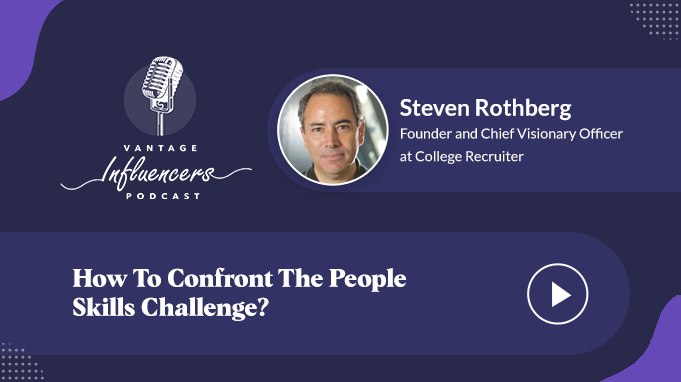
How To Confront The People Skills Challenge?
Episode Overview
Steven Rothberg founded the business that grew into College Recruiter back in 1991, building it from a small publisher of college campus maps into a job site now used by more than seven million students and recent graduates every year, and one that has been fully remote since 1997, long before it was common practice. In this conversation with host Susmita Sarma, he explains why talent acquisition teams today aren't really struggling with candidate quality so much as application flow itself: employers who once saw 30 people apply for a role are now seeing two, and neither is qualified, across every channel they use to source candidates.
Rothberg traces the shortage to two forces reshaping the labor market at the same time: workers reevaluating their careers since the pandemic and moving freely between industries they'd never have considered before, and companies with a history of underpaying or mistreating staff now losing them to nearby employers, like large warehouse operators, willing to pay significantly more for the same work. His sharpest point in the conversation is about honesty in hiring: companies that advertise a role as remote and then deliver hybrid create a bait and switch that pushes new hires out the door faster than leaving the role unfilled ever would.
Episode Highlights
- Application flow, not candidate quality, is the top hiring concern today; many employers report far fewer applicants across every channel than they saw a few years ago.
- Two forces are driving the shortage: people reevaluating their careers since the pandemic and moving between industries, and companies that historically underpaid or mistreated staff now losing workers to better-paying employers nearby.
- College Recruiter, the company Steven Rothberg founded, has been fully remote since 1997 and pays every employee the same rate for the same work, regardless of where they live.
- Compensation motivates people differently by pay level: raises matter enormously to lower-wage workers' daily lives, while higher earners respond more to interesting work and public recognition.
- Promising remote work and then delivering hybrid is a common and costly mistake; employees who feel misled tend to quit quickly, which hurts a company more than leaving a role open.
- The most common soft-skill gaps employers report are weak critical thinking, informal communication habits with older colleagues, and a poor sense of how one's work connects to company revenue or cost savings.
About the Guest
Steven Rothberg, Founder & Chief Visionary Officer, College Recruiter
Steven Rothberg founded the business that grew into College Recruiter in 1991, starting as a small publisher of college campus maps before adding a print employment magazine in 1994 and a job search website in 1996 that eventually became the company's entire focus. As Chief Visionary Officer, he now helps shape College Recruiter's strategy and leads its business development work, and the site is used by more than seven million students and recent graduates around the world each year. Steven has been quoted by NBC Nightly News, MSNBC, U.S. News & World Report, Bloomberg, the Wall Street Journal, the Chicago Tribune, USA Today, and CNN, and has been recognized by Fast Company, LinkedIn, and TAtech as one of the talent acquisition industry's most influential voices.
Connect with Steven on LinkedIn
Host
Susmita Sarma, Vantage Influencers Podcast Host
What You Will Learn
- Why application flow, not candidate quality, has become recruiters' biggest challenge
- What's really driving today's drop in job applications across industries
- How College Recruiter's location-independent pay model works, and why more companies are adopting it
- How compensation motivates employees differently depending on where they sit on the pay scale
- Why promising remote work and delivering hybrid instead backfires, and how to avoid the mistake
- Which soft skills employers say new hires lack most, and how to develop them
Key Topics & Timestamps
| Timestamp | Topic |
|---|---|
| 00:57 | Introducing Steven Rothberg and College Recruiter |
| 01:30 | Steven's path from Winnipeg to founding College Recruiter in 1991 |
| 04:40 | Why application flow, not candidate quality, is recruiters' top concern |
| 06:55 | The two forces driving the drop in job applications |
| 12:23 | Remote hiring as a long-term fix for skills shortages |
| 15:25 | What pay, rewards, and recognition candidates want today |
| 17:52 | The remote-versus-hybrid bait and switch |
| 22:04 | The soft skills employers say new hires lack most |
| 25:30 | The medium and long-term future of recruitment trends |
Full Transcript
Click to read the full episode transcript
Welcome to the Vantage HR Influencers Podcast. This podcast is sponsored by Vantage Circle, the simple and AI-powered rewards and recognition platform for employee engagement. One of the top organizational priorities today is recognizing the employee skill problem, which has a significant impact on the work that L&D leaders undertake and the solutions that they generate. We frequently observe executive leaders looking for information on how they can identify, analyze, and evaluate talent to make sure they can employ, upskill, and reskill them in order to create the type of company and culture they desire. In this episode of the Vantage HR Influencers Podcast, we'll finally have all the answers, so let's get started.
Susmita Sarma: Hello L&Ds, I'm your host for the show, Susmita Sarma, and today I have with me Steven Rothberg, the founder and Chief Visionary Officer at College Recruiter. Welcome to the show, Steven.
Steven Rothberg: Thank you very much for the opportunity, and looking forward to our conversation.
Susmita Sarma: Thank you so much for joining me here on the Vantage HR Influencers Podcast today, Steven. We'll be talking about confronting the skills challenge in today's workplace, but before that, it would be great if you could give us a brief about yourself and your experience as the founder and Chief Visionary Officer at College Recruiter.
Steven Rothberg: Sure, no sweat. So I grew up in Winnipeg, Canada, for your listeners who don't know where that is. It's dead center in Canada, just about an hour's drive north of the US border. It's the coldest city in the world with more than half a million people, which is why I moved. I've lived most of my life in Minneapolis, Minnesota, which is about halfway west in the United States, up near the northern border with Canada. And I'm married. My wife and I actually just celebrated our 29th anniversary, which seems like a lot more years to her than it does to me. Like most guys, I married up. And we have three adult kids and a dog.
I founded the business that College Recruiter grew out of way back in 1991. What it was initially was a small company that published maps of college and university campuses, and our customers were mostly restaurants, retailers, and apartment companies that would buy advertising around the borders to reach incoming students, new staff, and faculty.
In 1994, we added another publication, employment magazines, mostly for graduating seniors, fourth-year students in the US. The thing they need more than anything else is a job, and the magazine had job advertisements in it from sometimes small local companies, sometimes large national companies, along with articles on how to write a resume, how to network, and that type of thing.
In 1996, we added a website, a job search site, and over the next few years that basically took over the business. The growth we could see was coming online, not from print, so we gradually shut down the print publications and shifted all of our resources to the website. Today, College Recruiter is used on an annual basis by more than seven million students and recent grads. The kinds of jobs advertised there require zero to three years of experience, so it's jobs while they're in school, jobs for people just graduating, maybe their second job after graduating. And we're international. We have jobs in most countries around the world.
Susmita Sarma: So a lot of years into this business, Steven. What do you see as the major concern among recruiters today, and where do they actually need to invest?
Steven Rothberg: You know, the biggest concern for most recruiters today is very different than what it was two, three, four years ago. Today, the biggest concern is getting enough applications to a job opening that you can hopefully hire one person. Or if you're trying to hire 50 people, you need 50 times the applications. Or 500 people, 500 times the applications. So application flow, more than anything else, is the biggest concern.
I think the recruiters we talk with, or talent acquisition leaders, or advertising agencies, or recruitment process outsourcing organizations that sometimes represent large employers, don't have nearly as much of that concern. If they have three, four, five good applications, they're still confident they're going to hire a good person and that they can get that person to stay. It's harder than it was a few years ago, but the biggest issue we hear is organizations simply saying they're not getting applications. Three years ago they might have had 30 people apply for a job; today they're getting two, and neither one is qualified. And I'm not talking about applications from College Recruiter specifically, it could be from all of their sources, whether it's people going to their website, referrals, ads they're running, billboards on the street, whatever. All of their sources together, when we hear of a big problem, it is a lack of applications.
Susmita Sarma: Right. So what is the possible reason for this lack of applications in jobs today?
Steven Rothberg: There are a couple of major ones. One is we've all been living through COVID. COVID has done so many terrible things to so many people that I would certainly never say it's been a good thing, but like almost everything else, you can have something that's really bad and some things good can come out of it too. One of the few good things that came out of COVID is that I think it caused almost everybody to reevaluate their lives: is this what I want to be doing for the rest of my life? That's caused a lot of people who maybe worked for 10, 20, 30 years in a restaurant and identified themselves as a cook or a waiter to start their own business, or say, I've been a cook for 20 years, I want to do something different, I want to be a podcast host, something crazy like that.
And so there's been this huge reshuffling, and people who maybe were working in restaurants at low levels of pay have discovered that they can now go work in a hotel, or in a warehouse, or in a retail shop for higher pay. And it's like, why would I want to work for lower pay in a job that I'm bored with and don't really want to do anymore, or that's become physically too hard for me as I've aged, when I can move over to this other industry and make more money? So the opportunities to move from industry to industry are much more apparent now than they were three years ago. They were there three years ago too, but it was more unusual that people would do that. And also, companies in most areas of the world are greatly increasing the wages that they're paying people.
So when we hear of companies that are really struggling to hire people, it usually comes down to two factors. One is they have a history of treating their employees like crap, just really, really poorly. And the other is they tend to pay their employees like crap too, really low wages. And one of the difficult things for a lot of businesses is that if you have a retail shop, or a restaurant, some big company, an Amazon or a FedEx, might have a warehouse within 15 minutes of where your shop is located, and they might be paying 20, 30, 40, 50 percent more per hour for the same talent. How do you compete with that? That's a very difficult thing for a lot of these businesses. And the reality is you've got to pay the prevailing wage for the talent. If you want to hire people, and if you want to keep those people, then you've got to pay them at least as much as they could get by working somewhere else, especially people who are on the lower end of the pay scale, they're going to be more price sensitive. They should be.
Susmita Sarma: So basically, there has been self-evaluation, or maybe you could say a realization, that they deserve much better for themselves.
Steven Rothberg: Absolutely. And that's a good thing that I think most of us have realized.
Susmita Sarma: Yes, yes, yes. I hope this trend continues and successfully continues for generations. Depending upon a job is definitely not that preferential now, rather than making something of your own for yourself and your family, right?
Steven Rothberg: Yes. A hundred percent. I think it was just a couple of weeks ago, I saw on LinkedIn a story that was being shared about a restaurant, I believe it was in the US, though I don't remember exactly where, where the owner basically shut the doors, closed the restaurant forever, and put a sign on the door that said something to the effect of, closing the restaurant forever, sorry to my loyal customers, I can't find anybody to work for me, everybody's lazy, something like that. When you see stuff like that, that's a really good indicator that the owner of that restaurant was probably a terrible person to work for. And it's no wonder that the people who used to work for him or her have decided that their life would be better working somewhere else. So I don't think that's an employee problem, that's an employer problem.
Susmita Sarma: I bet. Also, targeting them as lazy people or something like that is definitely not the right thing, and maybe the owner should reconsider himself as an employer. Also, remote hiring has been a very important thing during the last two years, and it's going to continue, hopefully. So is it serving as a long-term solution to the skills shortages they're experiencing?
Steven Rothberg: Yes, absolutely. And, you know, the little company that I founded, College Recruiter, we have about 20 employees, so we're certainly not big, and we have some contractors as well, and we work very closely with a number of vendors and partners. But just in the last month and a half, we've hired a person in the Philippines, we've hired two people in Nigeria, and we're also likely going to hire a fourth person from overseas, quite possibly from India. We're not unusual, we decided as a company that we are not going to pay people differently based upon where they happen to live. Cost of living in a country like Nigeria, the Philippines, or India is way lower than the cost of living in the United States, but we're going to pay you the same regardless of where you live, because where you live is your choice, not ours, and we're paying you for the value of your work. I'm seeing more and more companies doing that, where they pay based upon the work performed by the employee, not based upon what the rent or food or transportation costs happen to be where they live. That opens the door for organizations to hire top talent wherever that talent may be. And when you restrict your hiring just to people who are within walking, cycling, or driving distance from your office or your business, it makes it far harder to recruit and retain that top talent. But when you can tap into the world, that's quite different, and we're seeing more and more companies doing that. We've been fully remote, Susmita, since 1997, so we were remote, fully remote, way before most companies were. Back then, we pretended we were not remote, because a lot of our customers would not have trusted us. But, and you've probably found this too with co-workers who were working remotely, it's a lot harder to manage somebody who's working remotely. The manager has to be a lot better in order to properly manage somebody who works remotely.
Susmita Sarma: Great, Steven. Thanks for sharing your story, and it's really wonderful to know that you guys have been working remotely for years now. So talking about benefits, rewards, and different types of recognition, what do you think candidates today look forward to in their workplaces?
Steven Rothberg: It really varies. And I think one thing employers at a high level should think of is that every employee is different, their needs and wants are going to be different. So those who are at the top of the pay scale, generally executives making really good income, increasing their pay by 5% just isn't going to matter all that much to them. At that point, they're not likely to be well motivated by money. On the other hand, people at the bottom of the wage scale, if you give them a 5% raise, a 10% raise, that probably helps ensure that they're going to stay with you for a lot longer. They can actually feed their family, they can buy medicine, they can do all those things that people at the top end of the pay scale just don't have to even think about. But people at the bottom end are struggling with that every single day. So wages for somebody at the low end are an incredibly powerful motivator, both for recruitment and retention. People at the top end tend to be motivated more by opportunity, is the work interesting, giving them a pat on the back, publicly praising them in front of their co-workers. Hey, Emily, that project that you just completed a week ago led directly to a customer asking for a proposal, and it looks like we're going to close that sale today. That kind of public praise is something almost all of us really love. But if you're at the bottom end of the pay scale, you're going to be like, the praise is great and I appreciate it, but I would really like to be able to feed my family today, could you give me a little bit more money?
So things like that for remote workers, just to circle back a little bit from what we were talking about a few minutes ago. One of the issues that I'm hearing from a lot of remote workers is a little bit of what you could call bait and switch. Companies sometimes are saying you can work remotely when actually what they mean is hybrid, two days in the office, three days at home, or something along those lines. That's not remote, that's hybrid, there's a difference. So be honest. We're hearing stories of employees being recruited, promised remote work, they show up, and then it turns into hybrid.
Susmita Sarma: Yeah, and then they turn into hybrid.
Steven Rothberg: Yeah, they turn into hybrid. Now, if you want hybrid and you got hybrid, perfect. But if you want remote and now it's hybrid, guess what's going to happen? You probably get hired, the recruiter gets to check a box, "I hired X number of people this month, yay, good for me," but then that person's going to quit as soon as they can. And that does the company more damage than if you just didn't have somebody there to begin with. So don't lie, don't mislead people, be honest. If it's hybrid, say it's hybrid, be happy, be proud of that. If that person needs to be in person 100% of the time, say it, own it, be proud of that, that's just the way your company operates.
Susmita Sarma: In fact, so many people are looking for hybrid opportunities now, rather than remote.
Steven Rothberg: Yeah, I think we're talking mostly about office workers, right? I mean, clearly, if you're going to be a physician performing surgeries, you kind of need to be in person for that. If you're going to be working as a cook or a waiter, you need to be in person for that, delivery drivers, warehouse workers, half of the population in most industrialized countries, the job requires them to be in person. Those sorts of jobs, office workers, people more like you and me, that's where you start to see big differences. Are we 100% remote? Are we hybrid? Are we in person? You'll see companies saying you have to be in person when really there's no real reason why, it's probably the owner or some manager just feels like that's the way it should be. But does the work really need to be in person? Probably not.
I think what we're seeing, especially with younger workers, those earlier in their careers, is that they have a strong preference for hybrid. They want the in-person time because they get the mentorship, they get the training, their boss sees them and interacts with them, which makes it more likely that they're going to get raises, that they're going to get promotional opportunities. They can pick up tips from co-workers, you know, you're having a problem using some kind of software, you poke your head around the cube and ask your co-worker, how do you do this, that's much easier in person than by Zoom. But we are definitely seeing, especially with, say, software engineers, a very strong preference for that work to be 100% remote, and not even just 100% remote in the sense of, if your company is in India, you can be anywhere in India, but 100% remote meaning if your company is in India and you want to be in Finland, go for it, you just have to work our hours. We're seeing more and more of that with technology workers.
Susmita Sarma: Well, brilliant answers, Steven. Now, let's talk a bit about soft skills, because in almost every episode of our podcast we talk about the regular hard skills that candidates lack or have in abundance. You stay connected with so many recent graduates, Steven, so it would be great to learn from you about the top most lacking soft skills in them.
Steven Rothberg: So soft skills are definitely the ones that employers complain about. Critical thinking skills are right at the top of that list, just kind of like looking at something and saying, that doesn't make sense, or I can figure out a better way of doing it. Those candidates are highly sought after by most employers.
Another soft skill employers will complain about, or value greatly, two sides of the same coin, would be things like professional decorum and language. So if you're texting with your boss, do not use emojis, unless your boss is a baby boomer, somebody in their 60s, and if he or she does that first, great, go for it. But don't use acronyms that are very common in social texts, like LOL, BFF, things like that, because a lot of older adults are just not going to be comfortable with that. Even if they're comfortable in a social situation with their friends or their kids, in a professional setting they'll look at that and think, you know what, that's unprofessional, that's not formal enough. So err on the side of being formal. Again, if your boss communicates with you informally, you can probably do so safely as well.
A third piece on the soft skill side, and this isn't anything specific to Gen Z, the newest generation coming into the workforce, this has been the case forever, is that when you're new to the workforce, you tend to forget, or not really think enough about the fact, that the company hired you either to increase revenues, or decrease expenses, or some combination of the two. So if you're just there thinking, I'm getting this work done, that's not enough. Think and communicate with your manager about the actual value that you're adding. Maybe you came up with a new way of getting some work done, and so rather than something taking two hours, now it takes 20 minutes. Make sure that your manager knows that you just saved the company an hour and 40 minutes every time that gets done. And what's the value there? What do the people who do that work get paid? How much did you just save the company over the course of the year? The more that you can communicate that to your manager, the more you're going to get paid, the better your opportunities are going to be. A lot of young adults especially just don't quite grasp the fact that companies hire you to increase their profits. So the more you can help them see that their profits are increasing, the better off you're going to be.
Susmita Sarma: Right. So moving forward, Steven, quickly, if you can say, how do you see the medium and long-term future of recruitment trends?
Steven Rothberg: Medium term, let's say over the next three to five years, we're going to see for sure increased use of automation to reduce the amount of grunt work, the repetitive work, things like scheduling appointments. That kind of work is increasingly being automated, automated reporting, sourcing where a candidate just applied and it gets surfaced to you so you don't have to go and keyword search your ATS every day, it just sends you, hey, she just applied and she's a perfect fit. We're going to see increased use of stuff like that.
Long term, I would not want to be a person searching resumes or CVs, or keyword searching for certain kinds of candidates, 10, 20, 30 years from now, because I think we're going to see a lot of that go to artificial intelligence, and you'll have one person doing the work of a hundred, because AI will be doing most of that work.
Susmita Sarma: Okay, finally, Steven, I'd like to know, if our listeners want to reach out to you, what is your address for the same?
Steven Rothberg: Yeah, easy, shoot me an email: steven@collegerecruiter.com.
Susmita Sarma: It's been a pleasure being with you. Well, thank you for your time today, Steven, thank you for all the stories, experiences, and information that you shared. It was a very fruitful conversation, and I really appreciate you for that, and hope to hear from you soon again on the Vantage Influencers Podcast.
Steven Rothberg: Count on it. Thank you.
Thanks for listening to the Vantage HR Influencers podcast. Please do subscribe to the Vantage HR Influencers podcast on Apple Podcasts, Spotify, and our YouTube channel for new episodes.
FAQ
Why are recruiters struggling to fill roles even when candidates are available?
According to Steven Rothberg, the core problem for most employers today isn't candidate quality, it's the sheer volume of applications coming in. Companies that used to receive around 30 applications for a role now might get two, and neither is qualified. He says this shortfall shows up across every sourcing channel, not just job boards, and it's the single biggest concern he hears from recruiters and talent acquisition leaders.
What is really driving the drop in job applications?
Rothberg points to two overlapping forces. The pandemic pushed many workers to reevaluate their careers and move into new industries they previously wouldn't have considered. At the same time, employers with a history of underpaying or mistreating staff are losing candidates to nearby companies, like large warehouse operators, that pay significantly more for similar work.
What's the difference between remote and hybrid work, and why does it matter?
Remote means working from anywhere, full stop, while hybrid means splitting time between home and the office. Rothberg warns that companies advertising a role as remote when it's actually hybrid create a bait and switch. New hires who discover the mismatch after joining tend to quit quickly, which he says does more damage to the business than leaving the position unfilled.
Which soft skills do employers say new graduates lack most?
Rothberg names critical thinking as the top gap, followed by professional communication habits, like avoiding slang or emojis with older managers, and understanding how day-to-day work connects to the company's revenue or cost savings. He says employees who can clearly communicate the value they add to their manager tend to get paid more and advance faster.
Related Reading
Also listen on