How to Integrate AI to Attract and Better Recruit Top Talent
Episode Overview
Recruitment used to run on resumes, job boards, and gut instinct. In this episode of the Vantage Influencers Podcast, Thad Price argues that the smarter way to think about hiring isn't as an HR function at all, it's a marketing and sales problem: attracting candidates the way you'd attract customers, then moving them through a deliberate pipeline instead of hoping the right person stumbles onto a job posting. He traces how that pipeline has evolved, from print classifieds to major job boards to today's AI assisted matching, and argues that every stage of that funnel, from first contact through the interview to the offer, is an opportunity for innovation that most companies still leave on the table.
Thad also pushes back on the idea that AI is here to replace recruiters. He frames the real opportunity as freeing recruiters from data entry and repetitive screening so they can spend more time on the part of the job that actually moves the needle, building trust with candidates who are qualified, engaged, and genuinely excited about the opportunity. Looking ahead, he argues the industry has gotten reasonably good at matching the right candidate to the right job, but has barely scratched the surface on matching candidates to the right company and the right skills, a gap he believes will define the next wave of recruiting technology. He closes with a candid take on where automation should stop: the human connection built during hiring, he argues, is what candidates remember, and what keeps them from ghosting an employer once they've accepted an offer.
Episode Highlights
- Recruiting works best as a marketing and sales problem: build a funnel, attract candidates the way you'd attract customers, then move them through qualified, engaged stages toward a hire.
- AI's real job in recruiting isn't replacing recruiters, it's clearing out data entry and repetitive screening so recruiters can spend more time on the human connection that actually drives a hire.
- The industry has gotten good at matching the right candidate to the right job, but has barely scratched the surface on right company and right skills fit, which is where innovation needs to go next.
- Ghosting now cuts both ways: employers not responding to candidates, and candidates not responding to employers. Faster, tailored, AI assisted communication is one of the clearest ways to fix it.
- Talent acquisition still gets treated as a cost center in a lot of organizations. The businesses that hire best instead treat human resources as their most valuable, revenue driving asset.
- No matter how much gets automated, the human connection in hiring, the part that makes someone want to accept an offer and show up every day, will never be fully replaced by technology.
About the Guest
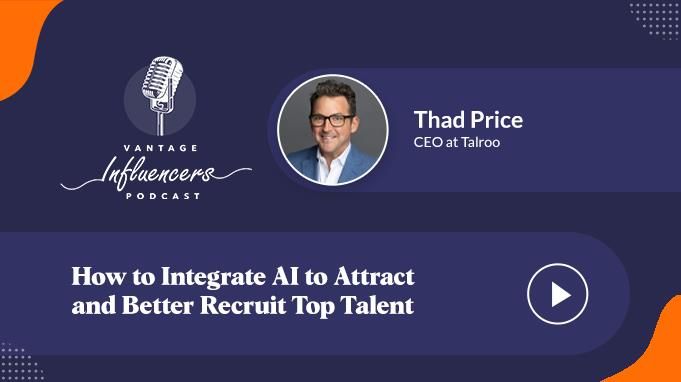
Thad Price, CEO of Talroo
Thad Price is the CEO of Talroo, an award-winning talent matching platform that helps enterprises source essential and hourly workers. With over 20 years in the online recruitment and job search industry, he is recognized as a thought leader in HR and talent acquisition, and believes no industry has a bigger impact on the economy than talent acquisition itself. Thad draws on client feedback to shape Talroo's product roadmap, with a focus on HR tech, programmatic job advertising, machine learning, big data analytics, AI, ad tech, and partnerships.
Host
Riha Jaishi, Vantage Influencers Podcast Host
What You Will Learn
- Why treating recruitment as a marketing and sales funnel, not just an HR task, changes how you attract and convert candidates
- Where AI genuinely helps recruiters today, and where it should stay out of the process entirely
- Why "right candidate, right job" isn't enough anymore, and what "right company, right skills" adds to the equation
- How two-way ghosting is reshaping candidate and employer expectations, and what to do about it
- Why treating talent acquisition as a revenue driver instead of a cost center changes hiring outcomes
- What part of the hiring process will never be fully automated, no matter how advanced AI gets
Key Topics & Timestamps
| Timestamp | Topic |
|---|---|
| 01:29 | Thad's career journey and the pivotal moments that shaped his approach to talent acquisition |
| 05:29 | How AI has changed the game for recruiters and candidates compared to a few years ago |
| 10:56 | Emerging trends in talent acquisition and HR tech over the next three to five years |
| 15:19 | Whether AI and automation can replace the human touch in hiring |
| 18:22 | If AI had to recruit you: what impresses candidates, and what turns them off |
Full Transcript
Click to read the full episode transcript
Welcome to the Vantage HR Influencers Podcast. This podcast is sponsored by Vantage Circle, the simple and AI-powered rewards and recognition platform for employee engagement.
Let's face it, finding top talent is far from easy. Traditional hiring methods just do not suffice anymore. But what if you could harness the power of AI, not just to find the right candidates faster, but to attract the best talent before they even hit the job boards? In today's episode, we're diving into how AI is revolutionizing recruitment, and how it's helping companies get faster, smarter, and more efficient in their hiring process. Whether you're looking to ditch the old ways or simply wish to stay ahead of the game, this one's just for you.
Riha Jaishi: Hello listeners, welcome to the Vantage HR Influencers Podcast. I'm your host, Riha, and today we have with us Thad Price, the CEO at Talroo. Welcome to the show, it's a pleasure to have you with us today.
Thad Price: Great to be here, thank you so much for the invite. Hopefully I can share some wisdom with your audience and provide value that can help you think about, and rethink, your talent acquisition and HR strategy.
Riha Jaishi: Thank you, it's a pleasure. So Thad, you've built such an impressive career at the intersection of talent acquisition and technology, and a profound understanding of how innovation can transform the hiring process. Just to kick things off, we'd love to hear about your journey. What were some of the pivotal moments or experiences in your career that shaped your approach to talent acquisition, and how did you realize that technology could play a powerful role in attracting and recruiting top talent?
Thad Price: Great question. I'll start from the beginning, when I think about my career and where I see a great opportunity in the industry. I've been in the talent acquisition and job marketplace industry for almost 20 years, and there's been a lot of change. I've seen the original component, which was newspapers, driving a lot of the responses to help-wanted ads, then the large job boards, CareerBuilder and Monster, coming into the market, and then of course Indeed, a great provider of value for job seekers and employers alike.
Throughout this process, you've seen a huge focus on value creation, in the form of how we really think about efficiency in the hiring and recruiting process. The way I think about recruiting and hiring is that it starts as a marketing and sales process. When you think about attracting candidates just like you'd attract customers in marketing, when you think of the idea of a funnel, or a sales pipeline, that a candidate works through in the hiring process, it opens up a lot of opportunity for innovation along each step of that process to be more effective.
First, part of that process is ensuring you're delivering qualified connections, qualified candidates, qualified leads. From there, you need terrific orchestration to make sure you're reaching the right candidates, engaging the right candidates, and being more effective, so at the end of the day you produce a hire. Not just any hire, a great hire, one that's going to perform for your business and help you grow revenue. That process continues to evolve, and there's a lot of innovation that can occur at each step of it.
Today at Talroo, we spend a lot of our resources focused on that top-of-funnel activity, attracting and matching candidates, especially for high-volume roles, essential worker recruiting, and of course skilled trades. That's where we spend a lot of our time, helping some of the nation's largest employers attract, find, and reach new candidate audiences. I'll leave it at this: I think the idea of finding a talent audience is very different from posting on a job board. Traditionally, that's how we recruit, we post on a job board. But it's really about reaching the right candidate audience wherever they may be, and unlocking value by providing a candidate you're likely going to connect with, and potentially hire.
Riha Jaishi: Thank you for such a rich and insightful answer, Thad. It's totally clear that your experience has shaped your forward-thinking approach to talent acquisition. Now, let's dive into something that's really transforming the talent landscape, and that's AI. It feels like just a few years ago the recruitment process was all about resumes, job boards, and human intuition. But today, AI is playing a massive role in how companies attract and hire talent. So in your opinion, how has AI really changed the game for recruitment compared to a few years ago, and how has it impacted the experience for both recruiters and candidates?
Thad Price: If you think about the job of a recruiter, it's to find the best candidate that's going to drive business outcomes. That is the job of a recruiter. It's not to focus on data entry or very mundane tasks, it's to build a human connection with the right talent that will drive your business forward. That's what recruiters love to do, that's why they're recruiters, connecting with people and establishing a relationship is exactly why they do what they love.
When we think about AI, let's take a step back and think about how it can improve our processes and our efficiency. How can technology and innovation help us connect faster, and more efficiently, with great talent, and ensure that the talent we're connecting with is qualified, engaged, and highly interested, through selling the opportunity, all the things that sit at the intersection of marketing, sales, and recruiting, so that we can place them with a company.
I like to think of it from that approach first, and then solve each component a little differently, thinking about where to use AI, when to use AI, and how it can solve those components. In our business today, we're using AI to help understand different industries, and to understand more about a candidate through their resume and job descriptions, matching job seekers to job descriptions, a very simple use case of using generative AI to be more effective at surfacing jobs to job seekers. Another use case is messaging, we're all using tools like that to help us communicate and jumpstart a process. I like to think of AI as something that helps us jumpstart or refine a process, so we become a lot more productive as a society, and especially in recruiting.
When we're more productive and more efficient, we can do what we love as recruiters: making human connections, finding the right candidates who can help grow the business, and making sure we're not replacing that human connection and recruiting activity, but using AI to jumpstart and elevate our processes to be even more efficient. Many employers today actually have more candidates than they need in a lot of cases, partly because AI has made it easier for job seekers to apply to many jobs at once, that's a discussion for another day, but when we look at the benefit AI provides businesses, the key is automating processes more efficiently so we can make better hiring decisions, not replacing the human aspect, but empowering it, so we're more effective and more efficient at reviewing applications, scheduling interviews, and everything else involved in the orchestration needed to attract, and then hire, great talent to grow a business.
Riha Jaishi: Great perspective, Thad, it's fantastic to hear how AI is evolving the recruitment process in such a meaningful way. Now, we're in this fast-evolving recruitment landscape, and it feels like every few months there's a new trend or technology shaping how we hire. From your position as a leader in HR tech and AI, what are some of the most exciting emerging trends or technologies you believe will have the biggest impact on talent acquisition over the next three to five years, and are there any innovations you're particularly excited about?
Thad Price: When we think about the process of attracting talent, I think as an industry we've done a good job, not a great job, of matching candidates with the right jobs. What I feel is missing, and where I see a lot of opportunity to leverage AI and other systems, is really focusing on right candidate, right job, right company, right skills. We've spent a lot of time on right job and right candidate, but not nearly as much time figuring out right company and right skills.
Any talent acquisition leader you talk to is focused on retaining their top talent, and some of that comes down to this company-fit aspect. If we can think about where we go as an industry, in a perfect world it would be one application, one hire, though that doesn't happen in practice. But in that funnel progression I mentioned, where someone looks at a job, applies, gets screened, qualified, scheduled, interviewed, and then receives an offer, there's a huge opportunity to use different technologies to really understand more about the company and the skills required, and how those skills translate into the job, and how what the job seeker is really looking for manifests into a good company fit.
If we crack that as an industry, there are so many downstream benefits for solving business problems in recruiting today, because ultimately that's why we're recruiting, to find talent that grows our business. Talent acquisition and HR get treated as a cost center, hiring people costs money. But businesses that are very successful at recruiting and hiring look at human resources very differently, as their most precious resource and a revenue driver, not a cost center. We're at an interesting reflection point as an industry, and it'll be exciting to see a lot of startups, and companies like Talroo, try to tackle this, because that's what has me excited about the future and how this technology can really accelerate what businesses are looking for: revenue growth and outcomes.
Riha Jaishi: Those are really exciting trends, it's clear the future of recruitment isn't just about efficiency, but about creating meaningful experiences for both candidates and companies.
Thad Price: Absolutely.
Riha Jaishi: So, as AI and automation reshape recruitment, there's a concern that we might lose the human touch, especially in employer branding and candidate engagement. Here's a fun question for you: what's the one part of the recruitment process you think will never be fully replaced by technology? Is there still room for the human spark, or are robots really taking away everything?
Thad Price: When you think about the act of hiring, the right candidates to grow your business, that's what we want, the right candidates, the right talent to grow the business. That process is driven by, and will always be, in my opinion, the human connection needed in hiring. We can refine processes, we can be more efficient, but we still need that level of customer service, that connection.
There are so many examples, when you think of e-commerce moving from brick-and-mortar retail experiences to online experiences, some of the most successful businesses bridge the gap between technology, innovation, and experience with customer service and connection. As we continue to invest in technology like this, the companies that embrace that connection and provide that level of service will be the ones seen as winners. The companies that try to automate everything and, for lack of a better word, focus all their energy on the dehumanizing experience will be the ones that lose, they won't be as effective at hiring and attracting the right candidates to grow their business, because that relationship only happens when we're in the driver's seat making those decisions. You have to remember that person is still going to need to show up every day, and that service aspect is so important. Where that sits in a more robot-oriented economy, I'm not sure, that's a conversation for another podcast.
Riha Jaishi: Love that, such an amazing perspective, couldn't have agreed more. Thank you so much. Okay, so coming up to the next one, here's a fun twist for you: if AI had to recruit you, how would you want it to approach the process? What would impress you, and what would turn you off?
Thad Price: We think today about the experience of a candidate, and over the years of searching for jobs online, there's been this feeling that employers lack responsiveness, ghosting, right? Over the last few years we've also been hearing about candidates ghosting employers. So now ghosting runs on both sides of the equation, the demand side and the supply side. That's where I think AI has really elevated the level of communication we need, because otherwise we just don't have enough resources to provide a timely response.
So, back to your question of how I'd like to be recruited: I think the best processes are timely in their response, tailored, and automated, whether that's using AI or not doesn't really matter. But then when we get to the process of bridging the gap between the interview and that human connection, that's where customer service and connection are so important. That's where you really forge a relationship, because you want to find, track, and hire talent that will commit and provide value for your business. If we can automate and leverage technology to make sure the orchestration before that is timely, effective, and tailored, then we can be more effective at attracting and recruiting top talent.
I'd advise leaders to really think about that top-of-funnel process, to be more effective and make sure we're reaching the right candidates, especially now, in a world of ghosting on both sides of the equation. If we can execute on that, we can be more effective in our pursuit of attracting, finding, and hiring great talent to grow businesses.
Riha Jaishi: I truly agree, Thad, such a unique take on this. Thank you so much.
Thad Price: You're welcome.
Riha Jaishi: Okay, so that's the end of it. Thank you so much, Thad, for joining us today and sharing such incredible insights. It's been more than a pleasure hearing your perspective on how AI is reshaping talent acquisition in such a massive way. We truly appreciate your time and expertise, and I'm sure our listeners are going to walk away with a lot to think about.
Thad Price: Thank you so much for the invite, great to be here.
Riha Jaishi: Thank you once again, Thad. And to our listeners, thank you for tuning in, we hope you found today's conversation as enlightening as we did. So until next time, take care, and we'll see you soon.
Thanks for listening to the Vantage HR Influencers Podcast. Please do subscribe to Vantage HR Influencers Podcast on Apple Podcasts, Spotify, and our YouTube channel for new episodes.
FAQ
How does Thad Price think recruiters should approach hiring?
As a marketing and sales problem. He argues recruiting works best when you think of candidates the way you'd think of customers, building a funnel that attracts, qualifies, and engages the right people until they become a great hire.
Is AI replacing recruiters?
No. Thad argues AI's role is to remove data entry and repetitive screening from a recruiter's day so they can spend more time building the human connection with candidates that actually leads to a hire.
What is "ghosting" in recruitment, and how has AI changed it?
Ghosting used to describe employers going silent on candidates. Today it happens on both sides, with candidates ghosting employers too. Thad sees AI assisted, tailored, and timely communication as one of the clearest ways to fix responsiveness on both sides of the hiring process.
Will AI ever fully replace the human side of hiring?
Thad doesn't think so. He argues the human connection built during recruiting, the relationship that makes someone want to accept an offer and show up for the job, will always be part of what makes hiring successful.
Related Reading
Also listen on