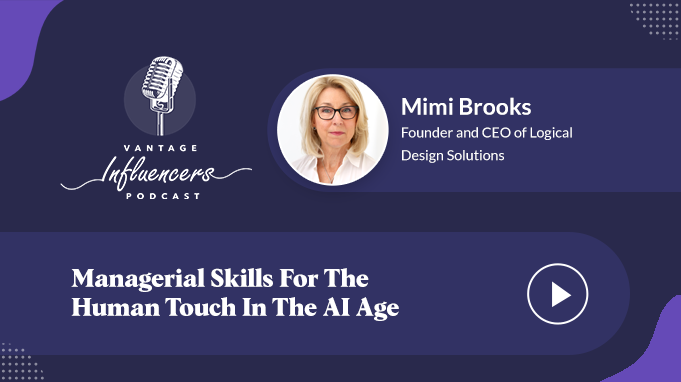
Managerial Skills For The Human Touch In The AI Age
Episode Overview
Mimi Brooks founded Logical Design Solutions in 1990 after starting her career at Bell Labs and AT&T, where she worked on what's now called user and employee experience design, long before either term existed. Her central argument is that AI's impact on management is "less a technology challenge and more a leadership challenge." Most organizations, in her framing, have "one foot in prior hierarchies and one foot in the new world," and the managers stuck straddling that gap are the ones at risk, not because they lack technical skill, but because they haven't reinvented how they lead.
Her sharpest reframe is on emotional intelligence: she prefers the term "relational intelligence," arguing the real skill isn't just people-to-people empathy but the ability to blend human judgment with machine input without one crowding out the other. She's equally direct about a structural problem she calls the "capacity quagmire": managers are so consumed by day-to-day chaos that they never get the time to actually plan for the change everyone agrees is coming.
Episode Highlights
- AI's impact on management is "less a technology challenge and more a leadership challenge." Organizations have one foot in old hierarchies and one foot in the new world, and managers straddling that gap are most at risk.
- Managers who "fly only by their instruments", relying on AI outputs without applying human judgment, put both themselves and their business at real risk, since AI's explainability and ethics remain genuinely unresolved.
- Mimi Brooks prefers "relational intelligence" over "emotional intelligence" as a term, because the real future skill is blending human judgment with machine input, not just interpersonal empathy alone.
- Redesigning work should focus on skills and flexible, fluid roles rather than rigid job descriptions, treating organizational design as a core HR value proposition rather than an afterthought.
- Change should be driven top-down and planned deliberately, rather than reactively adopted bottom-up in response to pressure, especially for wholesale shifts like location flexibility and hybrid work.
- The "capacity quagmire": managers are so consumed by day-to-day operational chaos that they never get the time or space to actually plan for the change everyone agrees is coming.
About the Guest
Mimi Brooks, Founder & CEO, Logical Design Solutions
Mimi Brooks is CEO of Logical Design Solutions (LDS), a consulting firm she founded in 1990 that designs enterprise digital solutions for Fortune 500 clients. A former AT&T executive, her career has spanned organizational design, technology-driven business transformation, and research on changing business-user behavior. She is a recognized industry thought leader on the future of work and digital business strategy, frequently presenting to Fortune 500 leadership teams and at industry conferences worldwide.
Host
Susmita Sarma, Vantage Influencers Podcast Host
What You Will Learn
- Why AI's challenge for managers is fundamentally about leadership, not technology
- The real risk of managers who rely purely on AI outputs without applying human judgment
- Why "relational intelligence" better captures the future skill managers need than "emotional intelligence" alone
- How to redesign work around flexible, skill-based roles instead of rigid job descriptions
- Why organizational change needs top-down planning rather than reactive, bottom-up adoption
- The "capacity quagmire" that keeps managers too consumed by daily chaos to plan for the future
Key Topics & Timestamps
| Timestamp | Topic |
|---|---|
| 01:50 | Mimi's corporate journey so far |
| 03:40 | Mimi's perspective on the role of AI in the workplace and its effect on managerial functions |
| 05:21 | How managers can create new, relevant value in an AI-informed workplace |
| 08:35 | Are managers at risk of being left behind by breakthroughs in AI? |
| 12:40 | Maintaining a human touch in decision-making while using AI tools |
| 16:30 | How businesses can cultivate change through renewing work design |
Full Transcript
Click to read the full episode transcript
As we stand on the brink of an ever-evolving technological landscape, it's imperative to consider the vital role that human beings play in the workforce. While machines continue to advance and take on more tasks previously done by humans, it's crucial to acknowledge the unique qualities that only we possess. After all, while AI can process data at lightning speed and analyze complex patterns, it can't replicate the warmth of a smile, the power of empathy, or the art of persuasion. So what does this mean for managers? It means it's high time and essential for managers to hone their "human touch" skills to stay relevant and impactful in their roles. Join us as we explore the skills managers will need in the age of artificial intelligence.
Susmita Sarma: Hello listeners, welcome to another episode of the Vantage Influencers Podcast, where we explore a wide range of HR topics designed to grab your attention and inspire you. I'm your host, Susmita, and today we'll be having a conversation on the topic of the human touch in HR in the age of AI, and for that, I have with me Mimi Brooks, the Founder and CEO at Logical Design Solutions. Hi Mimi.
Mimi Brooks: Hi Susmita, how are you?
Susmita Sarma: I'm very good, Mimi. First of all, I'd like to thank you for giving your invaluable time and joining us today. Before we dive into today's topic, what skills will managers need in the age of artificial intelligence, could you kindly walk us through your corporate journey?
Mimi Brooks: Of course, thank you for asking. My corporate career started back at Bell Labs and AT&T many years ago, when AT&T and the labs were really leading in human-computer interaction design. Very early on we called it "human performance engineering," the precursor to human factors engineering, which is what we'd now call employee and user experience. So I have a long history trying to juxtapose the needs of the business and business strategy with the enablement of people, where technology is a critical enabler. As a result, I started LDS, Logical Design Solutions, to work with more organizations in this space. In the last five to seven years or so, my focus has been acutely on organizational transformation, which started with working with large organizations on digital transformation, and early on, we said digital transformation is really about people, a lot less about the technology. So it's really an organizational transformation idea, and that's what we do today.
Susmita Sarma: Thank you for sharing your journey with us, Mimi, you've clearly gained a lot of insight and skill along the way. Before we move on, we'd love to know your perspective on the role of AI in the workplace, and how it has affected managerial functions.
Mimi Brooks: I think we're really starting to see AI and other frontier technologies affecting the true nature of work in businesses now. For many years, some vertical markets were more progressive than others in this regard. The obvious things got automated, the obvious jobs got impacted, but I think that represented a small percentage of work as we know it. Now what I see is us facing the wave head-on. We're really staring it down. There isn't a business I know of, or a company I work with, that doesn't see this impact as a here-and-now idea. We've moved digital from the fringe to digital at the core, and in that process, frontier technologies like AI are truly taking center stage in our strategies. Execution may vary company to company, but the concern and factoring of it is a high priority for everyone.
Susmita Sarma: We can all see AI has become highly prevalent in workplaces, especially in management, providing insights and automating routine managerial tasks. But to create value in an AI-informed workplace, it's the manager who needs to be strategic and intentional in their approach, ensuring AI is used ethically and responsibly, and that its benefits are shared across all levels of the organization. So how can managers do that, how can they create new, relevant value in an AI-informed workplace?
Mimi Brooks: Great question. Let me give a bit of context first, it seems to me that organizationally, in our systems and structures, including management as one of those structures, we have one foot in our prior, old hierarchies and managerial practices, and one foot in the new world, with the weight still on the old side, because people are struggling with the transition from long-instantiated managerial practices to what clearly needs to change in order to succeed in our new digital age. In that context, managers are critical catalysts to the "to-be" state, people still follow them, people still expect direction from them, they expect to understand ideas, they expect managers to action strategies. So the role of the manager is changing in terms of the line of sight they need to follow, truly the business strategy, and asking, how do we create new value in alignment with that strategy? When managers see their challenge as new value creation, in new organizational constructs that are flatter, more integrated, more peer-to-peer, more democratic, we've got to get managers into those new shoes, feeling comfortable that they can lead there, which is a dramatic departure from the command-and-control practices many of them came from. Digital natives, and people earlier in leadership positions, are naturally less encumbered by prior practices, but either way, we need to help managers step into these new roles that make them both critical and relevant.
Susmita Sarma: For managers who appreciate AI's capabilities and limitations, they're already better positioned to capitalize on its benefits while minimizing risk. Managers who resist or dismiss AI's possibilities, on the other hand, may fall behind, overlooking process optimization opportunities, and struggling to attract and retain talent in a labor market increasingly valuing AI skills. Can you foresee a scenario where these managers are at risk of being left behind by breakthroughs in AI?
Mimi Brooks: For sure, absolutely, just like I see the same effect on workers who don't adapt. Workers, including managers and leaders, need to adapt, and the question is in what context, as people leaders versus organizational leaders versus wherever. Being digitally conversant, understanding the business advantages and applications of frontier technology going forward, is table stakes. But I think the challenge is less a technology challenge and more a leadership challenge, being able to rally and motivate a workforce that works very differently. These new teams need to be more autonomous, cross-cultural, cross-discipline, cross-functional, which means managers need to know how to lead and motivate teams like that, which is a lot about removing obstacles and reducing risk for them so momentum can be established and maintained. So I'm concerned about managers who don't reinvent themselves, not just in their knowledge of the technology and its potential application, but in the whole organizational schema that needs to be operationalized to make it all work together.
Susmita Sarma: So it's not just re-skilling or getting technically advanced, it's also about mental preparedness to foresee things and accept that the workplace is genuinely changing.
Mimi Brooks: You're absolutely right, that's exactly how I see it. Skills are a component of it, absolutely, but equally valuable will be practices, the ability to forge relationships, negotiate toward good outcomes that are the sum of everyone's best thinking, because the change needed and the value creation expected is exponential. That's the whole game we're playing, new value creation that's exponential, because that's what machines offer us: learning on multiple timescales. The more we can get human performance and machine performance to coexist across those timescales, the more exponential value gets created. So the question is, how do we manage in environments where exponential value is the expectation?
Susmita Sarma: I was reading about collective intelligence, where AI and managers work together and the emotional intelligence of human and AI comes together, we'll get into that, but before we do, another question. As AI becomes more widespread, there's a risk managers become overly reliant on technology to make important decisions, which may affect their human touch in decision-making. How can managers ensure they maintain that human touch even while using AI tools?
Mimi Brooks: This is a very big issue, and it's the basis of a lot of the discussion happening now around ethics associated with these tools and platforms, and their explainability. It would be hugely detrimental for managers to only be able to "fly by their instruments", meaning they won't bring enough of their own human judgment and experience to really leverage, rather than interrupt, the machine's contribution to new work. Managers who can only fly by new instruments put themselves in a particularly risky position in terms of value to the business, and I think it exposes the business to real risk too.
Susmita Sarma: While machines or AI may be better suited to certain tasks, humans still excel at tasks requiring empathy, communication, and interpersonal skills, more specifically, emotional intelligence. What role does emotional intelligence play in managing in the age of AI?
Mimi Brooks: Great question. I think these human-only skills, empathy, relationship building, customer-centricity, everything we mean by 360-degree customer-centricity, are critical. I actually like the term "relational intelligence" more than emotional intelligence, I think it better describes the people-to-people side of this, which is as important as the people-to-machine side. A lot of the human, adorable skills we're talking about, needed in the future state, come down to the ability to bring good relational intelligence and decision-making into the equation, so we can meet people where they are and recognize that our workers have a lot of prerogative, and rightfully so, in the future state, a lot of choices that affect the work they do every day. We'd better make sure we've developed relationships with them that are genuinely win-win.
Susmita Sarma: Really good answer. Moving forward, redesigning the workplace to keep up with changing business models isn't just about hiring new people or training existing people with new skills. We also need to rethink and redesign how work itself is done, which is an ongoing process requiring business leaders and managers to be proactive in planning for these changes, and willing to ask tough questions about how jobs need to adapt. How can businesses cultivate change through renewing work design?
Mimi Brooks: I think this is one of the biggest challenges for HR that I see, and also one of the biggest opportunities, sincerely. If we think about organizational design as an epicenter skill of HR, of people-capability organizations, whatever we call the function these days, we have to see organization design at the center of our value proposition for the business. There's a huge question in companies today about who's going to design the new work, the new organizational structures. I think it's less about jobs and more about work that's flexible, enabling people with a skill set to move fluidly across work, picking what they think they can contribute to optimally, being fluid in how we think about people's roles. It's a role-flexibility idea, versus rigid job descriptions and job structures that limit human capacity. We really need to redesign work as we know it, with the context in mind that work is moving toward experience-based and skill-based structures, and as organizations become more agile, we have to design work that supports that flexibility in human choice.
Susmita Sarma: It's genuinely interesting to think about how our organizations will work even ten years from now, there will definitely be changes we can barely imagine.
Mimi Brooks: I agree, and when you think about how much of a change it's been for us just dealing with work-location flexibility, which is really what remote and hybrid work is about, and of course its genesis was quite traumatic, so I don't want to minimize the triggers that got us here. But the very basic idea of work location has been under discussion for a while now, and there's still no commonality in how businesses and leaders think about it, or long-term plans for it. Now add well-being, technological adaptation, new social contracts, it goes on. We really need to take this from the top down instead of reacting to it from the bottom up. That's a big point I encourage clients on, try to drive the change top-down rather than being reactive to these forces bottom-up, because the change is pretty wholesale. It's not going to happen overnight, but we should be planning for it.
Susmita Sarma: Definitely, it's a big challenge for managers, who need to stay on their toes for everything that's coming.
Mimi Brooks: I like North Star ideas here. I think it's hard for us to find where to focus our attention in time, we're all short on time and attention these days despite our work hours and the technology advantages we already have. Which means we need to pick our purpose carefully, and make sure we're balancing time between operational excellence, things we must do, and reinvention, things we must also do. I'm concerned we're getting caught in what I call a "capacity quagmire", we can't get our managers the time they need to think about and plan for change, because they're so overwhelmed day-to-day dealing with chaos that they don't have time to stop and think about how the short-term game becomes the long-term game. I see a lot of managers in organizations caught in this overwhelming situation, and we need to help them find ways to balance this, so more time goes to playing the long game, not 100% of their effort dealing with day-to-day chaos. My clients would describe this as a capacity problem, and I think it's pretty acute right now.
Susmita Sarma: Definitely, that resonates a lot, it's a big problem. It's part of the challenge that managers are running at a hundred miles an hour just trying to keep up day-to-day, but where does the time to reinvent and think about the future state come from?
Mimi Brooks: Exactly.
Susmita Sarma: Great answer once again, Mimi. It was a privilege to have you as a guest on our podcast, I look forward to staying in touch and perhaps collaborating again in the future. For our audience, how can they reach out to you?
Mimi Brooks: They can reach me on LinkedIn, and also on our website at www.lds.com, which has more information on LDS and easy ways to get in touch if anyone's interested. Susmita, thank you for having me, it was my pleasure.
Susmita Sarma: Before we say goodbye, let me express my heartfelt appreciation for you being a guest on our podcast today. Your insights and expertise made for an incredibly engaging discussion that our listeners will definitely value, but what really stood out for me was the warmth and sincerity that stayed with our conversation throughout. Thank you once again for your participation, Mimi.
Mimi Brooks: Thank you so much.
FAQ
Is AI's impact on management mainly a technology problem?
Mimi Brooks argues it's "less a technology challenge and more a leadership challenge." The real difficulty is rallying and motivating a workforce that operates more autonomously and cross-functionally, not simply understanding the technology itself.
What is "relational intelligence" and how is it different from emotional intelligence?
Mimi Brooks prefers "relational intelligence" as a term because it better captures the people-to-people side of management, alongside people-to-machine dynamics, blending human judgment with AI input rather than replacing one with the other.
What is the risk of managers relying too heavily on AI for decisions?
Mimi Brooks warns that managers who only "fly by their instruments," meaning they lean entirely on AI outputs without applying personal judgment and experience, put both their own value and the business at real risk.
What is the "capacity quagmire" Mimi Brooks describes?
It's the problem of managers being so consumed by day-to-day operational chaos that they never get the time or mental space to actually plan for the organizational change everyone agrees is necessary.
Related Reading
Also listen on