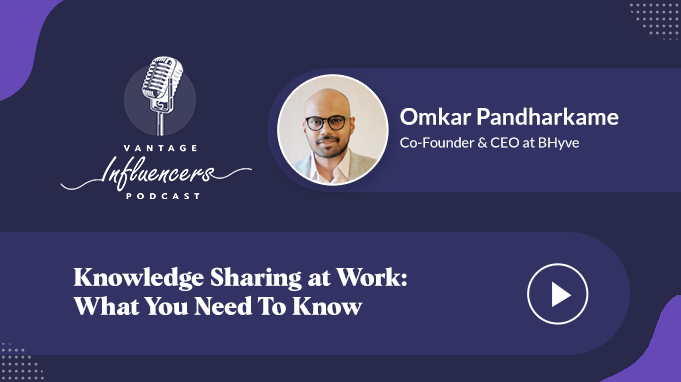
Knowledge Sharing at Work: What You Need To Know
Episode Overview
Omkar Pandharkame co-founded BHyve, a "future of work" platform built specifically around creating a culture of knowledge sharing, after training over 80,000 students and 600 school principals in design thinking and educational psychology, and co-founding a social enterprise, Desi Hangover, that sold over 500,000 Kolhapuri shoes across seven countries. His central distinction is that "knowledge management" and "knowledge sharing" are not the same thing: management is a static repository people deposit into occasionally, while sharing is dynamic, happening in the actual flow of work, more like a constant handshake between colleagues than a filing system.
His sharpest data points make the cost of not sharing knowledge concrete: employees waste roughly 20% of their time searching for answers colleagues already know, and the same problem gets solved from scratch two to three times over in large consulting organizations, simply because nobody knows who already solved it. His practical fix mirrors Vantage Circle's own territory directly. He argues knowledge sharing only becomes a habit once it's explicitly rewarded, pointing to Google's internal "Googler-to-Googler" (G2G) network as the clearest example of a company that built this into its actual culture, not just its tooling.
Episode Highlights
- Knowledge management and knowledge sharing aren't the same. Management is a static repository people deposit into occasionally, while sharing is dynamic, happening continuously in the actual flow of work.
- Employees waste roughly 20% of their time searching for answers colleagues already know, and in large consulting firms, the same problem gets solved from scratch two to three times over.
- Knowledge sharing protects against "knowledge attrition" during high turnover: a real network ensures departing employees' expertise doesn't leave with them, so new hires don't start from zero.
- Most companies stop at building a repository (a SharePoint, a Drive, a Notion) without completing the loop: ensuring the right people contribute knowledge, and that it reaches whoever needs it with minimal friction.
- Knowledge sharing only becomes a habit when explicitly rewarded. Google's internal "Googler-to-Googler" (G2G) network, where any employee can approach any other to learn something, built this into its culture, not just its tooling.
- A three-generation workforce ("generational khichdi": Gen X in senior management, Gen Y mid-management, Gen Z entering) creates friction, and structured knowledge sharing helps very different working styles actually learn from each other.
About the Guest
Omkar Pandharkame, Co-Founder & CEO, BHyve
Omkar Pandharkame is Co-Founder and CEO at BHyve. He holds an organizational psychology degree from the Higher School of Economics, Moscow, and has worked extensively in Indian academia, including as Program Director at ISME and ISDI, Mumbai. He has partnered with the Netherlands Education Ministry and the Romanian Youth Ministry on youth entrepreneurship initiatives, and has trained over 80,000 students and 600 school principals in design thinking and educational psychology. He also co-founded Desi Hangover, a social enterprise that has sold over 500,000 Kolhapuri shoes across seven countries, and is a visiting faculty member at TISS Mumbai, SPJIMR Mumbai, and SRCC Delhi.
Connect with Omkar on LinkedIn
Host
Susmita Sarma, Vantage Influencers Podcast Host
What You Will Learn
- The real distinction between "knowledge management" (a static repository) and "knowledge sharing" (dynamic, happening in the actual flow of work)
- The measurable cost of poor knowledge sharing: roughly 20% of employee time lost searching for answers colleagues already know
- How knowledge sharing protects against "knowledge attrition" when employees leave during high-turnover periods
- Why most organizations stop at building a repository instead of completing the actual sharing loop
- Why knowledge sharing only becomes a habit when it's explicitly rewarded, using Google's G2G network as the model
- Why a three-generation workforce makes structured knowledge sharing more important, not less
Key Topics & Timestamps
| Timestamp | Topic |
|---|---|
| 01:40 | Introducing Omkar and BHyve |
| 02:33 | The concept of knowledge sharing |
| 04:59 | Benefits of knowledge sharing |
| 07:35 | Problems with knowledge sharing in companies today |
| 10:05 | Best approaches to improve internal knowledge-sharing structure |
| 14:15 | Omkar's final thoughts |
Full Transcript
Click to read the full episode transcript
Without a doubt, automation and technology have advanced to the point where most organizations can use them. But whoever has the most knowledge, and the most effective methods for sharing it, wins the most benefits, knowledge acquisition, improvements in research and data-based tactics, and effective application of that information have proven to be as significant as the Industrial or Agricultural Revolutions.
Susmita Sarma: So now, what effect does this knowledge revolution have on workplaces? How can we foster a culture of creativity and information sharing, and most importantly, why should we do that in our workplaces? It's time to get deeper insights on the knowledge revolution and the knowledge-sharing concept in the workplace from our expert guest for this episode. I'm your host, Susmita, and please help me welcome my guest, Omkar Pandharkame, the co-founder and CEO at BHyve. Welcome to the show, Omkar.
Omkar Pandharkame: Hello, hi, thank you so much for having me.
Susmita Sarma: We're very pleased to have you here today. Before we jump into the topic, would you like to introduce yourself to our audience?
Omkar Pandharkame: Absolutely. My name is Omkar Pandharkame, and I'm one of the co-founders and CEO at BHyve. BHyve is a future-of-work technology that helps companies create a culture of altruism, a culture of knowledge sharing. Using BHyve, employees at organizations can share their best practices with each other and get rewarded for it, that's the gist of what we do.
Susmita Sarma: So our audience knows they've got a subject matter expert with us today, and we'll cover the new best practices of knowledge sharing, and importantly, which old practices we need to let go of. Let's start with the basics, Omkar, how would you explain the term "knowledge sharing"?
Omkar Pandharkame: I believe everybody is a combination of skills, competencies, and knowledge areas, if you look at any workplace, and you're humble enough, you can learn something even from the watchman, all the way up to the receptionist. The challenge is that we simply don't know whom to approach, how to approach them, whether they'll share, and for what purpose. So knowledge sharing, typically, is about creating a culture where knowledge exchanges happen as second nature in the workplace. At the end of the day, if I learn something from you and can implement it in my own work to increase productivity, that means knowledge has been effectively shared. Most water-cooler conversations might be gossip, but a few are actually about how someone won a deal, optimized a supply chain, or led a team, that wisdom is the foundation of knowledge sharing.
Susmita Sarma: So what are the most important things we need to understand about knowledge management in the workplace?
Omkar Pandharkame: The first thing is that we need to move beyond the whole concept of "knowledge management" and look at it instead as "knowledge sharing," because knowledge management is really just a repository.
Susmita Sarma: So knowledge sharing is a broader concept than knowledge management?
Omkar Pandharkame: Yes, it's far more dynamic. Knowledge management is fairly static, a bunch of people upload knowledge once a week, twice a week, maybe once a month. Knowledge sharing is about whether I can access someone else's knowledge in the actual flow of work. It happens far more frequently than the way knowledge management is conceptually treated, as a repository box people just deposit into, where nobody really knows how often it's used, what quality the knowledge is, or whether it's even kept updated.
Susmita Sarma: Now that we understand the basics of knowledge sharing, what are the actual benefits of knowledge sharing in the workplace?
Omkar Pandharkame: The first and foremost benefit is making sure knowledge doesn't leave the organization even if the person does. Let me explain, post-pandemic, during the Great Resignation, a lot of people left organizations, and what happened was a big void: a wild goose chase for whoever was left to figure out what that person used to do, essentially reinventing the wheel. A proper knowledge-sharing network makes sure that even if an employee leaves, their knowledge stays, and a new employee joining doesn't have to start from ground zero, that's the first benefit.
The second benefit: there's a statistic that in large organizations, employees waste about 20% of their time searching for answers that are already known to colleagues, they just don't know whom to approach, especially in mid-to-large, distributed organizations. There's another stat I read that the redundancy or repetition of a task in a consulting company happens at least two to three times, meaning someone's already solved a similar problem before, but nobody knows who, or where to find them. A knowledge-sharing network lets you tap into the collective intelligence of the organization and get the person looking for knowledge an answer quickly.
The last and biggest benefit, I think, is that if there's no culture of knowledge sharing in an organization, that organization is destined to struggle with employee engagement, which is predominantly what Vantage Circle focuses on. One of the biggest contributors to engagement is whether I actually have access to my colleagues' knowledge, if I don't, my engagement toward the company drops, and my risk of becoming disengaged rises significantly.
Susmita Sarma: As you mentioned, most companies lack this culture of knowledge sharing. Beyond that, what other problems do companies face today around knowledge sharing?
Omkar Pandharkame: The typical approach is, "let's make a SharePoint, let's make a Google Drive, let's make a Notion", and that's pretty much the start and end of it. That's just the depositing part of the story. Unfortunately, most organizations can't complete the loop, they don't ensure the right people actually deposit their knowledge, and at the same time, they don't make sure that knowledge reaches the people who need it with the least friction. That kind of approach is missing. The second issue, which resonates a lot with what Vantage Circle does, is that when you start rewarding positive employee behavior, it becomes a habit. Knowledge sharing is a really important, positive habit employees can embody, but unfortunately it's not being rewarded, and that's exactly why most knowledge-sharing platforms and networks fall flat.
Susmita Sarma: So overall, it's mostly about company culture, if you have the right culture, there'll be a lot more opportunity to actually enable knowledge sharing in the workplace?
Omkar Pandharkame: Yes, but it's also a bit of a chicken-and-egg situation, do you need the right culture first for knowledge sharing to happen, or can knowledge sharing itself create that culture? I actually believe it's the other way around, if you deploy the right tools, technologies, and platforms that enable knowledge sharing, the culture will follow. The best example is Google's internal "G2G" network, Googler-to-Googler, where any employee can approach any other employee to learn something. That's the kind of culture they've built specifically to ensure access to each other's knowledge, and it's a big part of why Google's work culture is so well known.
Susmita Sarma: Different firms have different approaches to improving internal information sharing, some employees might not feel confident writing, others might not be comfortable speaking up in meetings, so promoting different methods of sharing knowledge helps increase participation. From BHyve's perspective, what are the best strategies to improve internal knowledge sharing?
Omkar Pandharkame: The first thing is acknowledgment, recognizing each employee and the knowledge they actually possess. The second part is making that visible and explicit, that certain people in your company have expertise in specific skills, say, someone at Vantage Circle who's really good at customer acquisition. The moment you visualize that, employees can see what they have and what they need, that's the first part of the strategy. The second part is building actual knowledge handshakes between employees and embedding that into the regular work routine. The first instinct when someone's stuck at work is to Google the answer, but Google is actually one of the worst things for internal knowledge, because it gives you the most popular answer, not necessarily the right one for your context, versus being able to approach an actual expert within your own organization. The third part of the strategy is incentivizing or rewarding these knowledge handshakes, first capturing that someone asked a question or shared their knowledge, and then rewarding that behavior once it's captured.
Susmita Sarma: Would you like to share how BHyve helps organizations with this specifically?
Omkar Pandharkame: We're a full-stack platform that helps mid-to-large organizations build these kinds of knowledge-sharing networks. First, we create a skill passport for every employee. Second, we help build an internal Quora-style system, whenever an employee gets stuck on something, they come to BHyve, ask a question, and our AI finds the person within the organization who has the answer, connects them, and rewards that person for helping. The second piece is a peer-learning network, our AI suggests, based on an employee's existing skills and what they want to learn, other employees they could learn from. And the last piece is a mechanism for documenting tacit knowledge, the best practices, hacks, and know-how that normally only get shared informally over cafeteria tables, which employees can document, and which we help identify as high-quality and recommend to the people who need it most within the organization. That's how we help organizations build a genuinely thriving culture of knowledge sharing.
Susmita Sarma: Great work from BHyve, congratulations to the whole team on everything you've built. Any final thoughts before we wrap up today?
Omkar Pandharkame: My final thought is that the Indian workforce, and the global workforce more broadly, is going through a really important shift, I like to call it the "generational khichdi." Senior management is largely Gen X, mid-managerial roles are largely Gen Y, and the newest people entering the workforce are Gen Z, born after roughly 1999-2000. We're going to see a lot of friction, because all three generations have very distinct working styles. The only way to actually leverage that generational diversity is by enabling them to learn from each other and facilitating real knowledge sharing between them, and incentivizing it, which is where I'm genuinely excited about how, collectively, we can start rewarding employee knowledge-sharing behavior and encourage more of it.
Susmita Sarma: How can our listeners reach out to you?
Omkar Pandharkame: I'm on Twitter, and you can find me and BHyve online, happy to connect.
Susmita Sarma: Thanks, Omkar, for sharing your knowledge with us today, it was a genuinely fruitful session, and we look forward to many more. Thanks a lot for being part of the Vantage HR Influencers Podcast.
Thanks for listening to the Vantage HR Influencers Podcast. Please subscribe to the Vantage HR Influencers Podcast on Apple Podcasts, Spotify, and our YouTube channel for new episodes.
FAQ
What is the difference between knowledge management and knowledge sharing?
Omkar Pandharkame draws a clear line: knowledge management is a static repository people deposit into occasionally, while knowledge sharing is dynamic, happening continuously in the actual flow of work, closer to a constant handshake between colleagues than a filing system.
How much time do employees waste due to poor knowledge sharing?
Roughly 20%, according to a statistic Omkar Pandharkame cites: time spent searching for answers that colleagues already know, particularly in mid-to-large, distributed organizations where nobody knows whom to ask.
What is "knowledge attrition," and why does it matter?
It's the loss of institutional knowledge when an employee leaves an organization. Omkar Pandharkame argues a real knowledge-sharing network prevents this, ensuring new hires don't start from zero and departing employees' expertise stays behind.
How does Google encourage internal knowledge sharing?
Through its internal "Googler-to-Googler" (G2G) network, where any employee can approach any other employee to learn something, an example Omkar Pandharkame cites of a company that built knowledge sharing directly into its culture, not just its tooling.
Related Reading
Also listen on