Proven Paths for Women to Rise in Leadership
Episode Overview
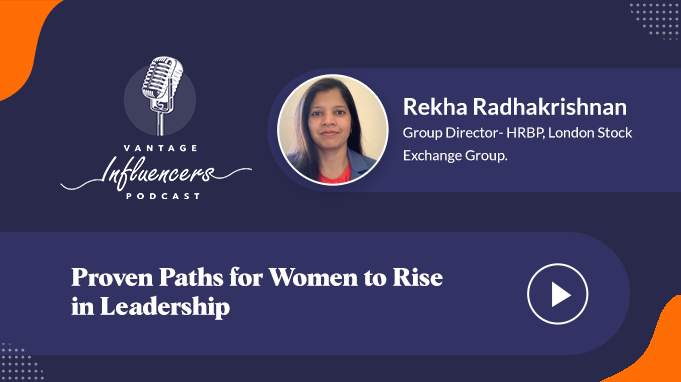
McKinsey estimates it will take nearly 50 years to reach gender parity for all women, a discouraging timeline, but not one that leaves individuals powerless. In this episode of Vantage Influencers, host Sanjeevani Saikia speaks with Rekha Radhakrishnan, Group Director of HRBP at the London Stock Exchange Group, about the practical, specific steps women can take to accelerate their own path to leadership.
Rekha draws on two decades of experience, including leading HR at Dell and Honeywell, to unpack why women often only apply for roles they're 100% qualified for, how to advocate for yourself without feeling like you're bragging, and why a career is better thought of as a 30-year marathon than a straight climb.
Episode Highlights
- Many women hesitate to apply for roles unless fully qualified, while men often apply meeting only half the requirements, partly because women lack visible role models who've already done it.
- Imposter syndrome is the gap between how you judge your own capabilities and how others actually see them, and women tend to underestimate themselves rather than overestimate.
- Self-advocacy doesn't have to mean announcing your wins. Asking thoughtful questions, following up with your own point of view, and offering a complementary idea draws attention to your contribution without feeling like self-promotion.
- McKinsey's "M-curve" model of a career: growth for the first five to seven years, a plateau or slowdown during family-building years, and a rise again later, a career is a marathon, not a 100-meter race.
- Networking works best when you lead with what you can offer, not what you need. Building real relationships, meeting people every six months, actually knowing them beyond a WhatsApp "good morning" message, matters more than LinkedIn connection counts.
- Organizational change (flexible work, parental policies) only goes so far if the underlying expectation at home doesn't shift too. Rekha argues real change starts there.
About the Guest
Rekha Radhakrishnan — Group Director, HRBP, London Stock Exchange Group
Rekha Radhakrishnan is Global Head and Group Director of Human Resources at the London Stock Exchange Group, based in Bangalore, with two decades of experience leading HR functions at Fortune 500 companies including Honeywell and Dell. A DE&I evangelist, she mentors and coaches emerging professionals moving into leadership roles. She holds a master's degree in business management from the University of Madras, is an alumna of the Indian Institute of Management, Calcutta, and is a certified SHRM-SCP, GPHR professional, and DDI-certified facilitator.
Connect with Rekha on LinkedIn
Host
Sanjeevani Saikia — Vantage Influencers Podcast Host
What You Will Learn
- Why women often only apply for roles they're fully qualified for, and how to push past that
- How to practice self-advocacy without it feeling like bragging
- The specific leadership skills women should focus on as leadership itself keeps evolving
- Why treating a career like McKinsey's "M-curve" instead of a straight line changes how you plan it
- How to network authentically, without it feeling transactional or slimy
- What organizations can (and can't) fix on their own, and where real change has to start
Key Topics & Timestamps
| Time | Topic |
|---|---|
| 01:35 | Common challenges women face on the path to leadership |
| 08:12 | Rekha's own journey with self-advocacy, and her advice |
| 10:47 | Essential leadership skills women should focus on to thrive in senior roles |
| 20:21 | Building strong networks and alliances without it feeling forced |
| 24:06 | Overcoming bias and stereotypes while staying authentic |
| 27:52 | What organizations still need to change to help women succeed in leadership |
Full Transcript
Read the full transcript
Sanjeevani: Welcome to the Vantage HR Influencers Podcast. This podcast is sponsored by Vantage Circle, the simple and AI-powered rewards and recognition platform for employee engagement.
Sanjeevani: It will take nearly 50 years to achieve gender parity for all women. Sorry to break it to you this way, dear listeners, especially our female listeners, but no matter how discouraging it sounds, this is what a McKinsey report has to say. Here's the thing though: while the timeline may seem discouraging, it doesn't mean we're powerless, there's a lot we can do to speed it up. Positive change doesn't have to wait for some distant future, it can start here and now, with the actions we take, the choices we make, and the communities we build. In this episode, we'll discuss the practical steps, strategies, and inspiring stories of women who've carved their own paths to leadership, and we're thrilled to be joined by an incredible guest, Rekha Radhakrishnan, to guide us through this conversation. She's currently Group Director of HRBP at the London Stock Exchange Group, and with her deep understanding of the challenges women face in leadership, she'll share valuable insight on how to rise, lead, and drive change. I'm your host, Sanjeevani Saikia, welcome to yet another episode. Let's begin. Hi, Rekha.
Rekha Radhakrishnan: Hi, Sanjeevani, thank you so much for having me, I'm very honored to be here.
Sanjeevani: We've got an interesting topic to dive into, proven paths for women to rise in leadership, and I'm genuinely excited to explore this with you. Before we begin, could you walk us through your professional journey so far?
Rekha Radhakrishnan: Thank you for the invitation, it's been an absolute pleasure joining you. My name is Rekha, I have around 20 years of experience. I currently lead the HR function for the London Stock Exchange Group in India, managing a global business partnering portfolio across one of our largest business units, supporting around 40 countries and roughly 8,000 employees. I've worked with a range of Fortune-listed companies in the past, including Dell Technologies and Honeywell, primarily leading people transformation, building organizational capability, and working toward business goals. I hold a master's from the University of Madras, and completed an executive program at IIM Calcutta. I'm based out of Bangalore, very passionate about learning and development, I enjoy traveling, and I'm an avid blogger. That's a bit about me.
Sanjeevani: Wonderful, thank you so much for sharing that, it was fantastic to hear. With your permission, I'd like to begin today's conversation.
Rekha Radhakrishnan: Let's go ahead.
Sanjeevani: It's no secret that women face unique challenges in their leadership journeys, systemic issues, deeply ingrained biases, our paths often look different from our male counterparts, we've seen that time and again. But there's a bright side too, many women have overcome these challenges and thrived. What are some of the common challenges you've faced, and how did you overcome them?
Rekha Radhakrishnan: Very true. There are a lot of obstacles we face in our journey through the corporate world. Let me start by saying the corporate world itself is genuinely unfamiliar territory for many of us, most women are first-generation entrants into it. My own mother, for instance, was a teacher who retired as a college professor, a very different journey. What we lack, to start with, are role models. That's the fundamental bridge we need to build for future generations. I often see women hesitate to apply for leadership roles unless they feel 100% qualified, whereas men will often apply meeting only half the qualifications. Why? Because they see far more people who look like them, who've "been there and done that," and think, I can do that too. So for those of us who are first-generation, or leading the way for the next generation, it's important to push past that self-doubt and go for the opportunity even when we don't tick every box. And women in particular carry a lot of imposter syndrome, the gap between how you judge your own capabilities and how others actually see them. You might think you're not that good at something, while someone else looking at you thinks, wow, she's really capable. We don't overestimate ourselves, if anything, we underestimate our own strength.
Sanjeevani: Do you think that's something society conditions into us, or something more inherited?
Rekha Radhakrishnan: It's a mix of both. As I said, there's a lack of role models, and then there's conditioning. We were often told as children not to be loud, to be quiet, not to wear bright colors, to blend in rather than stand out, not to laugh too loudly. When that's the ecosystem you've spent most of your life in, it's natural to fumble a bit when you enter a workplace that requires you to exercise power, showcase strength, ask for attention, and seek help outright. That's exactly why it's so important to build that inner strength before you can break the glass ceiling.
Sanjeevani: One key part of navigating leadership roles is the ability to advocate for yourself. We're often encouraged to be team players, which matters, but how does self-advocacy get perceived? I strongly believe self-advocacy is essential for career progression. How significant is it, and what advice would you give women trying to assert their value at work?
Rekha Radhakrishnan: That's such a true question. I used to believe that working hard and doing my job well would naturally lead to recognition, but nothing happened. At some point I realized I needed to be my own PR person, if you don't tell your story, someone else will, and trust me, they won't include the shiny bits. That said, most of us aren't comfortable announcing our own wins to the world. My advice is simple: start by sharing valuable information, which helps your stakeholders and leaders understand what you actually bring to the table. Lead with curiosity, ask questions, even if it feels like it might make you sound less informed. When a leader makes a point in the room, ask a clarifying question, go do your homework, and set up a follow-up conversation where you say, "I liked the idea you raised the other day, I've actually done something similar, or complementary, in my own work, here's how, do you have any thoughts?" You're not saying "I did this, I did that," you're drawing attention to what you can actually contribute. That's a great way to showcase your capabilities, get staffed on projects with genuinely strong people, and progress in your career.
Sanjeevani: Even if it feels a little uncomfortable to advocate for ourselves, we should still apply the right strategies and assert ourselves properly at work, that's a real takeaway from your answer.
Rekha Radhakrishnan: Absolutely.
Sanjeevani: Women aiming for senior roles need to focus on the right areas for growth, especially since leadership itself is evolving and the skills that mattered before aren't necessarily as relevant today. What key leadership skills should women be honing right now, and is there a specific set they need to focus on more than their male counterparts?
Rekha Radhakrishnan: I'd start by saying we need to know what we actually want. When I'm coaching leaders, I often find most of us genuinely don't know. There's a classic question, where do you want to be five years from now, and it's not necessarily about a specific title, it's about whether you have real clarity about who you fundamentally are. Opportunities are like a train, and you're standing on the platform, if you miss the first one, don't worry, another is coming, and another after that. The real question is: have you got the ticket to board it? That ticket is skill. Have you built it? Do you have a proof of concept you can show? Have you tested it? Do you have an original point of view? It's interesting, when I talk to women in tech right now, everyone talks about GenAI and prompt engineering, the next big thing, how it'll reshape everything. I ask them: what do you actually want to do with it, where do you see yourself in it? Have you taken a real leap and picked up the skill, or are you waiting to see if it's just hype? Are you sitting passively on the shore, drifting along, stuck doing what you've always done? Are you fitting in, or are you adding in? No matter your profession, marketing, communications, whatever it is, are you the first on your team to pick up something new? Do you wear the curiosity hat, and can you bring your team along with you? Most of the time we're not intentional about our own careers, we see someone else doing something interesting and think, I want that too, but what actual homework have you done toward it? Saying "I'm happy with any leadership role" doesn't help, it's like saying "I want to win Olympic gold" without knowing which sport. Intentionality is the key to career success.
Sanjeevani: I've noticed women often face stereotyping in their job roles too, the assumption that most HR people, or most teachers, are women.
Rekha Radhakrishnan: That is interesting. There are roles, HR, program management, teaching, where women are genuinely well represented, partly because emotional intelligence and the ability to empathize and bring people together come naturally to many women, and some of those associations have broken gender stereotypes in their own way. But the real question I ask is: if you're in HR, what new skill have you actually picked up in the last two years? The skill you learned when you joined HR ten years ago, are you still relying on the exact same one? Are you prepared for what this role will look like in the future? If not, you'll become redundant. The skills that got you afloat early on won't be enough if you actually want to rise, you need to stay relevant, build real problem-solving skills, even financial acumen. Say you're running an HR project, do you know how to cost it, forecast it financially? Whether you're running a marketing campaign, a hiring campaign, or a reorg, you need to understand risk, reporting, fixed versus variable costs. Every business ultimately runs for profit, so no matter your function or gender, you need to understand what it costs to run the operation.
Sanjeevani: There's a well-known interview with Indra Nooyi where she says a woman's biological clock and career trajectory are often in conflict. Do you believe that's true, and if so, how can organizations help bridge that?
Rekha Radhakrishnan: That's a fantastic question, and yes, it's true, particularly at certain life stages. Early in a woman's career, multiple things unfold at once, the career is going well, but there's also pressure to build a family, and that often happens in the first five to eight years of a career, exactly when you also want to settle down personally. My advice is to treat a career as a 30-year journey, more like seasons. There's McKinsey research that describes a career as an "M-curve": growth in the first five to seven years, then a period where you want to settle down personally, build a family, which may mean slowing down or pausing, especially the first few years of a child's life, and then as the child grows, gradually coming back and rising again. I'm a mother of an 18-year-old who just started college, I've been through those ups and downs myself, and now I'm at a stage where I can pivot again, because I finally have more time and energy to invest back into my career. Don't treat your career like a 100-meter race, it's a marathon. And I agree completely with Indra Nooyi, you can have it all, just not all at the same time.
Sanjeevani: That McKinsey M-curve framing is genuinely relieving, it's reassuring to know progress doesn't have to be constant to eventually rise again. Let's talk about networking. We're constantly told to "go meet people, connect, network," but no one really explains how to do it without it feeling slimy or awkward, or where to even start.
Rekha Radhakrishnan: I agree, networking can feel intimidating, especially for someone like me who's an introvert. Honestly, I'd rather finish my work and retreat to my own little cocoon than go mingle. My advice: start with common ground, find one or two people who genuinely inspire you nearby, at work, in your neighborhood, in your alumni network, and start by talking about something you both enjoy, it doesn't have to be about work right away, it could be a product, a marathon, an upcoming concert. And always, always offer something before you ask for anything, share support or resources, people remember that. What most of us actually do is only start networking the moment we need a job, sending out emails suddenly, and that doesn't work. Building real relationships takes time, and it's not about how many LinkedIn connections you have, it's how many of them you actually know personally. Have you taken time to meet them? What happens after that first meeting, have you nurtured it, or is it just a WhatsApp "good morning" message? Do you know them beyond that? I'd suggest meeting every six months as a reasonable baseline. Women also sometimes carry this fear that reaching out to someone they know, a neighbor, someone from the same club, feels like "using" them, when really you want people to feel valued as people, not just for what they can do for you. But that's exactly the question I'd put back: if you don't intend to ever leverage the relationship, what was the point of building the network in the first place? I met someone recently who told me confidently, "I build my network by attending industry events." Great, then what? "I connect with them on LinkedIn." And then? Often, nothing. Networking really begins after the event, after the LinkedIn connection, after the introductory note, can you actually convert that into a real relationship, one at a time?
Sanjeevani: Building the network, and actually leveraging it, those are two genuinely important takeaways from that. While individual strategies matter, we can't ignore the role organizations play in making leadership genuinely accessible for women. Are companies doing their part, and what more could they do?
Rekha Radhakrishnan: Organizations are an extension of society, change starts at home, in how we speak to our daughters, how mothers are respected within the household. Every employee, every leader, comes from a family, so it's a collective responsibility. What organizations can do is provide genuinely flexible working arrangements. Many women juggle family responsibilities alongside their careers. When a newly married woman, or a new mother, comes home exhausted from traffic and work pressure and still has to cook or manage the household, what's the standard response she usually gets? Often it's something like, "it's not like you need the money, just enjoy life, take care of your child," that attitude has to change first. Flexible work, remote options, real parental policies build a level playing field organizationally, but the deeper change has to happen at home too, giving women the confidence that they can balance both, or honestly, that sometimes it isn't about balance at all, it's a choice, made one day at a time. Today I can make round rotis, tomorrow I have to prepare for a big meeting, and the family needs to step in too. Organizations also need to be intentional about identifying high-potential women early and supporting them deliberately. In my experience, the real gap is that women often don't get enough support at home, which makes the juggling itself exhausting, physically and mentally, and any genuinely demanding role that takes you places will expect real hours of focused attention, can you actually sustain that without support? Mandatory unconscious bias training helps encourage diversity, but it also has to actively address the specific biases still holding women back.
Sanjeevani: We've reached the end of today's episode, and I've had a lovely conversation with you. Any final thoughts or a message for our listeners, and how can people reach out to you afterward?
Rekha Radhakrishnan: It's been an absolute pleasure. My parting thought: build allies, both male and female, who can help you challenge stereotypes, that's key. Allies can amplify your voice in meetings they attend and advocate for you behind closed doors, sometimes that ally is your manager, sometimes a friend, sometimes a colleague. But as women, we need to move past the internal struggle between wanting to be liked, avoiding conflict, and sometimes suffering in silence. Stay true to yourself, ask for what you want, go capture the world. And yes, feel free to connect with me on LinkedIn if you'd like to continue the conversation.
Sanjeevani: Wonderful, thank you so much, Rekha, it was a pleasure having you today, and thank you for everything you've shared, I'm sure our listeners will love this.
Rekha Radhakrishnan: Thank you so much, Sanjeevani, have a wonderful day.
FAQ
Why do women often hesitate to apply for leadership roles?
Partly the lack of visible role models who've already done it, and partly imposter syndrome, underestimating your own capabilities relative to how others actually see you. Men more often apply for roles meeting only half the stated qualifications.
How can women practice self-advocacy without it feeling like bragging?
By leading with curiosity and contribution rather than announcements, asking clarifying questions, following up with your own point of view or a complementary idea, and letting your input speak for your capability rather than listing your own achievements directly.
What is the McKinsey "M-curve" view of a career?
A model showing career growth in the first five to seven years, followed by a plateau or slowdown during family-building years, and a rise again later. It reframes a career as a 30-year marathon rather than a straight, uninterrupted climb.
How can women network without it feeling forced or transactional?
Start from genuine common ground rather than professional need, offer value before asking for anything, and actually nurture relationships over time (meeting roughly every six months) rather than only reaching out when you need something.
Related Reading
- Leadership: Fundamentals, Evolution, Challenges & Future
- The Challenges Faced By Women in The Workplace
This episode is part of the Vantage Influencers Podcast, where we bring HR thought leaders to discuss engagement, compensation, benefits, and everything related to HR.
Also listen on